Every bag of kibble comes with a feeding chart, and almost every dog owner I know follows it blindly. Then their dog gains five pounds in three months and they cannot figure out where it went wrong.
The chart is a starting point — not a prescription. How much to feed a dog depends on at least sixteen variables that a chart cannot account for, from your dog's actual body condition to the calorie density of the specific formula in the bag.
These sixteen factors are the ones that actually move the needle. Get them right and you will stop guessing and start feeding with a plan your vet would approve.
Where to start
Which Factors Matter Most for Your Dog Right Now?
You do not need to change everything at once. Pick the scenario below that sounds like your dog, start there, and layer in the rest over time.
1. Start With Your Dog's Ideal Body Weight Not Current Weight
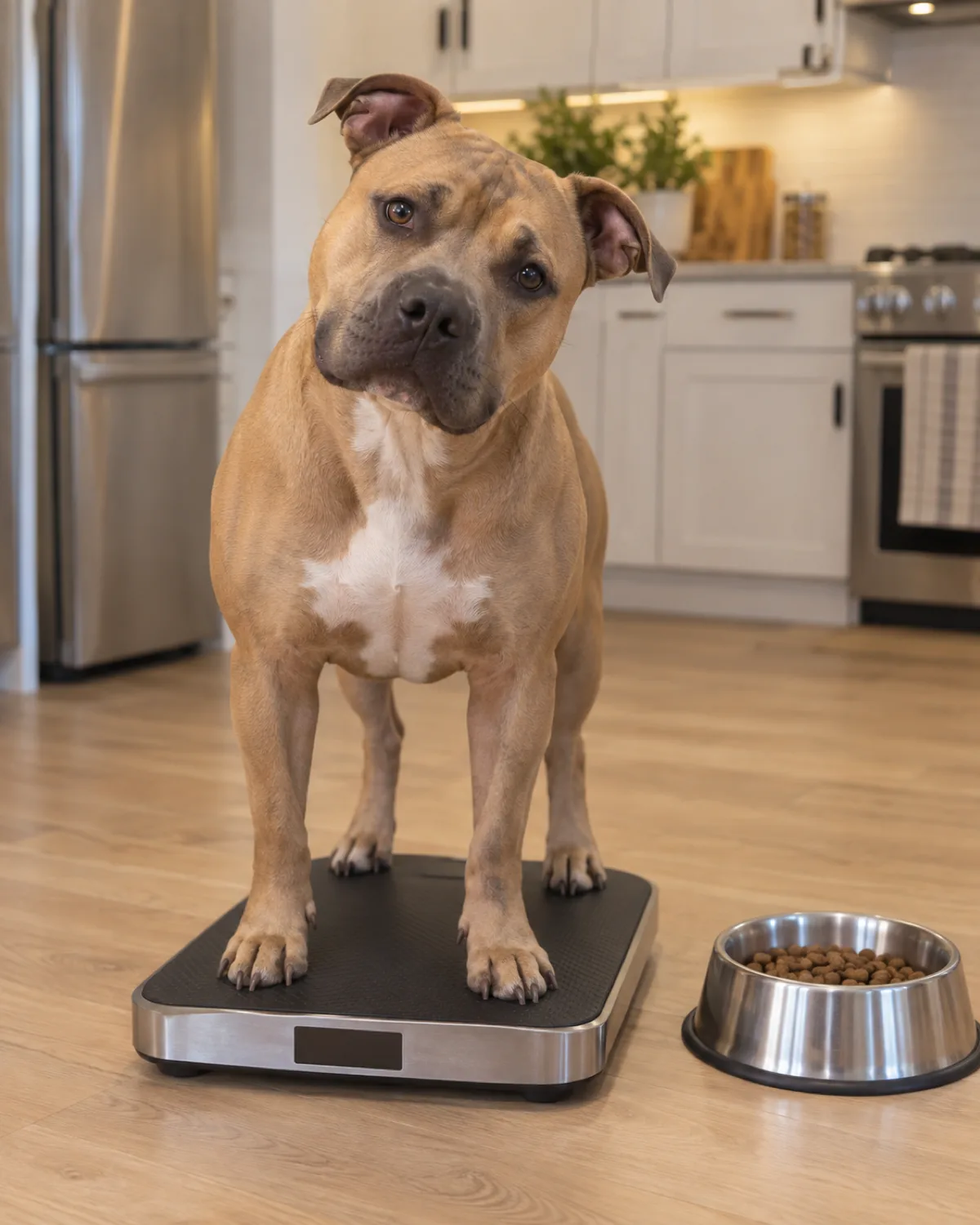
Every feeding chart on every bag starts with weight. The mistake most owners make is plugging in the number they saw on the scale this morning — the dog's current weight — instead of the dog's ideal weight.
If your dog is already ten pounds over, feeding for their current weight just maintains the extra fat. If they are underweight, feeding for their current weight keeps them thin.
Your vet can tell you the ideal weight range for your dog based on their frame and breed mix. If you cannot get to the vet right away, use the body condition score in the next section to estimate whether your dog is above or below target, then adjust the chart column accordingly.
- Overweight dog: Use the feeding chart row for the lower end of their ideal range, not their current weight.
- Underweight dog: Use the row for the higher end of their ideal range and increase gradually over two to three weeks.
- At ideal weight: Use the chart row that matches their current weight — this is the one case where the label works as-is.
The difference between feeding a seventy-pound dog at seventy pounds versus feeding them at their ideal sixty pounds can be two hundred extra calories a day. That adds up to a pound of body fat every two and a half weeks.
2. Learn the Body Condition Score Scale Your Vet Uses
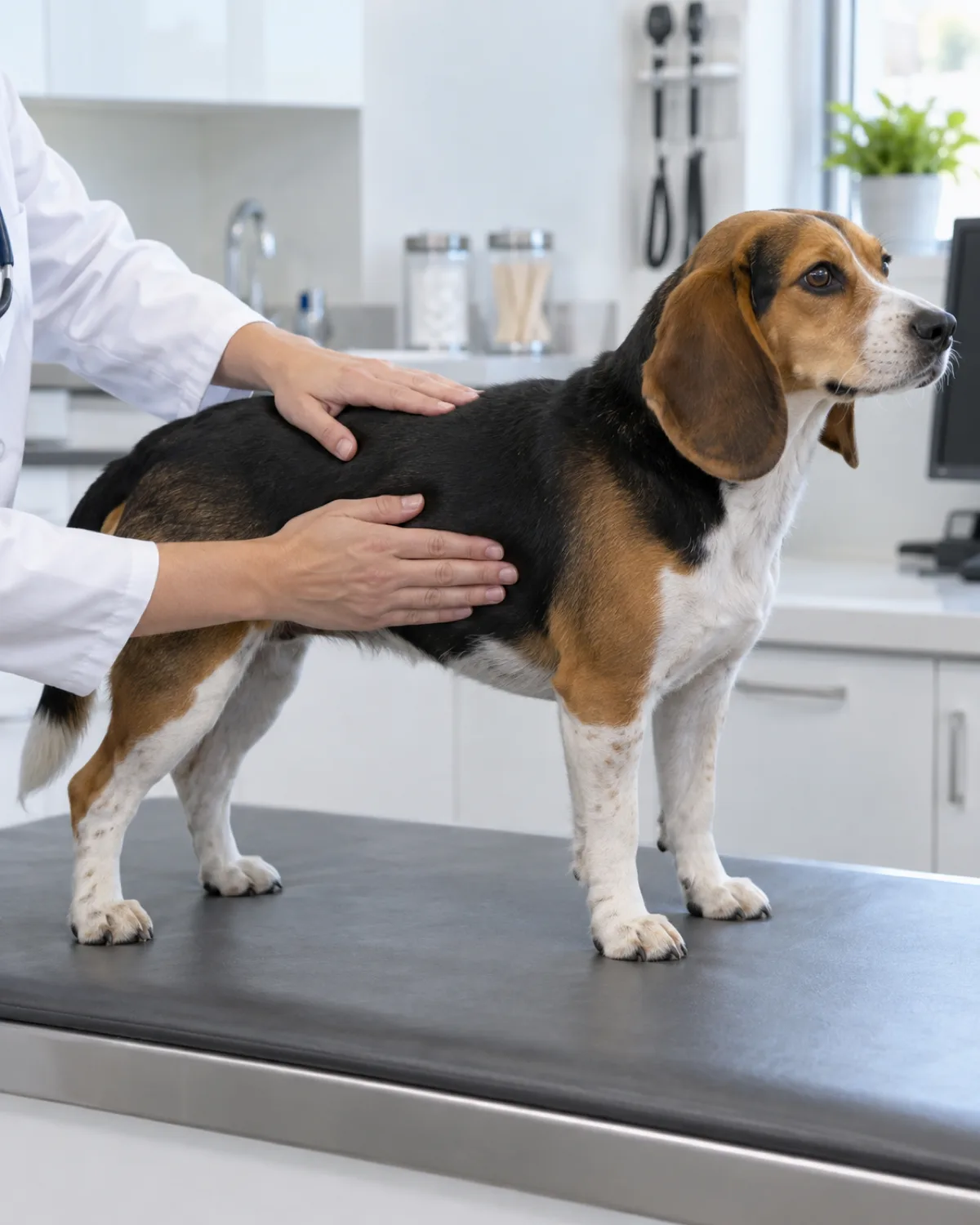
The body condition score is a one-to-nine scale that vets use to judge whether a dog is underweight, ideal, or overweight. It works the same way across every size and coat type, which makes it far more useful than the number on the scale alone.
Here is the quick version:
| Score |
What you see and feel |
| 1–3 |
Ribs, spine, and hip bones visible. Underweight. |
| 4–5 |
Ribs easy to feel but not visible. Clear waist tuck. Ideal. |
| 6–7 |
Ribs hard to feel under fat. Waist barely visible. Overweight. |
| 8–9 |
Ribs cannot be felt. No waist tuck. Belly hangs. Obese. |
You can check this at home in thirty seconds. Run your flat hand along your dog's side with light pressure — you should feel each rib like fingers under a thin blanket. Then stand above your dog and look down: there should be a visible tuck behind the ribs where the waist narrows before the hips.
If you score your dog at a six or higher, reduce the daily amount by ten to fifteen percent for two weeks, then recheck. If they score a three or below, see your vet before changing anything — there may be an underlying issue beyond portion size.
The three rules that matter most
3 Feeding Rules That Prevent Most Portion Mistakes
Get these three right and you will avoid eighty percent of the portion errors I see dog owners make. Everything else in this guide is fine-tuning.
Feed for ideal weight, not current weightThe number on the scale reflects where your dog is, not where they should be. Use your vet's target or a body condition score to find the right chart row.
Weigh the food, do not scoop itA heaped measuring cup can hold fifty percent more kibble than a leveled one. A kitchen scale costs less than one vet visit and removes the guesswork entirely.
Count every treat as part of the totalTreats, training rewards, dental chews, and table scraps all carry calories. Keep them under ten percent of daily intake and subtract them from the meal portion.
3. Match the Life Stage Column on the Feeding Chart
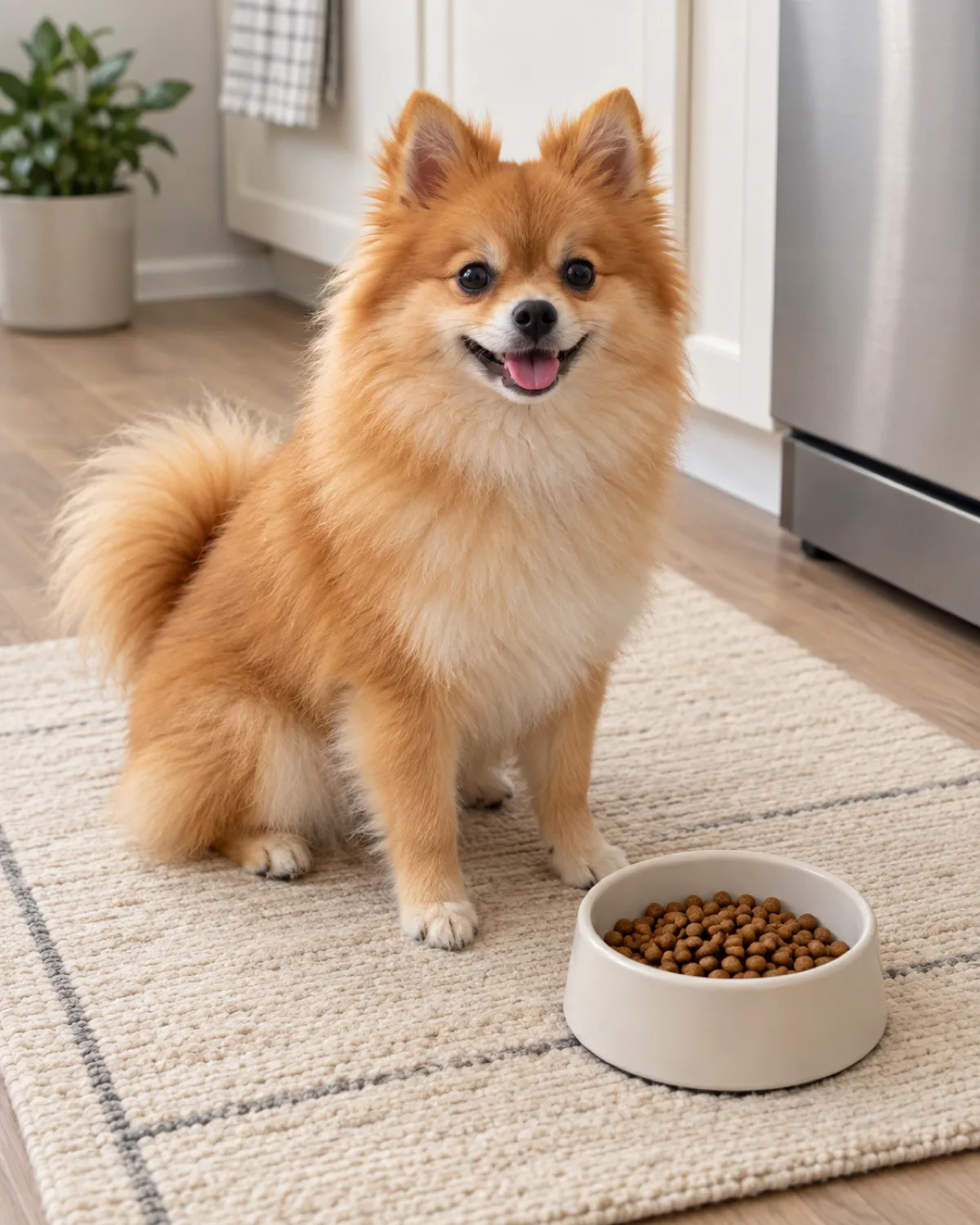
Puppies, adults, and seniors all have different calorie needs per pound of body weight — and many feeding charts combine all three on the same label. If you are reading the wrong column, you are starting from the wrong number before any other factor even comes into play.
Puppies under twelve months need roughly twice the calories per pound that an adult dog does because they are building bone, muscle, and organs at a rapid pace. If your puppy is on an adult formula by mistake, they may not be getting enough. If your adult dog is still eating a puppy formula, they are getting too much.
Seniors over seven or eight years typically need ten to twenty percent fewer calories than a healthy adult because their metabolism slows and their activity drops. Some senior formulas already account for this with lower calorie density, but others just change the protein source without changing the calorie count — so you still need to check.
If you have a puppy and want the full breakdown on meal timing and amounts by age, the puppy feeding schedule guide covers it week by week. For this article, the takeaway is simple: read the label, find your dog's life stage column, and ignore the other columns.
4. Factor in Daily Activity Level Beyond Backyard Play
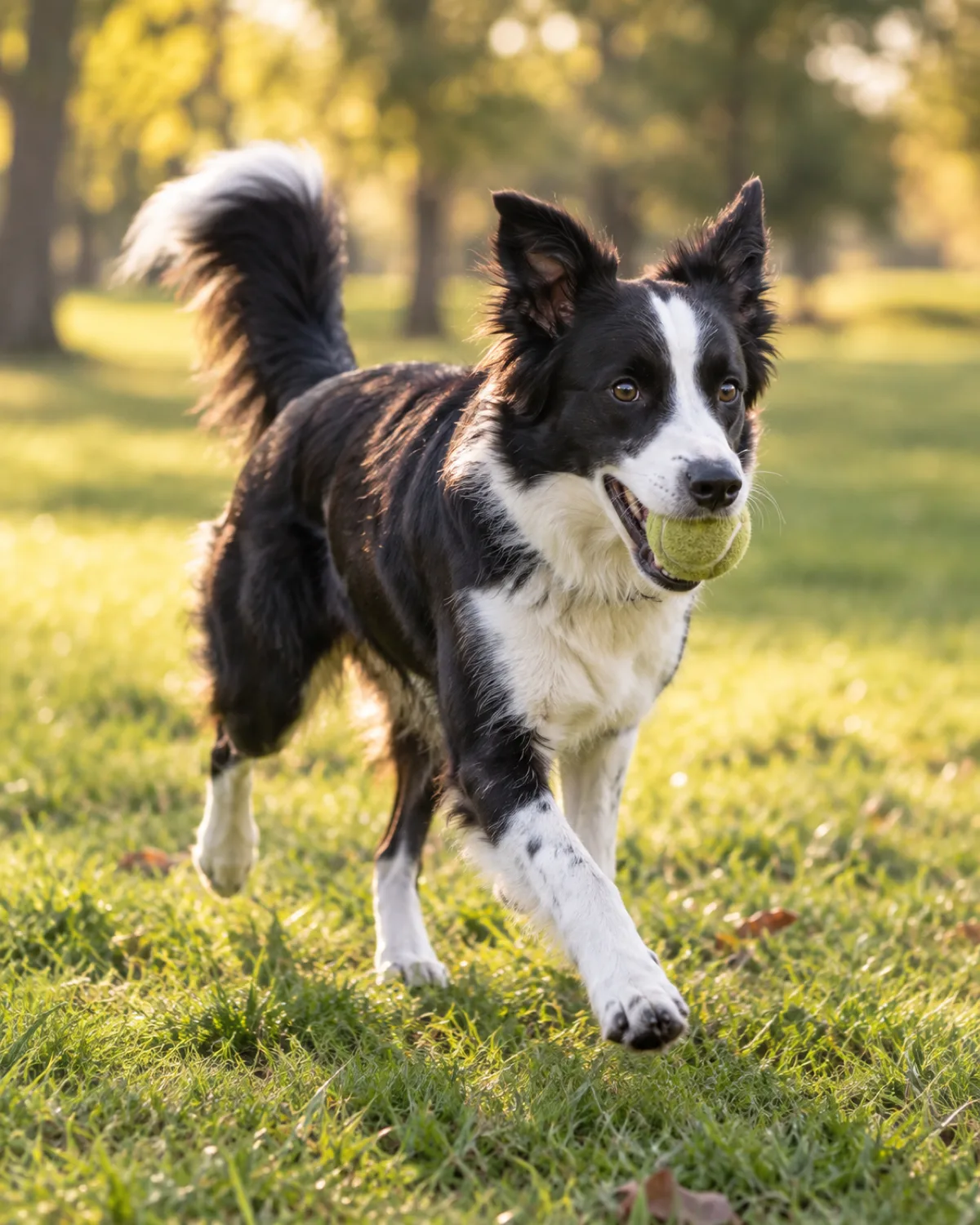
Feeding charts assume a moderately active dog. If your dog's daily exercise is a fifteen-minute walk around the block and some couch time, they are below that baseline and probably need less food than the chart suggests.
On the other hand, if your dog runs five miles with you every morning, swims three times a week, or works a herding or agility circuit, they may need twenty to forty percent more than the chart says.
Here is a rough activity multiplier to apply to the chart's suggested amount:
- Low activity (short leash walks, mostly indoor): reduce by ten to fifteen percent
- Moderate activity (thirty to sixty minutes of walking or play daily): use the chart as-is
- High activity (running, swimming, hiking, or sport training): increase by twenty to forty percent
- Working dogs (herding, hunting, search and rescue): increase by fifty percent or more, guided by your vet
The mistake is not just underfeeding active dogs — it is also overfeeding couch dogs. A fifty-pound dog who does nothing but potter around the backyard and nap can gain a pound a month on the "moderate" chart amount because those extra hundred calories a day have nowhere to go.
If your dog gets a lot of exercise and you want guidance on structuring their movement, how much exercise does your dog need covers the daily targets by age and size.
5. Check the Calorie Count on Your Specific Kibble Bag
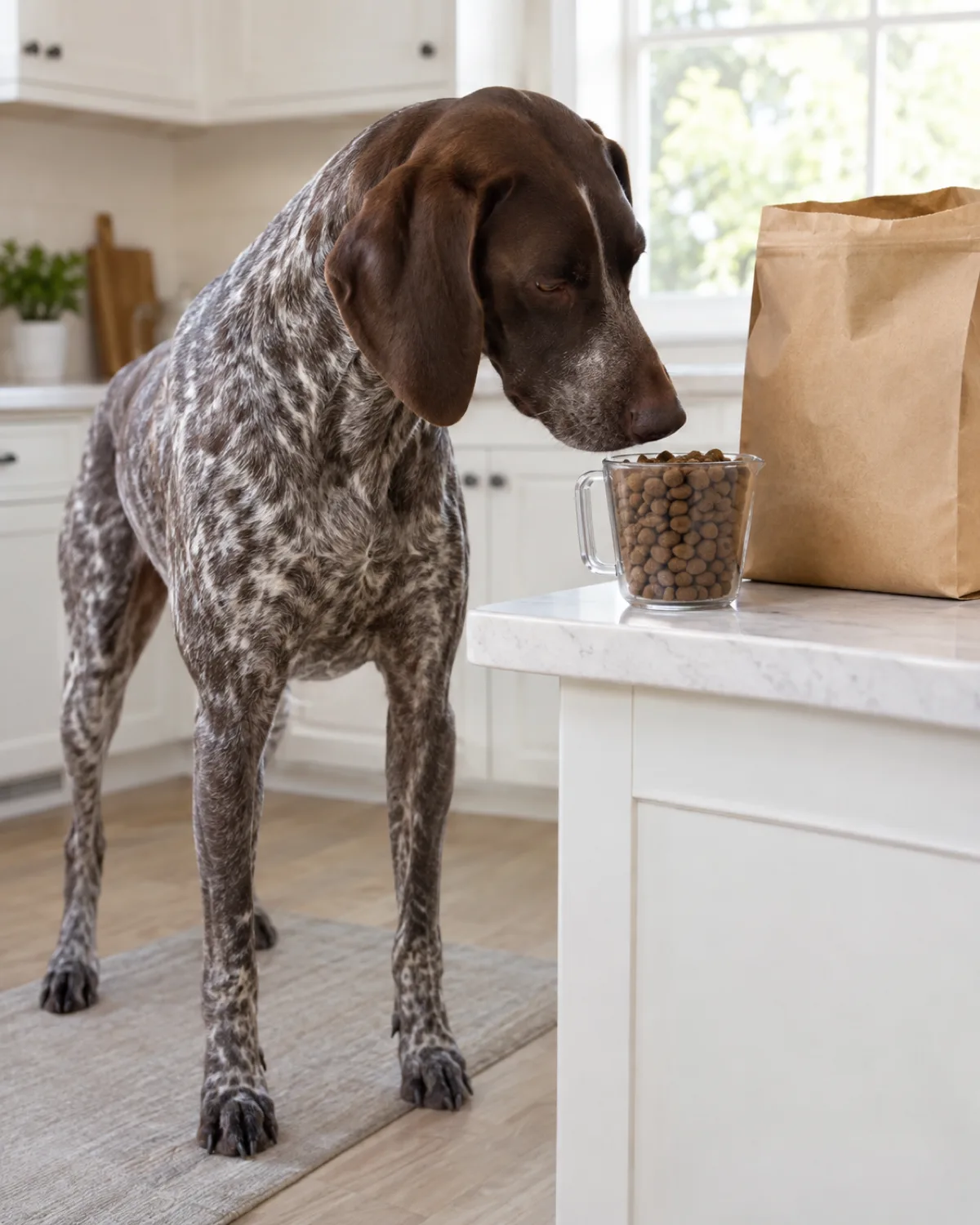
Not all kibble is created equal. One cup of a standard adult formula might be 350 calories. One cup of a high-protein performance formula might be 500 calories. If you switch brands or even flavors within the same brand without checking the calorie count, your dog could be eating forty percent more or less than you think.
The number you are looking for is kcal per cup (or kcal per kilogram) — it is printed on every bag, usually near the guaranteed analysis panel. Write it down or take a photo so you have it handy.
Here is a quick comparison to illustrate the range:
| Kibble type |
Typical kcal per cup |
| Weight management formula |
250–300 |
| Standard adult maintenance |
325–375 |
| All life stages / grain-free |
375–425 |
| High-protein performance |
450–525 |
If your vet says your dog needs 800 calories a day and your kibble is 400 kcal per cup, that is two cups total — split across meals. If you swap to a 500 kcal-per-cup formula and keep scooping two cups, you are feeding 1,000 calories and your dog will gain weight.
Every time you open a new bag — especially a different formula — flip it over and recalculate.
6. Use a Kitchen Scale Instead of a Measuring Cup
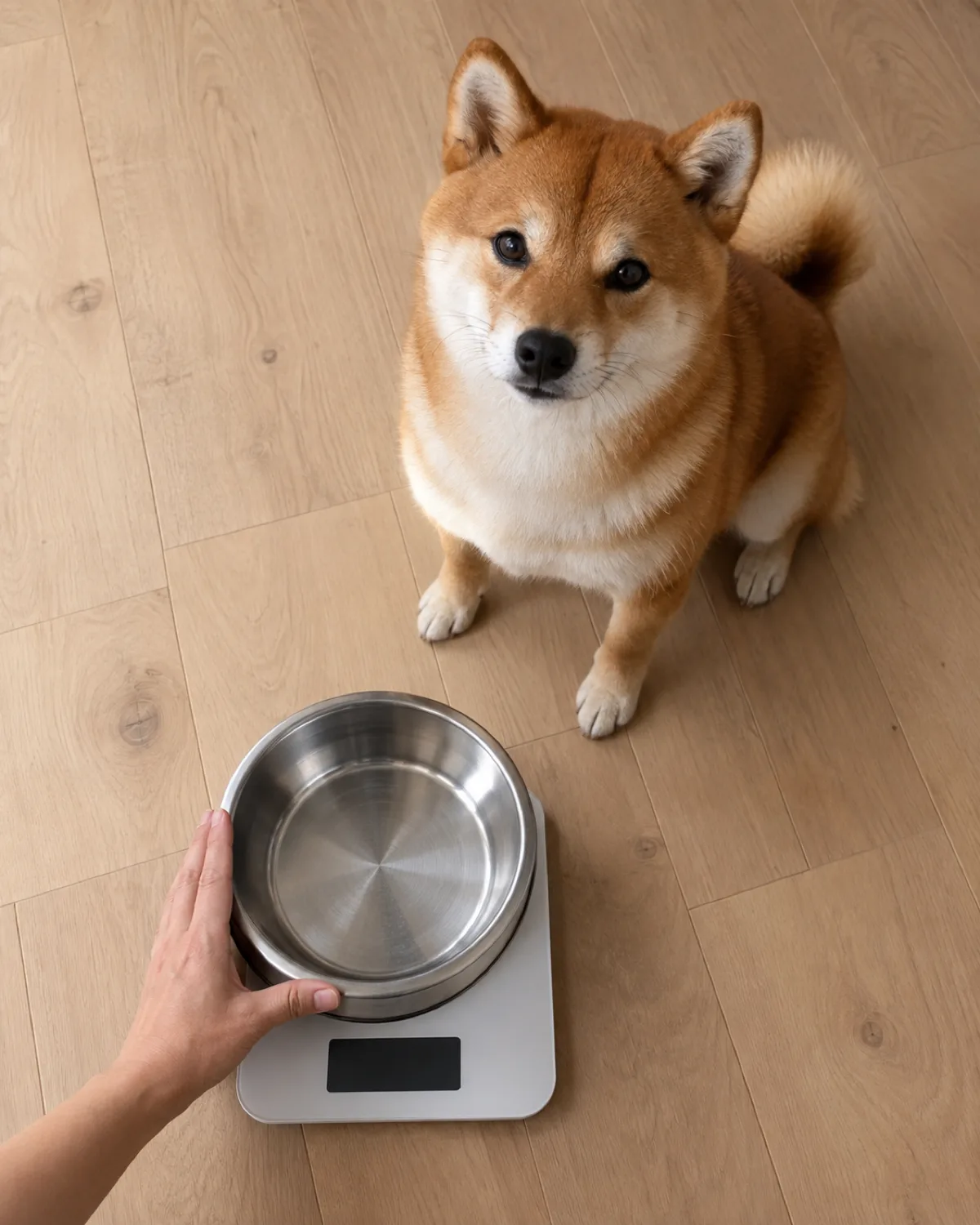
Measuring cups are the biggest source of portion creep in dog feeding. A leveled cup and a heaped cup can differ by thirty to fifty percent, and most people scoop without leveling. Over weeks, that drift adds up to real weight gain.
A digital kitchen scale that reads in grams solves this completely. Weigh the bowl, tare it to zero, pour kibble until you hit the target weight, done. No scooping variation, no guessing.
To convert from the bag's "cups" recommendation:
- Weigh one leveled cup of your specific kibble on the scale (different shapes and densities weigh differently — a cup of small dense kibble weighs more than a cup of large airy kibble).
- Divide your daily target calories by the kcal-per-gram to get the exact gram weight per day.
- Split that number across your meals.
Once you have the gram target dialed in, feeding takes ten seconds. You pour, the scale beeps, you stop. There is no tool that does more for portion accuracy for less effort.
7. Keep Treats Under Ten Percent of Daily Calories
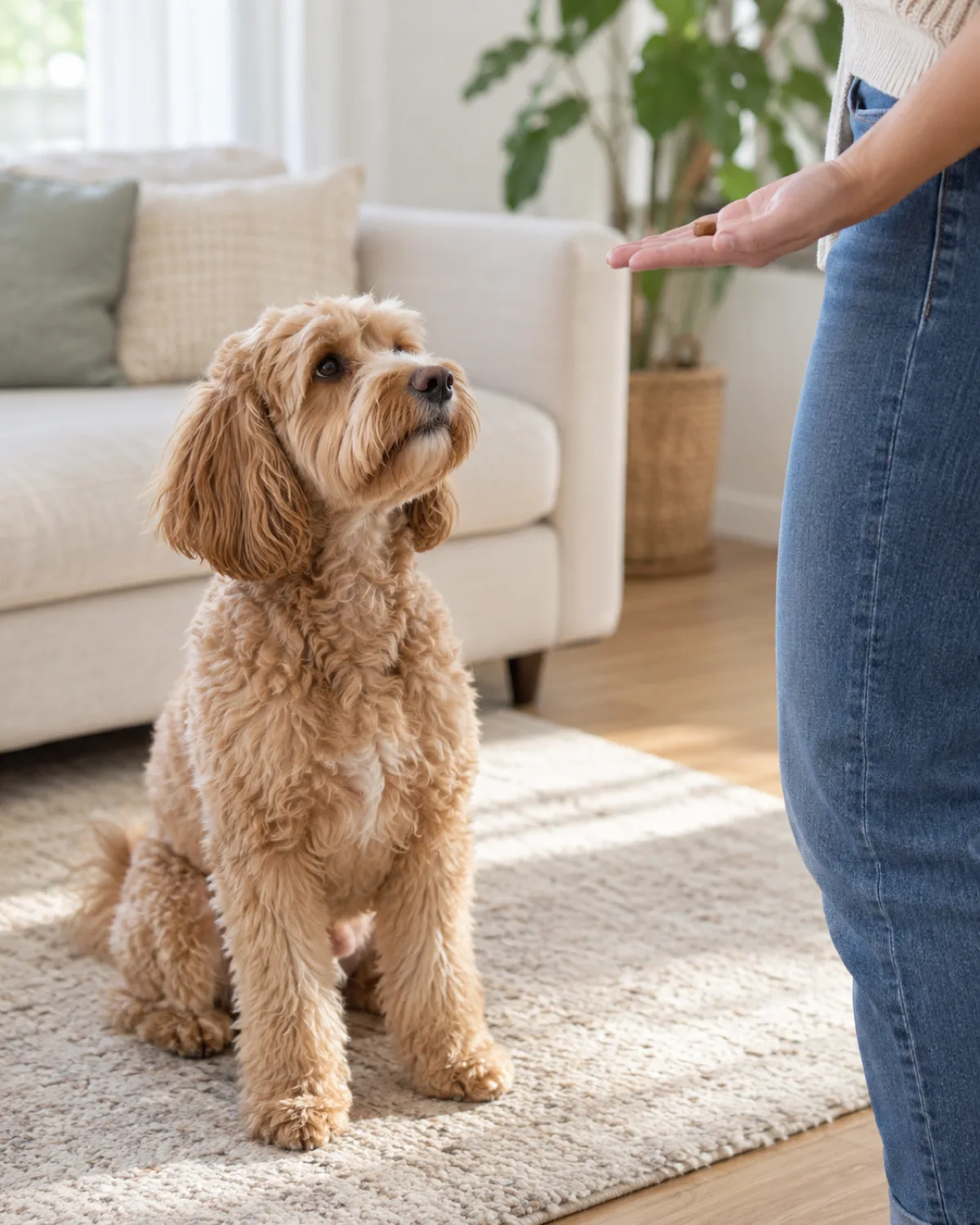
Treats are the invisible calorie source that derails portion control. A single large biscuit can be eighty calories. A bully stick can be one hundred and twenty. A smear of peanut butter on a lick mat can be two hundred.
The standard veterinary guideline is that treats should make up no more than ten percent of your dog's daily calorie intake. For a dog on 800 calories a day, that means eighty calories from treats — which is roughly four to six small commercial training treats, or two medium biscuits.
The part people miss is the subtraction. Treats are not free — they replace meal calories. If your dog gets eighty calories in treats during a training session, pull eighty calories out of the next meal. Otherwise you are feeding 110 percent every day and wondering why the weight creeps.
Here is what common treats actually cost:
- Small commercial training treat: 3–5 kcal
- Medium milk-bone style biscuit: 30–40 kcal
- Dental chew (medium dog): 50–80 kcal
- Bully stick (six inch): 80–130 kcal
- Tablespoon of peanut butter: 90–100 kcal
If you do a lot of training and want to keep treat calories low, the guide on dog training treats covers which treats pack the most motivation per calorie.
8. Adjust the Ratio When Mixing Wet and Dry Food
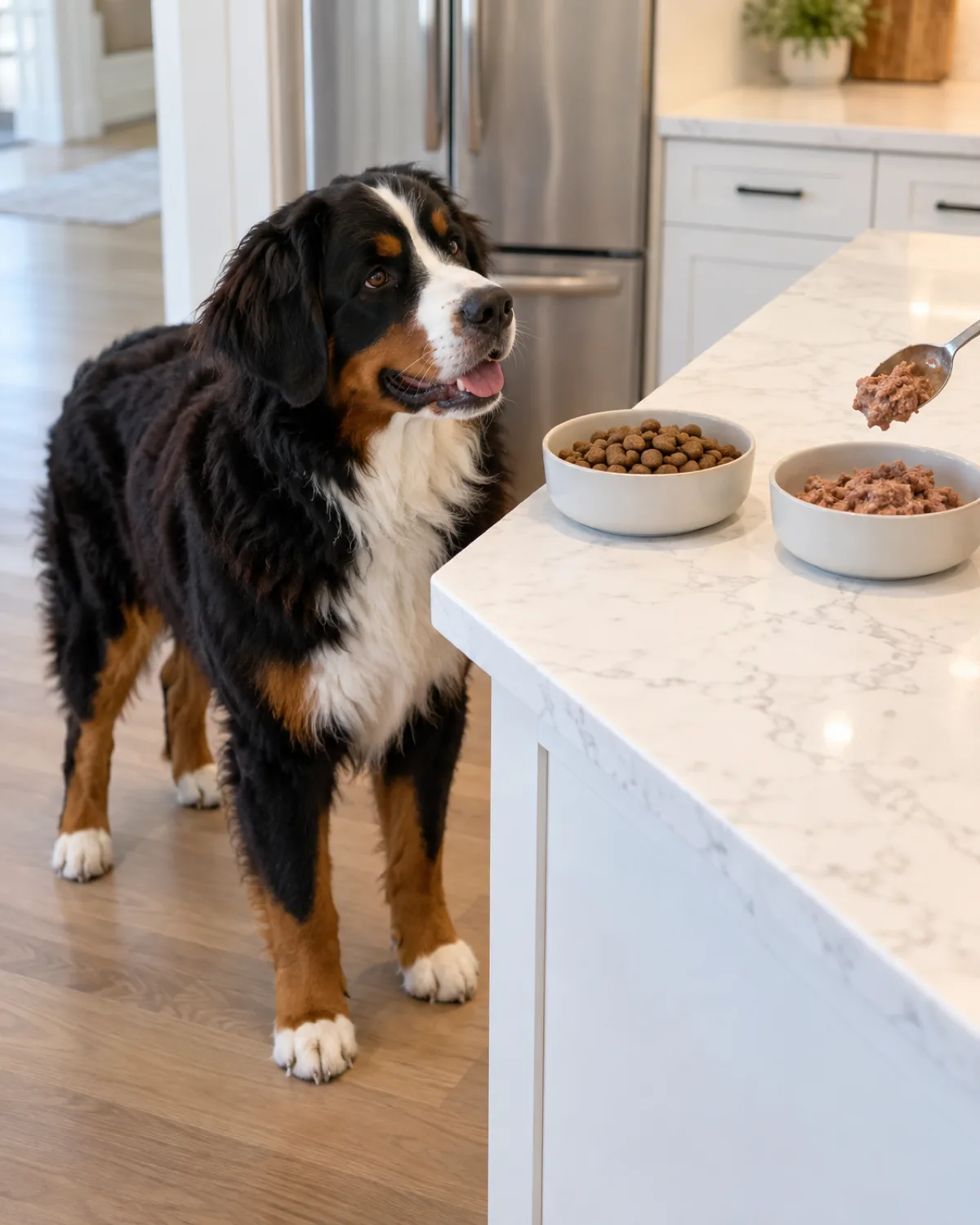
Mixing wet food into dry kibble is common — it adds flavor and moisture, and picky eaters tend to clean the bowl faster. But wet food has a completely different calorie density than kibble, and most people just add a spoonful on top without subtracting anything from the dry portion.
Wet food typically runs 25 to 50 kcal per ounce, while dry kibble runs roughly 90 to 130 kcal per ounce. So a quarter-cup of wet food adds fewer calories than a quarter-cup of kibble, but it still adds calories — and they need to come out of somewhere.
The simplest way to handle this:
- Check the kcal per can (or per ounce) on your wet food label.
- Decide how much wet food you want to add per meal.
- Subtract those calories from your daily kibble total.
- Reduce the dry portion by the equivalent gram weight.
For example, if you add half a can of wet food at 180 kcal per can (so 90 kcal), and your kibble is 360 kcal per cup, you need to pull about a quarter cup of kibble out of the daily amount to keep the total the same.
The mistake that catches people is doing the math once, nailing it, then switching to a different wet food brand that has a different calorie count — and not recalculating.
9. Account for Metabolism Changes After Spaying or Neutering
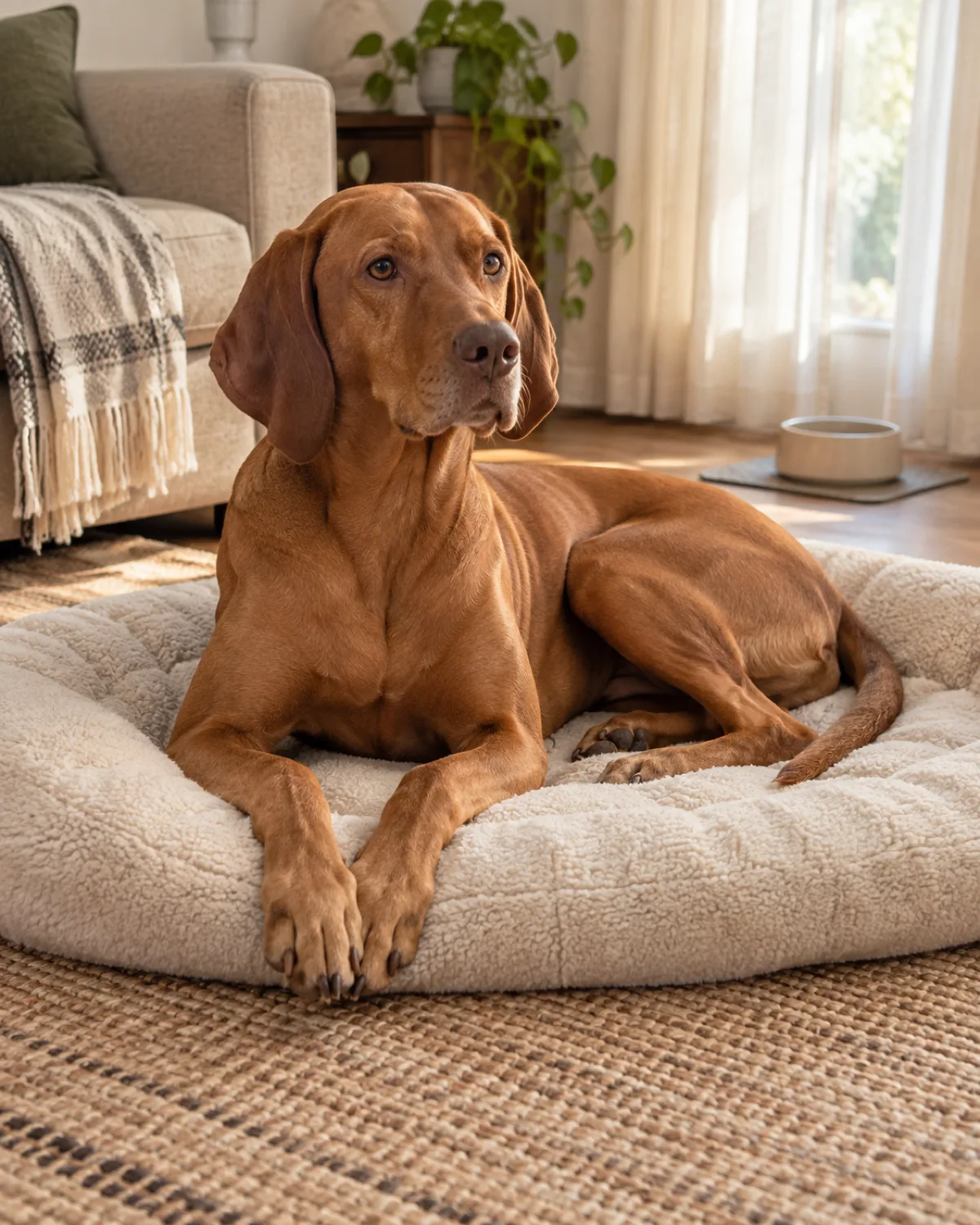
Spaying or neutering changes your dog's hormonal profile, and one of the downstream effects is a measurable drop in metabolic rate. Studies show that neutered dogs burn roughly twenty to thirty percent fewer calories at rest compared to intact dogs of the same size and age.
That means a dog who was eating two cups a day before the surgery may only need one and a half cups afterward to maintain the same weight. If you keep feeding the pre-surgery amount, the extra calories convert to fat — and because the hormonal shift also tends to increase appetite, your dog will happily eat every bite.
The adjustment window is the first two to four weeks after surgery. Most vets recommend reducing the daily amount by about twenty percent immediately after the procedure and then monitoring body condition over the next month.
If your dog is approaching the age where you are considering the procedure, when to spay or neuter your puppy covers the timing considerations alongside health factors.
10. Increase Portions Gradually During Pregnancy and Nursing
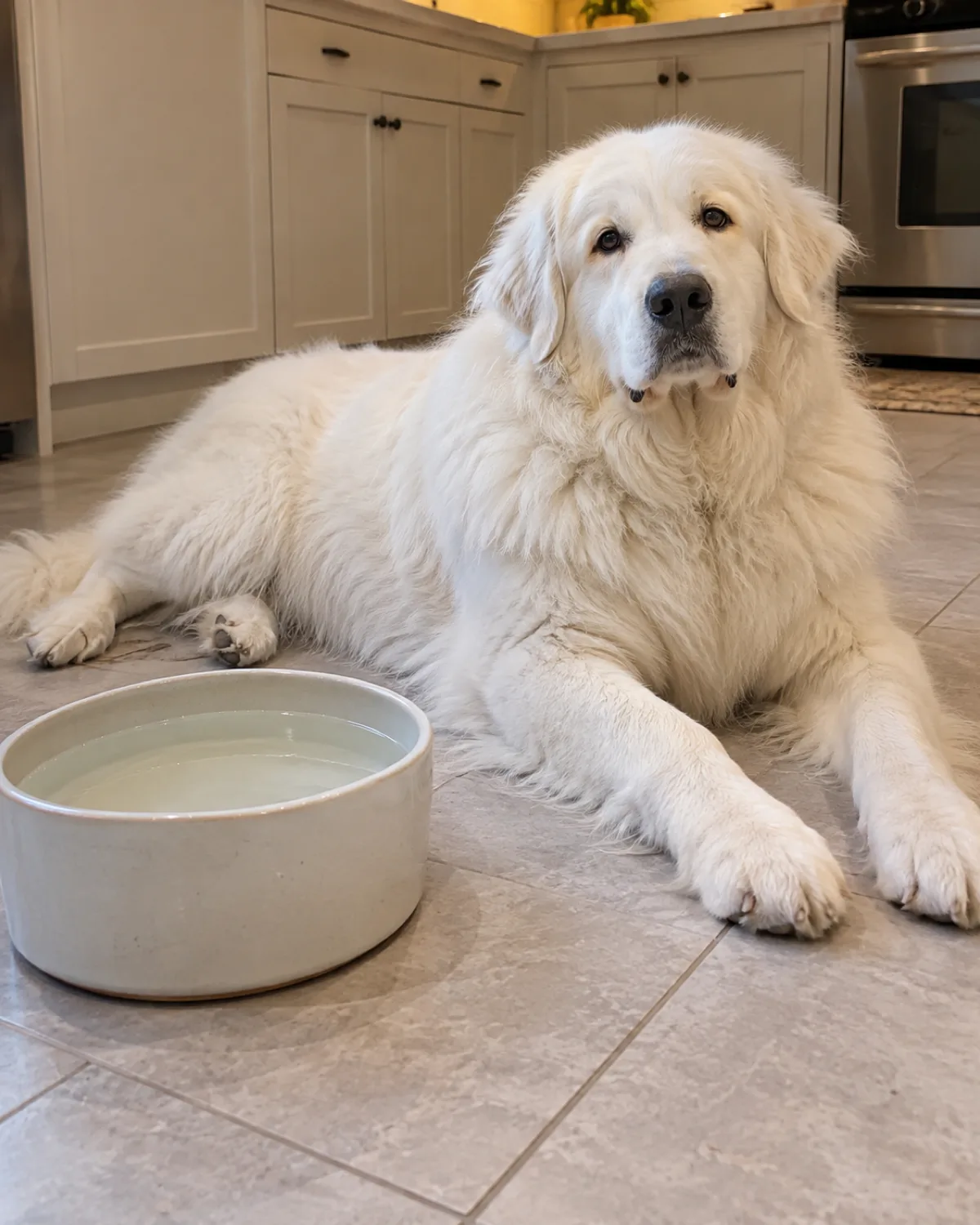
A pregnant dog does not need extra food during the first five weeks of gestation. The calorie increase comes in the final three to four weeks when the puppies are growing fastest, and it peaks during nursing — when a mother dog may need two to four times her normal maintenance calories to produce enough milk.
Here is a rough timeline:
- Weeks 1–5 of pregnancy: Feed the normal adult amount. The embryos are tiny and calorie demand is unchanged.
- Weeks 6–9 of pregnancy: Increase food by twenty-five to fifty percent, split across three or four smaller meals (the growing puppies compress stomach space).
- Nursing (weeks 1–4 after birth): Increase to two to three times the normal amount, often offered free-choice so the mother can eat whenever she needs to.
- Weaning (weeks 4–8): Gradually reduce back toward normal as the puppies transition to solid food.
The common mistake is increasing too early — piling on calories at week two of pregnancy when the dog does not need them yet, which leads to excessive weight gain that makes delivery harder. The other mistake is not increasing enough during nursing, which can leave the mother malnourished and thin.
This is one area where your vet should be closely involved. The numbers above are guidelines, and individual dogs vary significantly based on litter size, body condition at the start of pregnancy, and the demands of milk production.
11. Shift Seasonal Portions When Appetite Swings With Weather
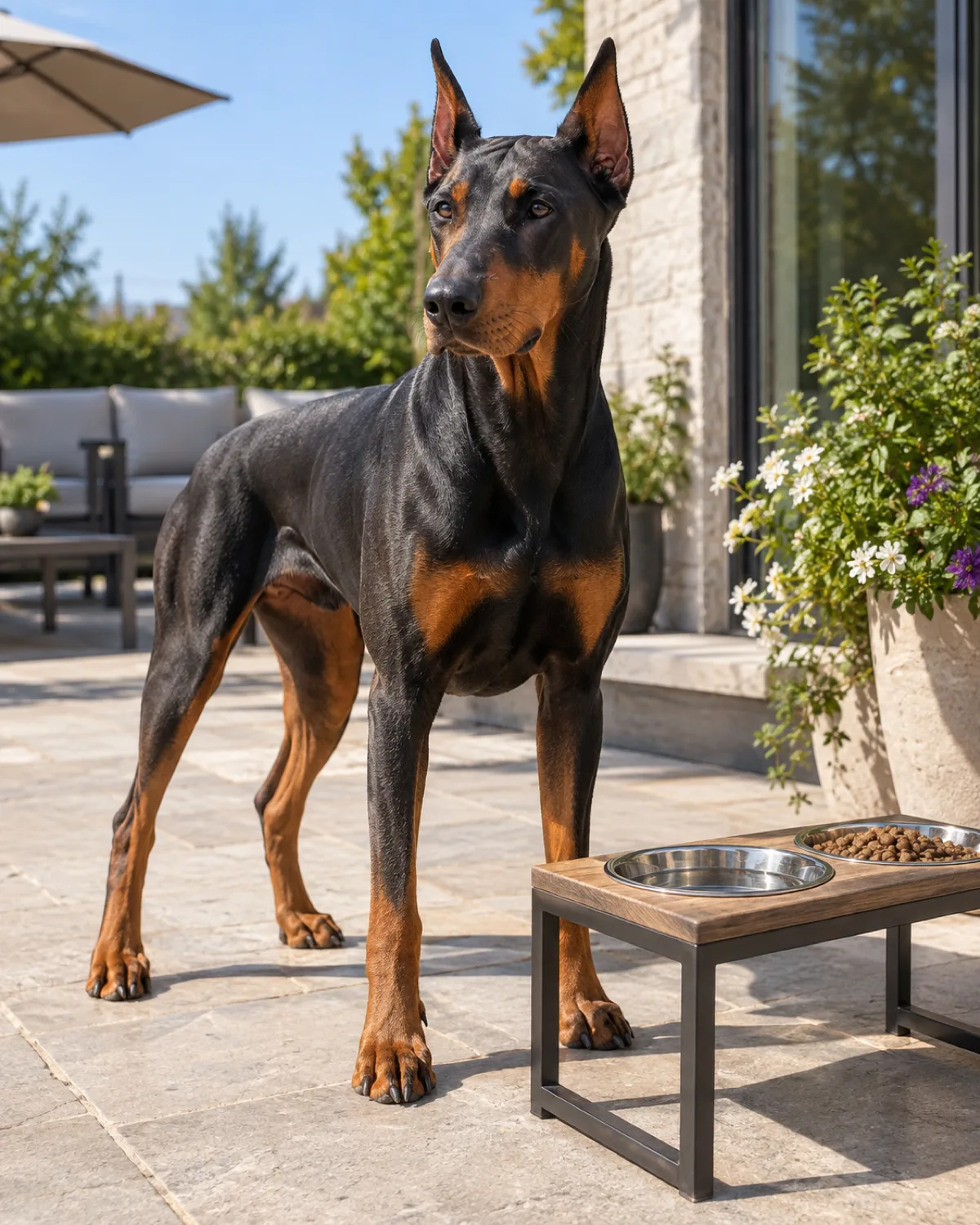
Dogs eat less in hot weather and more in cold weather. It is not a behavioral quirk — it is thermoregulation. In summer, a dog's body generates less metabolic heat because the ambient temperature is higher, so calorie demand drops. In winter, maintaining core body temperature in cold air burns extra calories, especially for dogs who spend time outdoors.
The swing is not dramatic for indoor dogs who live in climate-controlled homes, but it is noticeable:
- Summer months: Appetite may drop by five to fifteen percent. If your dog is leaving food in the bowl consistently during hot weeks, reduce the portion slightly rather than letting uneaten kibble sit and go stale.
- Winter months: Appetite may increase by ten to twenty percent, particularly for dogs with outdoor access or thinner coats.
The mistake is overreacting in either direction. A dog who skips one meal on a ninety-degree day is not sick — they are just hot. And a dog who seems hungrier in January may genuinely need a bit more, but a twenty-percent increase should be the ceiling unless they are doing heavy outdoor work in the cold.
If your dog spends time outside in summer, how to keep your dog cool in summer covers hydration and heat management alongside feeding considerations.

About the author
Jess Calloway
Jess Calloway edits Pawliqa, where she shares dog care, grooming, training, and new-owner tips — plus DIY and pet-friendly home ideas — for anyone who wants a happy, well-cared-for dog. As a dog mom to three very different dogs (and three very different appetites), she writes the honest, tested version of what actually works at mealtime. Every guide is image-led and reviewed for clarity, usefulness, image accuracy, and Pinterest-to-page alignment before it goes live. Visit the About page.
12. Manage Separate Bowls in a Multi-Dog Household
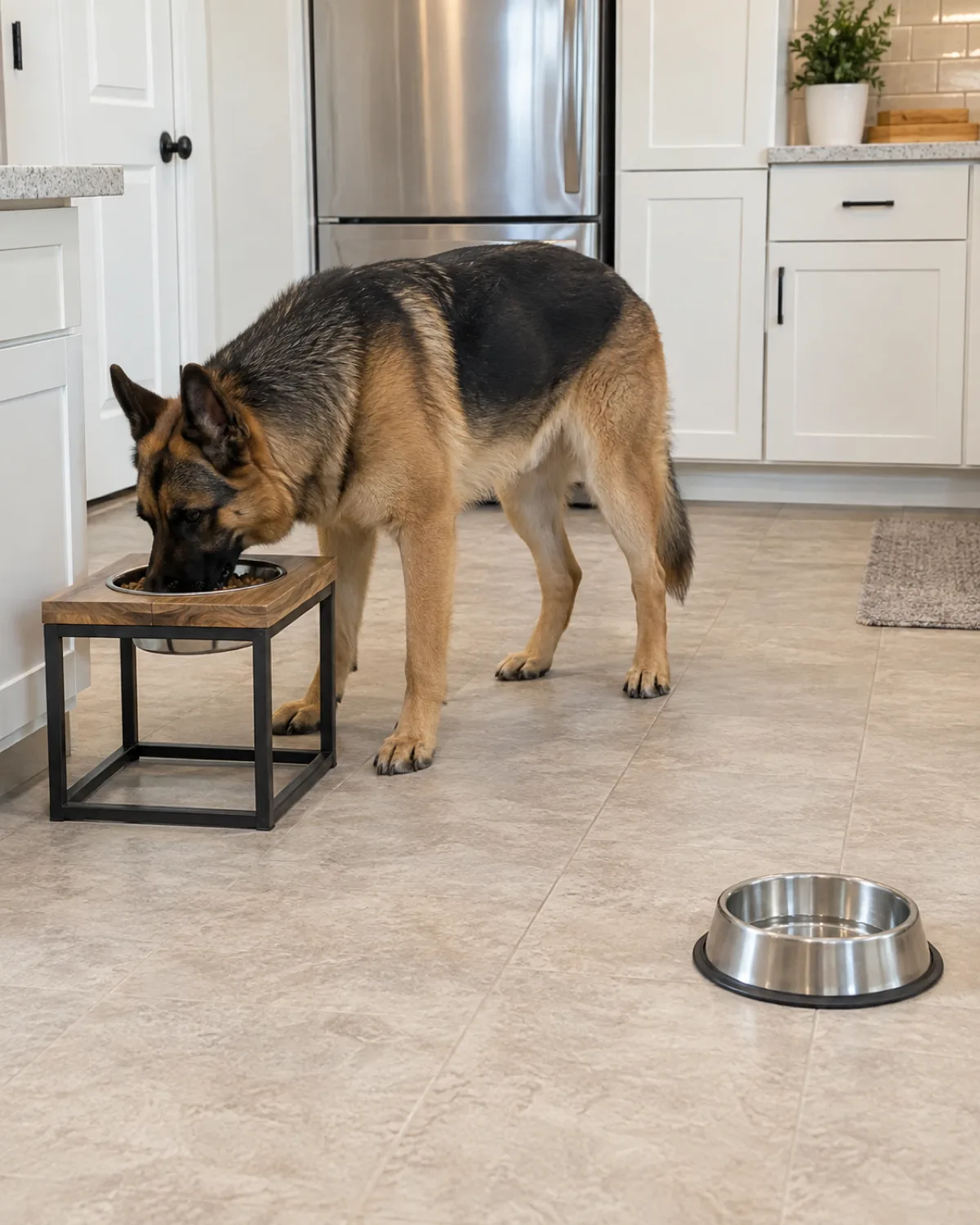
If you have more than one dog, shared bowls are the fastest way to lose control of portions. The faster eater finishes first, moves to the other dog's bowl, and eats the rest. One dog gains, the other dog loses, and you have no idea whose intake is what.
The fix is simple but non-negotiable: separate bowls in separate locations, supervised until both dogs are done.
- Weigh each dog's portion individually on the kitchen scale. Different dogs, different calorie needs.
- Feed in different rooms or at least on opposite sides of the kitchen with a gate or barrier between them.
- Pick up bowls after fifteen minutes. If a dog has not finished, the food goes away until the next meal. This prevents the fast eater from circling back and also teaches slow eaters to eat when food is offered.
If one dog needs to lose weight and the other does not, you cannot manage that with a shared bowl. The overweight dog will eat whatever the lean dog leaves, and the lean dog may eat less because they feel rushed by the other dog hovering.
For households with a new puppy joining an existing dog, how to introduce a new puppy to your dog covers the resource-guarding dynamics that often show up around food bowls.
13. Spot the Early Signs That You Are Overfeeding
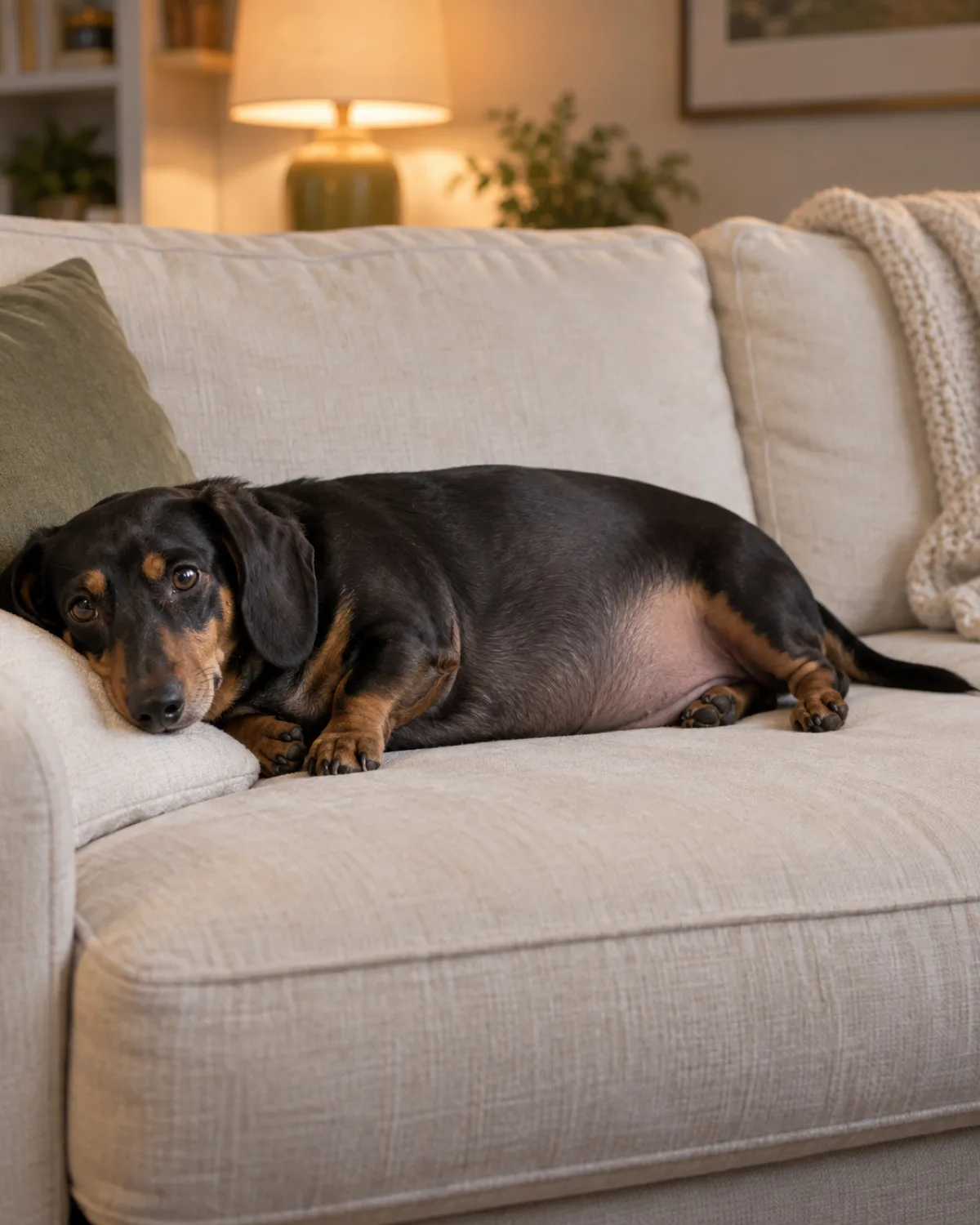
Weight gain in dogs is gradual enough that you stop seeing it. The dog looks the same every day because the change is ounces at a time — until suddenly their collar is tight and the vet says they need to lose eight pounds.
Watch for these early signs before the scale confirms it:
- Lost waist tuck. Stand above your dog and look down. If the body goes straight from ribs to hips with no inward curve, they are carrying extra weight.
- Hard-to-find ribs. If you have to press firmly to feel the ribs instead of finding them with light fingertip pressure, there is too much fat covering them.
- Reluctance to exercise. A dog who used to sprint for the ball and now trots after it may be carrying enough extra weight to make exertion uncomfortable.
- Increased begging. Counterintuitive, but overweight dogs often beg more — not because they are hungry, but because their insulin and hunger hormones are dysregulated from chronic overfeeding.
If you spot two or more of these signs, reduce the daily food amount by ten percent for two weeks and recheck. Do not crash-diet a dog — slow steady reduction is safer and more sustainable.
For dogs who have already gained significant weight, how to help your dog lose weight safely covers the full protocol from calorie targets to exercise adjustments.
14. Recognize When Your Dog Is Consistently Underfed
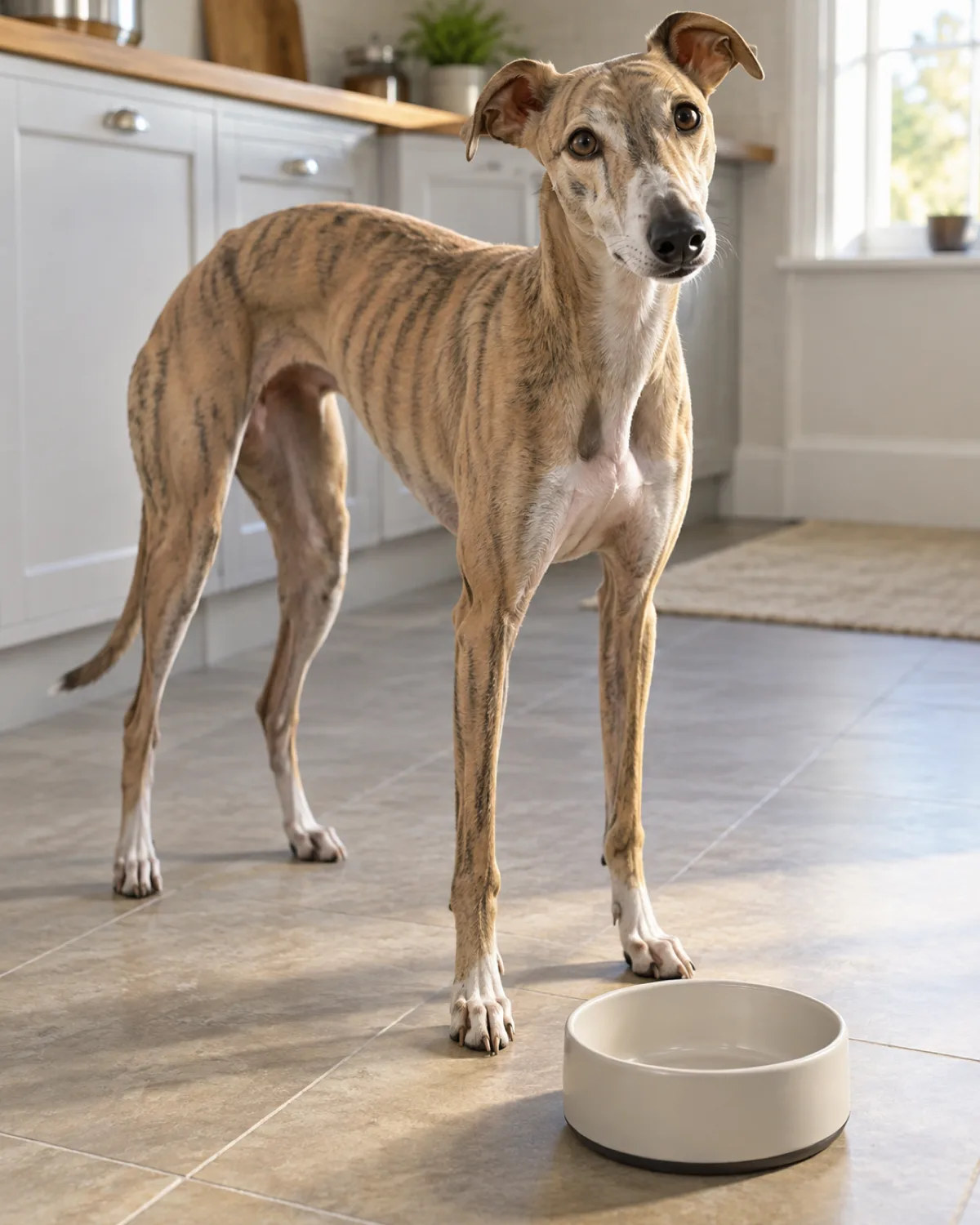
Underfeeding is less common than overfeeding, but it happens — especially when owners follow a weight-loss plan too aggressively, when a dog switches to a lower-calorie food without portion adjustment, or when a multi-dog household's fast eater is stealing from the slow eater.
Signs your dog may not be getting enough:
- Visible ribs without pressing. A healthy dog's ribs should be easy to feel but not visible from across the room.
- Prominent spine and hip bones. If you can see the bumps of the spine or the points of the hip bones, the dog is underweight.
- Dull, dry coat. A coat that has lost its shine or feels brittle may signal calorie or nutrient deficiency.
- Low energy and muscle loss. A consistently underfed dog will lose muscle mass before they lose fat, and they will seem tired even after rest.
If you suspect underfeeding, increase the daily amount by ten to fifteen percent for two weeks and reassess. If the dog does not respond — or if they are eating the expected amount but still losing weight — see your vet. Unexplained weight loss with normal intake can signal an underlying health issue that has nothing to do with portion size.
15. Recalculate Mid-Bag When Weight Starts Drifting
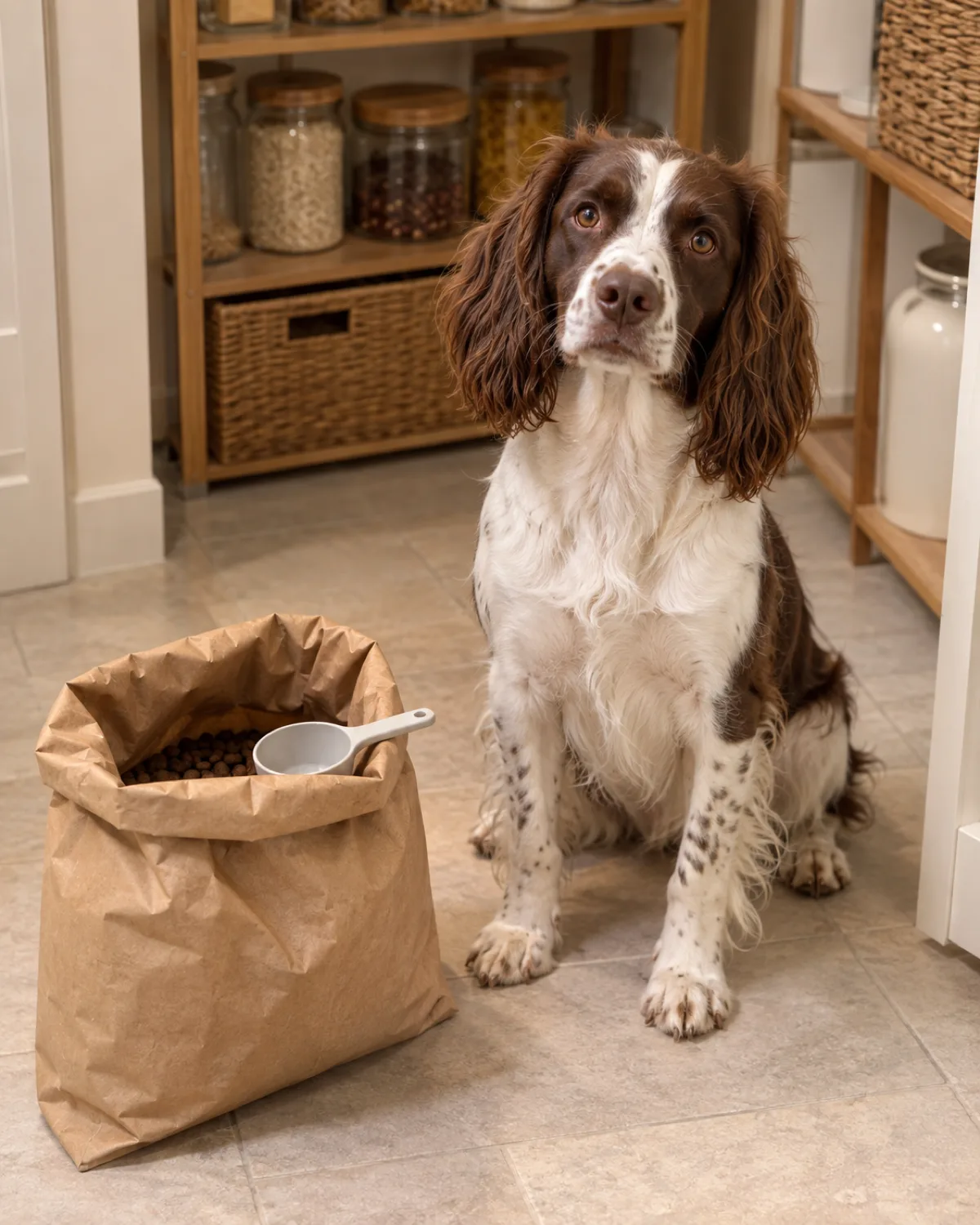
Most people set a feeding amount when they open a new bag and never touch it until the bag runs out. That works fine if nothing changes — but plenty of things change mid-bag.
Your dog's activity level shifts with the seasons. A dental chew you started giving daily adds calories. The weather turns cold and your dog burns more at rest. You start a new training routine and hand out fifty extra treat calories a day. The kids start sneaking table scraps.
Build a mid-bag checkpoint into your routine:
- Weigh your dog every two weeks. A bathroom scale works — step on holding the dog, step on without, subtract.
- If weight has drifted more than two percent in either direction, adjust the daily amount by five to ten percent the opposite way.
- If you changed anything (new treats, new exercise routine, new food topper, spay/neuter), recalculate that day instead of waiting for the weigh-in.
The goal is to catch drift early. A one-pound gain over two weeks is easy to reverse by pulling fifty calories a day. A five-pound gain over three months requires a structured weight-loss plan and a vet visit.
16. Build an Annual Vet-Check Portion Review Habit
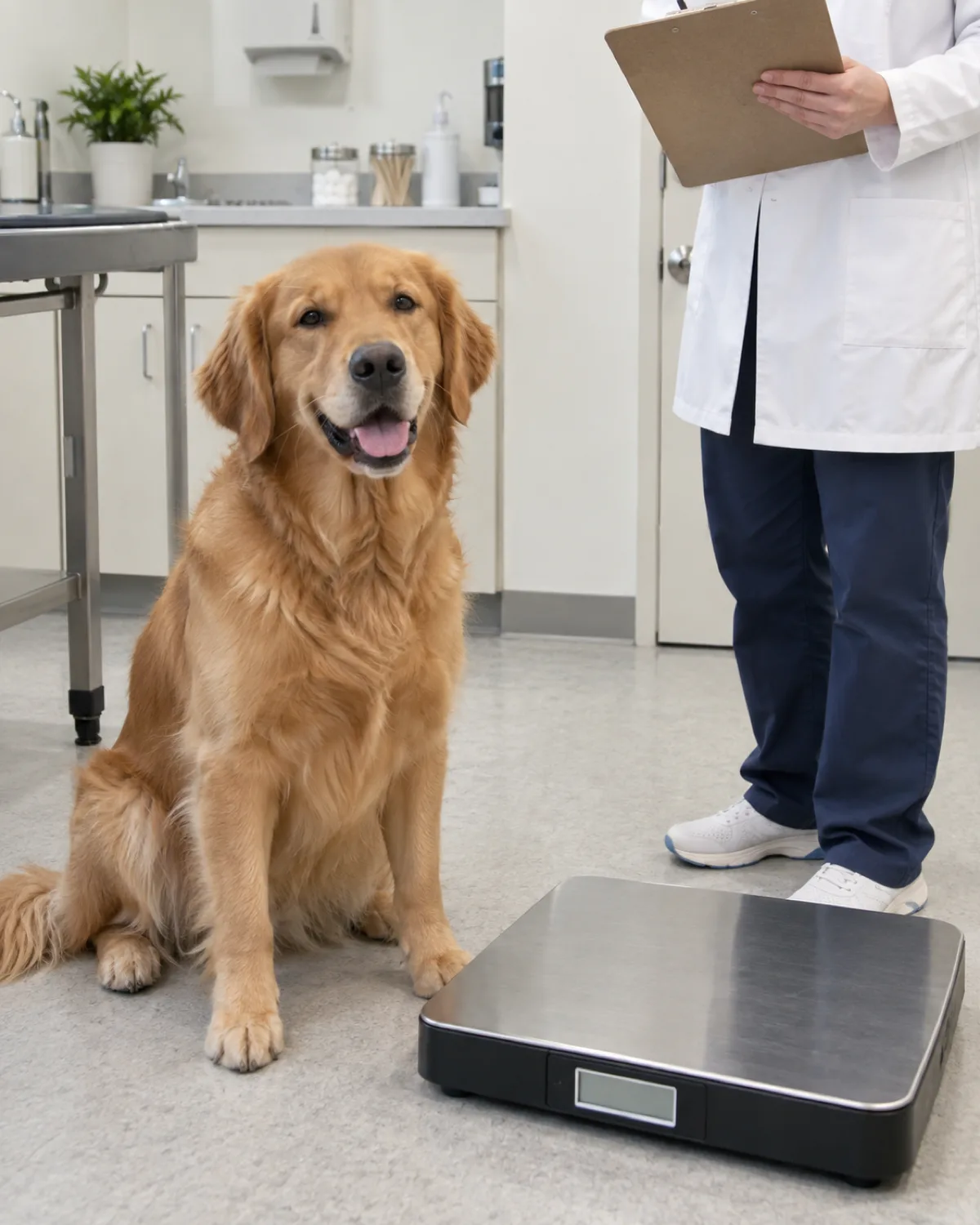
You can do all fifteen things above perfectly and still benefit from having your vet review your feeding plan once a year. Your dog ages, their metabolism shifts, and conditions like hypothyroidism or joint issues can change calorie needs in ways you cannot see from the outside.
At your annual wellness visit, bring two things:
- The exact food you are feeding (brand, formula, and calorie count per cup).
- Your current daily amount in grams or cups, including a rough estimate of daily treat calories.
Your vet will weigh your dog, assign a body condition score, and tell you whether the current plan is working or needs adjustment. This takes five minutes of the appointment and gives you a professional baseline to work from for the next twelve months.
If your dog is a senior, how to care for a senior dog covers the broader health picture including nutrition shifts that happen after age seven. For help choosing the right vet in the first place, how to choose the right vet for your dog walks through the decision.
Frequently Asked Questions About Feeding Your Dog
How many times a day should I feed my dog?
Most adult dogs do best on two meals a day — morning and evening — spaced about twelve hours apart. Puppies under six months need three to four meals a day because their stomachs are smaller and their blood sugar drops faster between meals.
Some large-breed dogs prone to bloat also benefit from two smaller meals instead of one large one, since a single oversized meal increases stomach gas and torsion risk.
Should I free-feed or use scheduled meals?
Scheduled meals are almost always better for portion control. Free-feeding — leaving food out all day — makes it impossible to track how much your dog is eating, which means you cannot catch weight gain early or adjust for treats, wet food additions, or activity changes.
The only situation where free-feeding works reasonably well is for a single-dog household with a naturally lean dog who self-regulates and never overeats.
How do I switch my dog to a new food without stomach problems?
Transition gradually over seven to ten days. Start with seventy-five percent old food and twenty-five percent new food for the first three days. Move to fifty-fifty for the next three days. Then seventy-five percent new food for the final three days before switching fully.
If your dog develops loose stool at any stage, hold that ratio for an extra two or three days before increasing the new food percentage.
Is it normal for my dog to skip a meal sometimes?
Yes, especially in hot weather, after a stressful event, or when a dog is simply not hungry. A healthy dog who skips one meal and eats normally at the next one is fine. If your dog skips two or more consecutive meals, refuses treats they normally love, or shows other signs like lethargy or vomiting, call your vet — something else may be going on.
How much water should a dog drink per day alongside meals?
A general guideline is about one ounce of water per pound of body weight per day. A fifty-pound dog should drink roughly fifty ounces, or about six cups. Dogs on dry kibble tend to drink more than dogs on wet food because kibble has very low moisture content.
Always keep fresh water available — do not ration water the way you ration food. If your dog is drinking dramatically more or less than usual, mention it at the next vet visit because sudden changes in water intake can signal kidney, diabetes, or hormonal issues.
Save this for later
16 Factors That Shape How Much to Feed a Dog
- 1Start with ideal body weightFeed for where your dog should be, not where they are now.
- 2Learn the body condition scoreA quick rib and waist check tells you more than the scale alone.
- 3Match the life stage columnPuppy, adult, and senior columns give different calorie targets.
- 4Factor in daily activity levelCouch dogs need less than the chart says; trail dogs need more.
- 5Check your kibble's calorie countOne cup can be 300 or 500 calories depending on the formula.
- 6Use a kitchen scaleA heaped cup can hold fifty percent more than a leveled one.
- 7Keep treats under ten percentSubtract treat calories from the next meal, do not add on top.
- 8Adjust for wet and dry mixingWet food adds calories — reduce the dry portion to compensate.
- 9Account for spay or neuter changesMetabolic rate drops about twenty percent after the procedure.
- 10Increase portions when nursingA nursing mother may need two to four times normal calories.
- 11Shift portions by seasonDogs eat less in heat and more in cold — small adjustments help.
- 12Manage multi-dog bowlsSeparate bowls, separate rooms, pick up after fifteen minutes.
- 13Spot overfeeding signsLost waist tuck and hard-to-find ribs are the earliest warnings.
- 14Recognize underfeeding signsVisible ribs, dull coat, and low energy mean the portion is too small.
- 15Recalculate when weight driftsA two-percent shift in two weeks means it is time to adjust.
- 16Build a vet-check review habitOne annual portion review catches drift that home checks miss.