A dog that loses its mind when the doorbell rings, launches into orbit before every walk, or spins in circles when a guest arrives is not being disobedient. It is stuck in a pattern of overarousal that it has never been taught to break.
The fix is not louder commands or more physical restraint. It is a calm, repeatable system: teach the dog what "settled" looks and feels like, then set up the environment so the dog can practice that state every day.
This guide covers daily overstimulation. For noise-specific panic during thunderstorms or fireworks, see the fireworks and thunderstorm guide.
Jump to a section
How to Calm a Dog Down
This guide walks through understanding overstimulation, reading the early signs, teaching the place cue, building structured down-stays, managing your environment, and creating a daily decompression routine.
Dogs do not choose to be overstimulated any more than you choose to flinch when something startles you. Arousal is a physiological state — heart rate climbs, adrenaline floods the system, and the thinking part of the brain takes a back seat to pure reaction.
Every dog has an arousal threshold. Below it, the dog can think, respond to cues, and take treats gently. Above it, the dog is running on autopilot: jumping, barking, spinning, mouthing, or zooming without any ability to process what you are saying.
The triggers stack. A dog that handles one visitor just fine might lose it when the doorbell rings while another dog is barking outside and dinner is five minutes late. Each trigger pushes the internal meter higher, and once the dog crosses the threshold, no amount of repeating "sit" is going to land.
Arousal is not aggression. An overexcited dog and a fearful dog can look similar from a distance, but the motivations and the fixes are different.
Some breeds have lower thresholds. Herding dogs and terriers were selected for reactivity. That does not mean they cannot learn to settle — it means they need more practice than a laid-back hound.
Puppies and adolescent dogs (roughly six to eighteen months) go through developmental phases where impulse control is genuinely harder. The protocols in this guide still apply, but expect slower progress during those windows.
Understanding the threshold explains why yelling "calm down" at an overexcited dog is pointless. The dog is above the line where verbal cues register. The work happens below the line, building the dog's ability to stay there.
Spot the Early Warning Signs
If you wait until your dog is already bouncing off the walls, you have missed the window. The place to intervene is during the buildup, when the dog is climbing toward the threshold but has not crossed it yet.
These are the signs to watch for:
Faster breathing with a closed or tight mouth — not the relaxed open-mouth pant of a warm dog
Pacing or inability to lie down — the dog walks in loops, sits for two seconds, stands, walks again
Ears pinned forward and body weight shifted onto the front legs — the dog is loading up to launch
Whale eye — the whites of the eyes are visible in a half-moon shape, and the dog is tracking something intently
Unable to take a treat gently — the dog snaps or fumbles food it would normally take with a soft mouth
When you notice two or more of these signs happening together, the dog is escalating. This is the moment to redirect — not with a loud command, but with a calm movement toward the dog's mat or a quiet room.
The basic commands guide covers the foundational cues that make redirection possible. A dog that has a reliable "come" and a reliable "place" gives you two exits before the arousal spills over.
Teach a Place Cue on a Mat
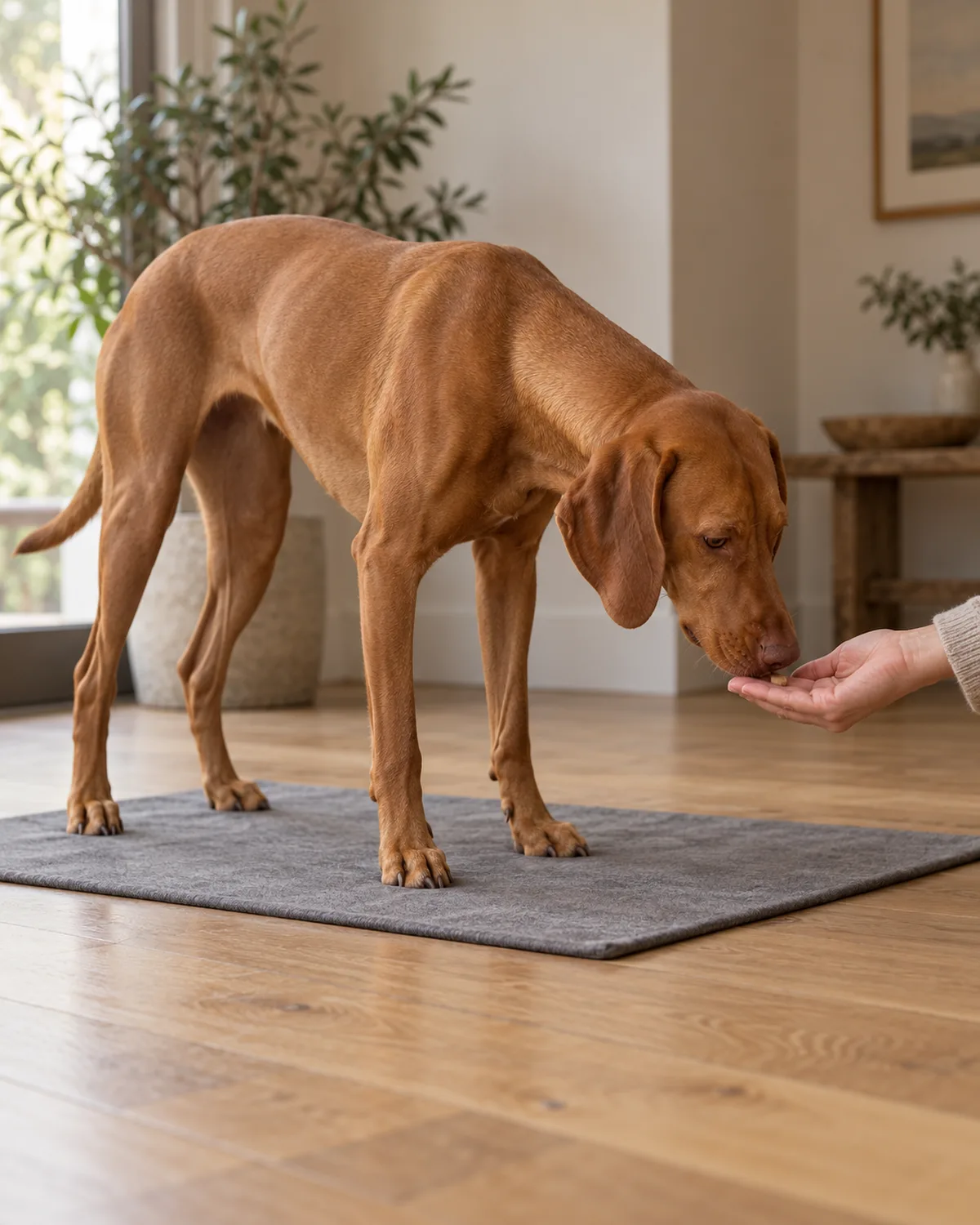
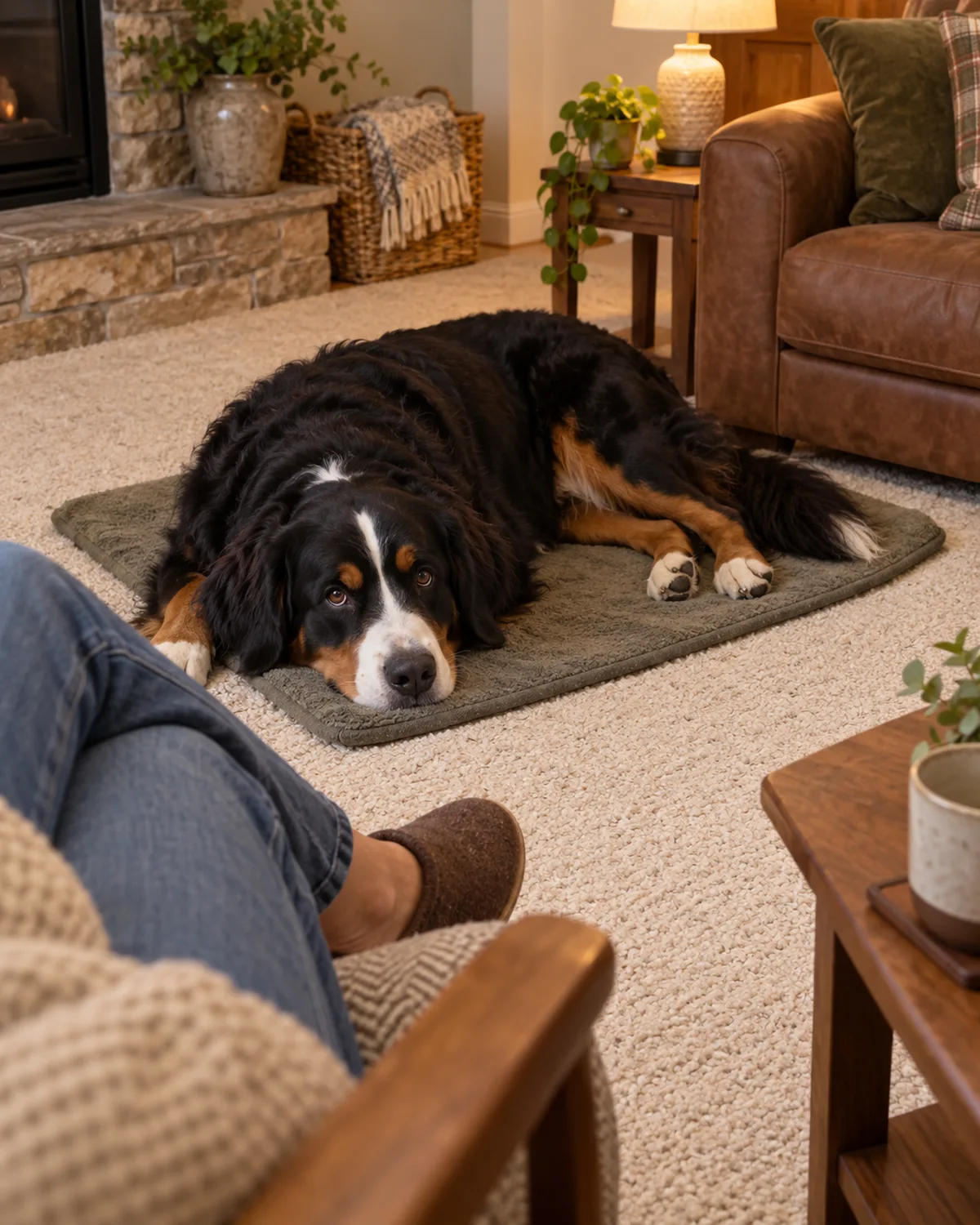
The place cue is the single most useful tool for calming an excitable dog. It gives the dog a specific location to go to and a specific behavior to perform — four paws on the mat, then settle.
You need a flat training mat, a towel, or a portable bed that the dog will only associate with calm behavior. Do not use the dog's regular sleeping bed.
Here is the progression:
Set the mat down. When the dog steps onto it, mark with "yes" and treat on the mat.
Toss a treat off the mat to reset. When the dog returns four-on, mark and treat.
Once reliable, wait one second before marking. Then two. Then five.
Add the cue "place" just before the dog steps on so the word predicts the action.
Add mild distractions — a person walking past, a toy nearby. Treat for staying.
Keep sessions short. Five minutes twice a day beats thirty minutes once a week.
Treats should be pea-sized and high value. Small pieces of cooked chicken or commercial training treats work well.
End every session before the dog gets bored or frustrated. If the dog leaves the mat, you pushed the duration or distraction too far — go back one step.
The stay guide goes deeper into building duration for position holds. The place cue is a specific application of the same principle.
The difference between a calm dog and an exhausted one
Three Rules That Make the Rest Work
Miss any of these and the training will stall or backslide.
Reward calm, not tiredA dog that finally lies down after an hour of zoomies is not calm — it is depleted. The goal is to catch and reward the dog choosing to settle when it still has energy to be wild. That is the behavior worth reinforcing.
Never yell “calm down”Your raised voice is another stimulus that pushes the dog higher. Speak in a low, slow tone or say nothing at all. Movement and energy level matter more than words when a dog is above threshold.
Practice every single dayOne place-cue session per day is the minimum. Consistency builds the neural pathway. Skipping three days and then doing a marathon session teaches the dog nothing permanent.
Practice Structured Down-Stays
Once the dog can go to its mat on cue, the next step is extending the time it stays there in a relaxed position. A structured down-stay is different from a rigid obedience "down" — you want the dog to actually relax, not hold a sphinx position while vibrating with tension.
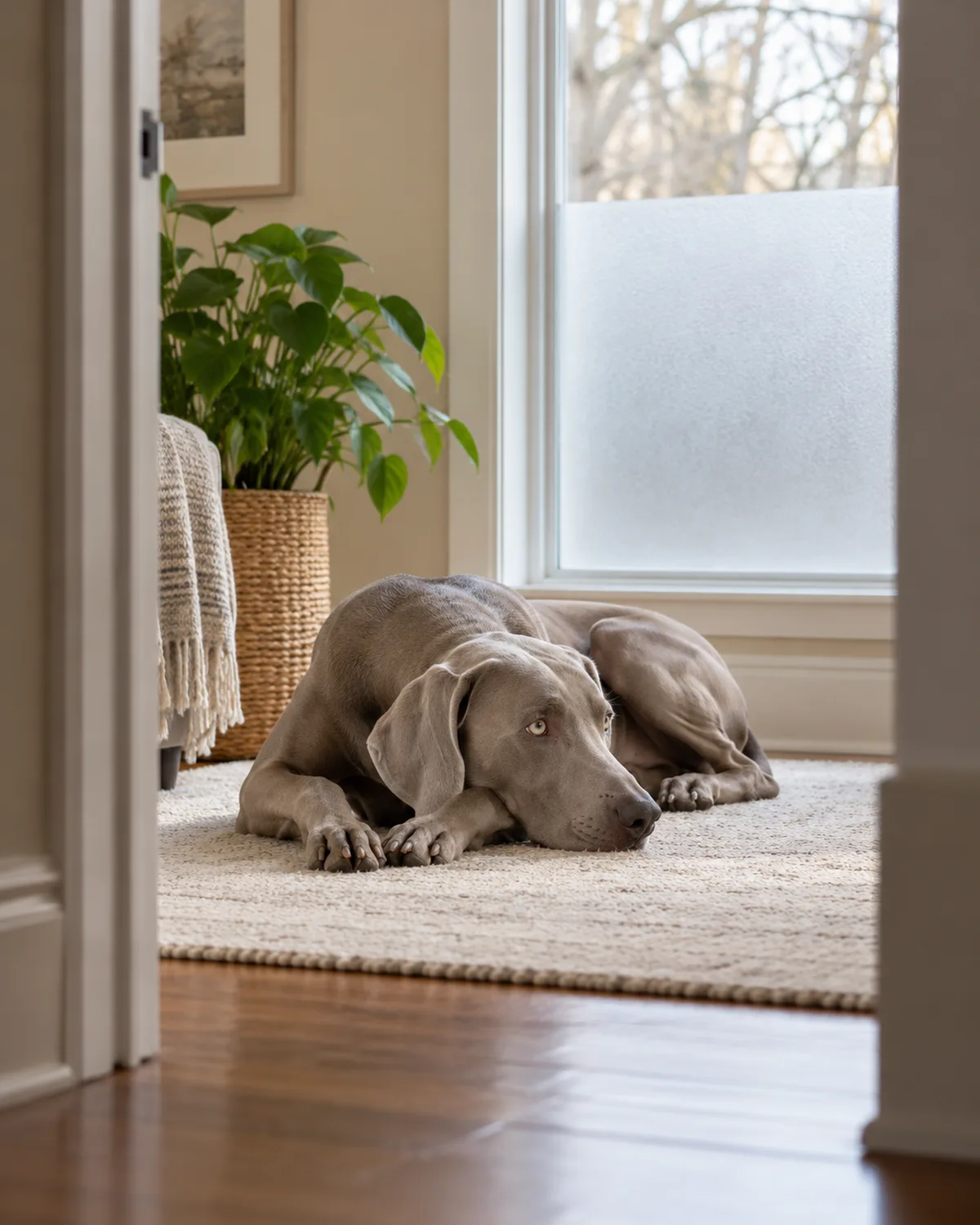
The relaxed down looks like this: the dog's hips shift to one side, the head may rest on the paws or turn to look around casually, and the breathing is slow and even. A dog that is lying down but staring at you with locked eyes and a tense jaw is complying, not settling.
Build duration in small increments:
Ask the dog to go to its mat and lie down. Mark and treat when the hips shift to one side.
Wait ten seconds. If the dog stays relaxed, treat again. If it pops up, calmly reset.
Add time in ten-to-fifteen-second jumps. Vary intervals so the dog cannot predict the treat.
Increase to five minutes, then ten. At ten minutes of relaxed mat time, most dogs start to enjoy it.
Stay in the room during early sessions. Leaving too soon teaches the dog that you walking away means the session is over.
Use a crate as a fallback if the dog cannot stay on an open mat. Some dogs settle faster in an enclosed space.
Practice during calm times first. Asking for a ten-minute down-stay while guests are arriving is an unfair test if the dog has only ever practiced in a quiet room.
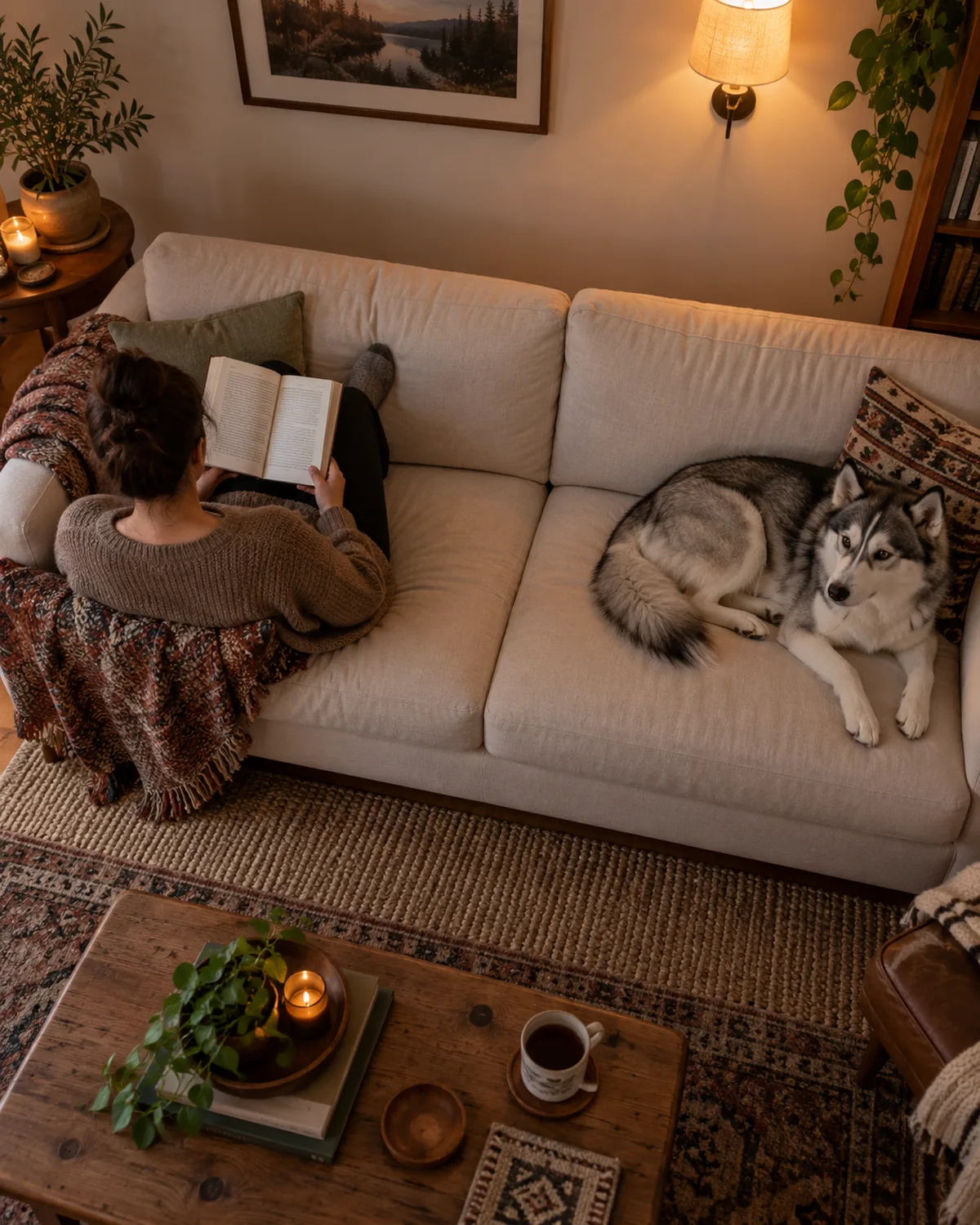
The transition from "I will stay because you asked" to "I choose to lie here because it feels good" is the real win. That shift usually happens around week two or three of daily practice.
Manage Your Home Environment
Training teaches the dog what to do. Environment management removes the opportunities to practice the wrong behavior while the training takes hold.
A dog that stares out the front window and barks at every person who walks by is rehearsing arousal dozens of times a day. No amount of place-cue practice can outrun that volume of practice in the wrong direction.
Practical changes that make an immediate difference:
Block visual triggers. Frosted window film on the lower half of street-facing windows stops the bark-at-every-passerby cycle without darkening the room. It costs a few dollars and peels off cleanly.
Stop roughhousing indoors. Tug and chase games belong outside or in a designated play area. Playing tug in the living room and then expecting the dog to settle in the same room sends mixed signals.
Change the greeting ritual. If you come home and immediately pet, talk to, and excite the dog, you are training it to associate your arrival with peak arousal. Walk in calmly, put your bag down, change your shoes, and greet the dog only after it has four paws on the floor.
Use baby gates strategically. A gate across the hallway leading to the front door gives you a buffer zone. The dog can see you greeting a visitor but cannot rush the door.
These changes are not permanent lifestyle restrictions. They are scaffolding that supports the training. As the dog builds better impulse control through place-cue and down-stay practice, you can gradually remove the barriers and test the dog's new skills.
Build a Daily Decompression Routine
An overexcited dog often has unspent mental energy, not just physical energy. A thirty-minute fetch session tires the body but does almost nothing for the brain. Decompression activities engage the thinking, problem-solving part of the dog's mind — the same part that needs to be active for impulse control.
Build a daily decompression block of twenty to thirty minutes that includes at least two of these:
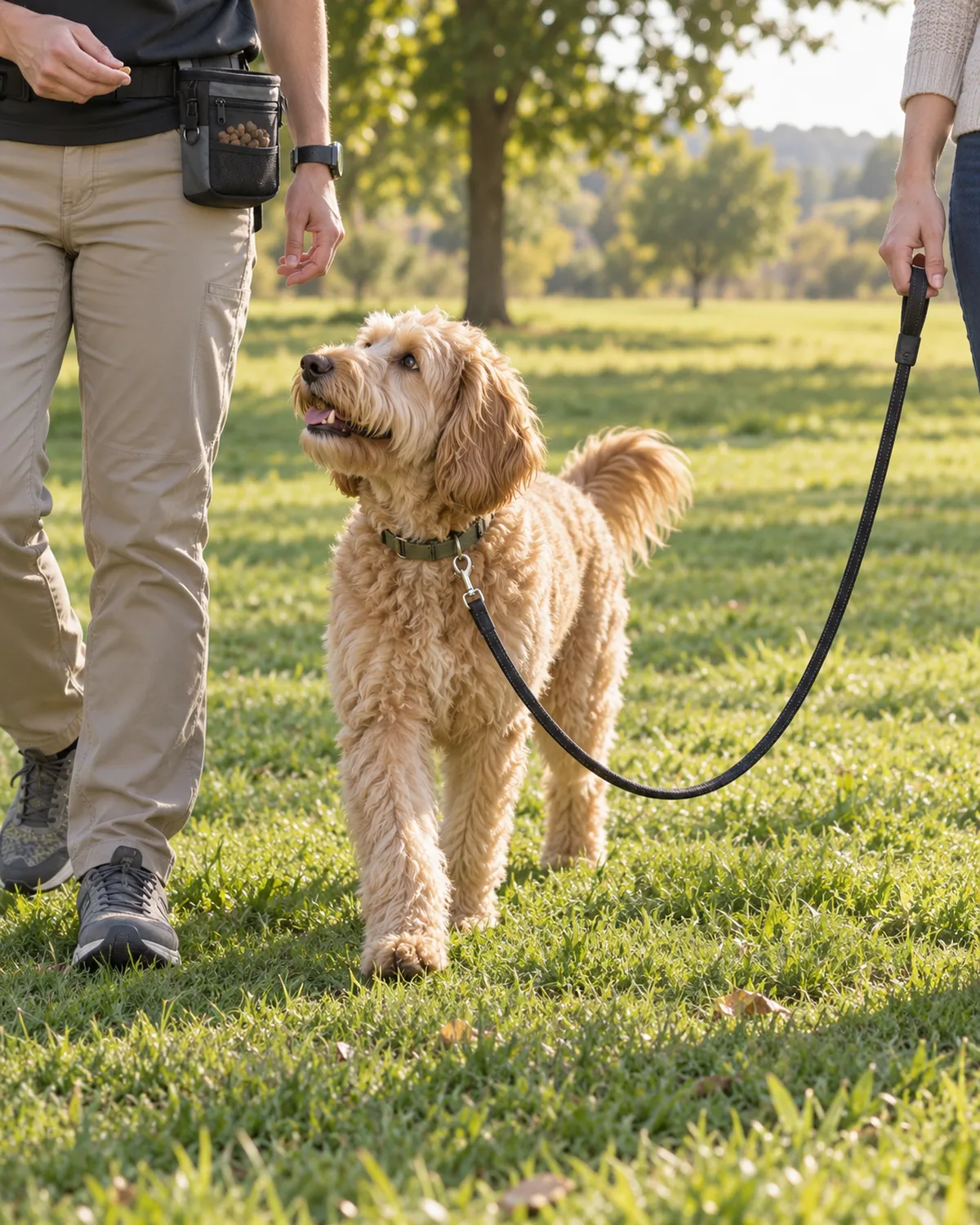
Sniff walks. Let the dog lead with its nose on a long leash. No heel, no pace requirements, no agenda. The dog decides where to go and how long to sniff each spot. Fifteen minutes of sniffing is more mentally tiring than thirty minutes of structured walking.
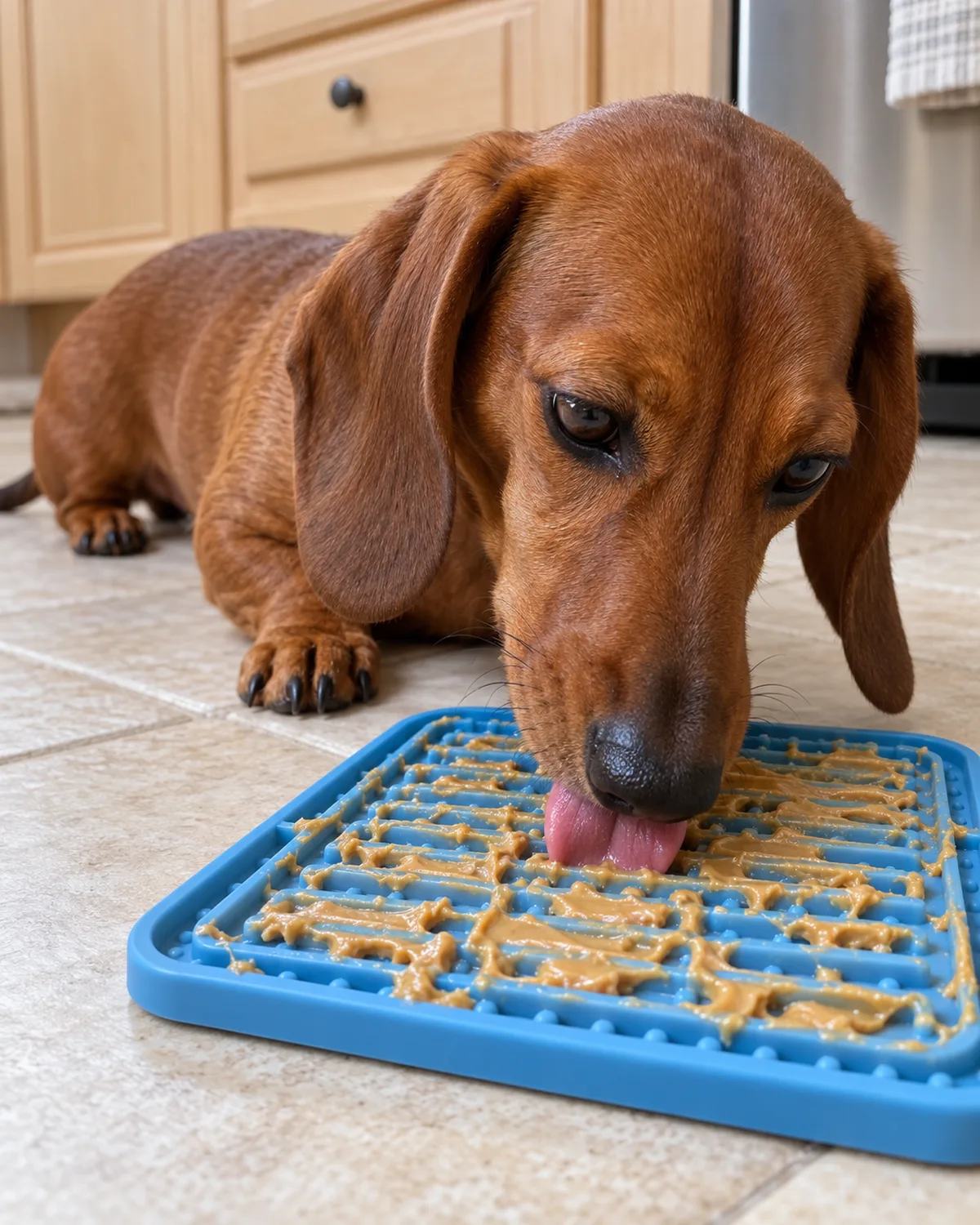
Lick mats. Spread peanut butter, plain yogurt, or wet dog food onto a ridged silicone mat and freeze it for twenty minutes before serving. The repetitive licking action releases calming hormones. A frozen mat lasts longer and works harder.
Stuffed Kongs or puzzle feeders. Feed part or all of the dog's daily meal through a puzzle toy instead of a bowl. The dog works for its food, which satisfies the foraging instinct and burns mental energy.
Calm chewing. A bully stick, a frozen raw bone (ask your vet about appropriate types), or a durable rubber chew toy occupies the jaw and activates the parasympathetic nervous system.
The brain games guide has more ideas for mental enrichment. The enrichment guide covers a broader range of activities for dogs that need a full daily rotation.
Schedule the decompression block at the time of day when your dog is most likely to escalate. For most dogs, that is late afternoon or early evening. Front-loading the calm activity means the dog hits the high-arousal window already partially spent.
Avoid These Common Mistakes
Well-meaning owners often do things that accidentally make overexcitement worse. If you have been working on calming your dog and seeing no progress, check whether any of these patterns are in play.
The three fastest ways to undo your progress:
Yelling or repeating commands louder — your raised voice matches the dog's energy level and confirms this is an exciting situation
Physically restraining the dog — holding a thrashing dog down teaches it to fight against restraint, not to relax
Punishing excitement — scolding a dog for jumping when you pick up the leash suppresses the symptom but redirects the arousal into mouthing, whining, or avoidance
Only exercising to tire the dog out. More exercise builds more stamina. A dog that needs an hour-long run to be calm today will need ninety minutes next month. Physical exercise is important, but it is not a calming strategy — it is a fitness program. Decompression activities address the mental side.
Inconsistency between household members. If one person enforces the place cue and another lets the dog jump all over them, the dog learns that the rules depend on who is in the room. Everyone in the household needs to follow the same protocol.
When to Call a Professional
Not every overexcited dog needs a professional trainer, but some situations go beyond what a consistent home routine can fix on its own.
Call a certified dog trainer or veterinary behaviorist if:
The dog has shown no improvement after two to three weeks of daily place-cue practice, environment management, and decompression activities
The excitement is escalating into nipping, body-slamming, or resource guarding when aroused
The dog shows signs of separation anxiety — destruction, howling, or house soiling specifically when left alone
Repetitive behaviors appear: spinning in circles, tail chasing, or licking surfaces for extended periods without a lick mat present
You suspect the arousal has a fear or pain component that you cannot identify
A certified professional dog trainer (CPDT-KA) or a veterinary behaviorist (DACVB) will assess the dog in person and create a behavior modification plan specific to your situation. Ask your vet for a referral if you are unsure where to start.
The reactive dog guide covers a specific subset of arousal — dogs that overreact to other dogs or people on leash. If your dog is calm at home but loses it on walks, that guide may be more relevant than a general calming protocol.
Save this for later
Calming Your Dog in 8 Takeaways
1Understand the arousal thresholdYour dog is not choosing to be wild — it is stuck above the line where thinking is possible.
2Catch the buildup earlyPacing, tight mouth, and whale eye mean the dog is climbing — redirect before it peaks.
3Teach the place cueA flat mat plus the word “place” gives the dog a clear destination and a clear behavior.
4Build relaxed down-staysHips shifted, breathing slow, head resting — genuine relaxation, not rigid compliance.
5Manage the environmentBlock window triggers, stop indoor roughhousing, and change the greeting ritual.
6Decompress dailySniff walks, lick mats, puzzle feeders, and calm chewing burn mental energy that fetch cannot reach.
7Stop making it worseYelling, physical restraint, and punishing excitement all add fuel to the fire.
8Know your limitTwo weeks of no progress means a certified trainer or veterinary behaviorist should step in.
pawliqa.com
Calming Your Dog FAQ
How long does it take to teach a dog to calm down on cue?
Most dogs show noticeable improvement within two to three weeks of daily place-cue and down-stay practice. The dog may not be perfectly calm in every situation by then, but you should see the dog choosing to go to its mat voluntarily and settling faster after excitement. Dogs with deeply ingrained arousal patterns or adolescent dogs in a developmental surge may need six to eight weeks.
Why does my dog get hyper every evening?
Late afternoon and evening are peak arousal times for most dogs. The day's stimulation has been stacking, dinner anticipation adds another layer, and family members returning home push the dog over threshold. Scheduling the daily decompression block — a sniff walk or frozen lick mat — thirty minutes before the usual witching hour helps take the edge off before the triggers pile up.
Does ignoring an excited dog actually help?
Turning away and withdrawing attention works for attention-seeking excitement — jumping on you, barking at you for play, pawing for treats. It does not work for arousal that is not directed at you, like window barking at passersby or spinning before a walk. For those situations, you need to remove the trigger or redirect the dog to its mat, not just ignore the behavior.
Are calming supplements safe for dogs?
Some calming supplements containing L-theanine or melatonin have shown mild effects in studies. Talk to your vet before starting any supplement, because the right choice depends on the dog's size and health status. Supplements are a support tool, not a replacement for the training and environment changes in this guide.
How do I calm my dog down before a vet visit?
Bring a portable mat, high-value treats, and a frozen lick mat to the waiting area. Keep your own energy low — dogs read your stress accurately. If the dog has severe vet anxiety, ask about pre-visit medication. The vet visit prep guide covers the full protocol.
P
About the author
Jess Calloway
Jess Calloway edits Pawliqa, where she shares dog care, grooming, training, and new-owner tips — plus DIY and pet-friendly home ideas — for anyone who wants a happy, well-cared-for dog. As a dog mom to three very different dogs, she writes the honest, tested version of what actually works. Every guide is image-led and reviewed for clarity, usefulness, image accuracy, and Pinterest-to-page alignment before it goes live. Visit the About page.
Teaching a dog to spin starts with a food lure at nose level, progresses to an open-palm hand gesture, and ends with a verbal cue alone. This guide walks through every stage, flags the mistakes that stall progress, and shows how to keep training sessions short and productive.
Fourteen puppy training games covering hide and seek recall, the name game, touch targeting, cup puzzles, puppy pushups, which hand, red light green light, muffin tin puzzles, tug with rules, scent work, two-toy fetch, obstacle courses, spin tricks, and settle mat training for puppies who learn best through play.
When a house-trained dog starts having accidents again, it is rarely about stubbornness. This guide walks through the vet check, deep cleaning, schedule rebuild, and positive reinforcement protocol that actually stops indoor peeing for good.