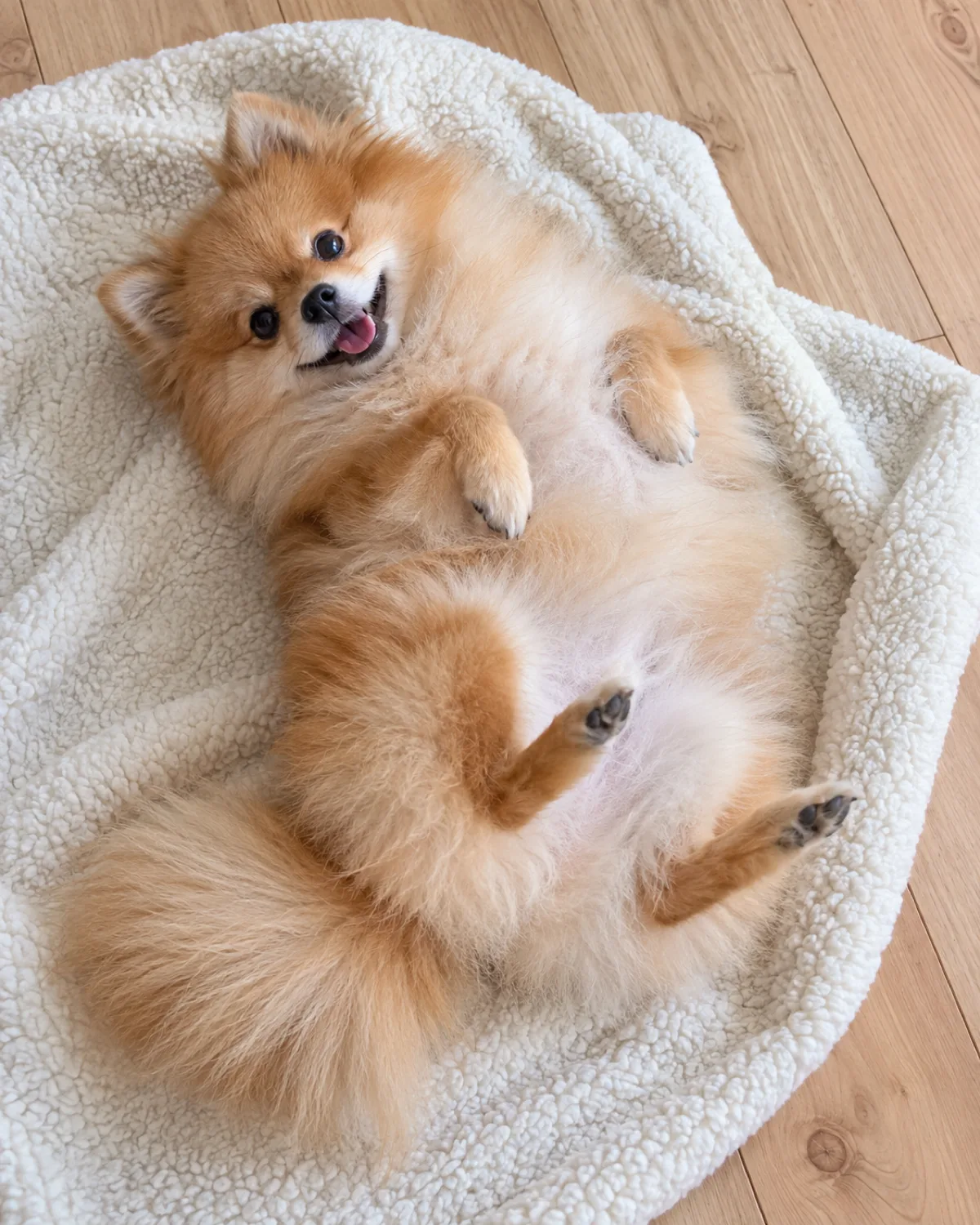
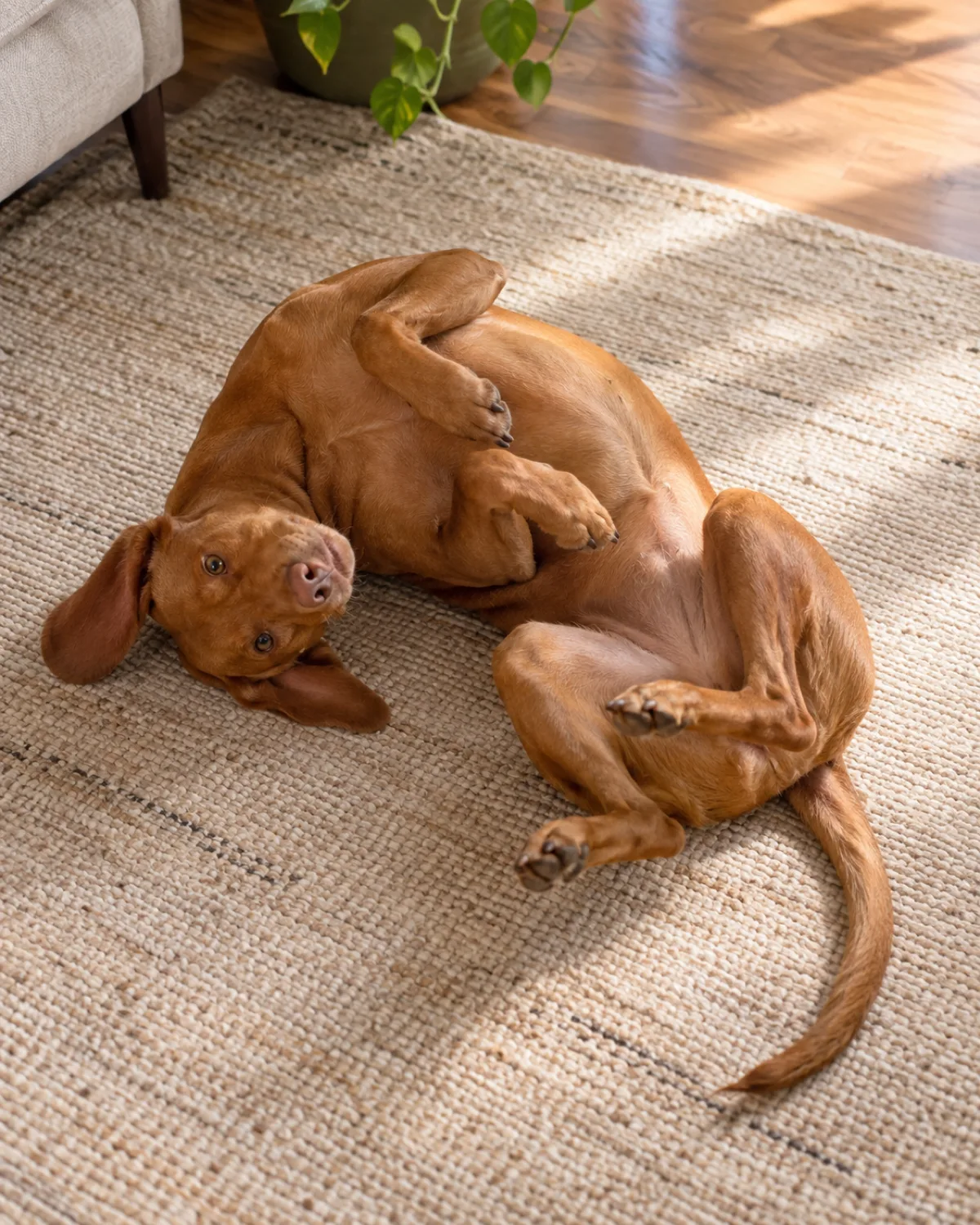
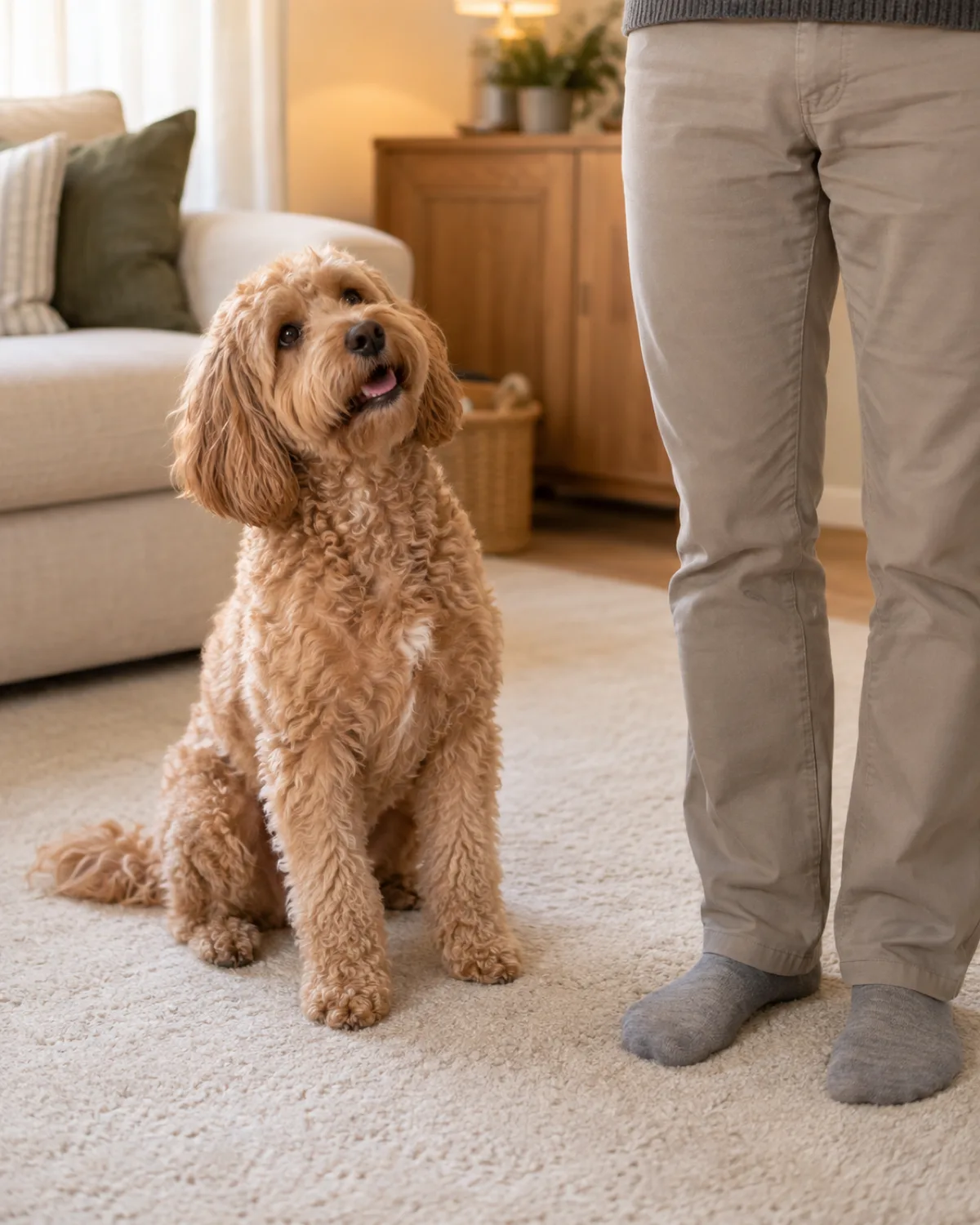
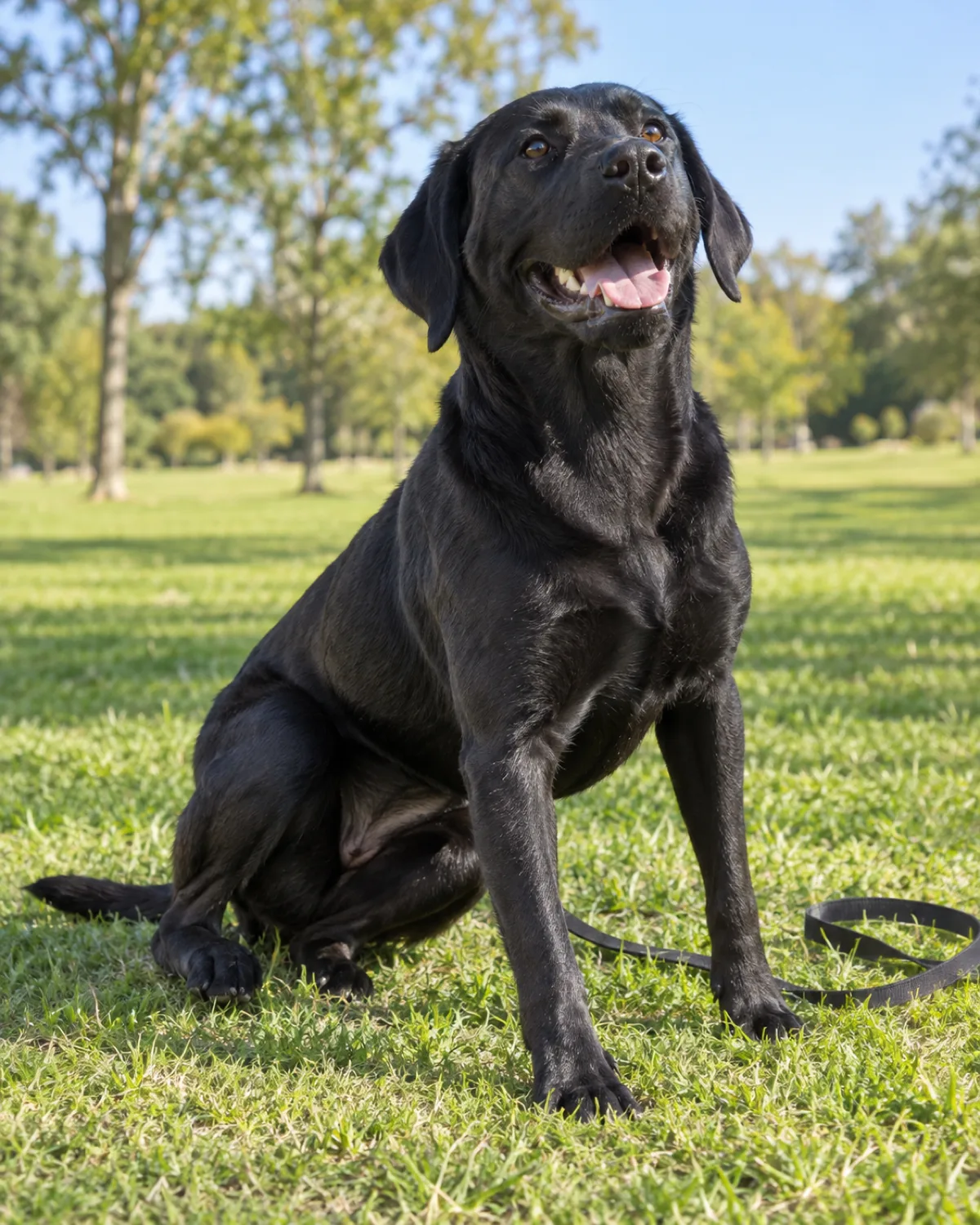
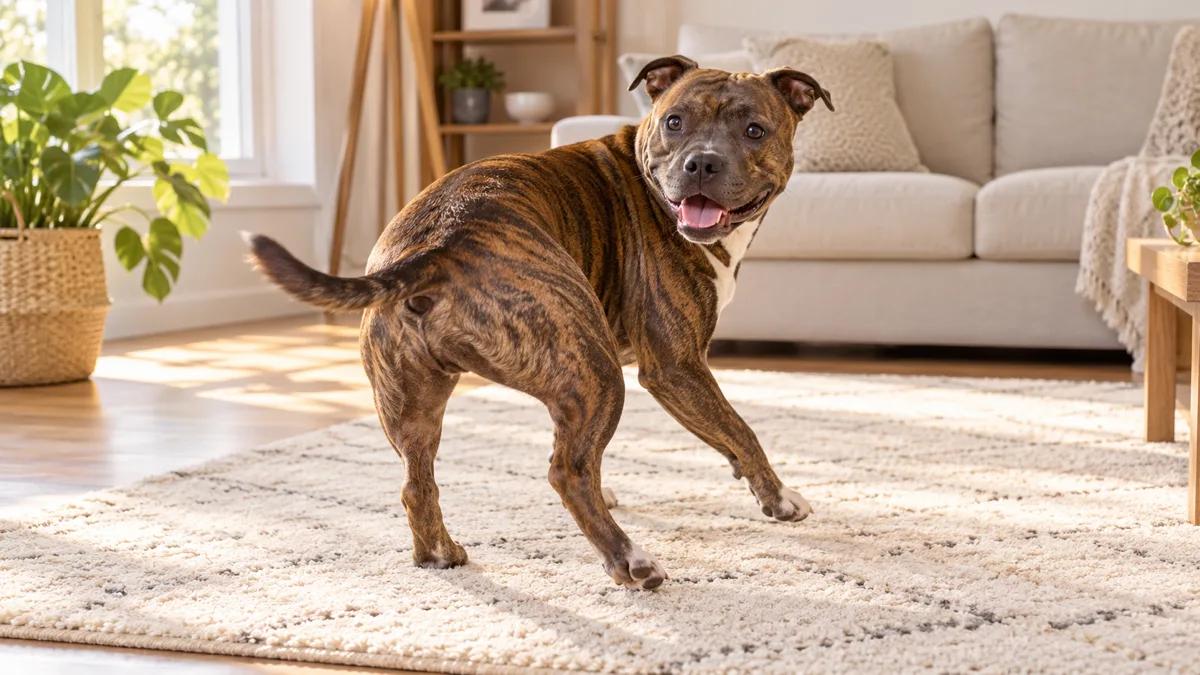
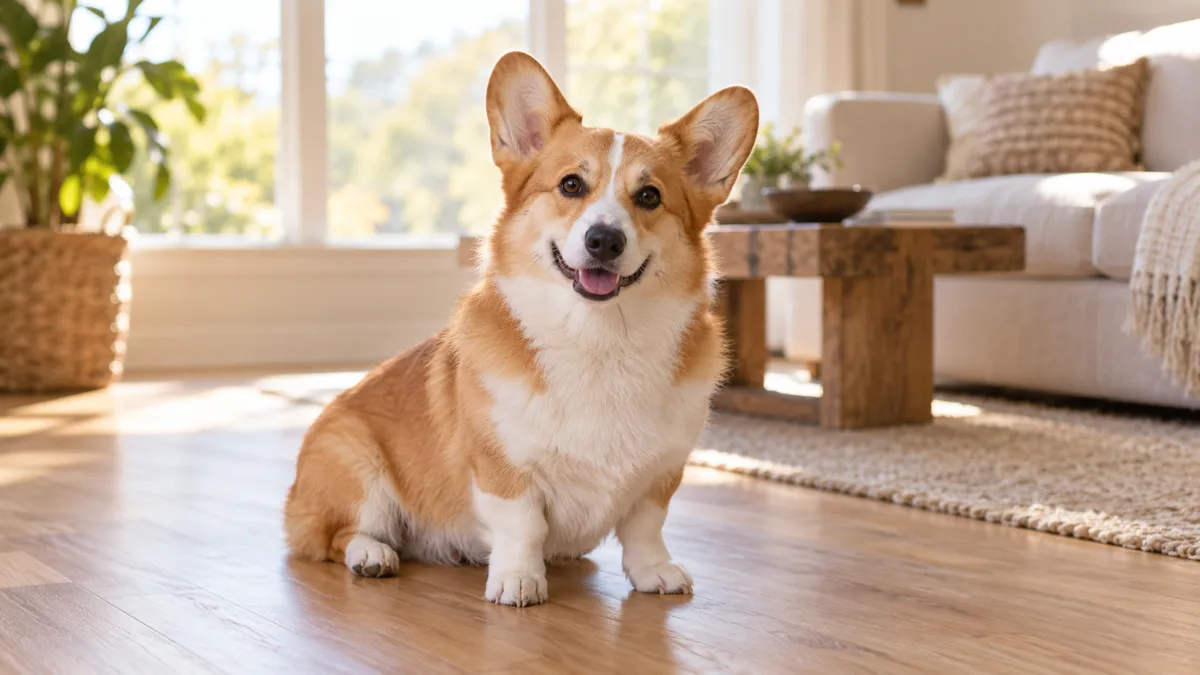
Roll over looks impressive, but it is really just a down with a twist. Most dogs stall on this trick because their owners try to lure a full rotation in one shot before the dog understands what any part of the movement means.
The fix is breaking the roll into smaller pieces, rewarding each piece until it is automatic, and then chaining them together. These fifteen steps take your dog from a basic down to a smooth, cued roll over that works on command.
Every step uses positive reinforcement only. No pushing, no rolling your dog over by hand. If a step takes three sessions instead of one, that is normal.
Your roll over roadmap
15 Tips for Teaching a Dog to Roll Over
Roll over is a chain of small movements — not one giant leap. These fifteen tips walk you from a solid down all the way to a fluent, cued trick that works in any room and links into longer trick sequences.
Most dogs learn roll over through food luring. But some dogs respond better to a hand signal or free shaping. Pick the path that matches your dog and you will get there faster.
Dog who already knows down and stayJump to Tip 4 guiding the nose to the shoulder. You already have the prerequisite, so you can start the lure path immediately.
Barrel-chested or stocky breedRead Tip 13 adjusting for stocky breeds before starting — you may need a wider lure arc and a softer surface than usual.
Dog who already rolls on its own during playSkip the lure entirely and go to Tip 10 adding the verbal cue. Capture the natural behavior by marking and rewarding it when it happens.
1. Confirm Your Dog Knows a Solid Down Before Starting
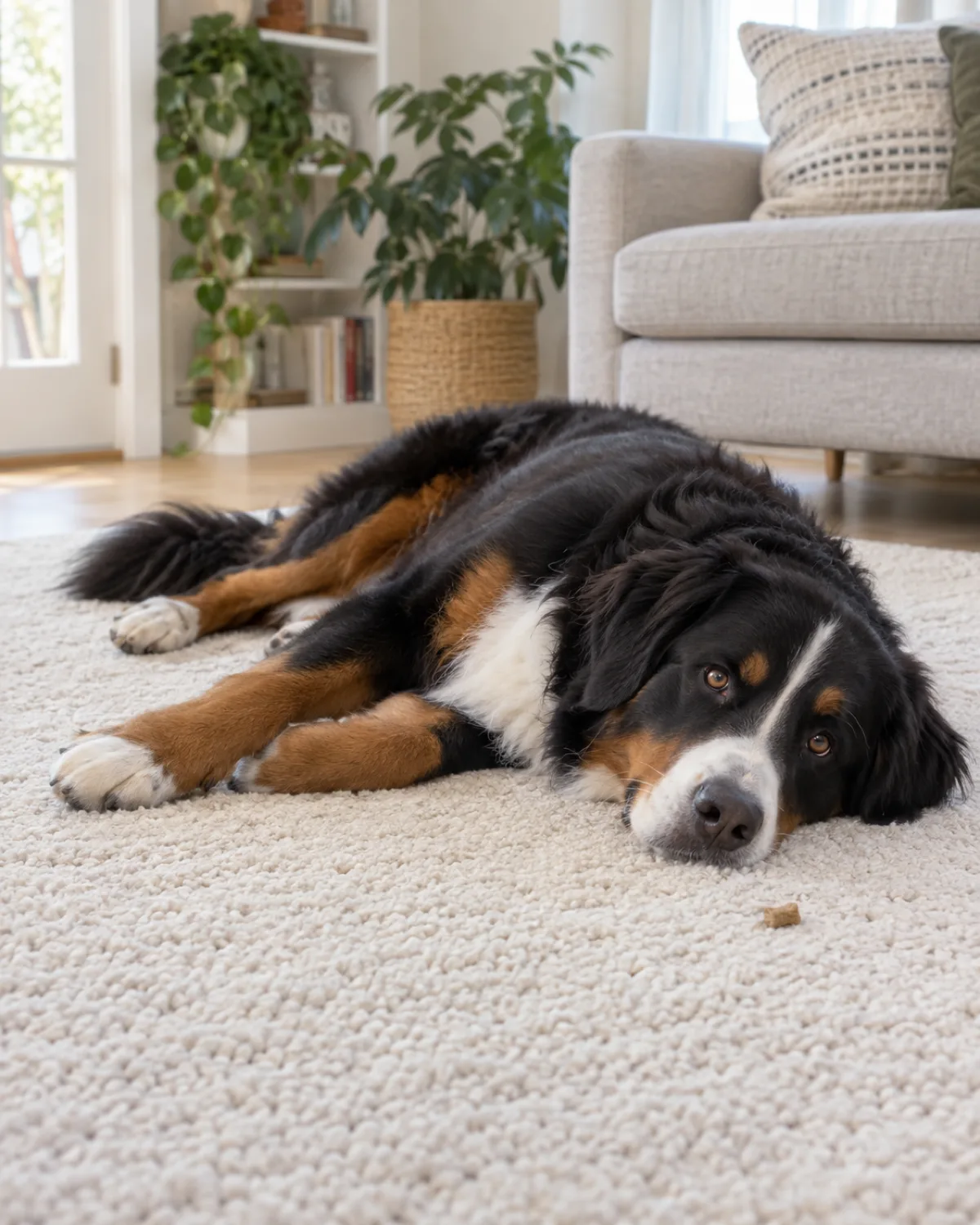
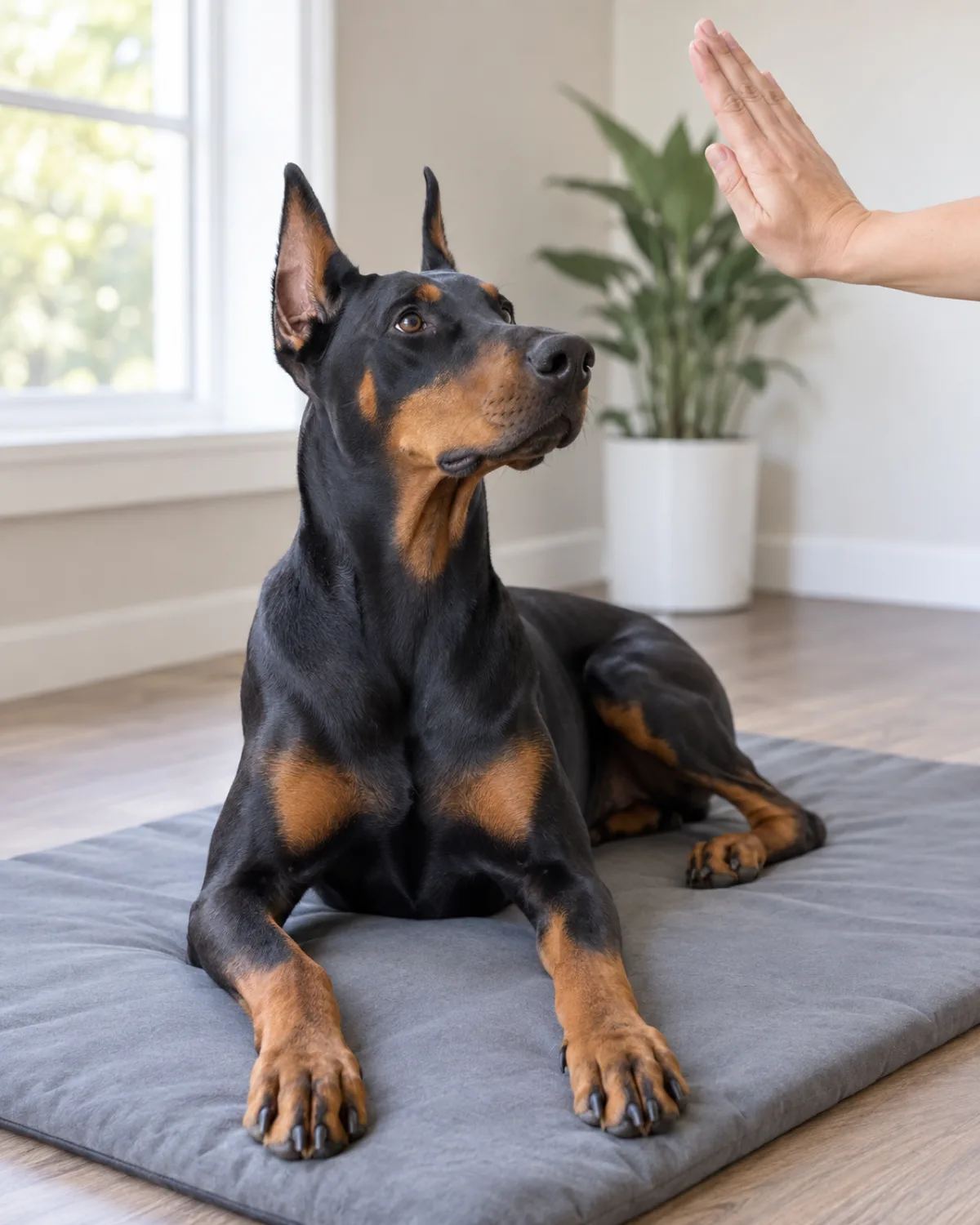
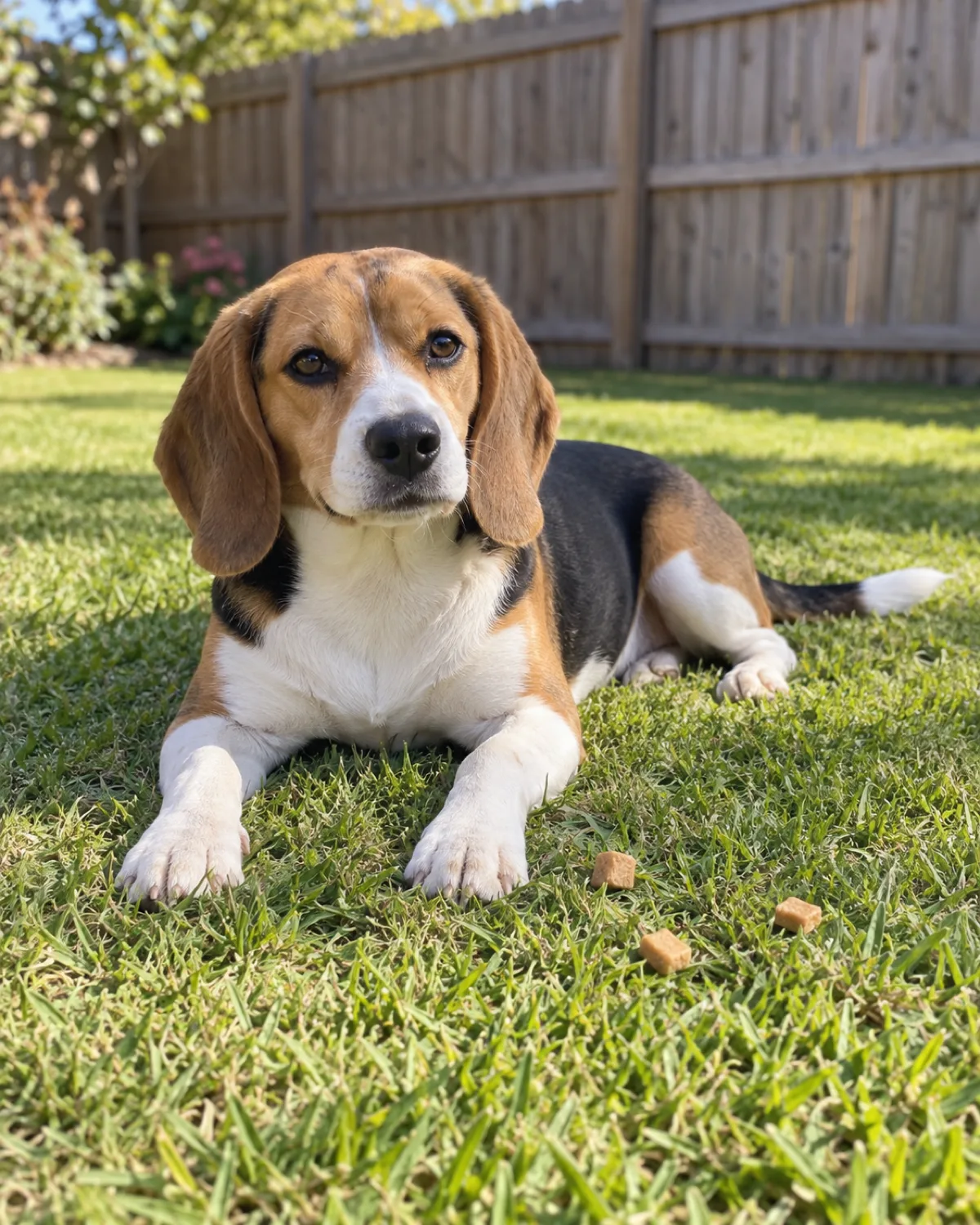
Roll over starts from the down position. If your dog does not have a reliable down — meaning they drop into it on the first cue and hold it for at least three seconds without popping back up — the roll over will fall apart before it begins.
The reason is mechanical. The lure path that initiates the roll goes from the dog's nose toward their shoulder blade while they are lying flat. If the dog keeps standing up to follow the treat, you cannot create the body twist that starts the roll. You end up chasing a standing dog in circles instead of guiding a lying dog through a rotation.
Test it now: Ask for a down in a quiet room with no distractions. If your dog drops and holds for five seconds, you are ready.
If they pop up immediately: Spend a few days reinforcing the down with longer holds before adding the roll over. The how to teach a dog to lay down guide covers the full progression.
If they know down but break it under excitement: Practice the down with the treat visible but not moving. The dog needs to hold position even when food is in your hand, because your lure hand will be active during the roll over training.
A rushed down leads to a broken roll. Get this foundation solid and everything after it goes faster.
2. Pick a Soft Non-Slip Surface for Every Practice Session
Dogs are more reluctant to roll on hard or slippery floors than most owners realize. A tile kitchen floor or a polished hardwood surface gives your dog two problems at once: it is uncomfortable to roll a spine across, and their paws slide out from under them when they try to push through the rotation.
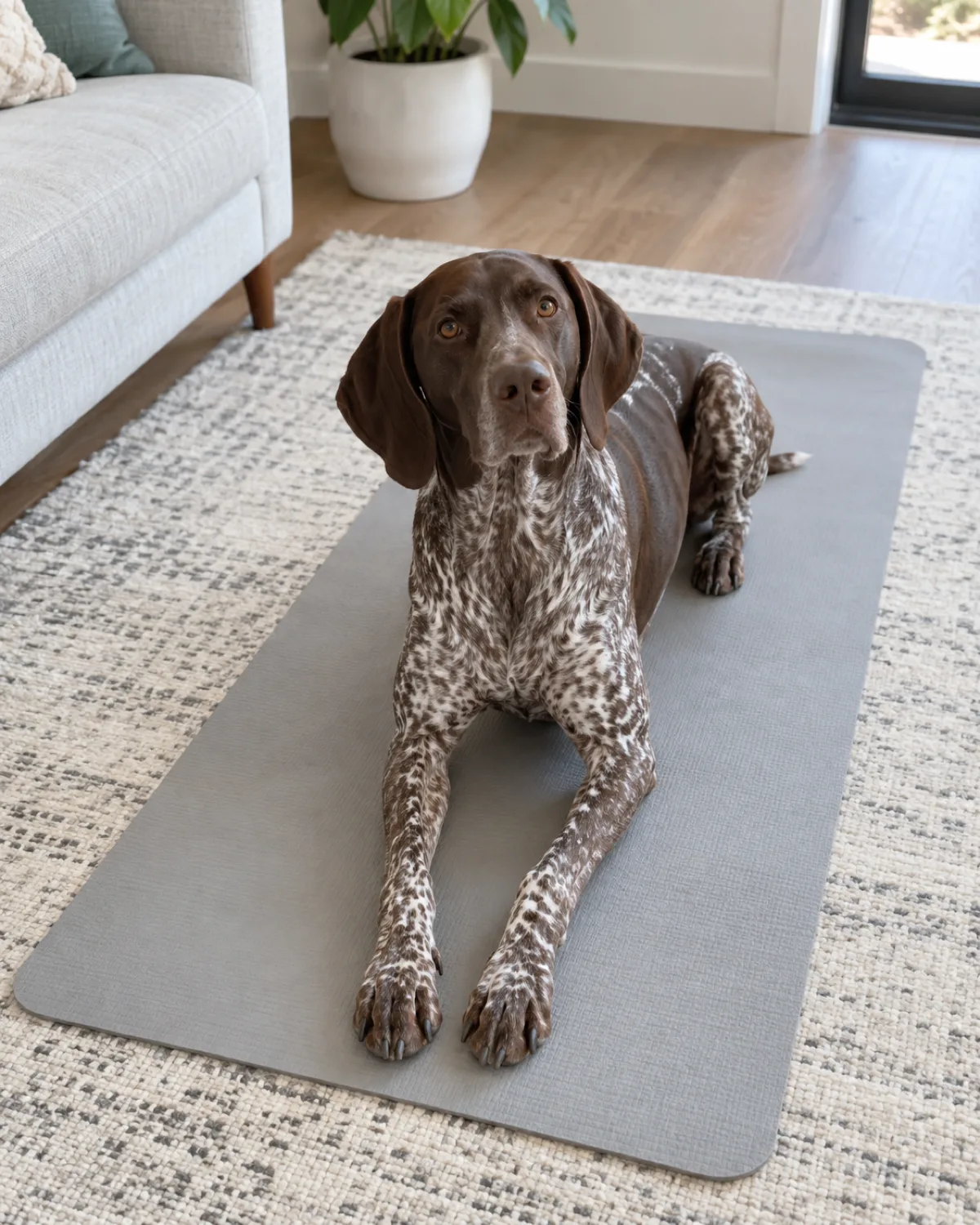
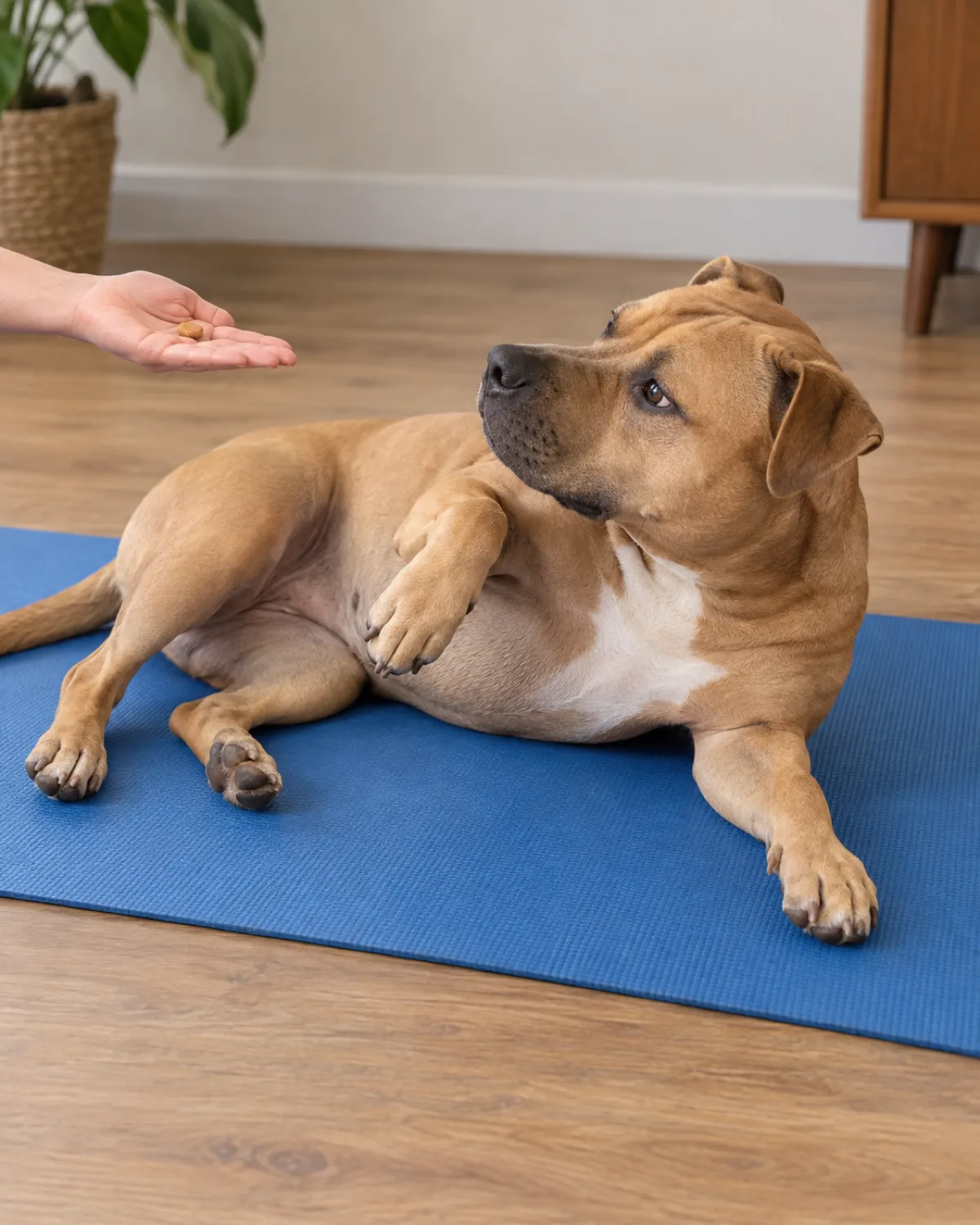
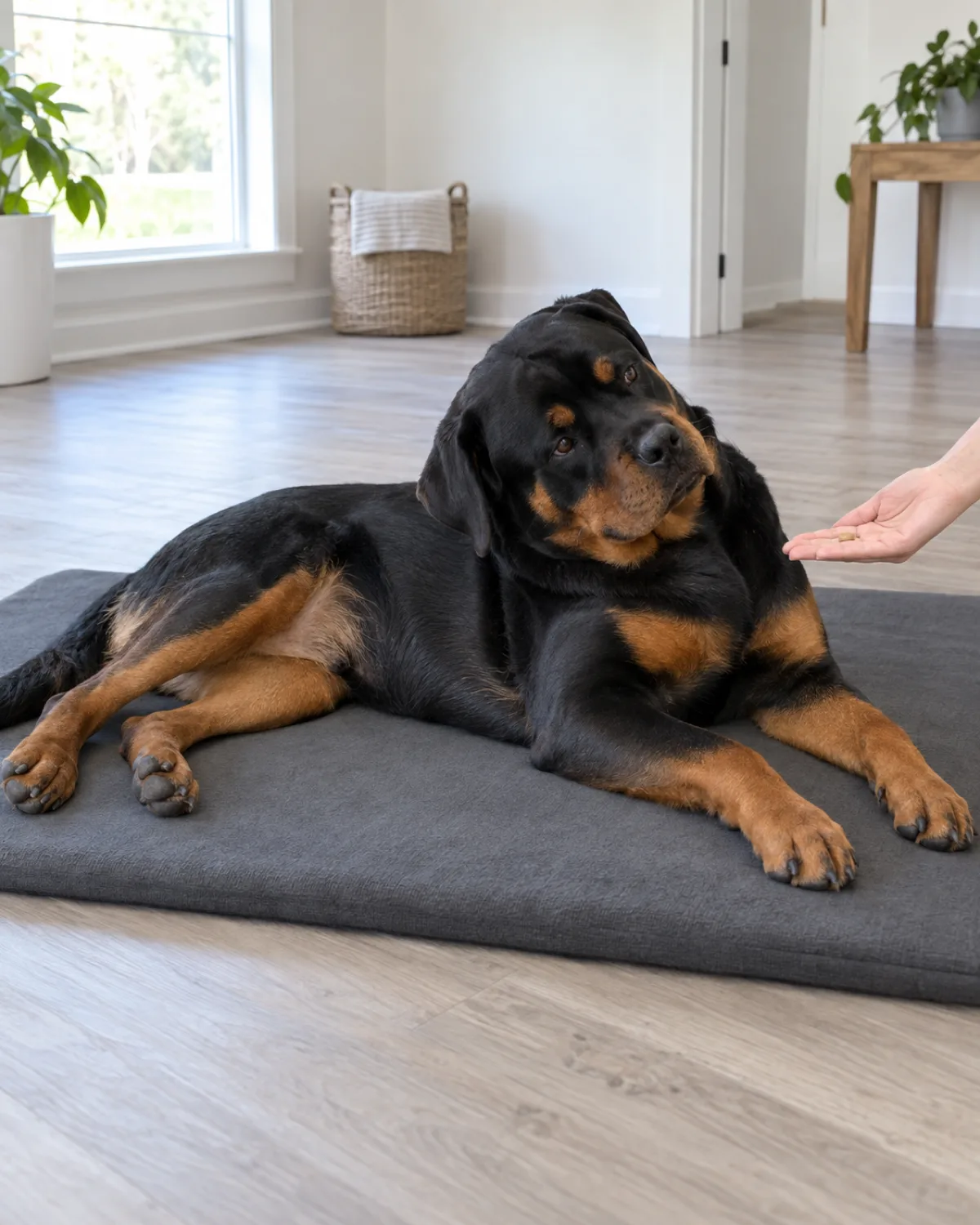
The ideal surface is a thick rug, a yoga mat, or a carpeted room. You want something soft enough that the dog's back does not hit a hard surface during the roll, and grippy enough that their paws can push off to complete the turn.
Yoga mats work well because they are portable and you can move them to different rooms later when you start proofing the trick.
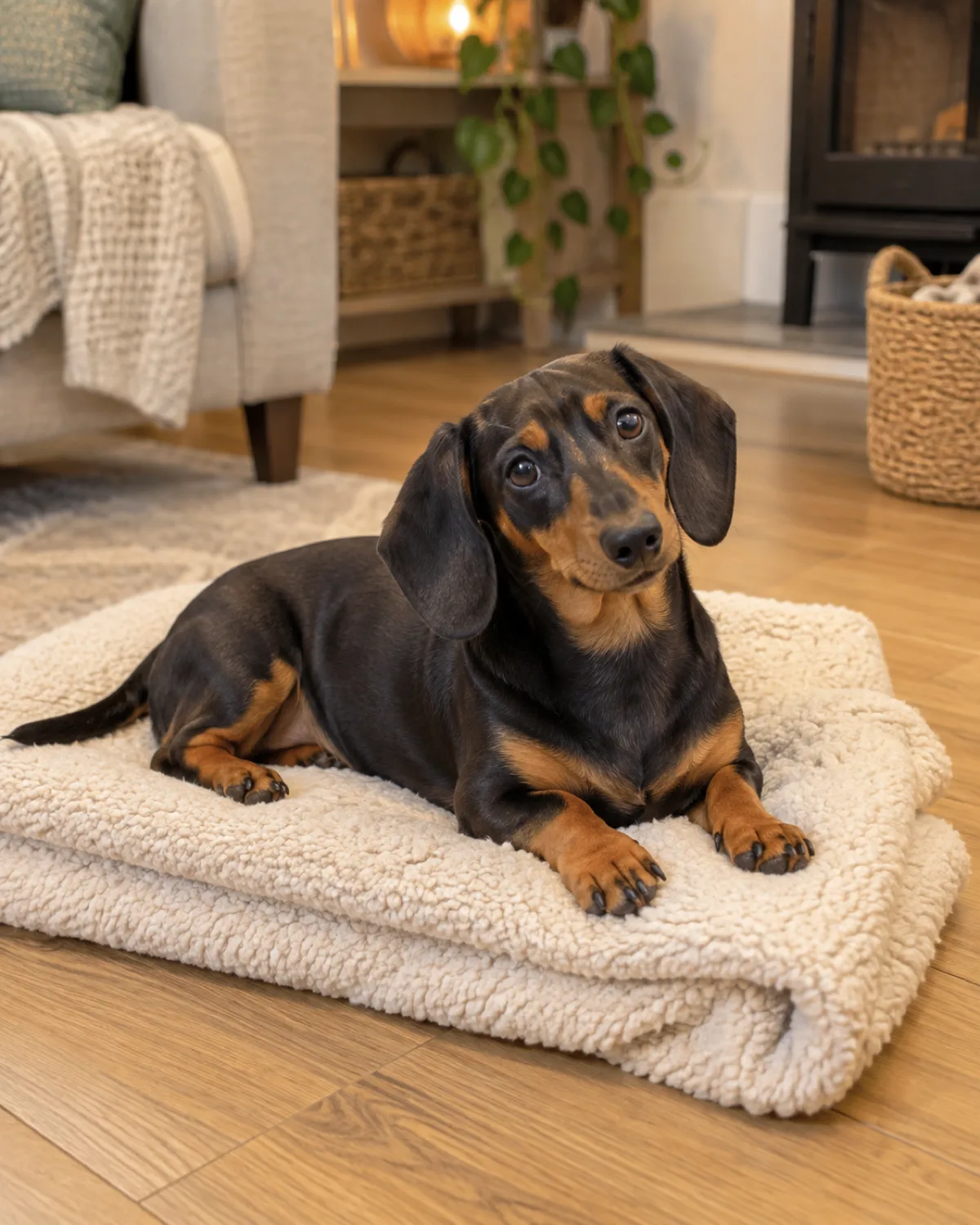
Folded blankets are good for small dogs who need extra cushioning along the spine.
Avoid outdoor concrete or pavement for early sessions — the surface is too hard and too distracting.
If your dog hesitates during the roll and you are on a hard floor, switch to a softer surface before assuming the dog does not understand the trick. The surface may be the entire problem.
Three rules that make or break this trick
3 Roll Over Training Rules to Follow From Day One
Ignore these and you will spend weeks undoing bad habits. Follow them and most dogs learn a clean roll in under ten sessions.
Master down before starting rollA dog who cannot hold a down for five seconds will pop up every time you move the lure. Fix the foundation first — it saves days of frustration.
Split into halves, not a full rotationA full roll is too much to learn in one shot. Teach the first half turn until it is automatic, then add the second half. Chaining comes last.
Fade the food lure before adding the cue wordIf you say roll over while still holding a treat, the dog learns that roll over means follow the food — not perform the movement. Hand signal first, verbal cue second.
3. Load the Lure Hand With a High-Value Treat
The treat in your hand is doing two jobs at once: it is the reward, and it is the steering wheel. If you use a low-value treat that your dog is only mildly interested in, they will lose focus the moment the lure path gets challenging — which is exactly the moment you need their nose glued to your fingers.
Pick something your dog finds irresistible. Soft treats work better than crunchy ones because your dog can smell them more easily through your closed fist.
Good options: small pieces of cooked chicken, freeze-dried liver, string cheese torn into pea-sized bits, or commercial soft training treats.
Poor options: dry kibble, large biscuits that take time to chew, or anything that crumbles and falls out of your hand during the lure motion.
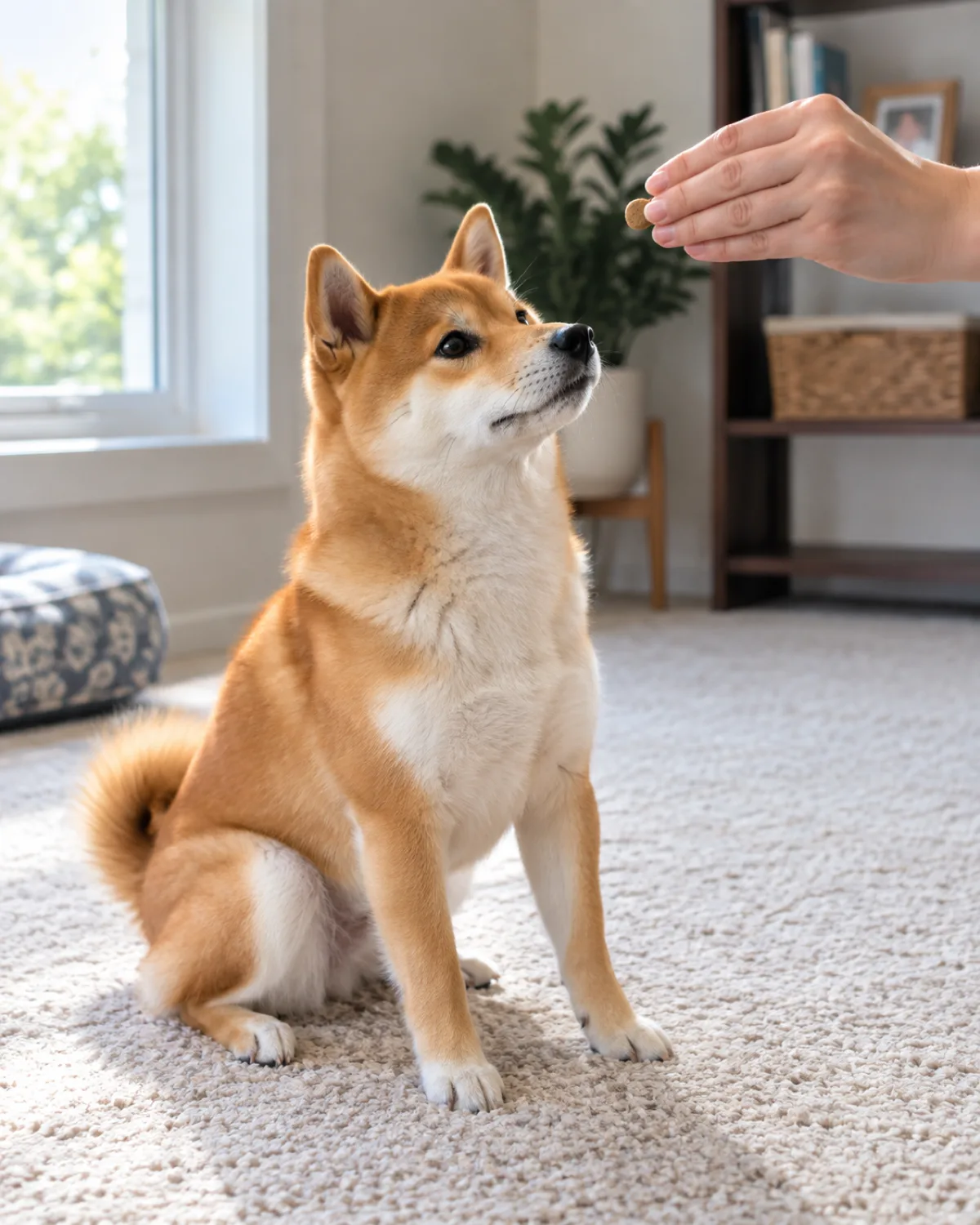
Hold the treat between your thumb and first two fingers with your palm facing down. Keep the treat enclosed — you want the dog to follow the scent trail of your hand, not fixate on a visible piece of food. Your hand position matters because the same hand motion will eventually become your hand signal after you fade the food lure.
For a deeper look at choosing and using treats in training sessions, the training treats guide covers the full hierarchy from low to high value and how to phase them out.
4. Guide the Nose Toward the Shoulder to Start the Roll
With your dog in a down, bring the treat to their nose and then slowly arc it toward the back of their shoulder — on whichever side the dog naturally leans toward. Most dogs have a preferred side, just like people are left- or right-handed.
The key is speed: move the lure slowly enough that the dog's nose stays on your hand the entire time. If you move too fast, their head whips around but their body does not follow. If you move too slowly, they may try to grab the treat before the body twist begins.
What you are looking for in this first motion is the head turning far enough that the dog's weight shifts onto one hip. The dog does not need to roll yet — they just need to twist their head and neck far enough that their body starts to follow.
Lure path: Start at the nose, arc back toward the shoulder blade, and then angle slightly downward toward the spine.
Reward timing: The moment the dog's head turns and their hip shifts, mark it with a yes or a clicker and reward immediately.
Common mistake: Lifting the treat upward instead of arcing it backward. An upward lure makes the dog sit up, not roll sideways.
Repeat this head-turn-to-hip-shift five to ten times per session. The dog needs to learn that turning their head in that direction pays off before you ask for anything more.
5. Reward the Hip Drop Even Before a Full Roll Happens
Most owners wait too long to reward. They hold out for the full roll and the dog gives up after three attempts because nothing they try earns a treat. The trick is to reward the smallest step in the right direction — and the hip drop is that step.
When your dog's head follows the lure far enough that their hip shifts and drops to the floor, that is a rewardable moment. It does not matter that they have not rolled. What matters is that their body weight just committed to the direction you want.
Mark and reward this hip drop every single time for the first two or three sessions. You are building a pattern in the dog's mind: head turns, hip drops, treat appears.
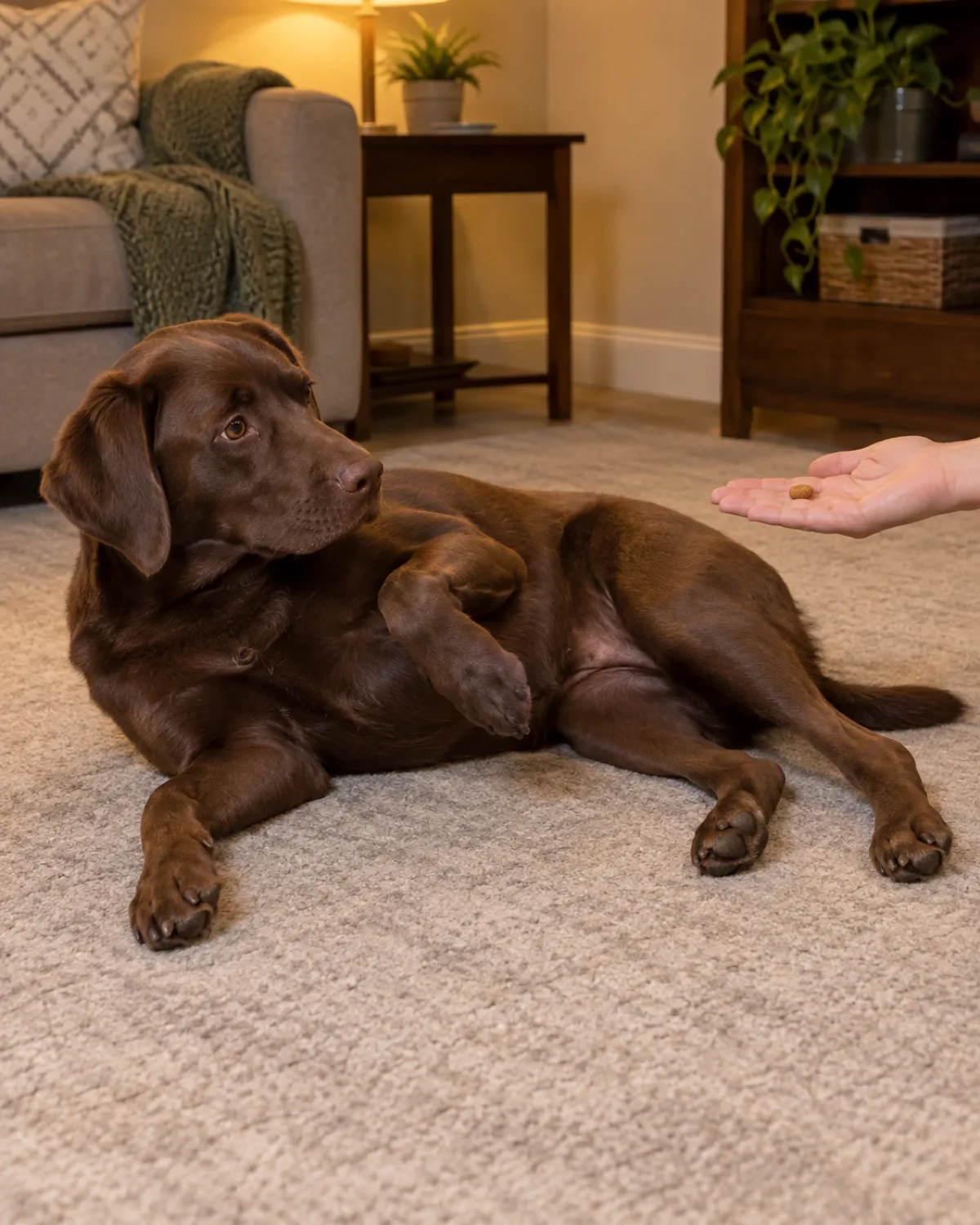
What the hip drop looks like: The dog is lying on their chest, their head turns to follow the lure, and one hip rolls flat to the ground so they are now lying more on their side than on their chest.
What to do if the dog stands up instead: You moved the lure too fast or too high. Reset to a down and try again with a slower, lower arc.
This is where patience separates a successful training sequence from a frustrating one. If you skip the hip drop reward and hold out for a full roll, your dog has no idea which part of the movement you want. Reward the pieces and the whole trick assembles itself.
6. Split the Full Roll Into a Half Turn First
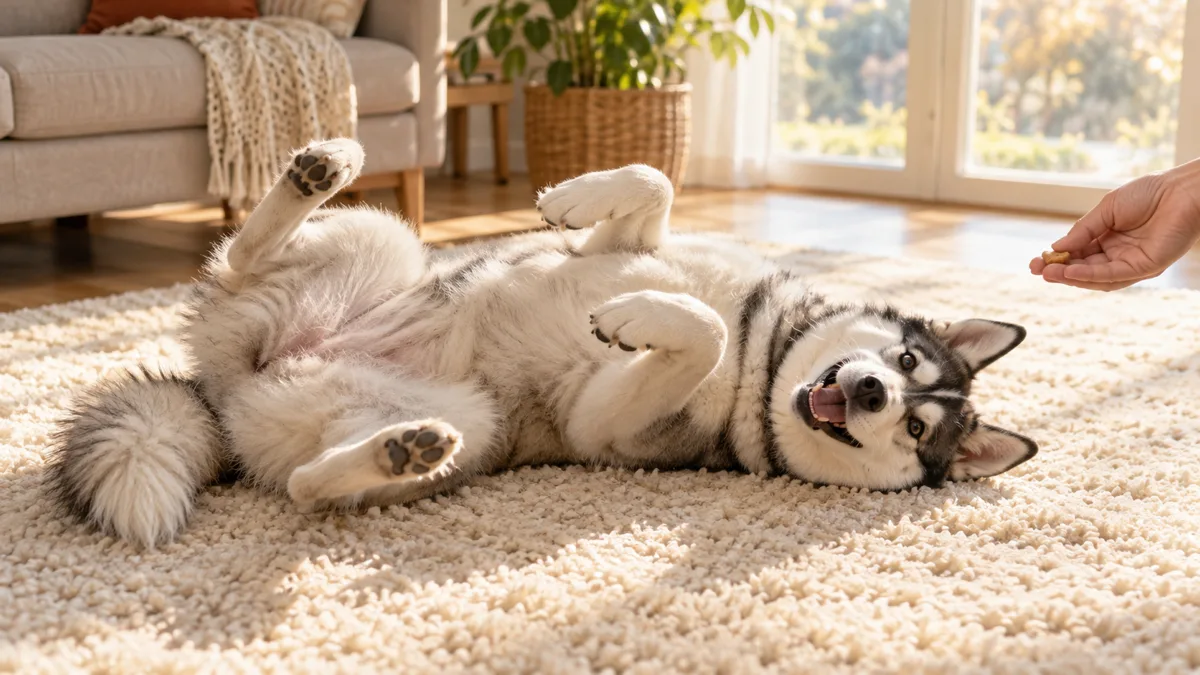
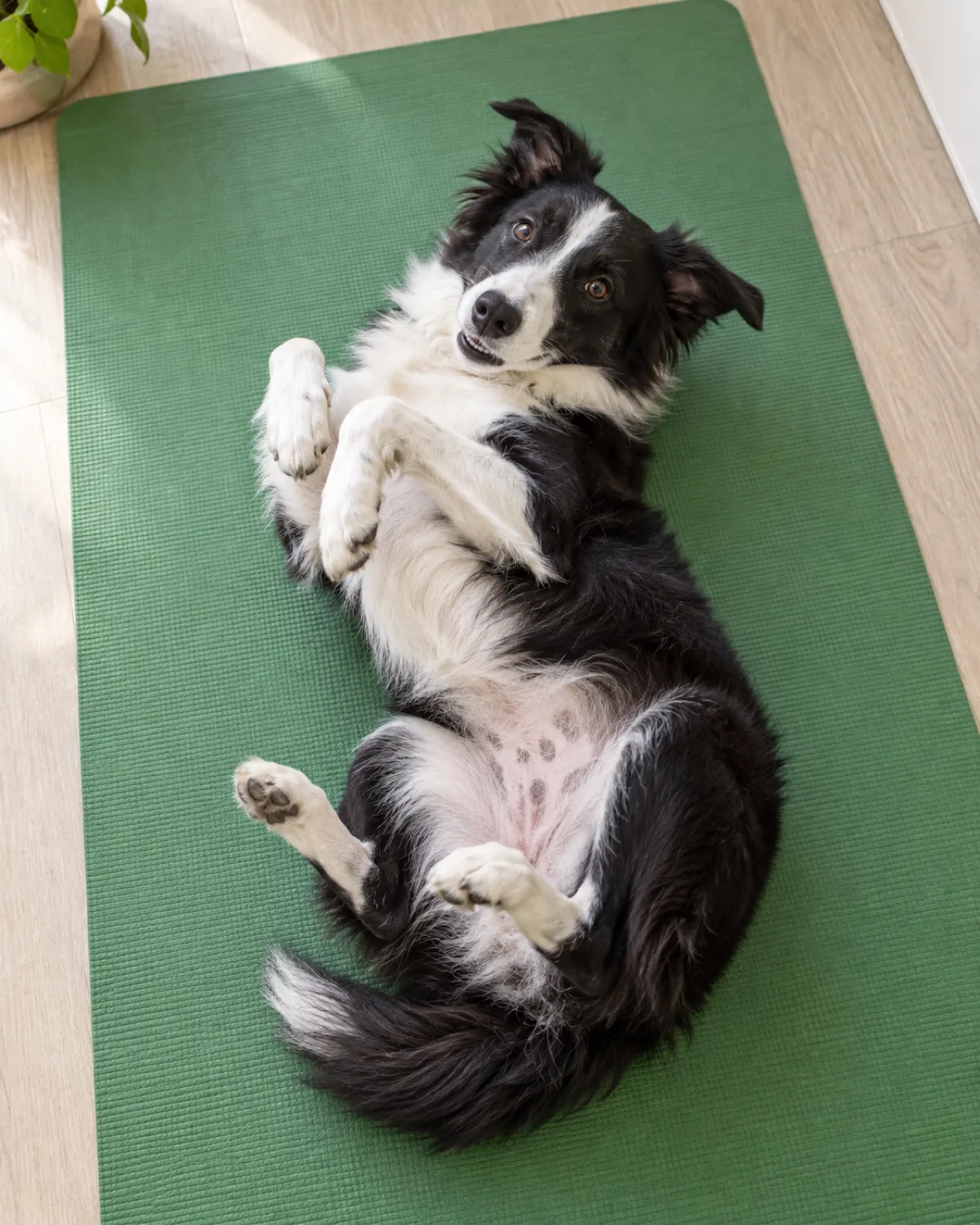
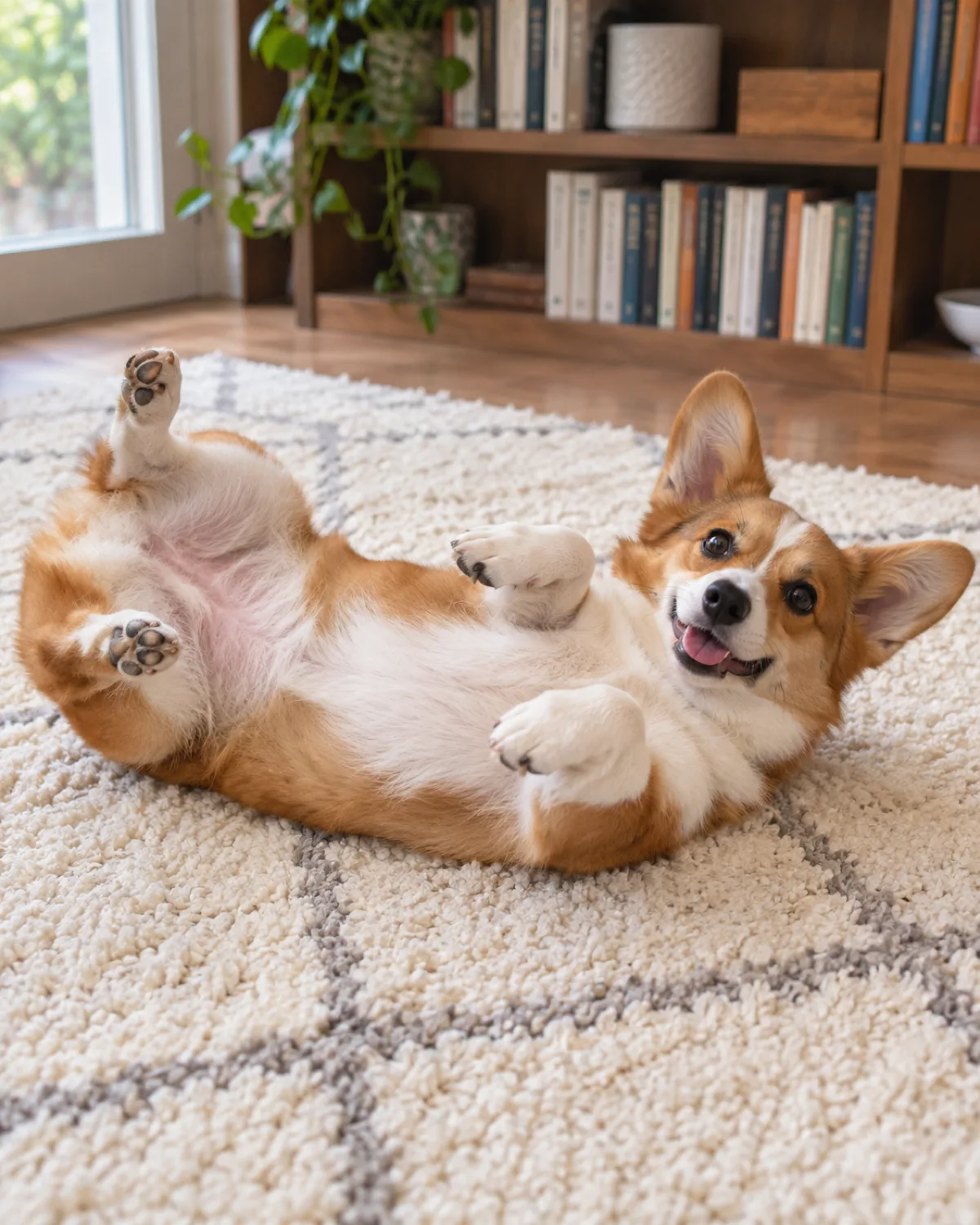
Once your dog reliably drops their hip when you lure toward the shoulder, the next step is getting them onto their back — belly up, spine on the ground. This is the halfway point of the roll, and for many dogs it is the hardest part because lying belly-up feels vulnerable.
Continue the lure motion from the shoulder down along the spine. The dog's head will follow, their body will twist further, and if the lure speed is right, they will roll onto their back with all four legs in the air.
The moment they land belly-up, mark and reward. Do not try to complete the roll yet. You are building confidence in the belly-up position.
If the dog panics belly-up: Reward even a partial lean onto their back and build up gradually. Some dogs need several sessions before they are comfortable lying fully on their spine.
If they roll straight through to the other side: You are moving too fast. Slow down and catch them in the belly-up position before they complete the turn.
Session length: Keep this step to five repetitions per session. Belly-up positions are mentally taxing for dogs who are not used to them.
A dog who is comfortable on their back is ninety percent of the way to a full roll. The second half of the rotation is mechanically easier — gravity helps them fall to the other side once they are past the balance point on their spine.
7. Add the Second Half Once the First Half Is Automatic
When your dog rolls onto their back without hesitation — landing belly-up on the first lure attempt in at least eight out of ten tries — it is time to add the second half.
From the belly-up position, continue moving the lure in the same arc direction, past the dog's opposite shoulder, so their momentum carries them over to the other side. Gravity does most of the work here. The dog just needs to follow the treat past the tipping point and their body will fall into the completion naturally.
Lure path for the second half: From belly-up, arc the treat toward the ground on the opposite side of the dog from where you started. Their head follows, their body tips, and they land on their chest facing the opposite direction.
Reward timing: Mark and reward the instant all four paws touch the ground on the other side. Speed of reward matters — the dog needs to connect the completion of the roll with the treat delivery.
Some dogs will immediately roll all the way through on the first attempt because the belly-up position is now comfortable and the momentum is there. Others need a few sessions of practicing just the second half: start them belly-up (by hand or by luring the first half), then lure them through the completion.
The goal at this stage is two separate behaviors the dog can do reliably: first half (down to belly-up) and second half (belly-up to completion). Chaining comes next.
About the author
Jess Calloway
Jess Calloway edits Pawliqa, where she shares dog care, grooming, training, and new-owner tips — plus DIY and pet-friendly home ideas — for anyone who wants a happy, well-cared-for dog. Teaching roll over to three dogs with three completely different body types (and three completely different opinions about lying on their backs) taught her that splitting the trick into halves is not optional — it is the entire method. Every guide is image-led and reviewed for clarity, usefulness, image accuracy, and Pinterest-to-page alignment before it goes live. Visit the About page.
8. Chain Both Halves Into One Smooth Continuous Roll
Now that your dog can do each half reliably, the goal is to combine them into one fluid motion without a pause in the middle.
Start from a down and lure through the entire rotation in one continuous arc — shoulder, spine, belly-up, opposite shoulder, completion. The lure hand never stops moving. The speed should be steady and smooth, fast enough that the dog does not stall belly-up but slow enough that they do not lose track of the treat.
The first few chained attempts may be clumsy. The dog might pause on their back, roll too fast and overshoot, or try to grab the treat midway. All of these are normal.
If the dog stalls belly-up: You have been rewarding the belly-up position too heavily. Do two or three reps where you only reward the full completion, not the halfway point.
If the dog overshoots and keeps rolling: They have momentum but no precision. Slow the lure down and make sure you mark the completion at exactly the right moment — when all four paws land, not when they are still spinning.
Practice the full chain five to eight times per session. Once the dog completes the full roll smoothly on eight out of ten attempts with the food lure, you are ready to start fading the lure out.
9. Fade the Food Lure Into a Hand Signal Gradually
This is the step most owners skip, and it is the reason their dog will only roll over when they are holding a treat. Fading the lure is not optional — it is what turns a food-dependent trick into a real trained behavior.
The fade happens in stages over several sessions:
Stage one: Do the full lure motion but with an empty hand. Keep the treat in your other hand or your pocket. If the dog rolls, mark and deliver the treat from the other hand.
Stage two: Shrink the lure motion. Instead of arcing your hand all the way around the dog's body, do a smaller circular motion in the air above the dog. The dog's muscle memory fills in the gaps.
Stage three: Reduce the motion further to a simple wrist circle or a finger twirl. This becomes your hand signal.
At each stage, if the dog stops performing, go back one stage and do five more successful reps before trying to shrink the motion again.
The hand signal should be distinct and consistent. A small circular motion with your index finger is the most common hand signal for roll over because it mimics the direction of the roll. Use the same hand, the same motion, and the same height every time.
10. Add the Verbal Cue Only After the Dog Offers the Roll Reliably
The verbal cue goes on last — not first. This is counterintuitive because most owners want to say roll over while they teach the trick. But if you pair the word with the behavior before the dog understands the behavior, the word becomes meaningless noise that gets tuned out.
Wait until the dog responds to your hand signal alone on at least eight out of ten attempts. Then add the verbal cue right before the hand signal:
Say "roll over" in a calm, clear voice.
Immediately give the hand signal.
The dog performs the roll and gets rewarded.
After twenty to thirty repetitions of this sequence, test the verbal cue alone — say "roll over" without the hand signal and wait three seconds. If the dog rolls, you have a verbal cue. If they do not, go back to pairing the verbal cue with the hand signal for another ten reps.
Keep the cue short and distinct. "Roll over" works. "Roll" works. "Do a roll" is too long and too similar to other phrases you might say casually.
Say it once. Repeating the cue teaches the dog that the first one does not count. One cue, one pause, one reward if they perform.
The basic dog commands guide covers this same cue-before-action principle across all foundation commands.
11. Keep Every Training Session Under Five Minutes
Five minutes is the ceiling, not the target. Most productive roll over sessions last two to four minutes. After that, dogs lose focus, start offering random behaviors to see what earns a treat, and the quality of each repetition drops.
Short sessions work better for three reasons:
Mental fatigue is real. Learning a new physical movement while also processing treat delivery and cue timing is cognitively demanding. A tired dog makes sloppy rolls that build sloppy habits.
Ending on a success matters. If you train for ten minutes, the last three minutes are likely frustrating attempts where the dog has already checked out. Ending on a clean rep after three minutes leaves the dog wanting more — which means they start the next session eager instead of reluctant.
Multiple short sessions beat one long one. Three two-minute sessions spread across the day produce better results than one six-minute session. The rest periods between sessions let the learning consolidate.
Set a timer on your phone. When it goes off, finish the current rep, reward, and stop — even if the dog is doing well. Especially if the dog is doing well. You want to quit while you are ahead.
12. Help Dogs Who Get Stuck Rolling to One Side Only
Most dogs develop a strong preference for rolling in one direction. They will roll left without hesitation but act completely confused if you lure them to the right — or vice versa. This is normal and it is not a training failure.
The preference comes from two sources. First, dogs have a dominant side just like humans have a dominant hand. Rolling toward their dominant side feels natural; rolling the other way feels awkward. Second, you probably lured the trick from one side during all your early sessions, so the dog practiced one direction far more than the other.
For most purposes, a dog who rolls reliably in one direction has learned the trick. You do not need to teach both directions unless you want to.
If you do want a bilateral roll:
Start the second direction from scratch. Go back to the hip drop stage and lure toward the opposite shoulder. The dog needs to build the muscle memory for this direction independently.
Keep the directions on separate cues. Some trainers use "roll over" for left and "roll" for right, or use different hand signals for each direction.
Expect the second direction to take about half the time as the first, because the dog already understands the concept — they just need to learn the mechanics on the other side.
13. Adjust the Lure Path for Barrel-Chested or Stocky Breeds
Bulldogs, pugs, corgis, dachshunds, and other breeds with wide chests or short legs have a harder time physically completing a roll. Their center of gravity is different, and the barrel shape of their ribcage means they do not tip over the balance point as easily as a lean dog does.
This does not mean they cannot learn roll over. It means you need to adjust two things:
Wider lure arc. Instead of a tight circle close to the body, swing the lure in a wider arc that gives the dog more momentum to carry them past the balance point. A narrow arc stalls a stocky dog on their back like a turtle.
Thicker padding. A standard yoga mat may not be enough. Use a folded comforter or a thick dog bed so the spine has cushioning during the rotation. Barrel-chested dogs put more weight on a smaller surface area of their back during the roll.
There are also some breeds and individual dogs for whom roll over is genuinely uncomfortable due to spinal structure. If your dog consistently resists the belly-up position despite weeks of patient training, or if they show signs of discomfort during the roll, consult your vet before continuing. The trick is not worth a back injury.
Breeds that typically need adjustments: Bulldogs, French Bulldogs, Corgis, Dachshunds, Basset Hounds, and any deep-chested or wide-bodied dog.
Breeds that roll easily: Most medium-built dogs with proportional legs and a moderate chest depth — herding breeds, retrievers, and mixed breeds with balanced proportions.
14. Proof the Trick in New Rooms and Outdoor Locations
A dog who rolls over perfectly in the living room may stare at you blankly when you ask for it in the backyard. This is not stubbornness — it is context-dependent learning. Dogs do not automatically generalize a behavior from one environment to another. You have to teach them that roll over means roll over everywhere.
Start by moving to a different room in the house. Bring your portable mat so the dog has a familiar surface under them, and run through five reps. Most dogs transfer quickly within the same house.
Then move outside to a low-distraction area — a fenced backyard with no other dogs or people around. Expect the first two attempts to be rough. The dog may need a few lured reps before the hand signal alone works in the new setting.
Add one variable at a time. New room, then new room with mild distractions, then backyard, then front yard, then a friend's house.
Bring your mat for the first session in each new location. The mat becomes a contextual cue that tells the dog this is a training session, even in an unfamiliar place.
Lower your criteria temporarily. In a new location, reward a half roll if that is all you get on the first attempt. The criteria will return to a full roll within a few reps.
For more on training in distracting environments, the how to teach a dog to stay guide covers proofing techniques that apply to every trick.
15. Build a Trick Chain by Linking Roll Over With Other Commands
Once roll over is fluent on both a hand signal and a verbal cue, you can link it with other commands to create trick sequences. This is where roll over goes from a standalone party trick to a building block in your dog's repertoire.
Simple chains to start with:
Sit → Down → Roll Over → Sit. This is the classic sequence. The dog sits, lies down, rolls, and pops back up to a sit. Reward only after the final sit so the dog learns to complete the full chain.
Shake → Down → Roll Over. Start with a shake to warm up, then flow into the roll. The transition from shake to down keeps the dog engaged because they are doing multiple behaviors in a row.
Roll Over → Play Dead. Teach the dog to roll halfway (belly-up) and hold the position on a separate cue like "bang" or "play dead." This is an easy add-on because the dog already knows the belly-up position from the half-roll training.
When chaining, only reward at the end of the chain — not after each individual behavior. This teaches the dog that the sequence is one continuous task, not three separate tricks that each earn a treat.
Start with two-behavior chains and build up to three or four as the dog gets fluent. If the chain breaks down, shorten it by one behavior and practice until that shorter chain is smooth before adding the next link.
The dog training tips guide covers chaining and other intermediate training concepts that take your dog beyond basic obedience.
Frequently Asked Questions About Teaching Roll Over
At what age can I start teaching a puppy to roll over?
Most puppies can start learning roll over at around four to five months old, once they have a reliable down command and enough coordination to control their body during the roll. Younger puppies can learn the hip-drop and head-turn steps but may not have the body control for a full rotation yet. Keep sessions to two minutes for puppies and use extra-soft surfaces to protect developing joints.
Why does my dog only roll halfway and stop?
The most common reason is that the belly-up position still feels uncomfortable or vulnerable. Go back to rewarding the belly-up position by itself for several sessions until the dog lies on their back without tension.
Another possibility is that you are moving the lure too slowly through the halfway point, which gives the dog time to think about the position instead of flowing through it on momentum.
Is roll over safe for dogs with back problems?
If your dog has a diagnosed spinal condition, disc disease, or chronic back pain, consult your vet before teaching roll over. The twisting motion puts rotational stress on the spine that may be fine for healthy dogs but risky for dogs with existing issues. For senior dogs without diagnosed problems, the roll is generally safe as long as you use a well-padded surface and do not force the motion.
How long does it usually take a dog to learn roll over?
Most dogs learn a lured roll over in one to three weeks of daily five-minute sessions. Fading the lure and adding the verbal cue adds another one to two weeks.
Some dogs — particularly food-motivated breeds with flexible builds — pick it up in a few days. Stocky or barrel-chested breeds may take longer because of the physical mechanics. A dog who already knows several tricks learns new ones faster because they understand the training game.
Can older dogs still learn the roll over trick?
Yes — age is not a barrier to learning, only to physical comfort. If your senior dog can lie down and get back up without pain, they can likely learn roll over. Use thick padding, keep sessions to two or three minutes, and watch for any signs of stiffness after practice.
The how to train an older dog guide covers age-appropriate training adjustments. Older dogs often learn the concept quickly because they have years of experience reading human cues — they just need more time between reps and softer surfaces.
Save this for later
15 Tips for Teaching a Dog to Roll Over
1Confirm a solid down firstThe dog must hold a down for five seconds before you start the roll.
2Pick a soft non-slip surfaceA yoga mat or thick rug prevents sliding and cushions the spine.
3Load a high-value treatSoft treats your dog loves keep their nose glued to your lure hand.
4Guide nose to shoulderA slow arc from nose to shoulder blade starts the body twist.
5Reward the hip dropMark the moment the hip shifts — do not wait for a full roll.
6Split into a half turnGet the dog comfortable belly-up before asking for the full rotation.
7Add the second halfGravity helps once past the balance point — lure past the opposite shoulder.
8Chain both halvesOne smooth continuous lure arc from down through full rotation.
9Fade to a hand signalEmpty hand first, then shrink the motion to a finger twirl.
10Add the verbal cue lastSay roll over before the hand signal after the dog is fluent.
11Keep sessions under five minutesShort sessions ending on success beat long ones ending in fatigue.
12Fix the one-side-only habitTrain the second direction separately if you want bilateral rolling.
13Adjust for stocky breedsWider lure arc and thicker padding for barrel-chested dogs.
14Proof in new locationsMove rooms, then outdoors — bring your mat as a context cue.
15Build a trick chainLink roll over with sit, down, shake, or play dead for sequences.
Teaching a dog to spin starts with a food lure at nose level, progresses to an open-palm hand gesture, and ends with a verbal cue alone. This guide walks through every stage, flags the mistakes that stall progress, and shows how to keep training sessions short and productive.
An overstimulated dog is not being bad. This guide walks through the place cue, structured down-stays, environment management, and daily decompression routine that teach a dog to settle on its own.
Fourteen puppy training games covering hide and seek recall, the name game, touch targeting, cup puzzles, puppy pushups, which hand, red light green light, muffin tin puzzles, tug with rules, scent work, two-toy fetch, obstacle courses, spin tricks, and settle mat training for puppies who learn best through play.