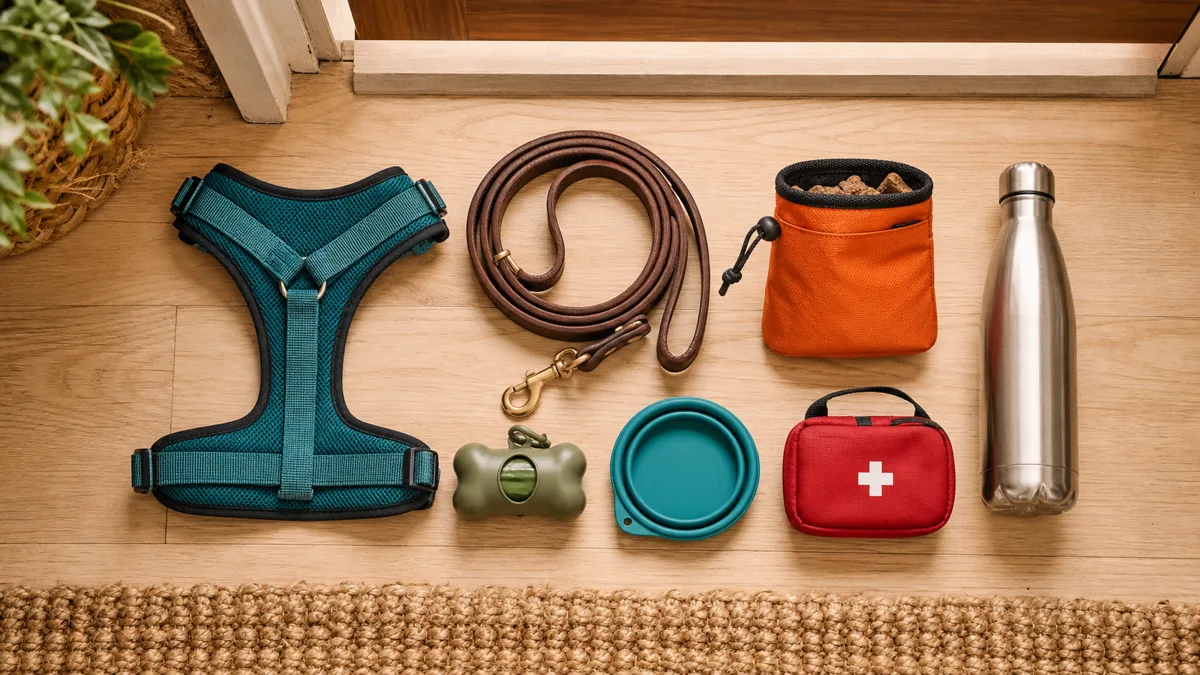
We used to walk out the door with a leash and hope for the best. Then we forgot poop bags two blocks in and had no water on an August walk that went longer than planned.
Every one of those problems had a five-dollar fix. The trick was knowing what to carry and keeping it by the door so grabbing it took less time than finding shoes.
Here are fourteen dog walking essentials that cover safety, comfort, and cleanup on every walk.
Jump to an essential
14 dog walking essentials you need before the next walk
From the right harness to a door-side gear station, these fourteen items cover safety, comfort, and cleanup on every walk. Jump to the one you are missing.
1. Start with a Well-Fitted Harness That Distributes Pressure Safely
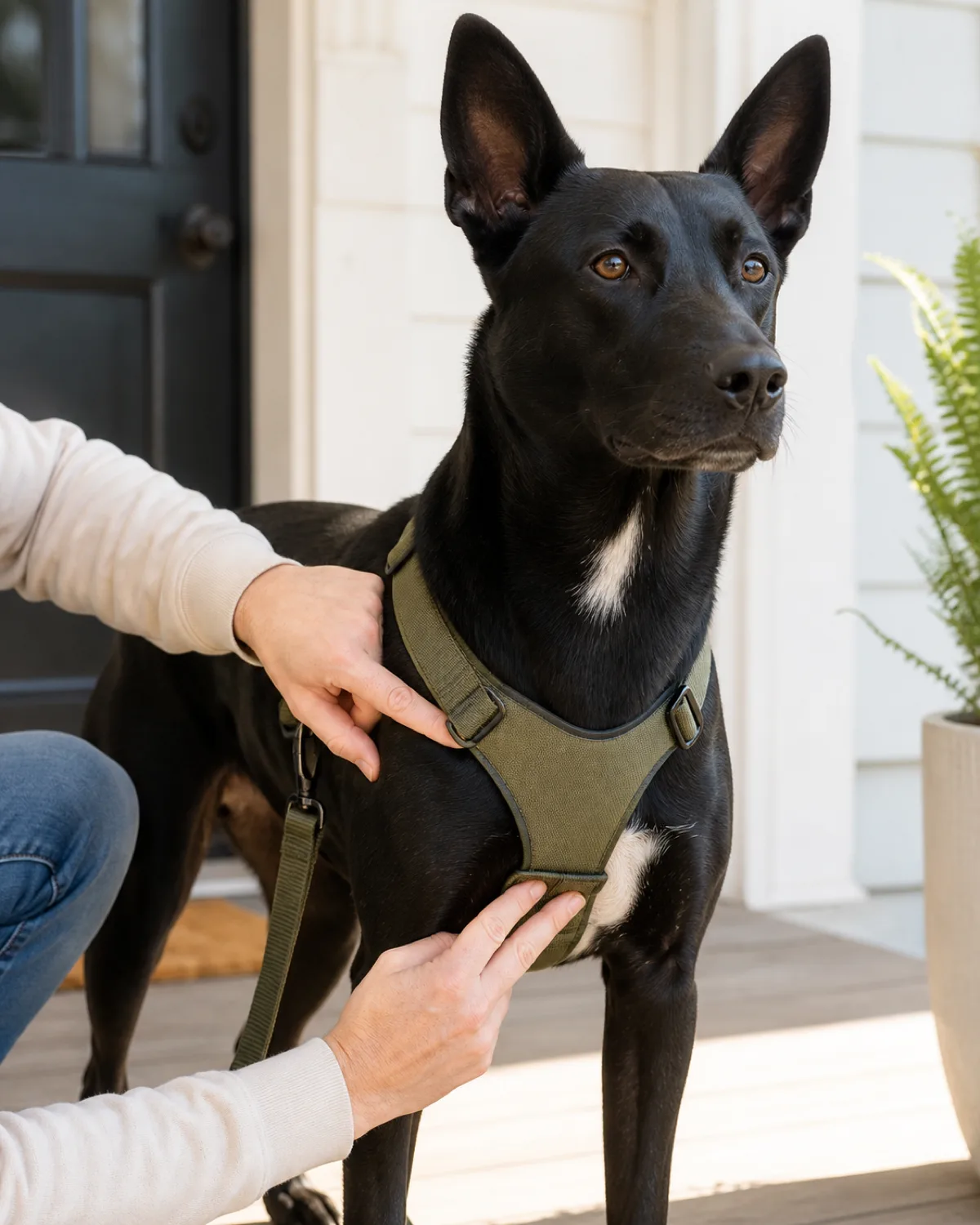
A harness is not a style upgrade from a collar. It is a safety upgrade. A flat collar concentrates every pound of pulling force on the trachea, and repeated pressure there can cause coughing, gagging, and long-term airway damage — especially in smaller dogs or breeds with already-narrow windpipes.
A Y-shaped or H-shaped harness routes that force across the chest and shoulders instead.
- Fit test: slide two fingers under the chest strap. If you cannot fit two fingers, the harness is too tight. If you can fit your whole hand, it is too loose and the dog can back out of it.
- Check every two weeks for puppies and growing dogs. They outgrow gear faster than you expect.
- Front-clip harnesses redirect pulling energy sideways, which helps with dogs still learning loose-leash walking (see our guide to stopping leash pulling).
The best harness is the one your dog wears without rubbing, chafing, or restricting their shoulder movement. If your dog lifts their front legs oddly or resists putting it on, the fit is wrong.
2. Choose a Leash Length That Gives Freedom Without Losing Control
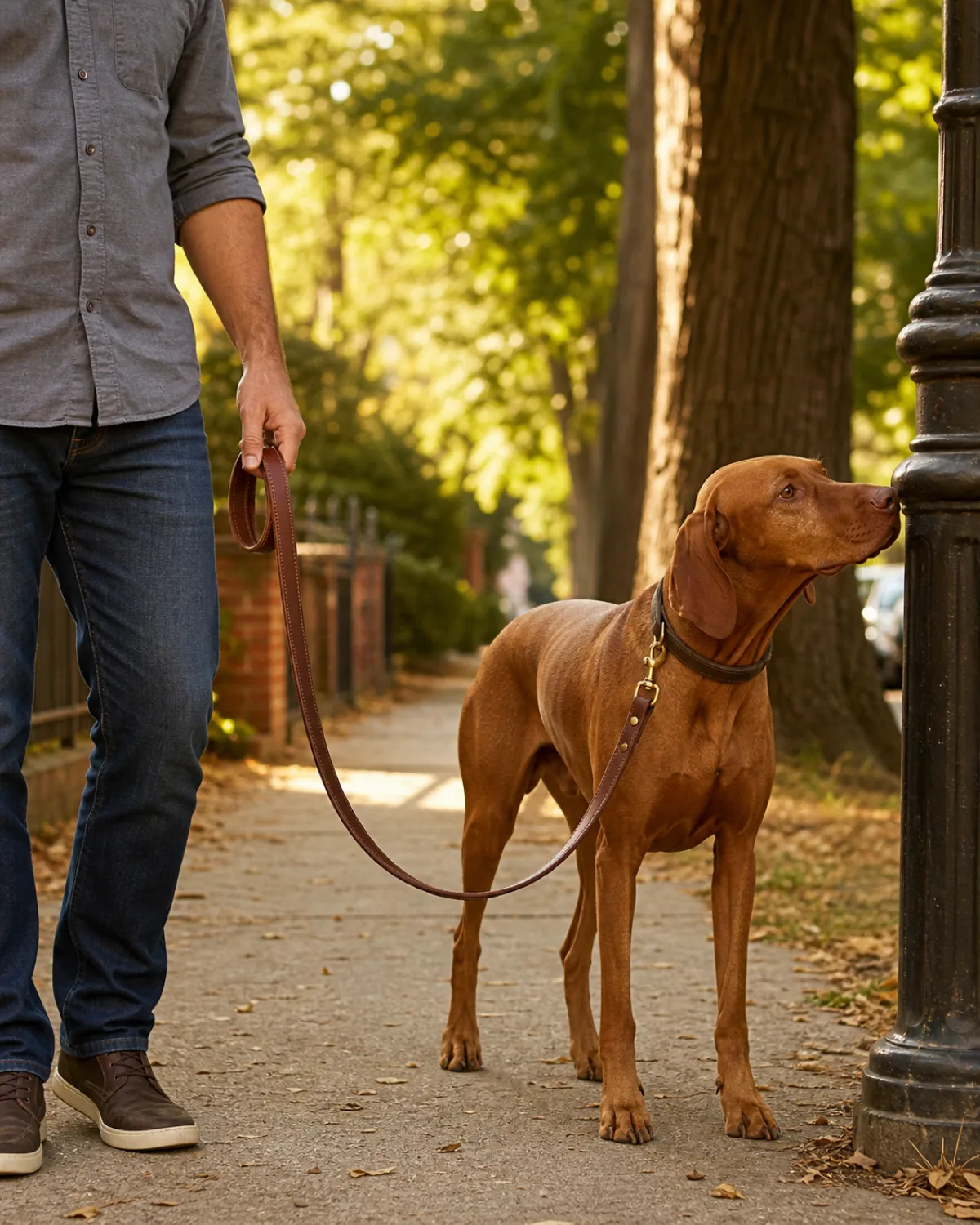
Six feet is the standard leash length for a reason. It gives your dog enough slack to sniff a fire hydrant, step off the sidewalk to investigate a bush, and walk slightly ahead or behind without constant tension.
Shorter than six feet keeps the dog too close for comfortable exploration. Longer than six feet makes it hard to reel them in quickly near traffic or other dogs.
- Retractable leashes feel convenient, but they train your dog that pulling extends their range — the opposite of what you want. They also snap under load, entangle legs, and offer zero stopping power when a squirrel appears.
- Dual-handle leashes have a short grab handle near the clip and a six-foot loop at the end. The short handle gives you instant close control in crowded areas without changing leashes.
- Material matters: nylon is light and cheap, biothane is waterproof and wipes clean, leather softens over time and lasts years. Avoid chain leashes — they are heavy and serve no training purpose.
3. Carry Poop Bags on Every Single Walk No Exceptions
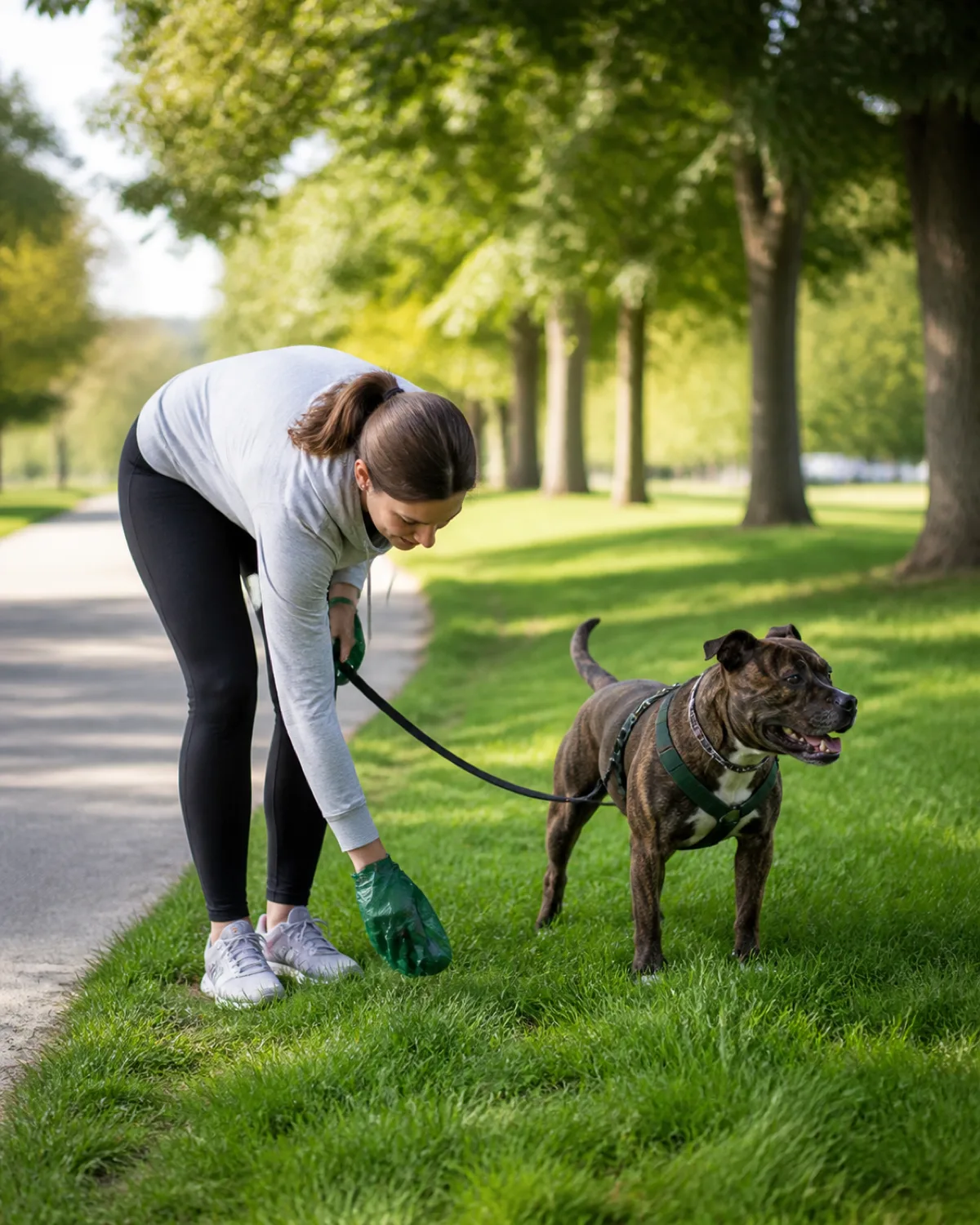
This one needs no justification. Every municipality expects it, most will fine you for skipping it, and your neighbors will remember.
A bone-shaped bag dispenser clipped to the leash handle keeps bags accessible without you thinking about it. Load it at home and forget about it until you need one.
- Carry at least two bags per walk. Your dog will occasionally surprise you with a second stop, and finding yourself empty-handed two blocks from home is the worst.
- Compostable bags break down faster in industrial composting facilities, but they do not vanish in a regular landfill any faster than standard plastic. Use whichever you prefer — the important thing is using one at all.
- Tie the full bag and carry it until you reach a trash can. Leaving tied bags on the sidewalk for pickup later is the loophole nobody believes.
Not sure what to buy first? Start with whatever you are missing right now
Where should you start?
You do not need all fourteen items on day one. Pick the gap below that sounds most familiar, and start there.
4. Clip a Treat Pouch to Your Waist for On-the-Go Rewards
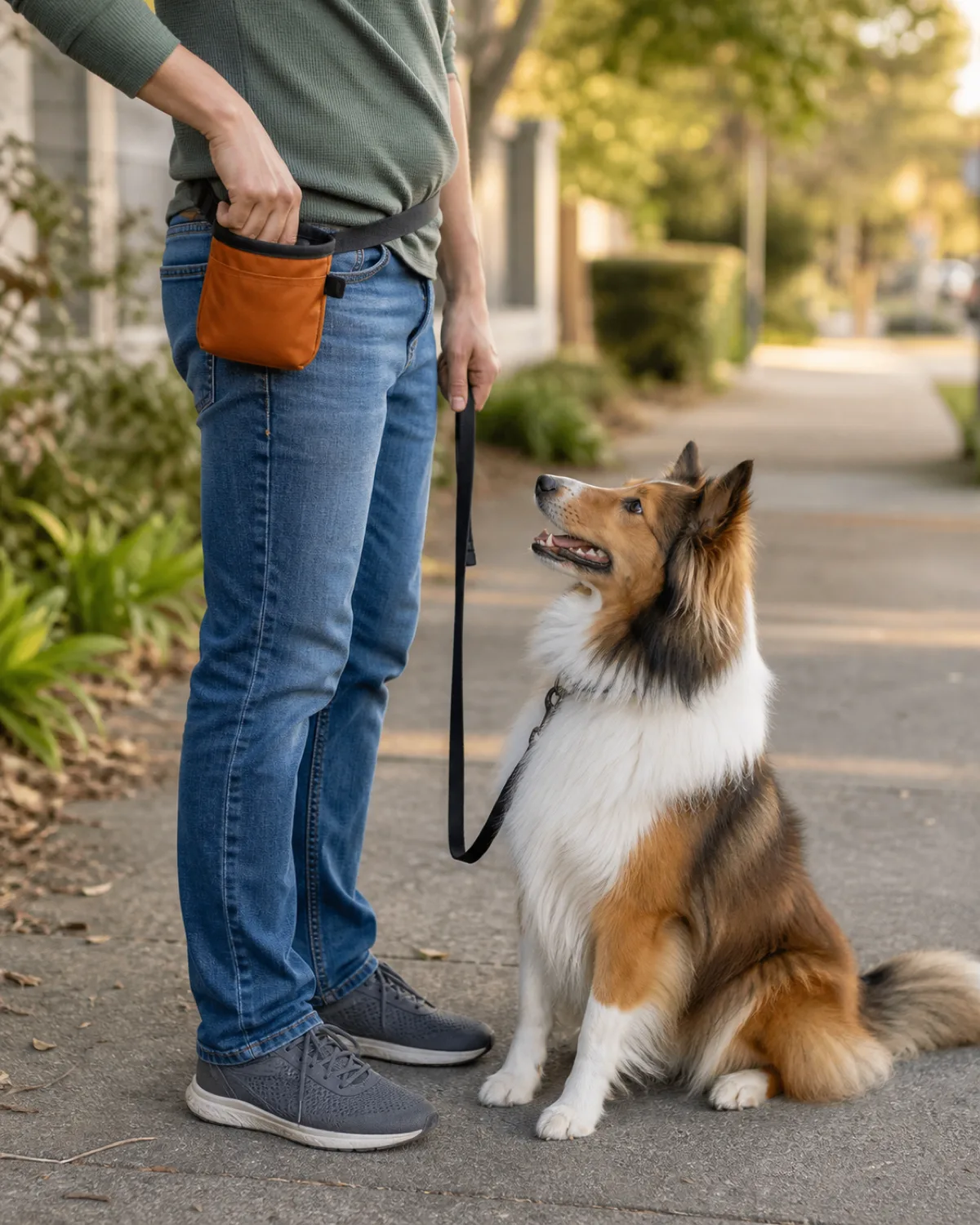
Crushed treats rattling around in a jacket pocket sound fine until you need one in under two seconds to reward a calm response to a trigger. You dig, the moment passes, and your dog learns nothing.
A dedicated treat pouch clips to your belt or waistband and opens with one hand — usually a magnetic closure or a spring hinge.
- Speed matters: a reward delivered within two seconds of the behavior is the one your dog connects to that behavior. Five seconds later, they have already moved on.
- Pouch keeps treats fresh, not crumbled and mixed with lint. Training treats are small, soft, and smelly — they disintegrate in pockets.
- Doubles as a poop bag holder: many pouches have a side clip or zippered pocket for bags, consolidating two things into one belt attachment.
For more on using treats during walks to reinforce good behavior, see our dog walking tips guide.
5. Bring a Collapsible Water Bowl and a Bottle for Longer Walks
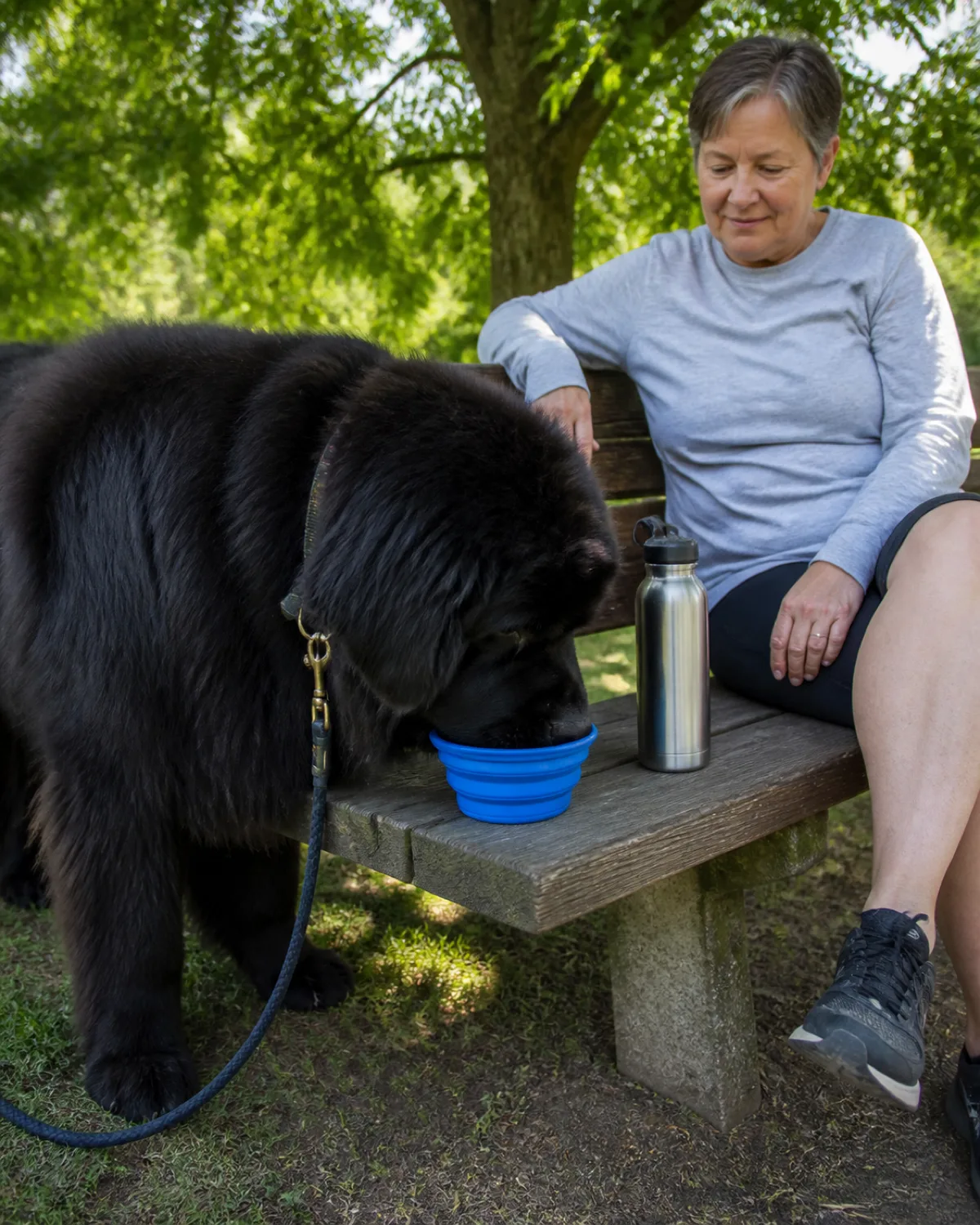
Dogs cool down by panting, not sweating. That means they lose moisture faster than you do, and they cannot tell you when they are thirsty. On any walk over twenty minutes — or any walk on a warm day — bring water.
A collapsible silicone bowl folds flat and weighs nothing. Pair it with a stainless steel water bottle or a bottle with a built-in trough and you have hydration covered without a backpack.
- Offer water every fifteen to twenty minutes on hot days, even if your dog does not seem thirsty. By the time a dog shows signs of dehydration — thick saliva, dry gums, lethargy — it has gone too far.
- Skip shared public water bowls outside cafés and stores. Stagnant communal bowls can harbor bacteria, parasites, and viruses from other dogs.
- The last thing you do before leaving the house: fill the bottle. Make it part of the door check.
6. Attach a Visible ID Tag with Your Current Phone Number
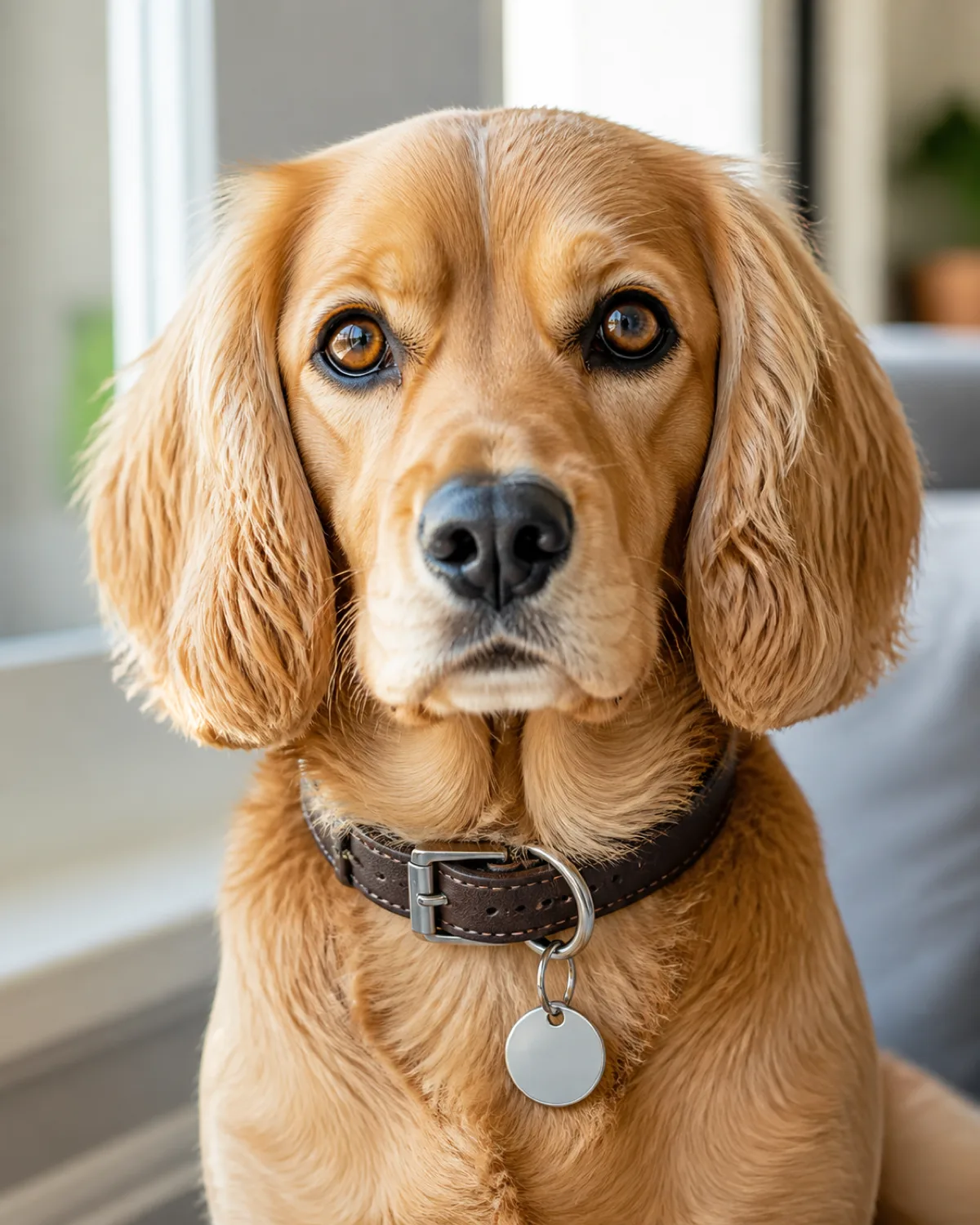
A microchip is essential backup, but it is invisible. A stranger who finds your dog on a sidewalk cannot scan a chip. What they can do is read a tag.
An engraved metal tag on the collar or harness D-ring with your phone number and city is the fastest path from lost to found.
- Engrave, do not print. Printed tags fade in weeks. Engraved stainless steel lasts for years.
- Include your phone number and city. Skip the dog's name if you want — a finder does not need it to call you.
- Update the tag every time you move or change your number. The most common reason ID tags fail is outdated information.
- Add a second tag to a different piece of gear — one on the collar, one on the harness. If your dog slips out of one, the other still has your number.
7. Add Reflective Gear or an LED Clip for Dawn and Dusk Walks
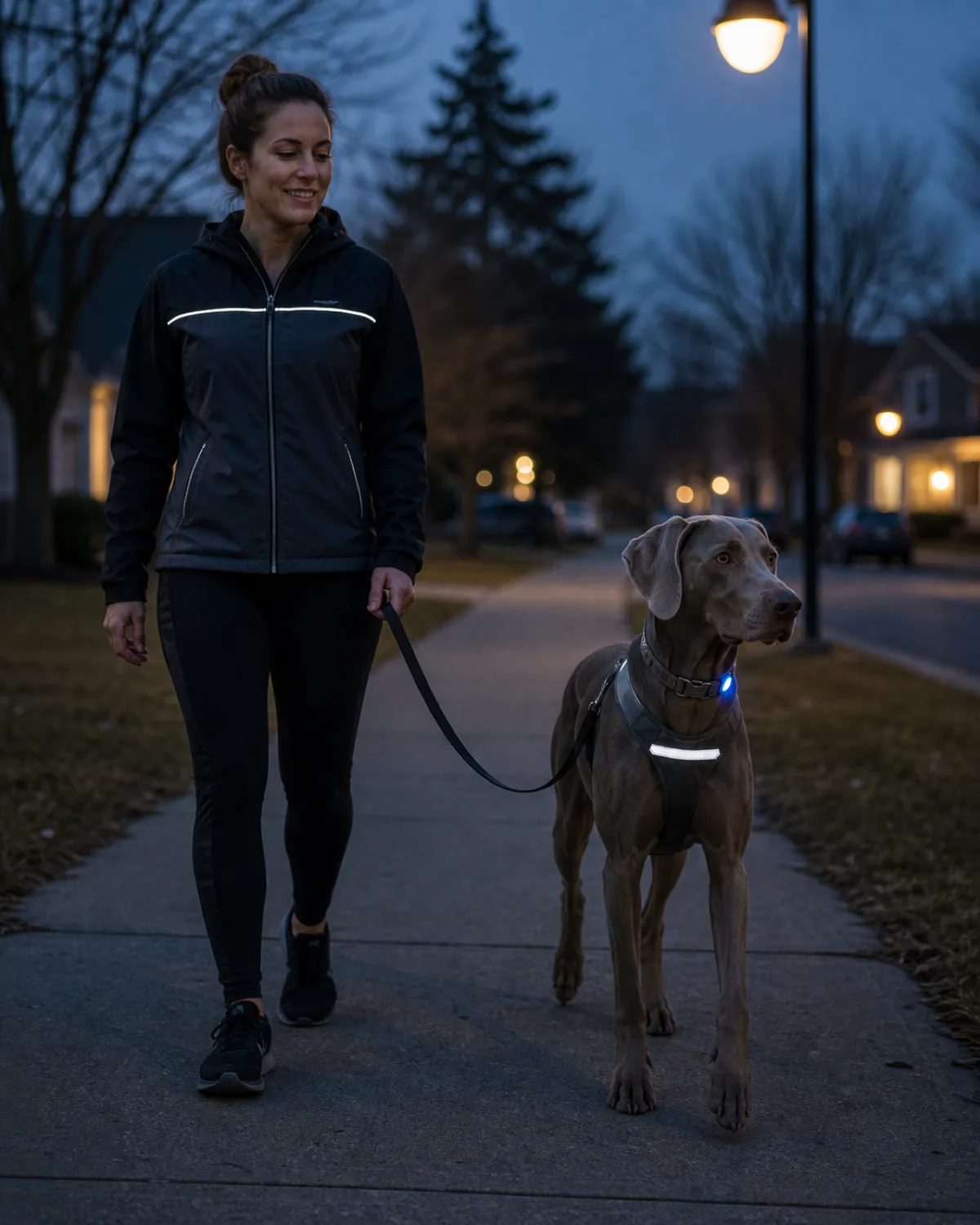
Dawn and dusk are when most dog owners walk. They are also when drivers have the hardest time seeing pedestrians and low-to-the-ground animals on or near the road.
A reflective harness, a detachable reflective band, or an LED clip on the collar makes your dog visible from over two hundred feet away in headlights.
- You need visibility too, not only your dog. A reflective vest, jacket with reflective piping, or a clip-on light on your belt means a driver sees both of you.
- LED clips are cheap and rechargeable. Clip one to the collar D-ring and forget about it until it dims.
- Reflective leashes exist and they work. The line connecting you to your dog should be visible too — a dark leash stretched across a sidewalk is invisible to a cyclist.
The four rules that separate a prepared walker from a frantic one
The gear philosophy behind every item
Good walking gear is not about buying the most expensive version of everything. It is about solving four problems before they happen.
Control before comfortThe harness and leash come first because without them, nothing else matters. A dog you cannot safely manage near traffic is a dog in danger, regardless of how nice your treat pouch is.
Reward within reachEvery walk is a training opportunity. Having treats accessible in two seconds means you can reinforce good behavior the moment it happens instead of fumbling while the moment passes.
Prepare for the thing that has not happened yetWater, a first aid pouch, reflective gear, ID tags — none of these matter until the one walk where they do. That walk always comes, and you will not know which one it is beforehand.
Organize at the door, not in your headIf gear lives in a fixed spot by the exit, you grab and go. If it is scattered around the house, you spend five minutes assembling it and forget something every third walk.
8. Pack a Small First Aid Pouch for Unexpected Scrapes
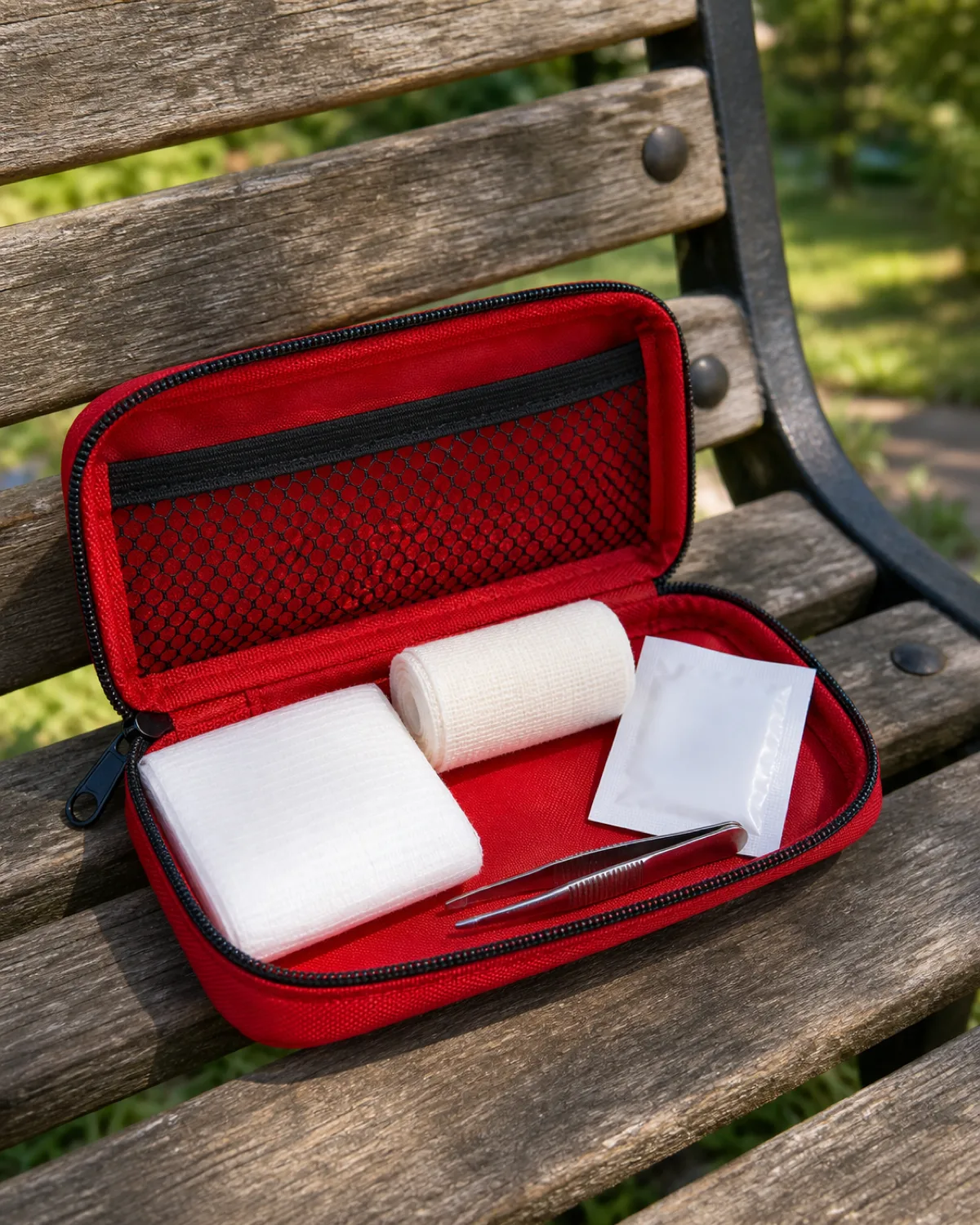
You do not need a full veterinary kit. You need a small zippered pouch with five basics that handle the most common trail and sidewalk injuries:
- Gauze pads for pressing on a cut paw.
- Self-adhesive wrap to hold the gauze in place until you get home.
- Styptic powder to stop a torn nail from bleeding (the same powder groomers use).
- Antiseptic wipes for cleaning a scrape before wrapping.
- Tweezers for pulling out thorns, foxtails, or glass splinters.
Tuck the pouch into your treat bag or clip it to a belt loop. It adds almost no weight and takes up less space than a phone. For a complete home kit breakdown, see our dog first aid kit guide.
The pouch matters most on new routes, off-trail walks, and any path with gravel, broken glass, or dense brush.
9. Use a Hands-Free Leash Setup When You Need Both Arms
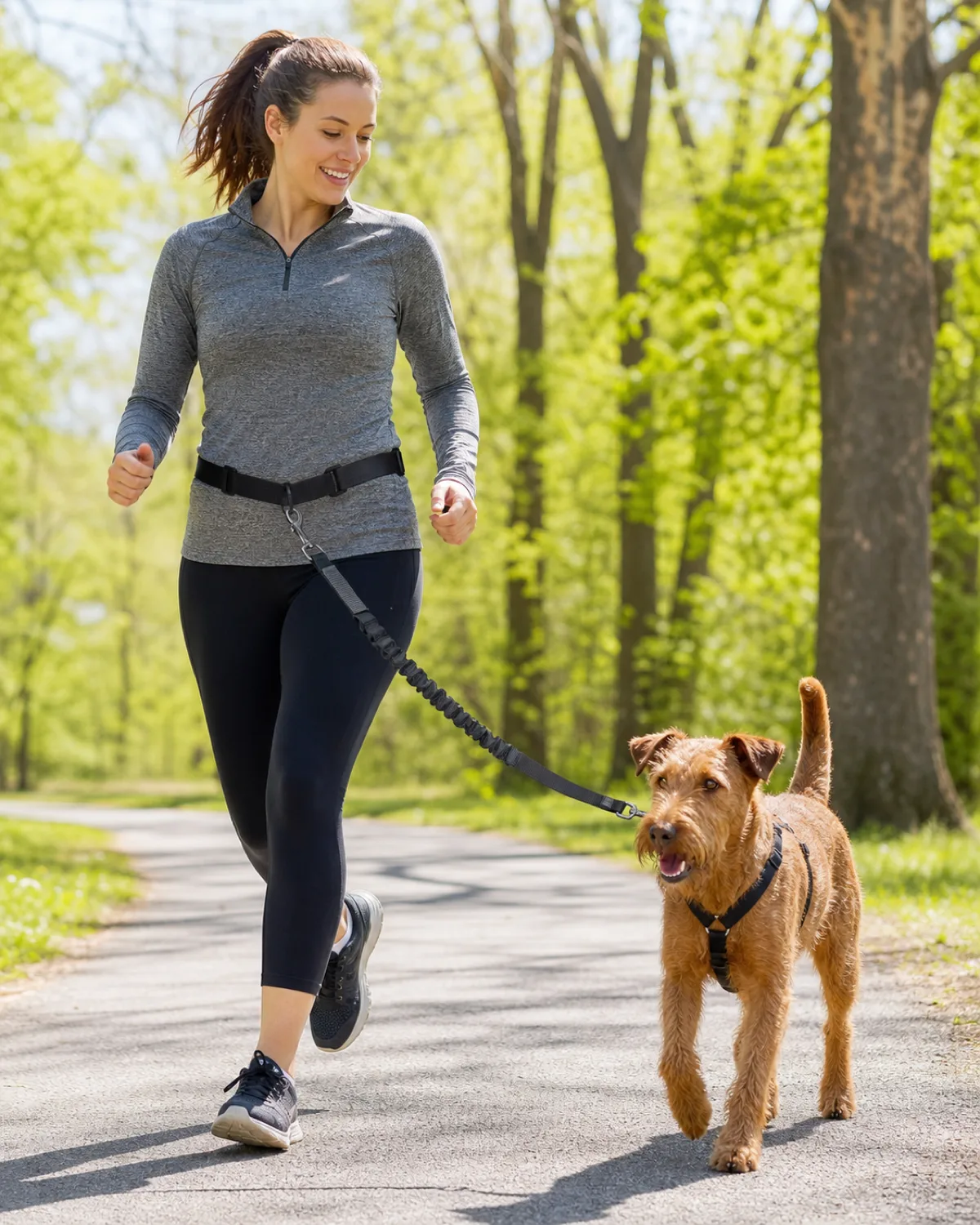
A waist-belt leash wraps around your hips and connects to the dog through a bungee section that absorbs sudden lunges. Your hands stay free for running, pushing a stroller, carrying coffee, or managing a second dog.
A crossbody leash does the same thing with a diagonal strap instead of a belt — better for people who find waist belts uncomfortable.
- The bungee section is non-negotiable. Without it, a sudden lunge transfers directly to your spine. The elastic absorbs the shock before it reaches you.
- Not for untrained pullers. A dog that consistently pulls hard against a leash needs to learn loose-leash walking with a handheld leash first. Hands-free is the graduation step, not the starting point.
- Test it on a calm, familiar route first. Do not debut hands-free on a busy street with squirrels. Start in your neighborhood at a quiet hour.
10. Keep Paw Wipes or a Small Towel in Your Pocket for Muddy Days
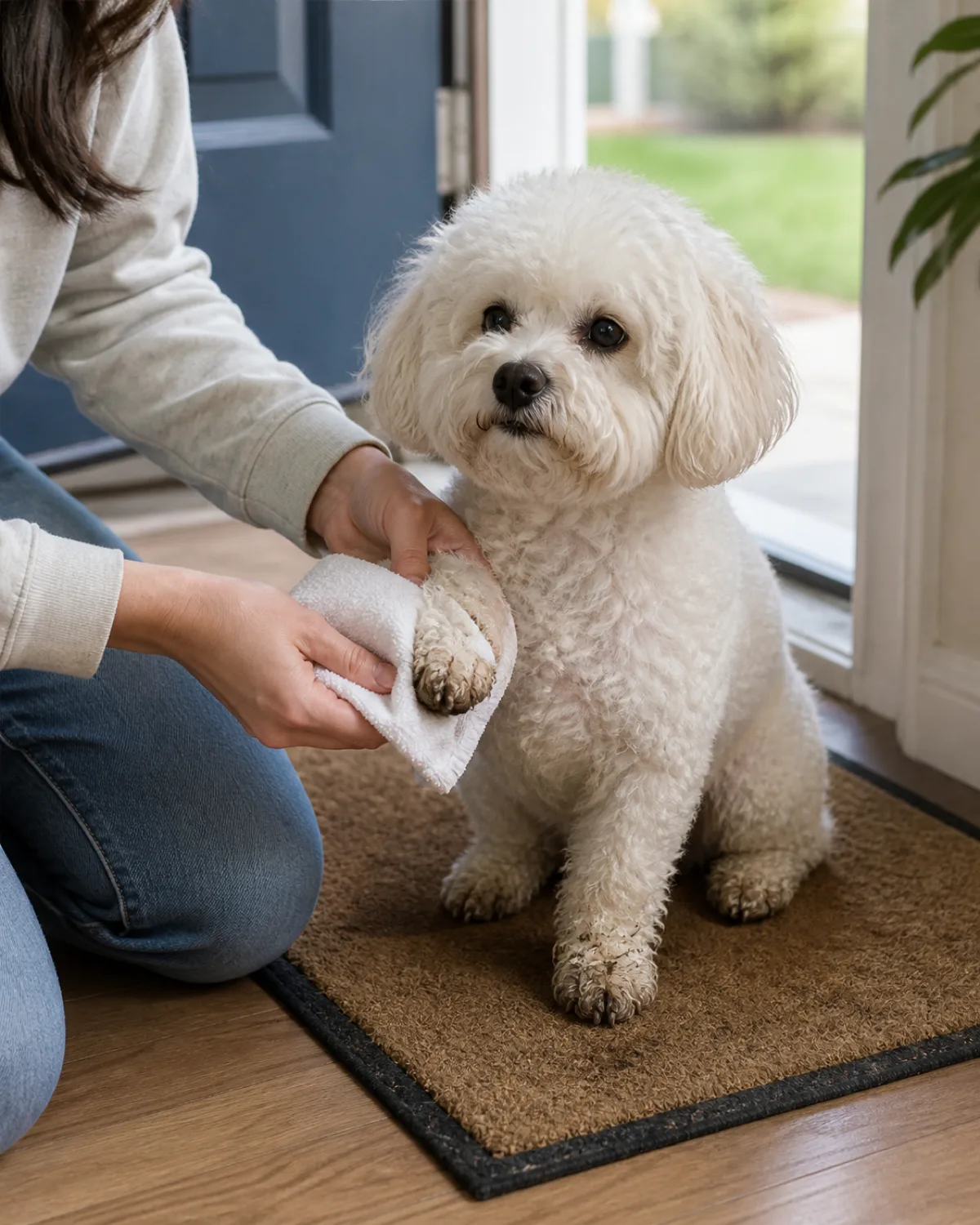
The walk ends at your front door, but the mud does not. Walking straight inside after a rainy walk means paw prints across every surface your dog touches in the next ten minutes.
A small microfiber towel by the door or a pack of paw wipes in your jacket pocket solves it in two minutes.
- Wipe between the pads, not just the surface. Mud, salt, and debris collect in the crevices between the paw pads and stay there until you dig them out.
- Winter salt is especially important to remove. Road salt irritates paw pads and is toxic if your dog licks it off. A quick wipe after every winter walk prevents both.
- For a full paw cleaning routine, see our guide to cleaning dog paws after a walk.
Keep the towel in a basket by the door with the rest of your walking gear. Toss it in the wash weekly.
11. Carry a Spare Bag for Unexpected Finds or Wet Gear
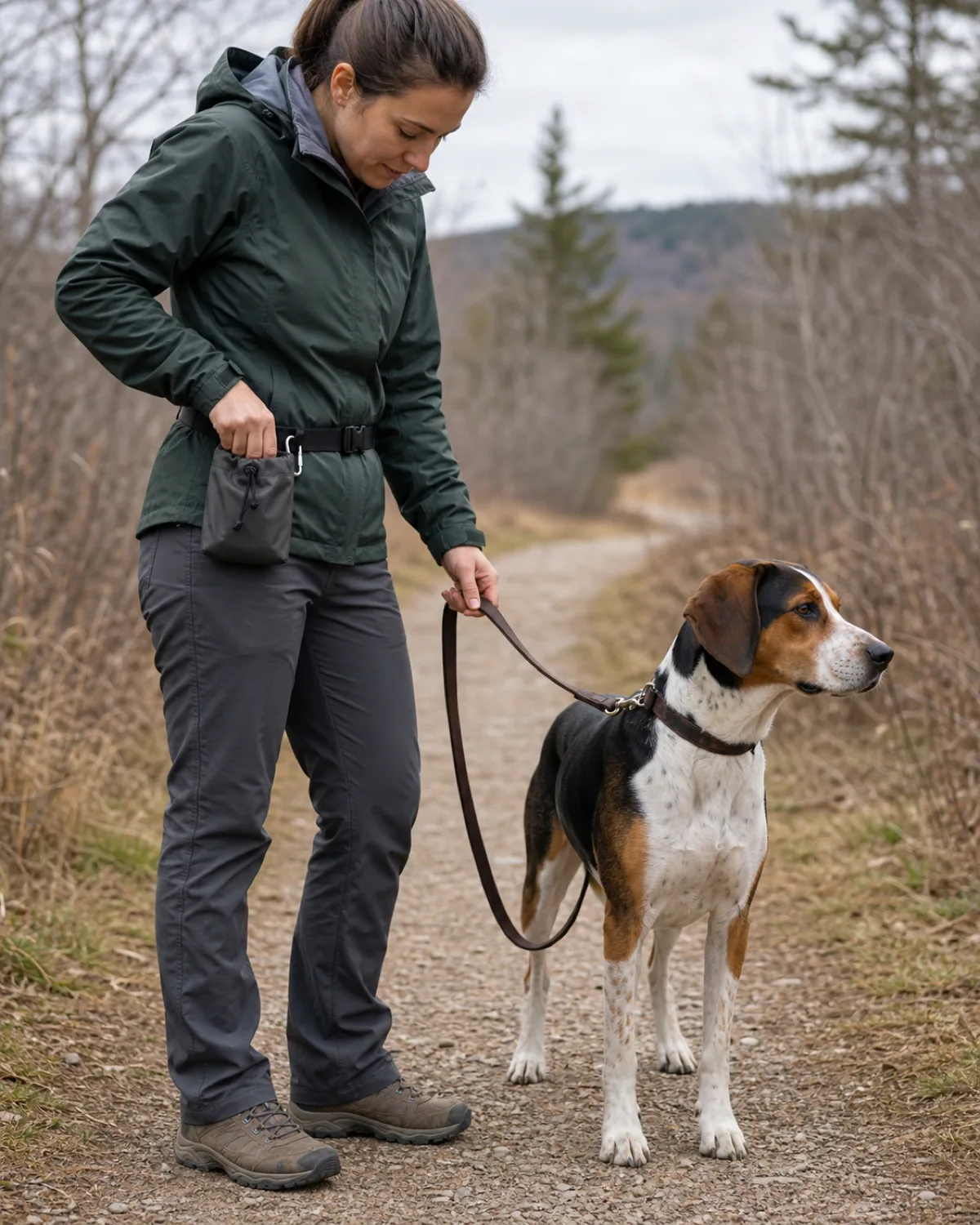
This is not a second poop bag — though carrying extras of those is wise. This is a plain waterproof drawstring bag or a gallon zip-lock that serves as a catch-all.
Use it for:
- A wet towel after wiping muddy paws mid-walk.
- A gross tennis ball your dog found and refuses to drop.
- Your phone if it starts raining.
- A soaked treat pouch after an unexpected downpour.
- The sock or glove your dog proudly stole from someone's yard.
Clip it to your belt or stuff it flat in a jacket pocket. It weighs nothing until you need it, and on the walk where you need it, you will be glad it is there.
12. Wear the Right Shoes Yourself Because Your Comfort Matters Too
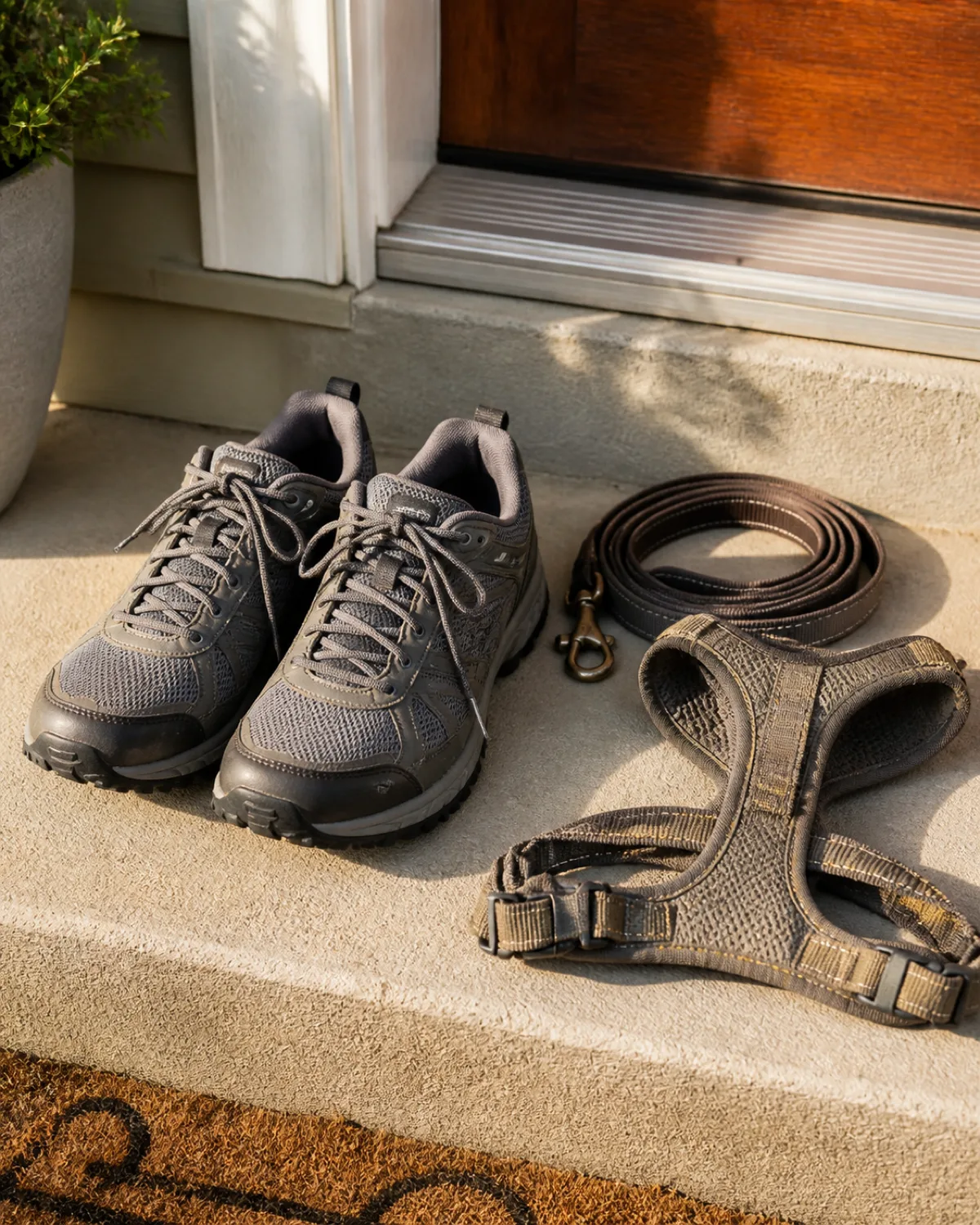
Every dog walking gear list focuses exclusively on the dog. But you are the one walking thirty to sixty minutes a day, every day, in rain and cold and heat.
Supportive walking shoes or trail runners with a waterproof upper make the difference between looking forward to the walk and dreading it because your feet hurt or your socks are soaked.
- Arch support and cushioning matter when you do this daily. Flip-flops and flat canvas sneakers are fine for a five-minute yard trip, not a thirty-minute neighborhood walk.
- Waterproof uppers remove one of the biggest excuses to skip the evening walk. Wet feet end walks early.
- Keep your walking shoes by the door with the rest of the gear. If you have to dig through a closet for shoes, that is one more friction point between you and the walk.
Save this for later
14 Dog Walking Essentials Every Owner Needs
- 1A well-fitted harnessDistributes pressure across the chest instead of the trachea — test with the two-finger rule.
- 2A six-foot standard leashEnough slack to sniff, not enough to reach the road. Skip retractable.
- 3Poop bags every walkBone-shaped dispenser on the leash handle. Carry at least two bags per walk.
- 4A clip-on treat pouchOne-handed access for two-second rewards. Magnetic closure is fastest.
- 5Collapsible water bowl and bottleAny walk over twenty minutes needs water. Silicone bowl folds flat in a pocket.
- 6A visible ID tagEngraved metal with your phone number and city. Update every time you move.
- 7Reflective gear or LED clipMakes you and your dog visible from two hundred feet at dawn and dusk.
- 8A small first aid pouchGauze, wrap, styptic powder, antiseptic wipes, tweezers — five items, fits in a pocket.
- 9Hands-free leash setupWaist-belt with bungee for running or multitasking. Graduate to it after loose-leash basics.
- 10Paw wipes or a towelTwo minutes at the door saves muddy prints across every surface in the house.
- 11A spare catch-all bagWaterproof drawstring for wet gear, found objects, and surprise rain.
- 12Supportive walking shoes for youYou walk thirty to sixty minutes a day too. Waterproof uppers remove the rain excuse.
- 13Seasonal gear adjustmentsSummer: extra water and timing. Winter: paw wax and reflective gear. Spring: tick supplies.
- 14A door-side gear stationHook rack by the exit with everything in a fixed spot. Grab and go in thirty seconds.
13. Adjust Your Gear Bag by Season So Nothing Catches You Off Guard
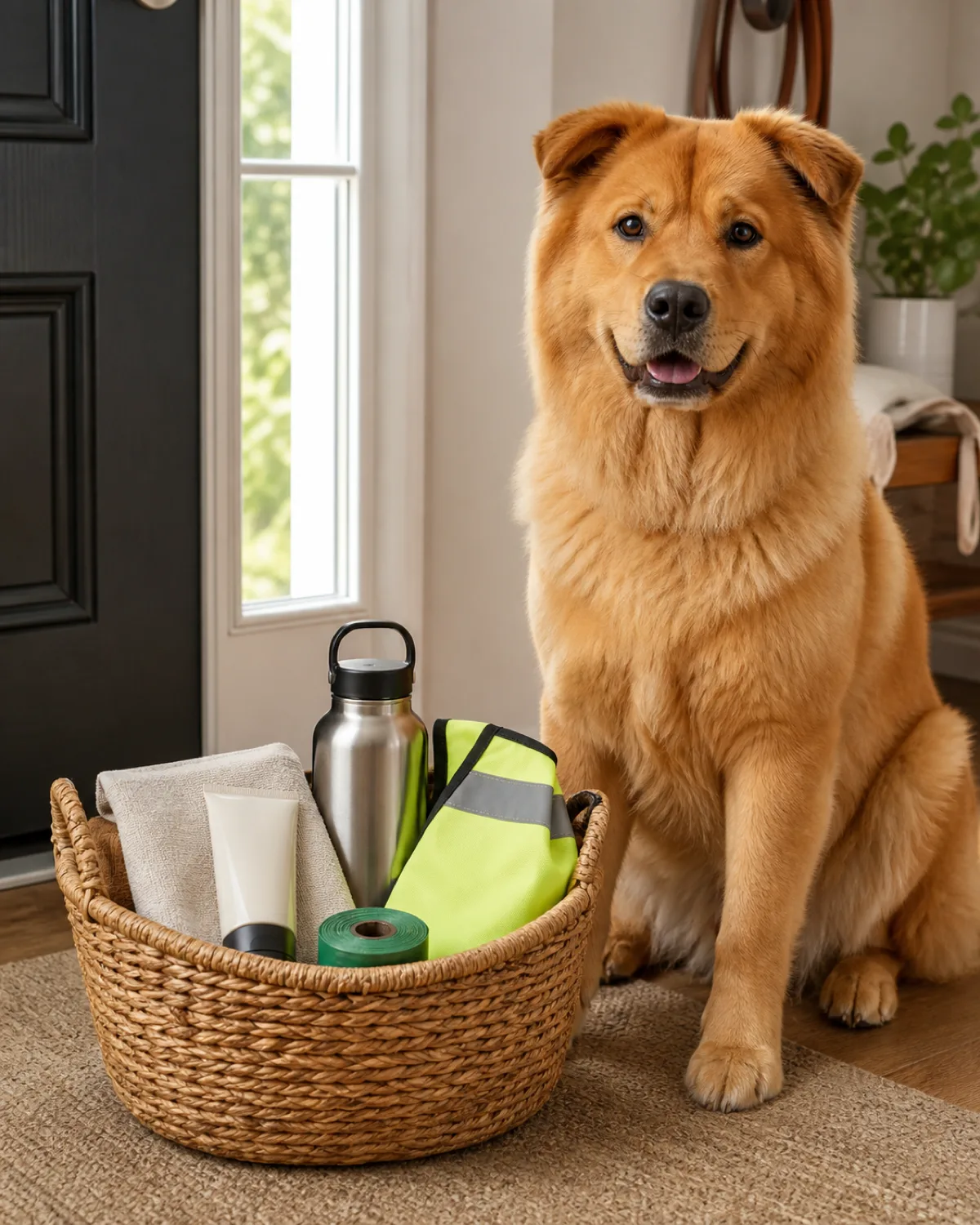
The gear that works in June will leave you unprepared in January. A seasonal review every three months keeps your walking kit matched to the conditions.
Summer adjustments:
- Extra water and a second collapsible bowl.
- Walk before 8 AM or after 6 PM to avoid hot asphalt (press the back of your hand to the pavement — if you cannot hold it for five seconds, it is too hot for paw pads).
- Skip the heavy treat pouch belt and clip it to shorts instead.
Winter adjustments:
- Paw wax before every walk to protect against salt and ice.
- Shorter, more frequent walks instead of one long one.
- Extra reflective gear because dark comes at 4:30 PM.
Spring and fall adjustments:
- Tick check supplies — a fine-tooth comb and tweezers in the first aid pouch.
- A lightweight rain jacket for you (the dog does not need one unless they are short-coated and shivering).
- A towel upgrade from a small one to a full-size one as mud season arrives.
14. Do a Quick Gear Check at the Door Before Every Walk
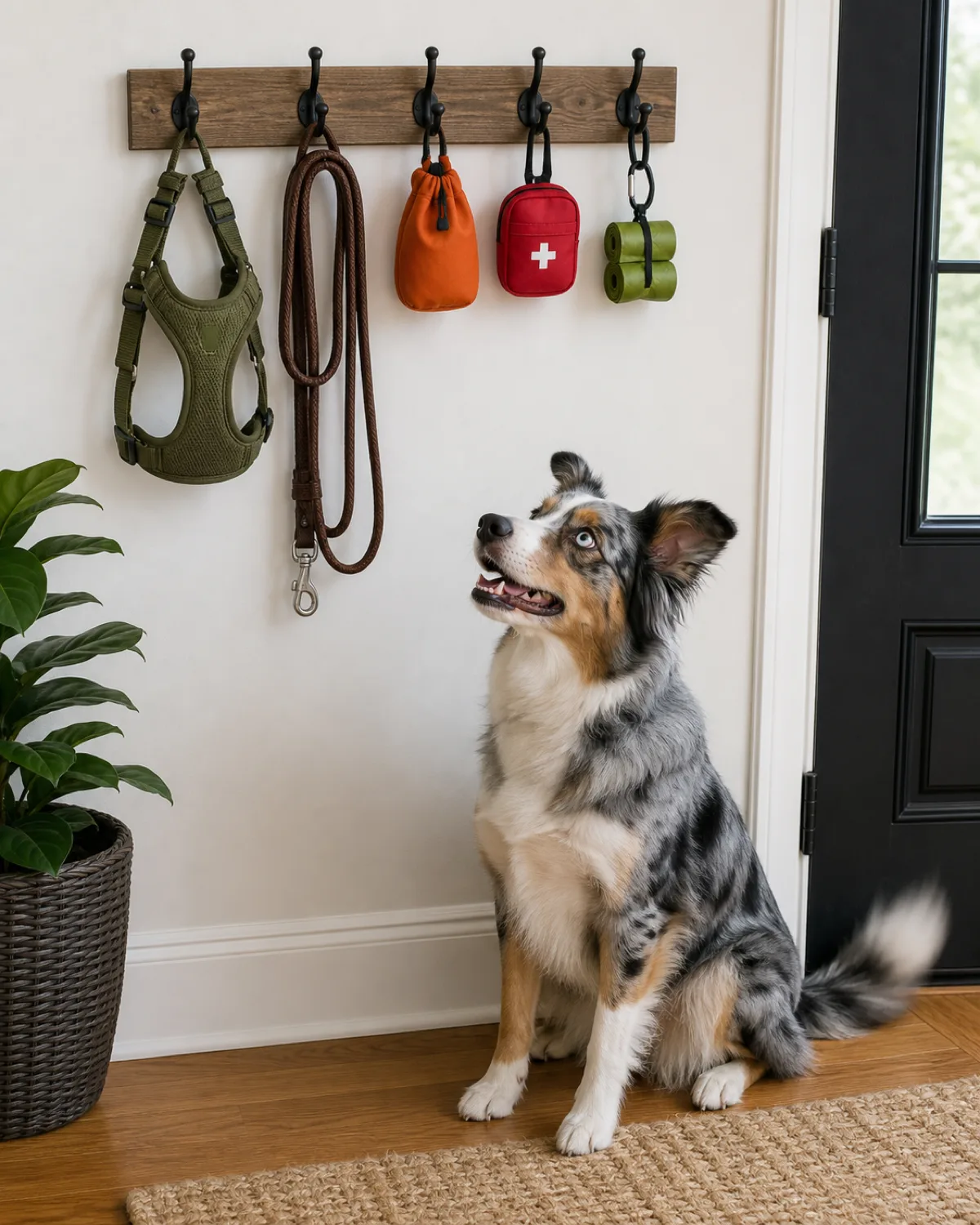
Every item on this list is useless if it is scattered around the house when you need it. The single highest-impact change you can make is giving your walking gear a permanent home by the front door.
A wall-mounted hook rack, a small basket on a console table, or even a dedicated shelf in the entryway closet — any of these work as long as every item has a fixed spot.
- Harness on a hook. Leash coiled on the next hook. Treat pouch on the third. Poop bags clipped to the leash handle.
- Water bottle and collapsible bowl on the shelf below, already filled.
- First aid pouch, spare bag, and paw towel in the basket.
The thirty-second scan at the door before you walk out catches the one thing you forgot. Over time it stops being a scan and becomes muscle memory: grab harness, grab leash, grab pouch, check water, go.
Your dog already knows the routine. The gear station means you do too.
FAQ
What is the single most important dog walking essential?
A well-fitted harness. It keeps your dog safe from tracheal pressure, gives you control, and serves as the anchor for everything else — the leash clips to it, the ID tag hangs from it, and reflective elements attach to it.
Do I need a treat pouch if my dog walks well already?
Yes. Even a well-trained dog encounters new situations on walks — a passing skateboard, a loose cat, a construction noise — and having treats within two seconds lets you reinforce calm responses before they slip. A pouch also makes it easy to practice recall on every walk.
How do I know if my dog needs water during a walk?
Offer water every fifteen to twenty minutes on warm days, regardless of whether your dog looks thirsty. Excessive panting, a dry nose, thick saliva, and slowing pace are late-stage signals. By the time you notice those, dehydration is already setting in.
Is a retractable leash ever okay?
For well-trained dogs in open, low-traffic areas like empty fields or quiet trails, a retractable leash can give extra exploration range. For sidewalks, neighborhoods, and any area with traffic or other dogs, a standard six-foot leash gives better control and teaches better walking habits.
What should I carry for walks in the rain?
Your standard gear plus a towel (upgrade to full-size), a waterproof bag for your phone, and waterproof shoes for yourself. Skip the umbrella — you need at least one hand for the leash. A lightweight rain jacket with a hood keeps you dry without limiting your range of motion.
P
About the author
Jess Calloway
Jess Calloway edits Pawliqa, where she shares dog care, grooming, training, and new-owner tips — plus DIY and pet-friendly home ideas — for anyone who wants a happy, well-cared-for dog. As a dog mom to three very different dogs, she writes the honest, tested version of what actually works. Every guide is image-led and reviewed for clarity, usefulness, image accuracy, and Pinterest-to-page alignment before it goes live. Visit the About page.