
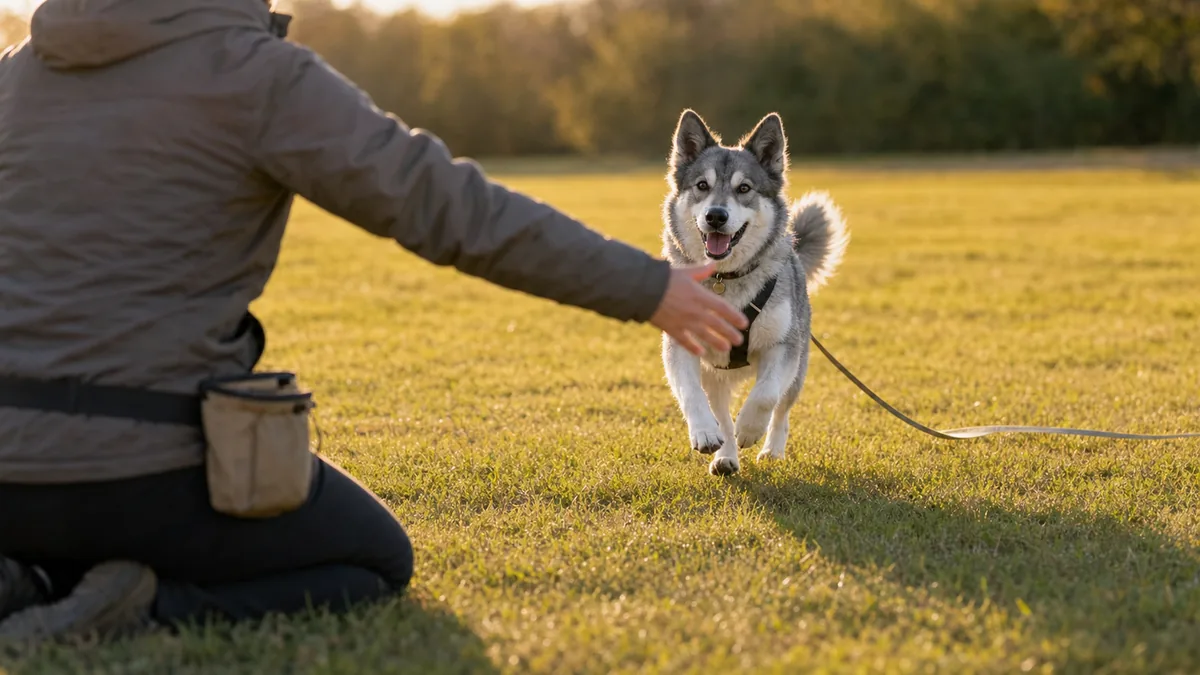
Recall is the behavior every owner wants and the one that breaks first. We assume it should just exist, like sit — it doesn’t. Coming when called is a learned skill, and “come” is a bank account.
This is the calm, positive-only version: how the cue is built from scratch, how a long line keeps every rep honest, why most people quit on day seven, and the mistakes that poison the word.
My biggest dog had a recall close to zero until age two — not from a love problem, but because I had been spending the cue and never replenishing it. A thirty-foot line plus a month of deposits turned it around.
Recall is built, not commanded. It works when “come” reliably means “great thing happens,” and breaks the day “come” stops paying. Skip to whichever step matches where you are right now.
- 1Why most “come” commands stop working
- 2The recall game (long line, reward, always pay)
- 3Charge the cue in low distraction first
- 4Three ways to poison the cue (stop doing these)
- 5The distraction ladder: kitchen to park
- 6The long line: a 30-foot safety net
- 7The mid-run recall drill (call, run away, pay big)
- 8Premack: use the distraction as the reward
- 9Emergency recall: a separate word for “now”
- 10What to do when your dog ignores you
- 11Recall in the real world: parks, hikes, beach
- 12The 30-day recall plan (most people quit day 7)
- 13When recall won’t stick — manage, don’t force
Why Most “Come” Commands Stop Working
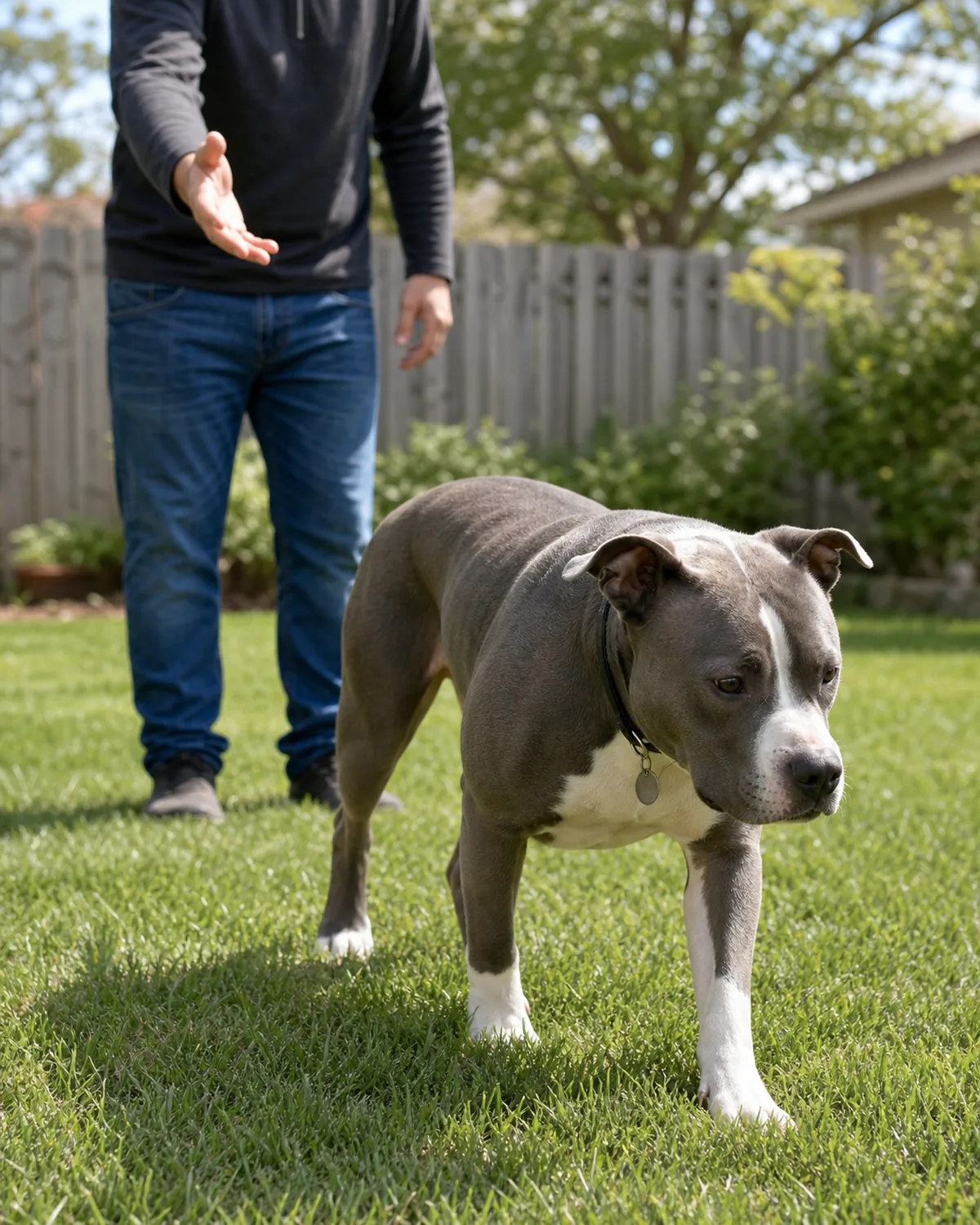
Recall is a bank account, not a command. Every time you call the dog, they come back, and something genuinely good happens, you deposit. Every time you call and they ignore you with no consequence, or you call and then clip the leash on and end the fun, or you call to clip nails or give a pill, you withdraw.
The average pet owner withdraws five times a day and deposits zero. Six months later they are in the park calling a dog who has learned that the word “come” reliably means nothing or, worse, means the good stuff stops. Dominance isn’t the problem. The balance sheet is.
- Audit your last week: count the times you called and paid versus called and didn’t.
- Every recall that has no payoff is a withdrawal, including the ones the dog ignored.
- The word doesn’t need replacing yet — but the account does need rebuilding.
The Recall Game: Long Line, Real Reward, Always Pay
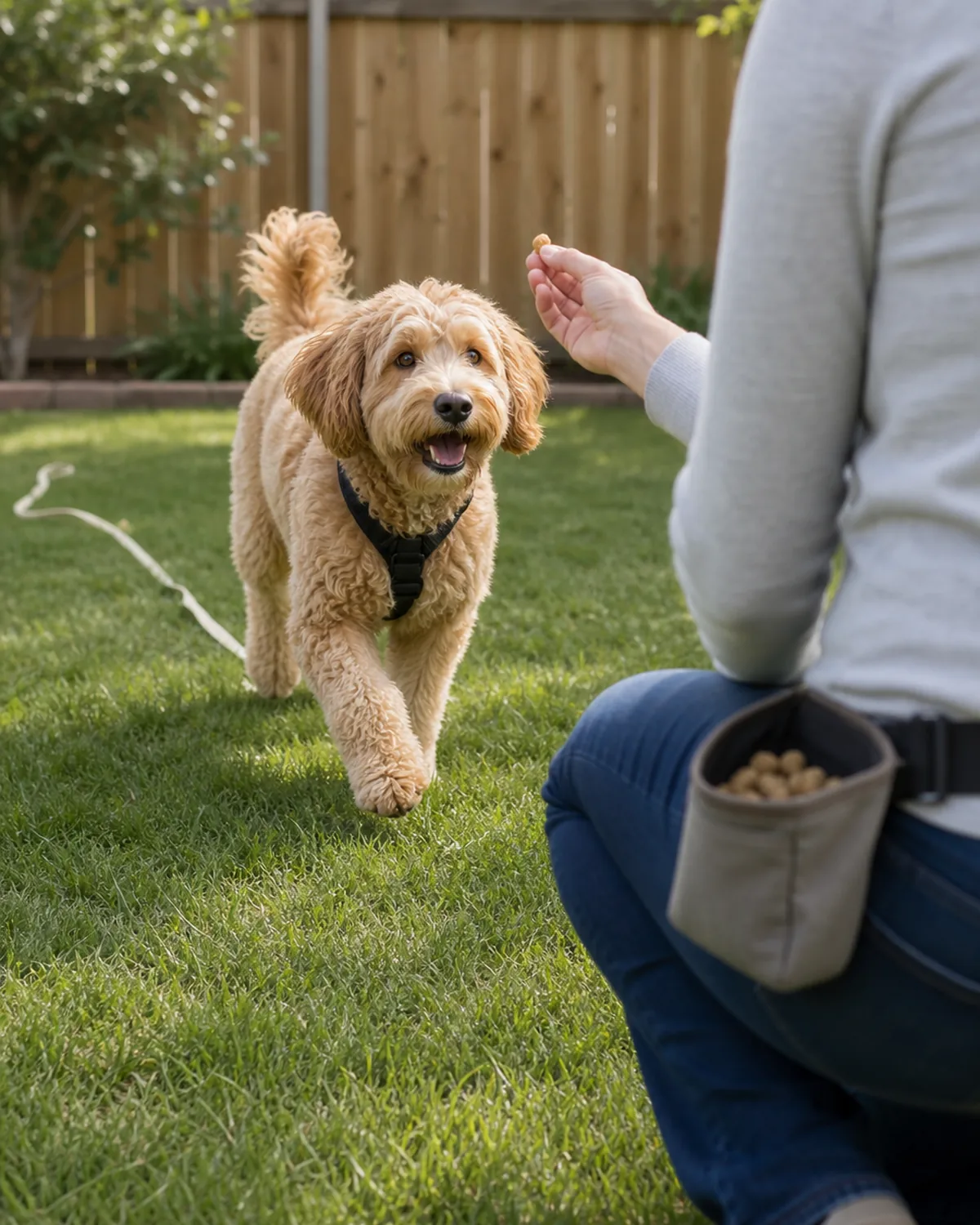
The foundation everything else stands on is the recall game. Thirty feet of biothane long line clipped to a Y-front back-clip harness — never the collar — letting your dog explore. You wait. The moment they choose to look at you or take one step in your direction, you mark with a “yes” or a clicker and pay with five small high-value treats fed one at a time.
Then release them back to whatever they were doing. The release is half the reward. For the first two weeks, every recall ends in jackpot food plus freedom restored. No exceptions. No skipping the pay because they came quickly. You are buying every future rep with this one.
- The long line guarantees you can always make the recall happen — that’s the point.
- Pay in jackpot food (chicken, cheese, freeze-dried liver), not the day’s kibble.
- The release back to the fun is half the reward — don’t skip it to save a minute.
Charge the Cue in Low Distraction Before Anything Else
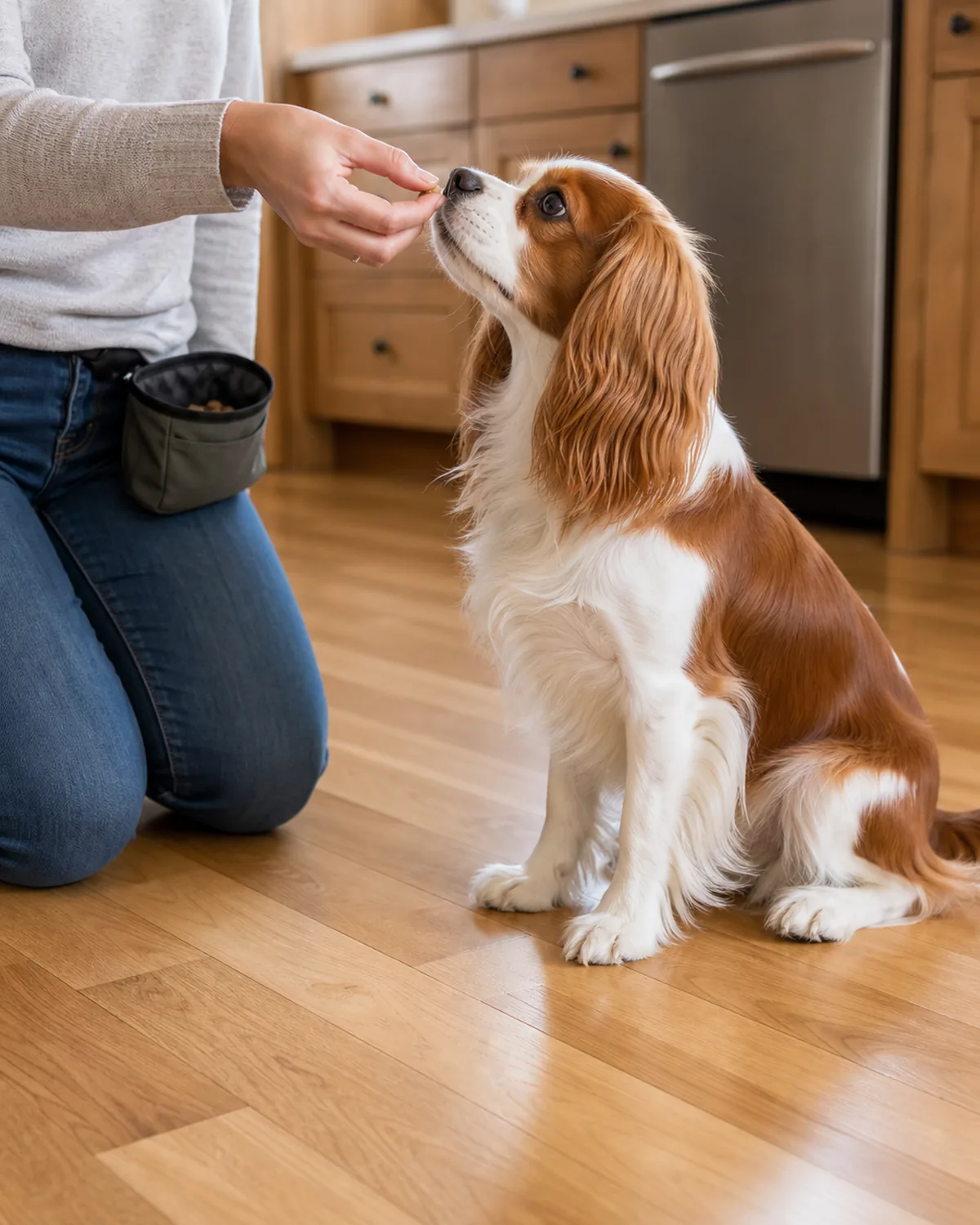
Don’t introduce the word “come” in the park. Don’t even introduce it in the yard yet. Start in the kitchen, your dog three feet away, you crouched down. Say the cue once in a warm voice, mark the instant they turn their head toward you, and feed a small soft treat at nose level.
Twenty reps a day for three days, in three different rooms. The dog’s brain stops processing “come” as a sound and starts processing it as a Pavlovian promise: good thing is about to land. That promise has to exist before you take it anywhere louder than a kitchen.
- Pick one cue word and stick with it — the new word matters less than consistency.
- Twenty short, easy reps a day beat one long session that burns the dog out.
- The cue is “charged” when the dog whips their head around the moment you say it.
You do not need every step at once. Find the version of “your dog” below and begin there.
Three Ways to Poison the Cue (Stop Doing These Today)
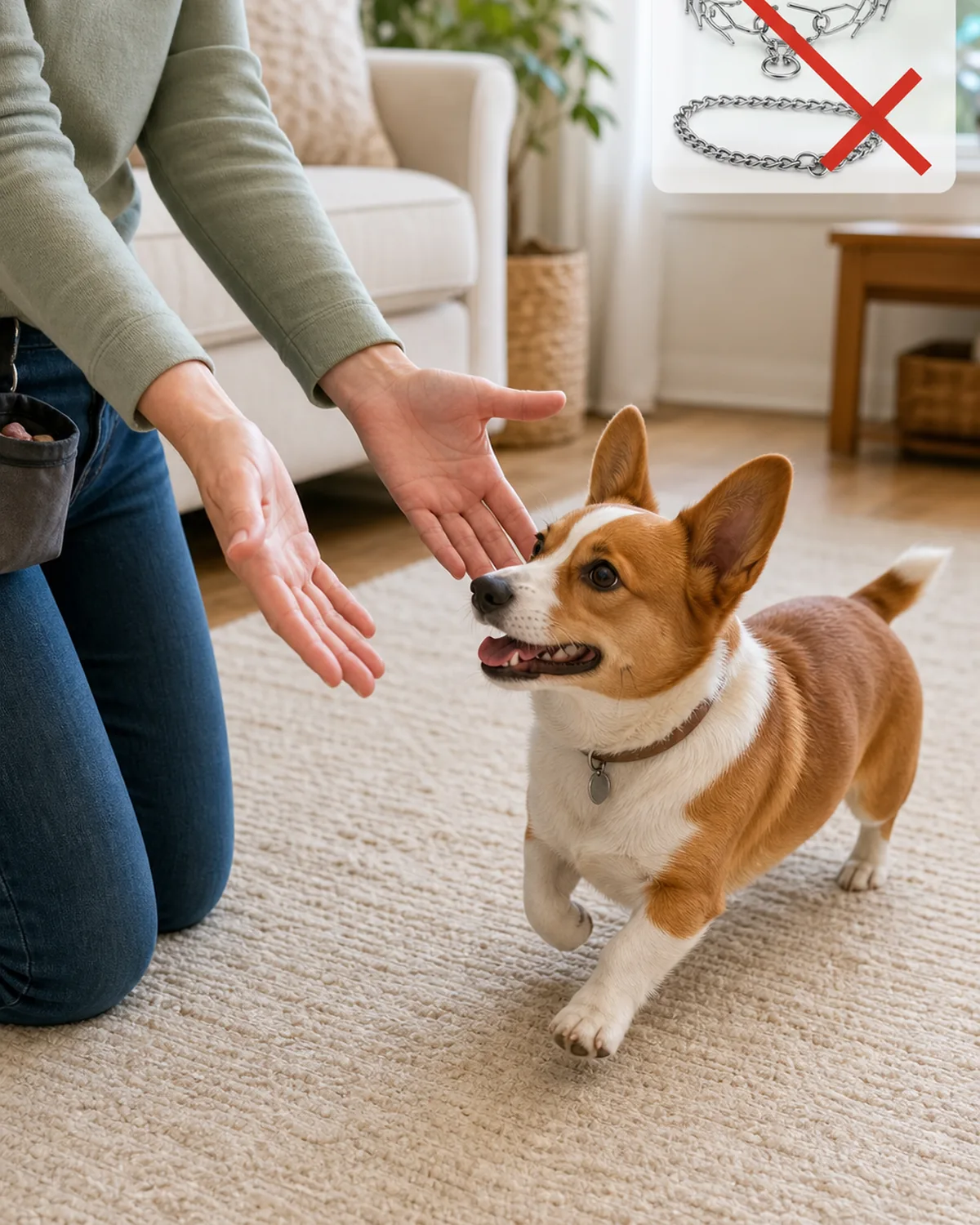
Three habits quietly destroy a working recall. The first is calling the dog and then doing something unpleasant — clipping nails, giving a pill, ending the park visit. The cue starts to mean “the good thing is over.” The second is calling when the dog is free to choose between you and a chasing rabbit. Every ignored cue teaches them the word is optional.
The third is using punitive collars. Prong, pinch, choke and shock collars do not build recall — they teach the dog the cue predicts pain or fear. Force-free certified trainers don’t use them for a reason. If your cue has already collected one or more of these patterns, retire the word, pick a new one, and rebuild the account from step three with clean rules.
- Never end the fun with the recall cue — release the dog back to play after paying.
- Never call when you can’t make it happen; use the long line until the cue is solid.
- No prong, no choke, no shock — they poison recall faster than any other mistake.
The Distraction Ladder: Kitchen → Hallway → Backyard → Quiet Street → Park
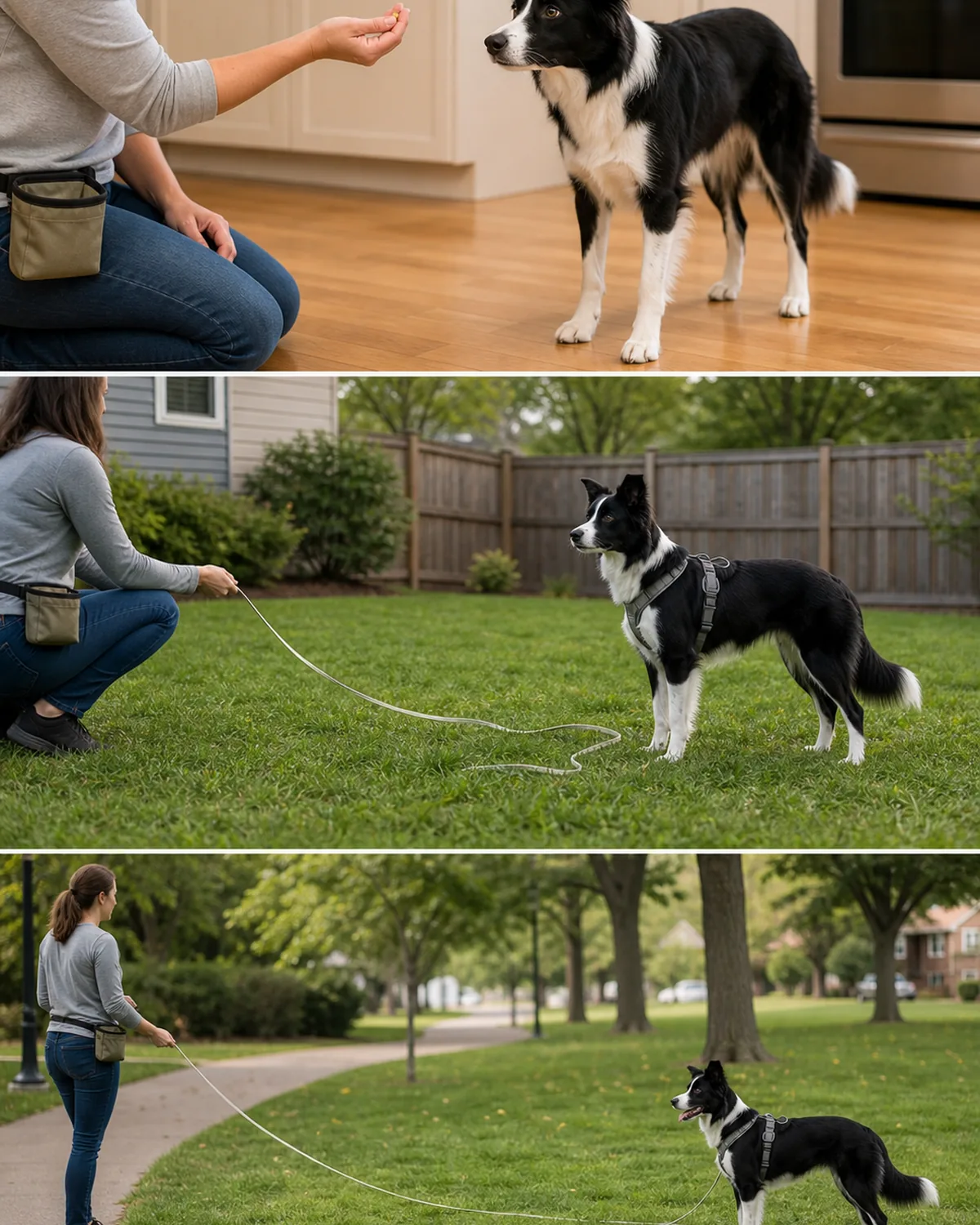
If you can’t get the cue in your kitchen, you won’t get it in a park. The ladder runs kitchen, hallway, backyard, quiet street, busy park. You only climb a rung when the lower one delivers five clean recalls in a row. Climbing too fast is the most common reason recall stalls — the environment is doing the teaching, not the word.
When recall fails at a level, drop down two rungs the next day. That feels backward, but pressure is what makes default behavior kick back in. A few easy reps at a lower level rebuild confidence faster than ten more attempts at the level that just broke.
- Five clean recalls at a level is the minimum before you climb the ladder.
- Failing at a level isn’t a setback — it’s a signal to drop down two rungs.
- Pressure rebuilds default behaviors fast; the ladder exists to protect the cue.
The Long Line: A 30-Foot Safety Net That Lets You Practice Real Recall
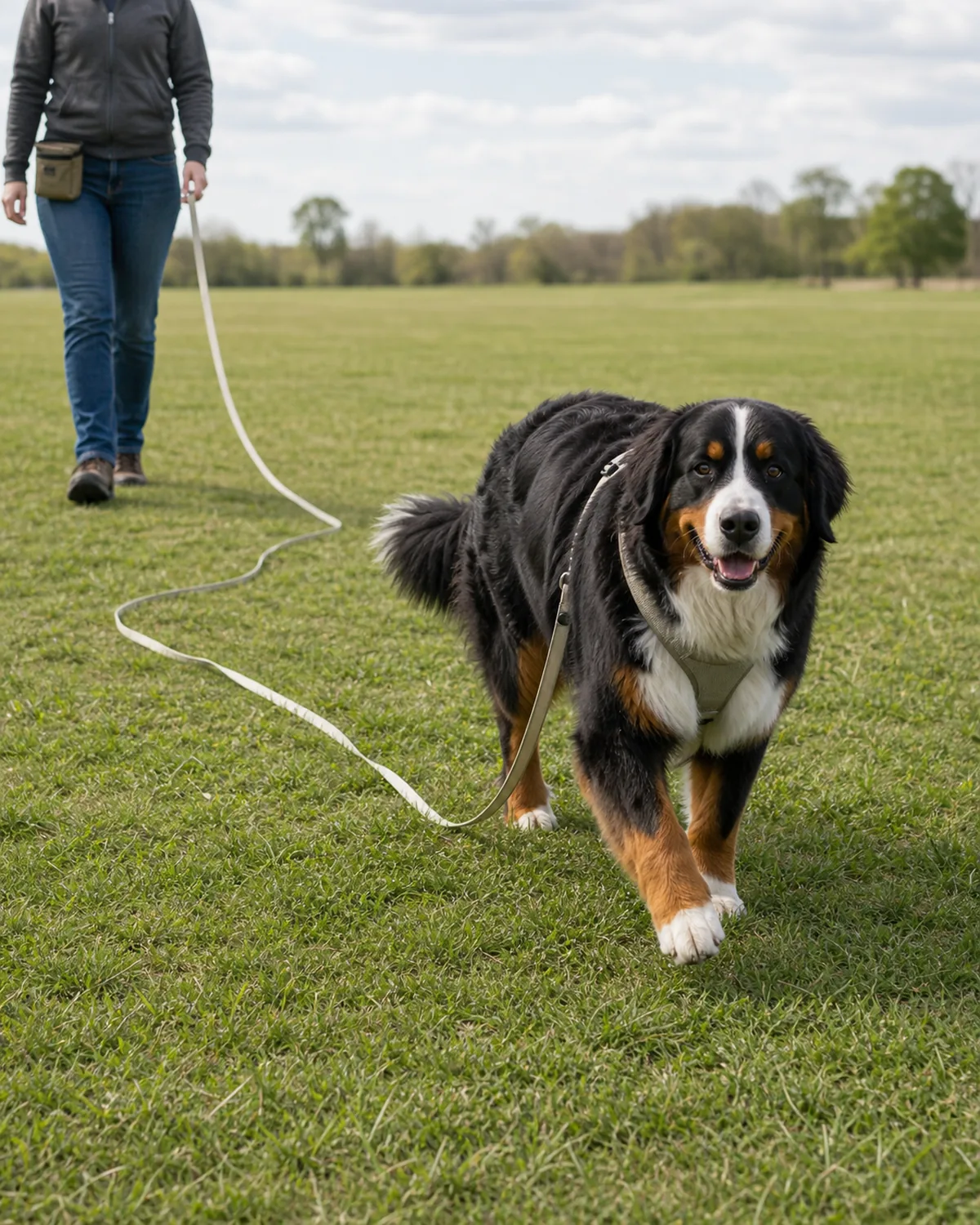
The long line is the gear that makes everything else work. Twenty to thirty feet of flat biothane or cotton — not retractable — clipped to a Y-front padded harness with a back D-ring. The line drags loose on the ground; you don’t hold it tight. The point is not to control the dog. The point is so when you call, you can guarantee the recall happens.
If they don’t come, you walk down the line, take it up, and lead them back gently. No yelling. No dragging. The line means every recall rep ends successfully, which means every rep is another deposit. Use it for thirty days minimum, even in fenced yards. Then transition to a fifteen-foot drag line for another month.
- Use a flat biothane or cotton line, never a retractable, never on the collar.
- Clip to a back-clip Y-front harness so a sudden pull doesn’t hit the neck.
- The line is for guaranteeing reps, not yanking the dog back — keep it slack.
The steps work because of four ideas underneath them. Get these right and recall builds week over week; ignore them and these are the mistakes that quietly burn down everything you taught.
The Mid-Run Recall Drill: Call, Run Away, Pay Big
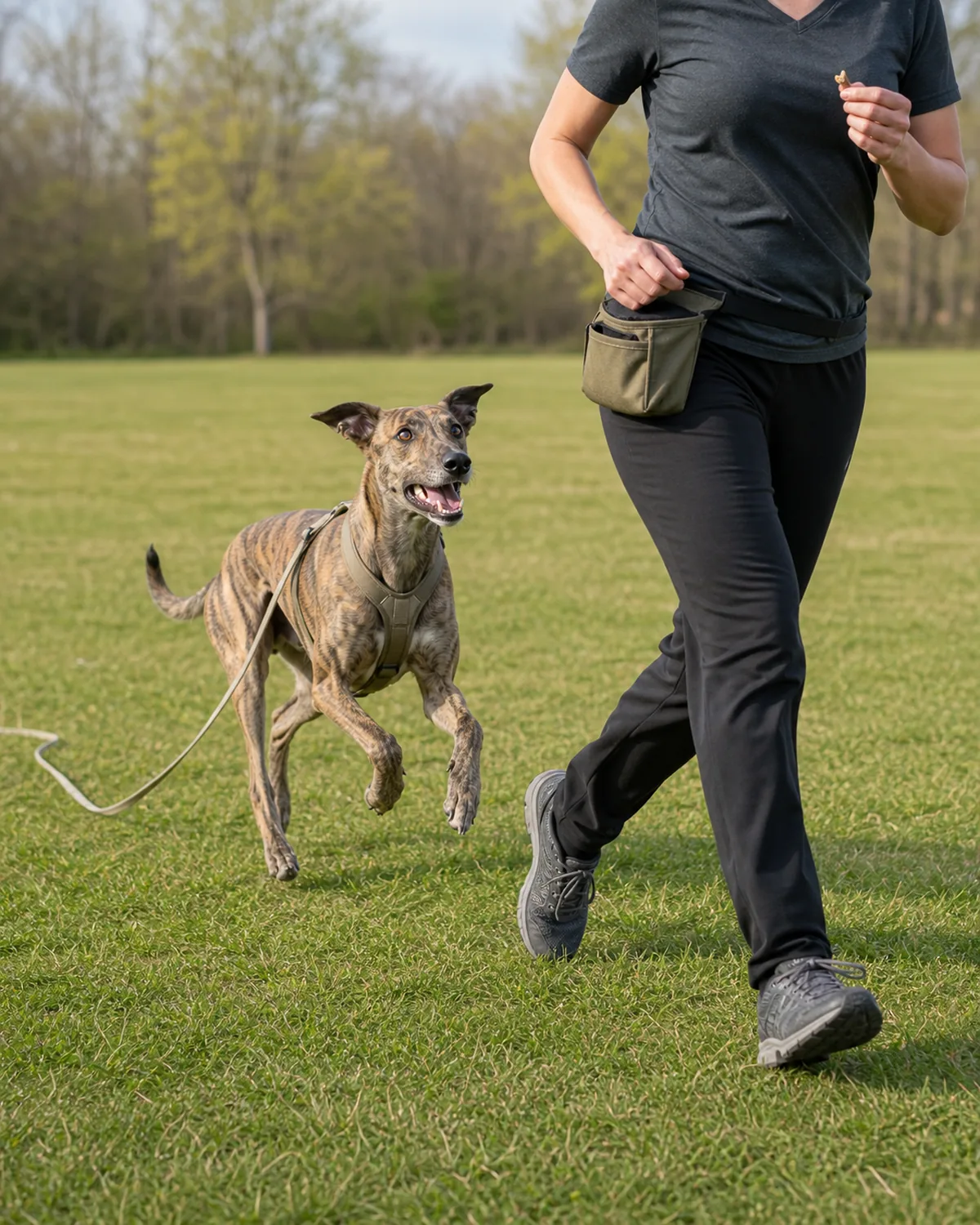
Standing still and calling a distracted dog is the slowest way to teach recall. Call the cue, then immediately turn and jog backward ten steps. Your dog’s chase drive does the rest — they will run toward you almost reflexively, because moving away triggers follow behavior in nearly every dog.
When they catch up, jackpot. Five to ten small pieces of high-value food, one at a time, for about fifteen seconds. Then release. Insert this drill three to five times into every walk. Your dog never knows when the run-away is coming, which keeps you interesting all day instead of just at meals.
- Turn and jog backward the moment you say the cue — don’t wait for a response.
- Pay over fifteen seconds in many small bites, not one big piece, to extend value.
- Randomize the drill across the walk; predictability is what dulls a working cue.
Premack: Use the Distraction As the Reward
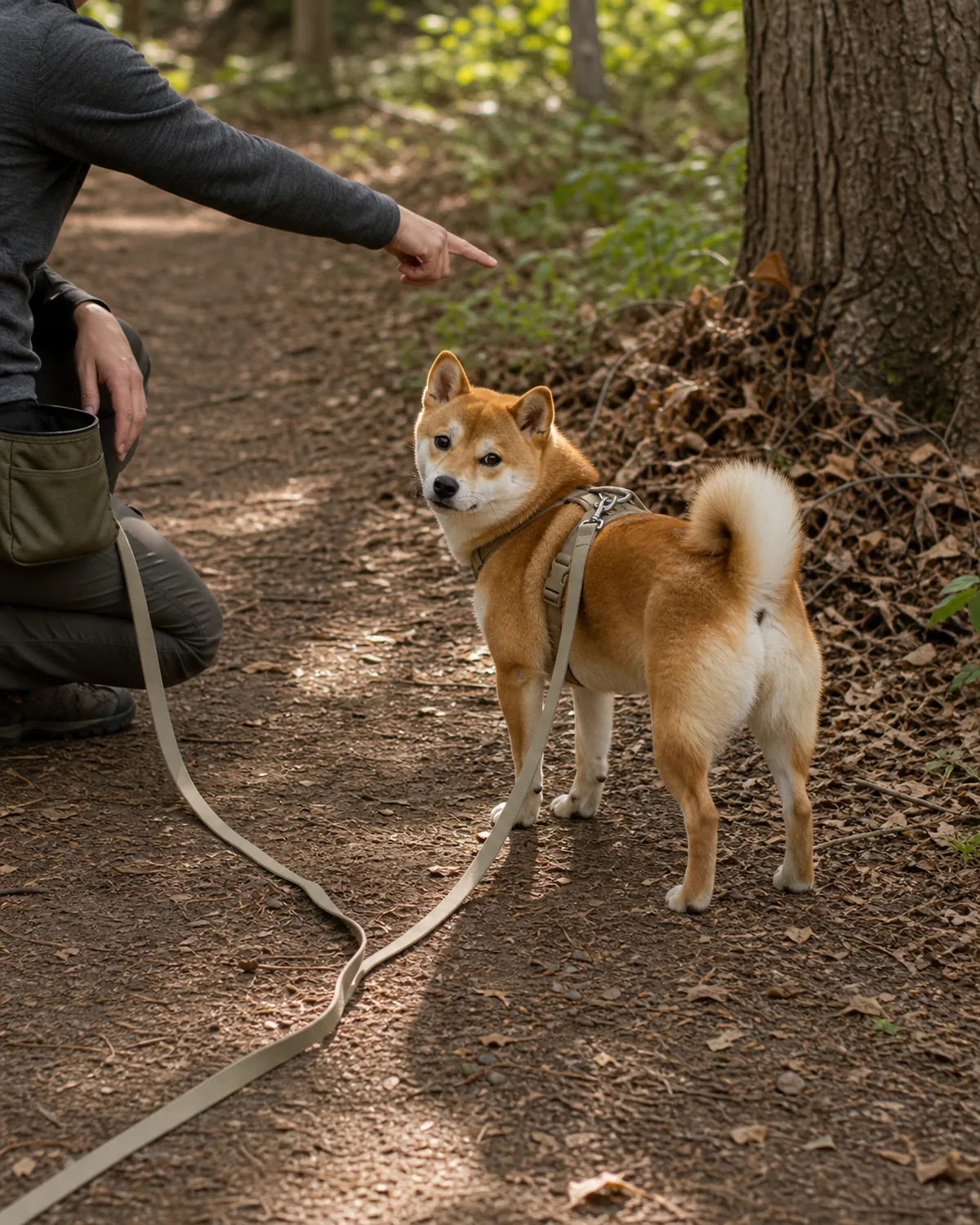
The most advanced trick is also the simplest. Your dog wants to sniff a tree. You call them back, mark, pay one small treat, then point at the tree and say “go sniff.” The distraction itself becomes the reward. After a few weeks, recall starts to mean “the door to the fun thing opens” rather than “the fun thing ends.”
This pattern, named after psychologist David Premack, is what flips off-leash from anxious to easy. The dog learns that returning to you is a transaction, not a punishment. You owe them the squirrels, the smells, the play. The fastest way to lose a reliable recall is to make every successful one end in the leash coming on and going home.
- The release back to the distraction is part of the payoff — don’t skip it.
- Premack works on sniffs, play with other dogs, fence-trotting, even chasing leaves.
- Save end-of-park recalls for the rare jackpot version — not your daily default.
Emergency Recall: A Separate Word for “Drop Everything and Come Now”
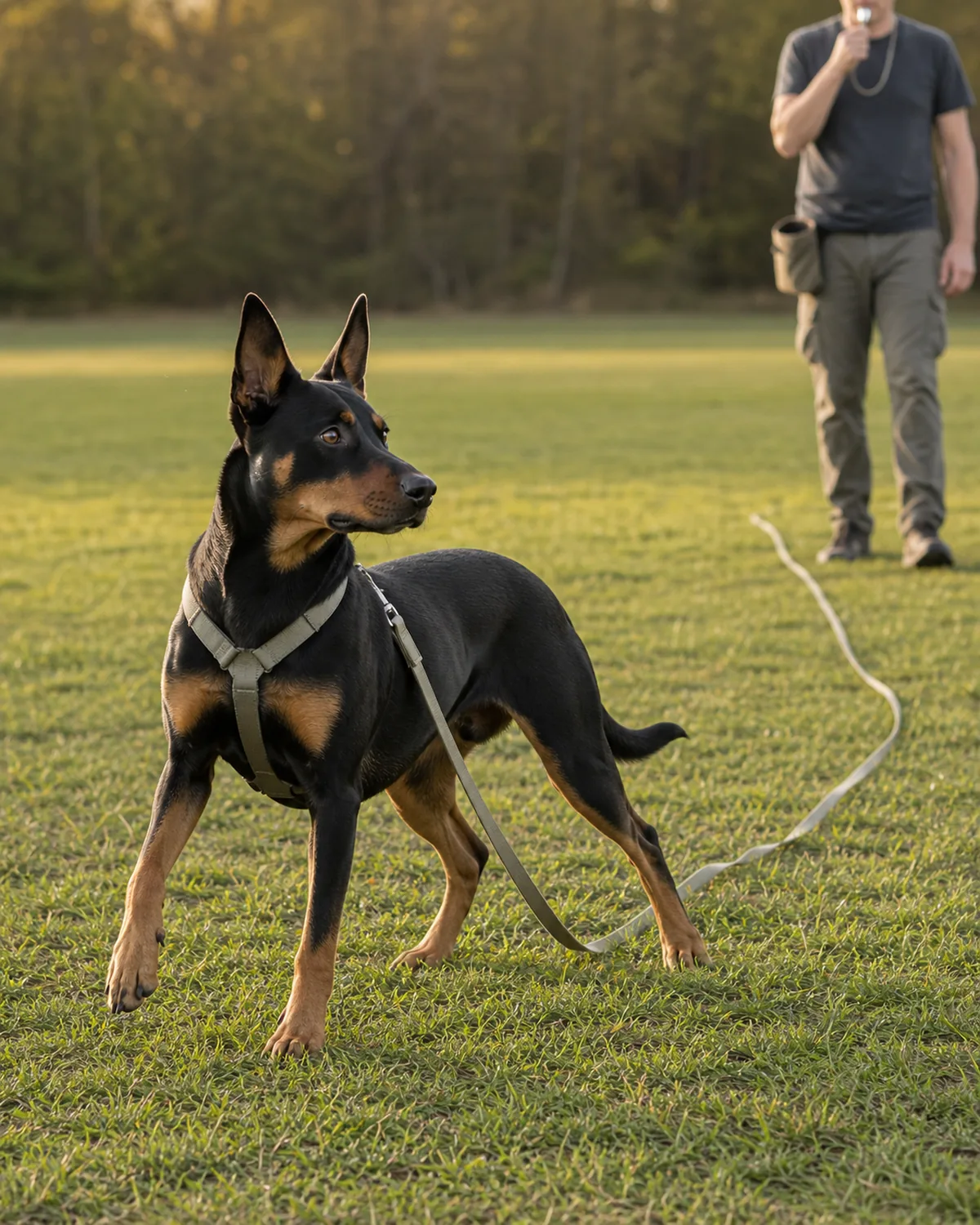
Your daily cue will sometimes fail. That is fine. But there are moments when a missed recall would mean a car, a fight, or a swallowed pill bottle, and those moments cannot fail. Build a second, sacred cue — a word you have never said before plus a short whistle pattern — and reserve it for emergencies.
The rule is brutal: this cue is only ever paid in jackpot, and only in safe, controlled training reps. Never use it to call the dog in from the yard, never to clip a leash on. A fresh-roasted chicken thigh on a plate when the dog returns. One reckless use in a non-emergency context burns the cue forever, so guard it.
- Pick a brand-new word the dog has never heard, plus a clear whistle pattern.
- Drill it once a week in controlled setups with the biggest jackpot you can make.
- Never use the emergency cue daily — it is a one-shot tool, not a backup recall.
How to Teach a Dog to Come When Called: 30-Day Plan
- 1It’s a bank accountEvery paid recall is a deposit; every unpaid call is a withdrawal — audit the balance.
- 2The recall gameLong line plus jackpot reward plus release — every rep, no exceptions.
- 3Charge the cueKitchen first: say the word, mark, treat — twenty reps a day for three days.
- 4Don’t poison itNever punish the return; never call when you can’t enforce; never end the fun.
- 5Climb the ladderKitchen, hallway, backyard, quiet street, busy park — only when the rung below is solid.
- 6Long line is gear30-foot biothane on a back-clip harness — not retractable, never on the collar.
- 7Run away as you callCall, then run backward — chase drive beats standing still every time.
- 8Premack the rewardRecall back, mark, treat, then release back to the sniff or play — open the door.
- 9Emergency cueA separate word plus whistle — only ever paid in jackpot, never burned daily.
- 10No second callMissed cue? Close the distance and lead back calmly — never repeat the word.
- 11Real-world safety15-foot dragline for thirty days off-leash; random recalls in dog parks too.
- 12Stick the 30 daysMost owners quit day 7 — that flat week is when recall actually clicks.
- 13Some dogs manageScent hounds and sighthounds may need long-line management, not perfect recall.
pawliqa.com
What to Do When Your Dog Ignores You: The No-Second-Call Rule
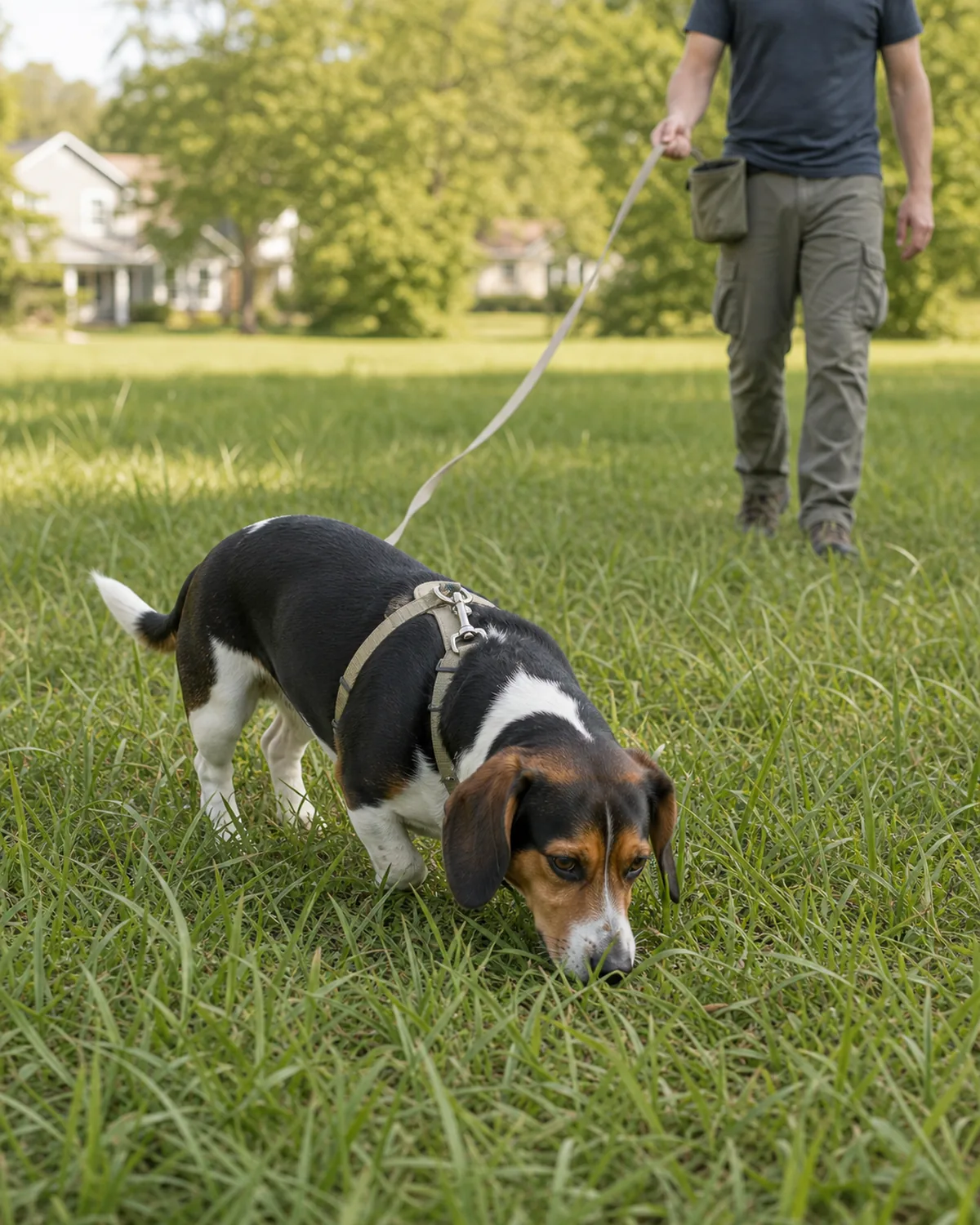
You call once. Nothing happens. Now what? Do not call a second time. Do not call a third time. Each repetition burns a little of the cue. Instead, calmly walk down the long line, gently take up the slack, and lead your dog back to where you were standing. No talking. No scolding. Just close the distance and reset.
Once you are both back where you started, give them thirty seconds of leash-restricted neutrality, then release them back to sniff with no further punishment. The next session, drop down a rung on the ladder. The cue you just used is fine — what failed was your environment management. Fix that and the cue keeps working.
- Calling the cue twice in a row is the fastest way to teach the dog to ignore it.
- Take up the long line calmly — this is a reset, not a correction.
- The next session drops two rungs down the ladder; the cue itself stays intact.
Recall in the Real World: Parks, Hikes, Off-Leash Beach
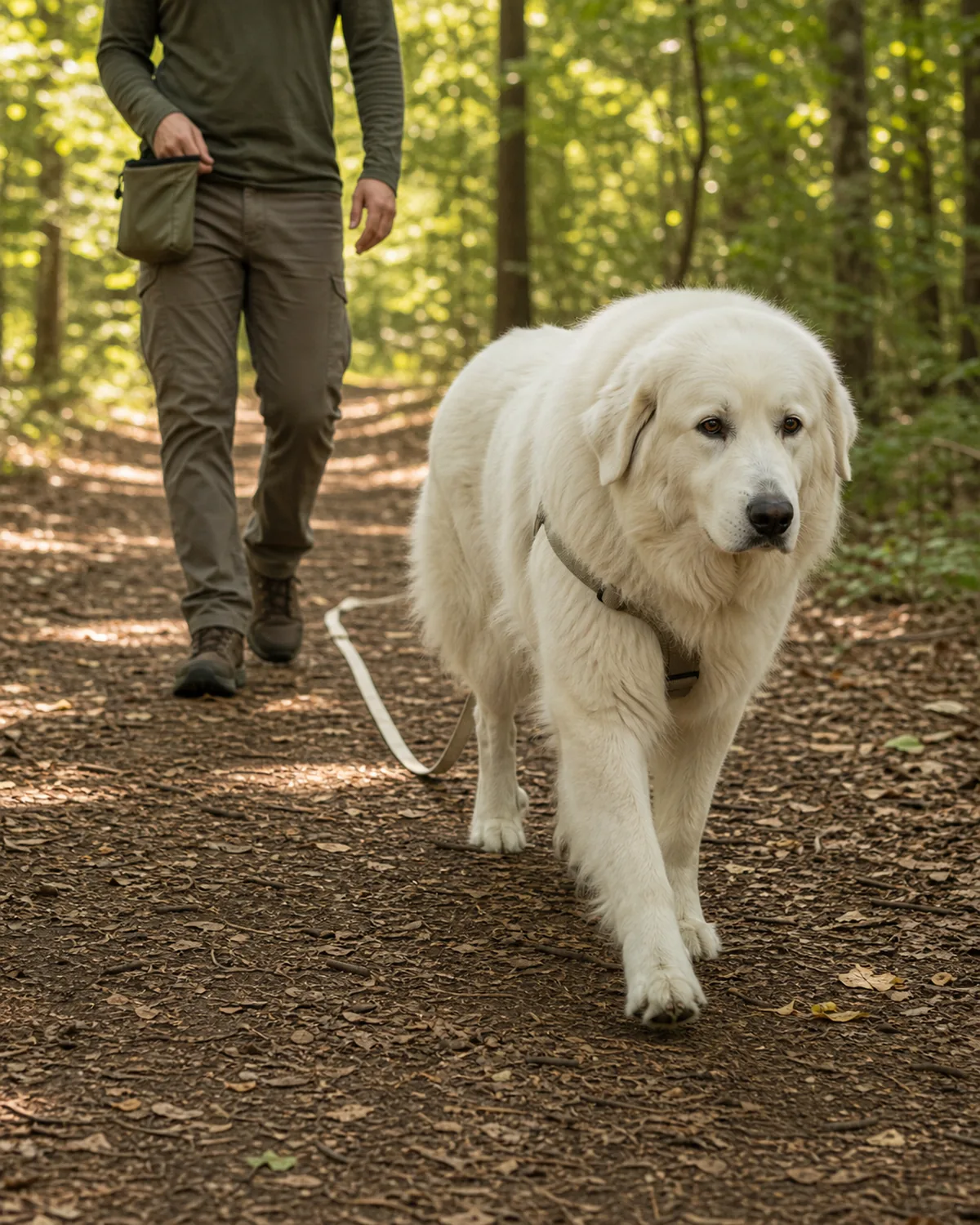
Real environments are where recall earns its keep, and where most owners get over-confident too soon. Two rules. First, your dog wears a fifteen-foot drag-line for thirty days after their first off-leash session. They forget it is there; you can step on it. Second, rehearse a random recall every two to three minutes on hikes and at parks, before you ever stop holding the line entirely.
That cadence builds an “interrupt-and-return” pattern. The dog learns that recall happens often and is always rewarded, so it never feels like the end of fun. On the day a real distraction shows up — a runner, a stray dog, a cliff edge — that pattern is already loaded and ready to fire.
- Use a fifteen-foot drag-line for the first thirty days of any new off-leash venue.
- Practice a random low-stakes recall every two to three minutes; pay it like a reward.
- New venue equals dropping one rung on the ladder; treat each park like a first park.
The 30-Day Recall Plan: Most People Quit Day 7
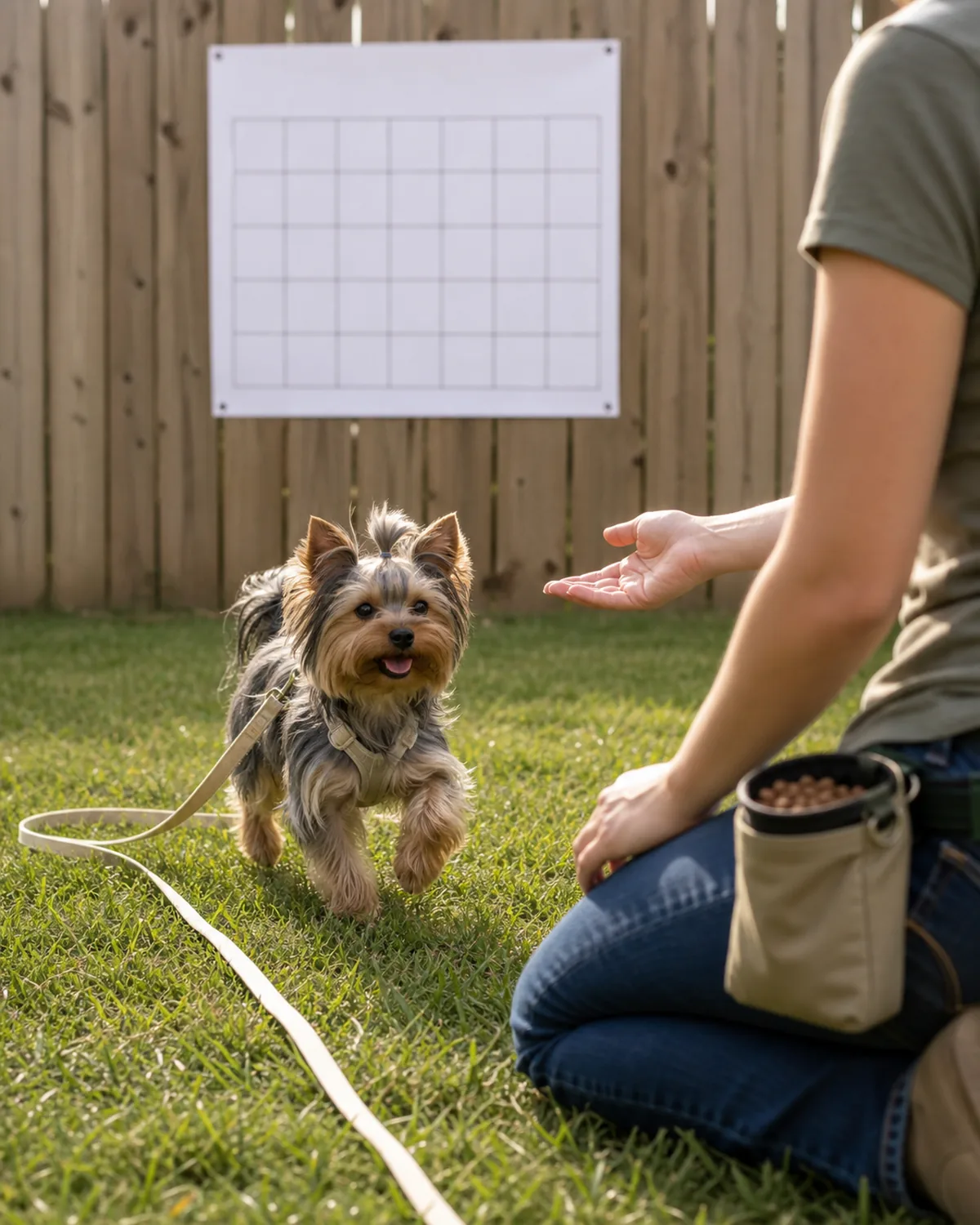
Here is the skeleton you can hang the rest on. Week one: indoor charge-the-cue drills, twenty reps a day across kitchen, hallway, and living room. Week two: backyard recall game on a long line, mid-run drill, distance growing from five to fifteen feet. Week three: quiet streets early morning, distance to thirty feet, introducing premack on real smells.
Week four: higher-distraction park, all four tools layered, emergency cue introduced once a week. Day seven to ten almost always feels like nothing is working. That is the week the cue is actually about to click.
Crate training in the same month gives the dog a calm baseline to come back from. Keep sessions under ten minutes. Push through that flat week and the curve breaks upward.
- Week one indoors, week two backyard, week three quiet street, week four park.
- Day seven to ten feels flat — push through; that is when the cue is consolidating.
- Keep training sessions under ten minutes; daily-life recalls don’t count toward that.
When Recall Won’t Stick: Scent Hounds, Sighthounds, and Managing Instead
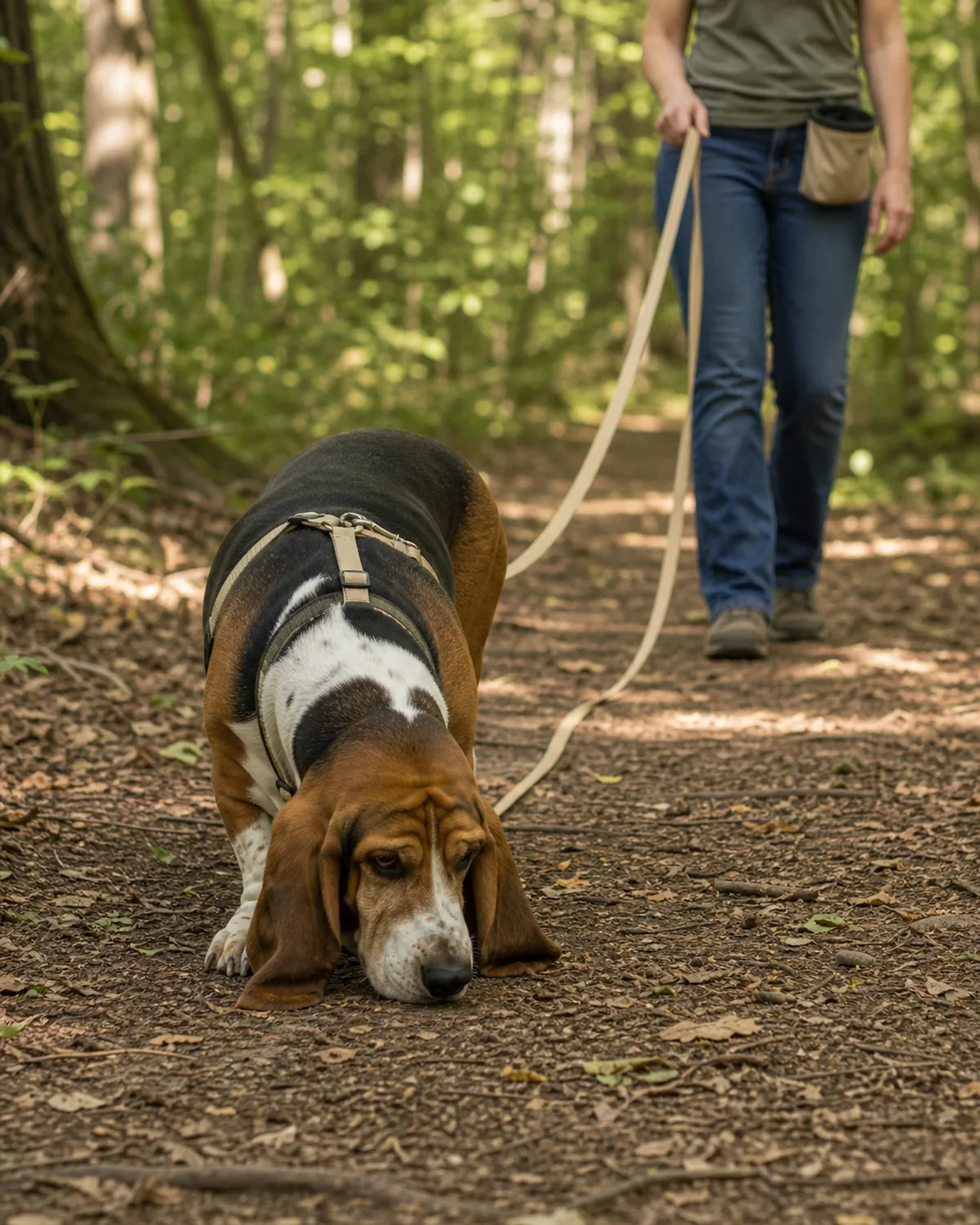
Some dogs do not have a recall ceiling that matches off-leash freedom. Dogs bred for scent work — beagle and basset families — switch off external input the moment the nose engages. Dogs bred for sight-driven pursuit can see and chase before you finish the cue word. Four to six weeks of textbook training that doesn’t move the needle is usually a hardware signal, not a training failure.
For those dogs, the honest answer is to manage rather than train. A long line on every walk. A fenced area for off-leash. A working partnership with a force-free, fear-free certified trainer if the gap is wide.
As with any trigger-based behavior, recall only stays clean when you stop spending the cue in situations the dog can’t win. Manage the environment and the relationship stays intact.
- Four to six weeks of correct training with no progress is a hardware signal.
- Scent hounds and sighthounds often need lifelong long-line or fenced management.
- Certified force-free trainers (CCPDT-KA, KPA, IAABC) help diagnose the ceiling.

Jess Calloway edits Pawliqa, where she shares dog care, grooming, training, and new-owner tips — plus DIY and pet-friendly home ideas — for anyone who wants a happy, well-cared-for dog. As a dog mom to three very different dogs, she writes the honest, tested version of what actually works. Every guide is image-led and reviewed for clarity, usefulness, image accuracy, and Pinterest-to-page alignment before it goes live. Visit the About page.