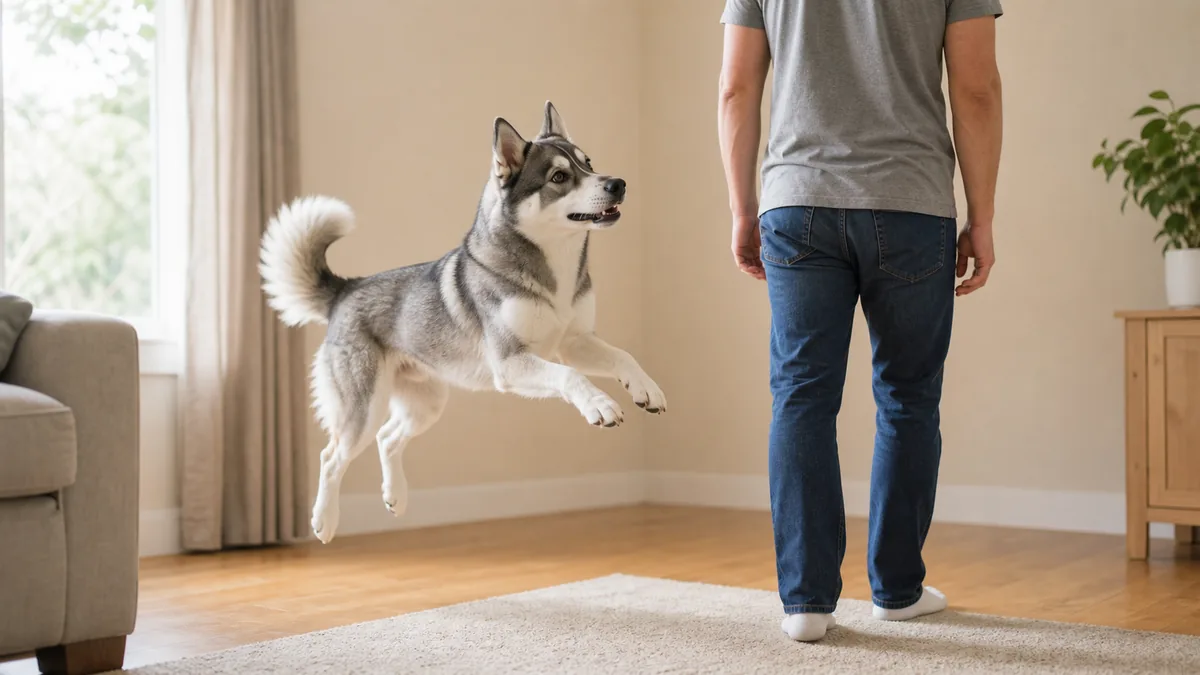
Jumping on people is one of the most common complaints from dog owners — and one of the most accidentally trained behaviors out there. It starts cute in puppyhood, gets reinforced by every person who laughs or pets the dog, and suddenly feels impossible to fix.
Here is the part most guides skip: your reaction is almost certainly making it worse. Every push, every “no,” every knee-up is still attention. And attention is what the dog wanted. You are feeding the behavior you are trying to stop.
This guide walks through the full protocol — extinction principle, door management, guest consistency, and marker timing. Every piece of it has been tested in my own house with dogs who had years of jump history built in.
Jumping is not a dominance problem and it is not a breed problem — it is a dog who learned that launching at people gets a reaction. The fix is consistent extinction, a clear sit-to-greet replacement, and every person your dog meets staying on the same page. Here is the full protocol, from the first turn-away to the confident front-door greeting.
- 1Why dogs jump and why scolding makes it worse
- 2The extinction rule: zero reaction the moment paws leave the floor
- 3The 180° turn-away: how to do it correctly
- 4Teaching the sit-to-greet replacement behavior
- 5Mark and reward four paws on the floor — timing is everything
- 6Managing arrivals: exercise, leash, and the calm-entry sequence
- 7Briefing guests: the one-sentence script that keeps training on track
- 8Practice reps: low-distraction first, then real-world arrivals
- 9Children and elderly visitors: the higher-stakes management plan
- 10The crate and leash as management tools between training sessions
- 11Why the whole household must follow the same rules
- 12Progress timeline: what to expect in week one and week four
- 13When to get a trainer: anxiety jumping vs. habit jumping
Why Dogs Jump on People (And Why Instinct Makes It Worse)
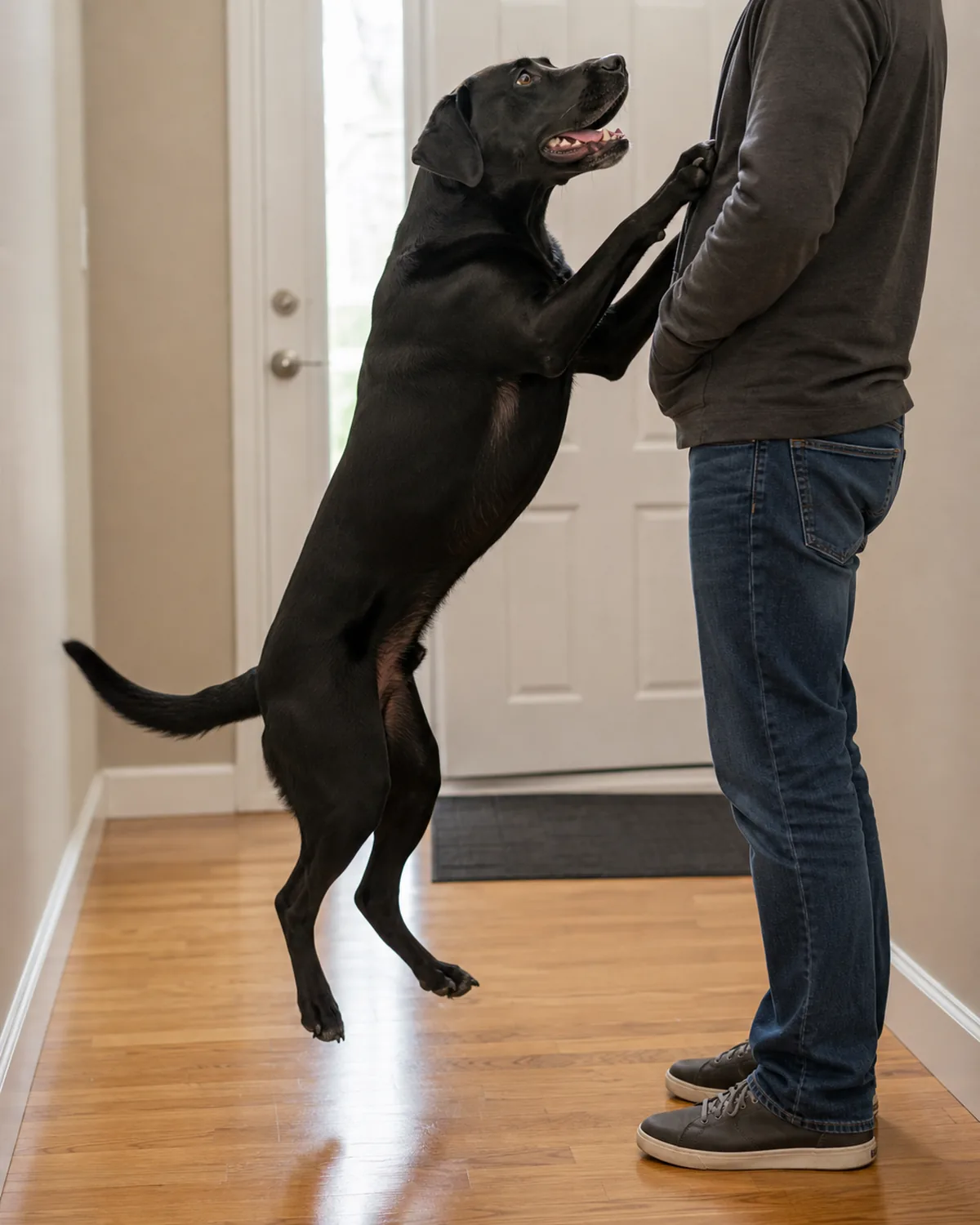
Jumping is not defiance. It is a social greeting behavior that is hardwired from birth. Puppies sniff the faces of adult dogs to gather information and signal submission — jumping up is an attempt to reach a human face and say hello the way they were built to.
Every time that jumping produced eye contact, a laugh, a push, or any touch at all, the behavior got stronger. It did not matter that you were annoyed. The dog was not reading your tone — it was reading the outcome. Contact happened. Jump worked.
That is the mechanism that makes this so sticky: once a behavior lands on an intermittent reinforcement schedule — rewarded sometimes but not always — it becomes the most resistant to extinction. The dog keeps trying because the reward is unpredictable, not because the dog is stubborn.
The first rule of fixing jumping is stopping the accidental reinforcement. Not reducing it. Stopping it entirely. One person rewarding it undoes the work of ten who do not.
The Core Rule: No Reward While Four Paws Are Off the Floor
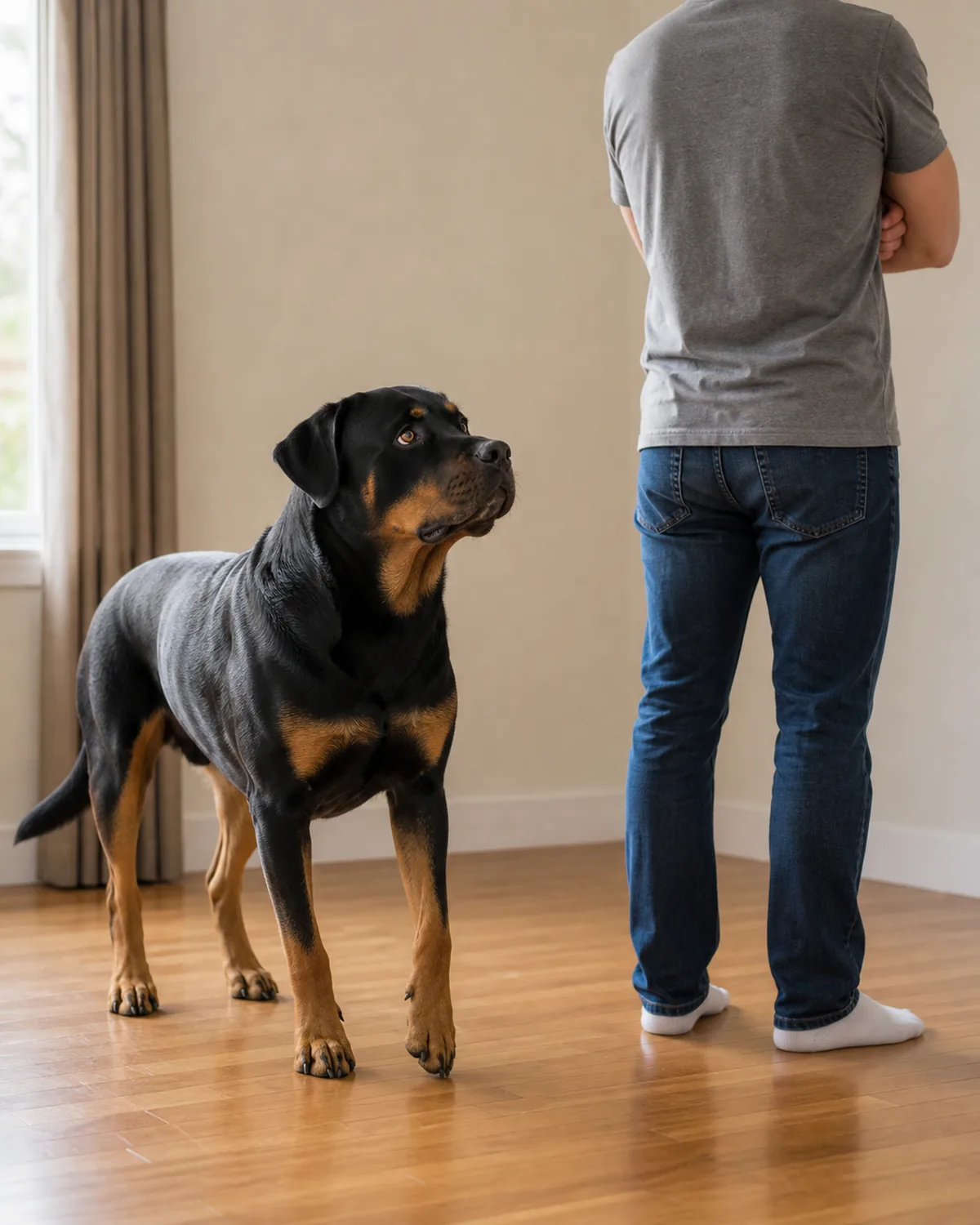
Extinction has one requirement: remove all reinforcement the moment the behavior occurs. Not most reinforcement. All of it. No eye contact, no voice, no touch, no shift of weight toward the dog.
The timing matters more than most people expect. A delayed “no” — even a second after the paws land — still marks the wrong moment. The dog connects the reward or punishment to whatever happened in that moment, not to what occurred two seconds ago.
When the dog jumps, your entire job is to become instantly unrewarding: no face, no hands, no words. The millisecond the dog stops jumping and paws are on the floor, that is the window for attention. Not before.
This rule applies to everyone. The behavior stays on an intermittent schedule as long as one person still delivers attention on the jump. Consistency is not a training preference here — it is a biological requirement for extinction to work.
Turn Away, Not Into: The Body Language Reset
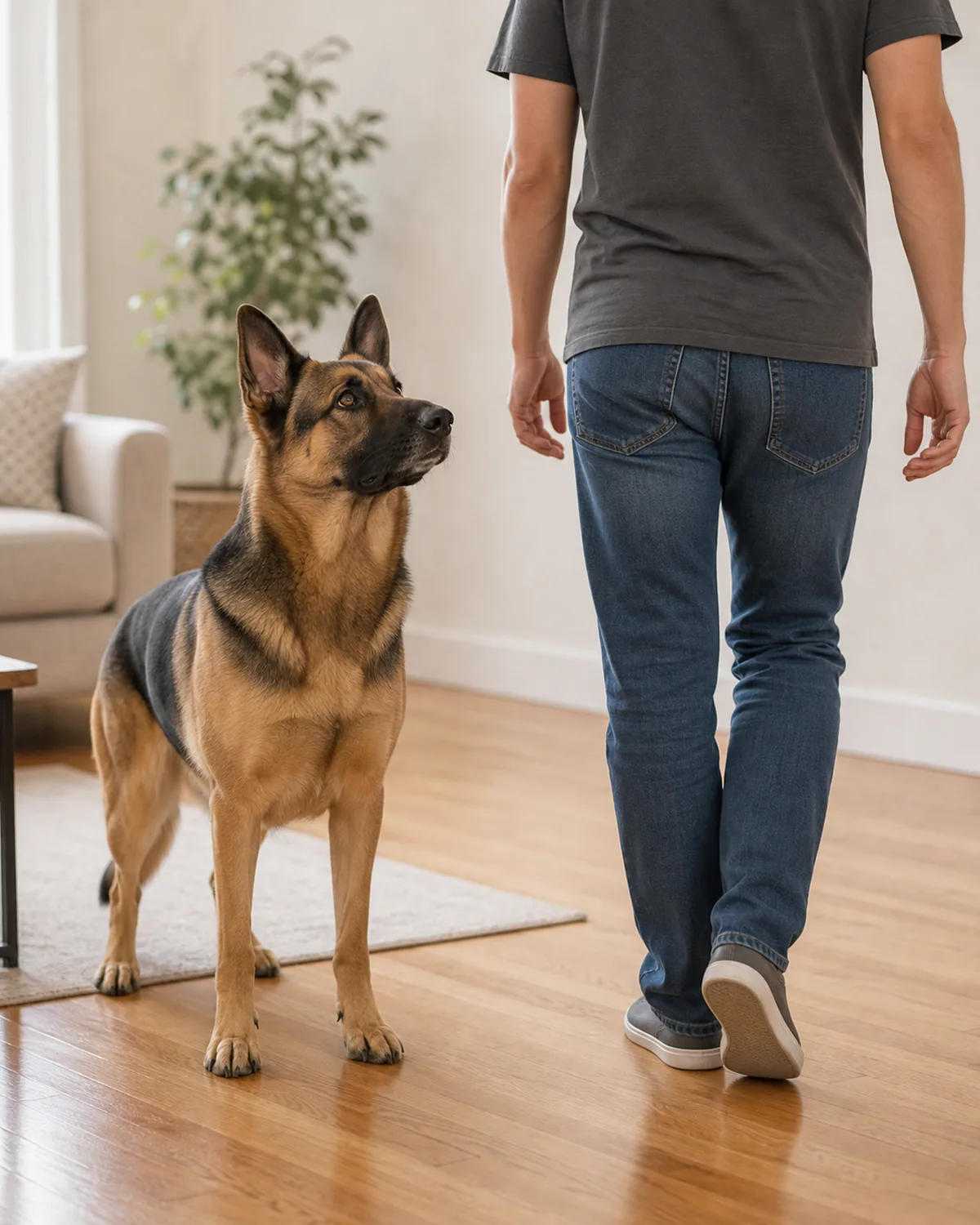
The turn-away is the physical execution of the core rule. The moment front paws leave the floor, you make a smooth 180° pivot: cross your arms, face away from the dog, go silent. No other movement. No glance back.
The reason this works is that turning into the dog — even to push it down — is still engagement. Your body facing the dog is the social reward. The dog is not analyzing your emotional state; it is reading whether your attention is available. Turning away removes that signal entirely.
Hold the position until you feel four paws on the floor and a genuine two-second settle — not a brief landing before the next attempt. Then turn slowly and calmly deliver attention. If the dog jumps again in response to you turning, you pivot again immediately.
This feels unnatural at first because it requires doing nothing when your instinct is to react. That gap between instinct and protocol is exactly where most training falls apart. The pivot must become automatic.
The protocol is the same whatever your dog’s age — extinction plus a replacement behavior — but where you start and how fast you can move depends on how deep the habit runs. A puppy who has jumped twice is a very different training problem from a three-year-old who has been greeted with hands and squeals every day of his life. Match your entry point to your dog’s actual history.
Teach “Off” as a Cue, Not a Correction
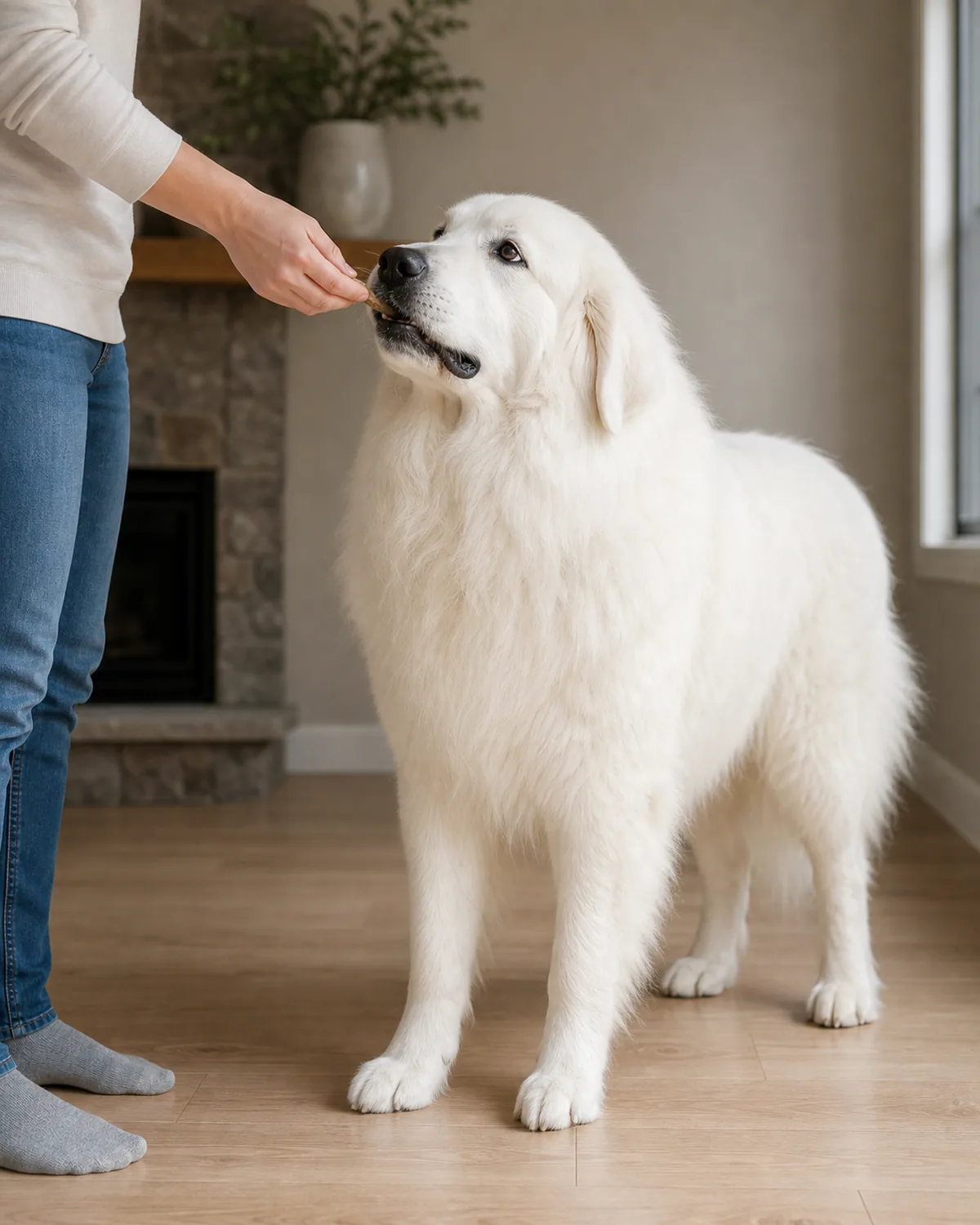
“Off” is not a punishment word. When you say it in frustration after a dog has been jumping for three seconds, it is noise. The goal is to build “off” as a predictive signal that means four paws on the floor equals something worth doing.
Timing for this is counterintuitive: say “off” the moment the front paws land on the floor, then immediately mark and treat. You are not luring the dog down, and you are not rewarding the jump.
How “Off” Becomes a Reliable Cue
You are pairing the cue with the behavior of four-paw contact, so the word eventually calls up that behavior on its own.
Once the dog has a strong “off” response with low distraction — practiced deliberately, not during real greeting chaos — you can use the cue at greetings, furniture, and counters.
The same cue covers all surfaces because the behavior it calls is always the same: all four feet on the floor.
The Sit-to-Greet Protocol: Replace Jumping With a Job
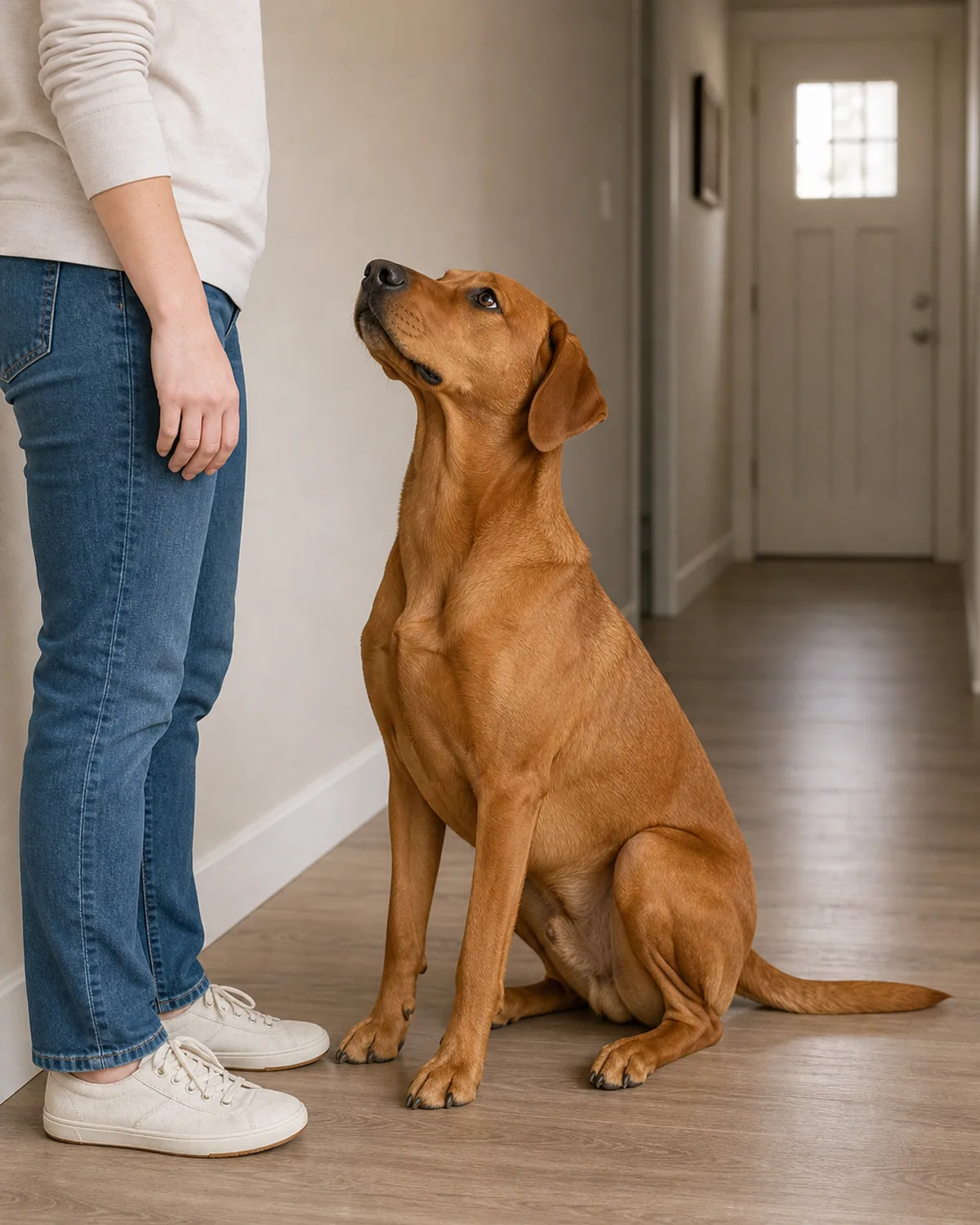
Extinction removes a behavior, but it leaves a vacuum. Dogs who are not jumping still need to do something during a greeting, and without a replacement behavior, that energy tends to find another outlet — circling, barking, or a different kind of pushy contact.
The sit-to-greet protocol gives the dog a job. Sitting is the only behavior that unlocks a greeting. A hand extends only when the dog holds the sit. The moment the sit breaks and front paws lift, the hand withdraws and the person turns away. The dog learns the door opens one way.
Start training the sit-for-greeting in a low-distraction setting before adding guests. Practice arrivals with someone the dog knows, repeat five to ten times in a session, and end on a successful hold.
Dogs cannot jump and sit simultaneously — you are redirecting arousal into an incompatible behavior, not fighting the arousal itself.
Door Arrivals: Manage the Trigger Before Training Takes Over
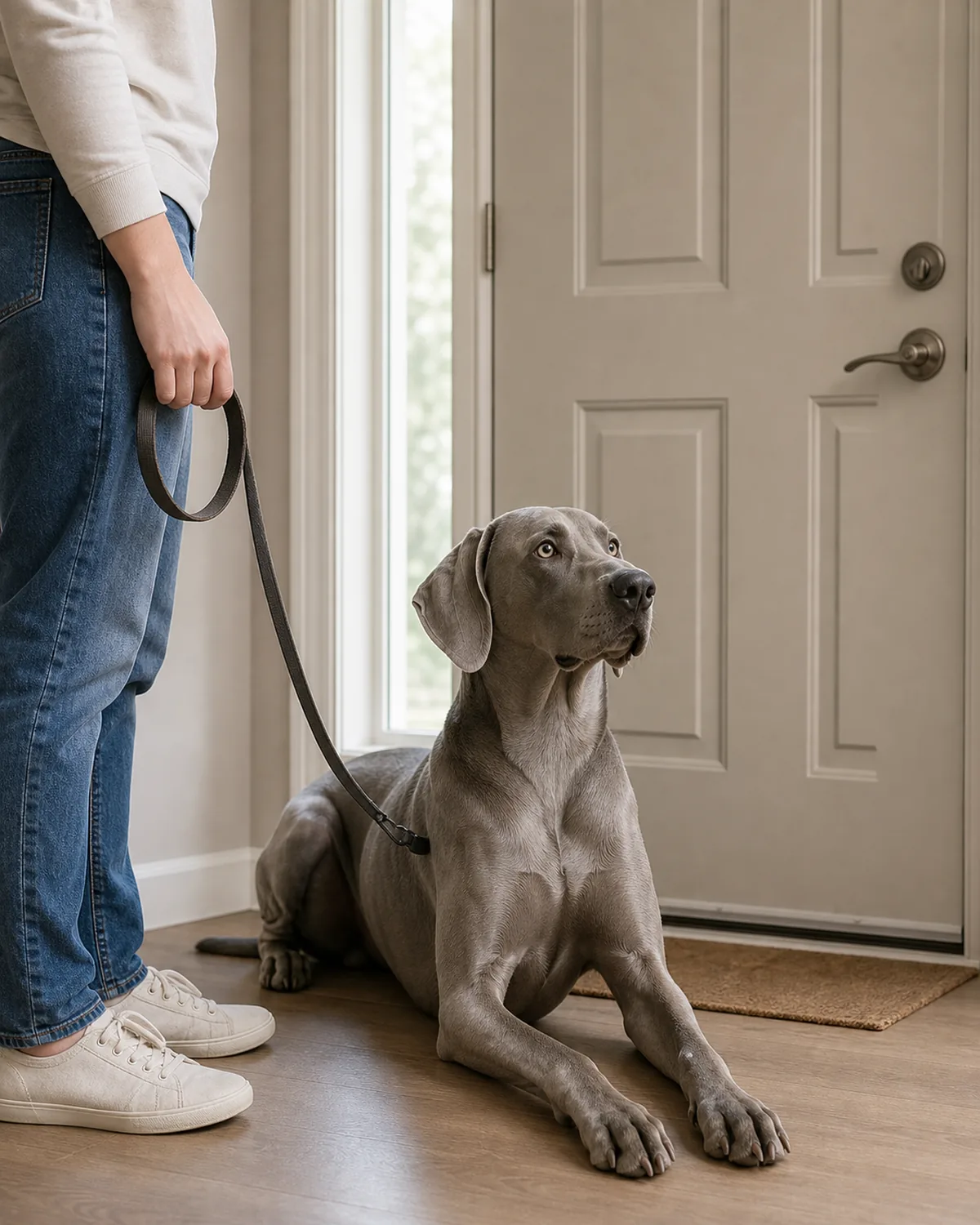
The door is the highest-arousal moment in a dog’s day. Training a sit-to-greet in the kitchen is not the same thing as holding it together when the doorbell rings and someone walks in. Management fills the gap while the trained response is still fragile.
Lower the Energy Before the Door Opens
One of the most underestimated tools is exercise before the arrival. A solid walk or play session beforehand reduces the energy load significantly.
Understanding how much exercise your dog needs changes how manageable door greetings become — an under-exercised dog is working against its own impulse control.
Use a Leash and Barriers to Fill the Training Gap
A leash at the door gives you a way to structure the greeting without relying on the dog to self-regulate what it cannot yet reliably self-regulate. Keep it loose and use it only to prevent full rehearsal of the jump, not as a correction tool.
If guests arrive before the dog is settled, the most reliable option is a crate or a barrier gate — removing the dog from the trigger until arousal drops, then doing a calm introduction separately.
Management is not training. It does not teach the dog anything about what to do. But it prevents practice of jumping during the period when the replacement behavior is not yet solid enough to hold under pressure.
Stopping jumping is not complicated, but it is unforgiving. Every rule below exists because breaking it keeps the behavior alive — usually without the handler realizing it. Read all five before you start your first session.
-
1
Zero reaction the moment paws leave the floor — silence, stillness, and a 180° turn.Any sound, eye contact, or touch — including “no” or pushing the dog down — is attention, and attention is the reward that keeps jumping going. The turn-away must happen the instant the jump begins, not after the dog lands.
-
2
Everyone your dog meets must follow the same protocol, every single time.One person who lets the jumping slide keeps the behavior on a variable reinforcement schedule — the most powerful schedule in learning. Variable rewards are harder to extinguish than consistent ones. Every exception resets the progress clock.
-
3
Mark and reward four paws on the floor, not after the dog sits — timing is the lesson.Your dog needs to learn that ground contact itself earns attention. If you wait for a full sit before you mark, you teach the sit but miss the more important lesson: all four paws on the floor means good things happen, regardless of what the dog does with the rest of his body.
-
4
Manage arrivals before training: exercise first, leash at the door, crate if needed.Arousal is the engine that drives jumping. A dog who has had a proper walk arrives at the door calmer and with more capacity to make the right choice. A leash and a crate are not punishment — they are management tools that prevent the dog from practicing the wrong behavior while the training is still building.
-
5
End every practice session on a successful four-paw greeting, not a failed rep.The last thing your dog experiences in a session is what he rehearses until the next one. If the final rep ends with a jump that got a reaction, that is what he practices. Shorten the session, lower the difficulty, and finish with a win every time.
Getting Guests on the Same Page: The Consistency Script
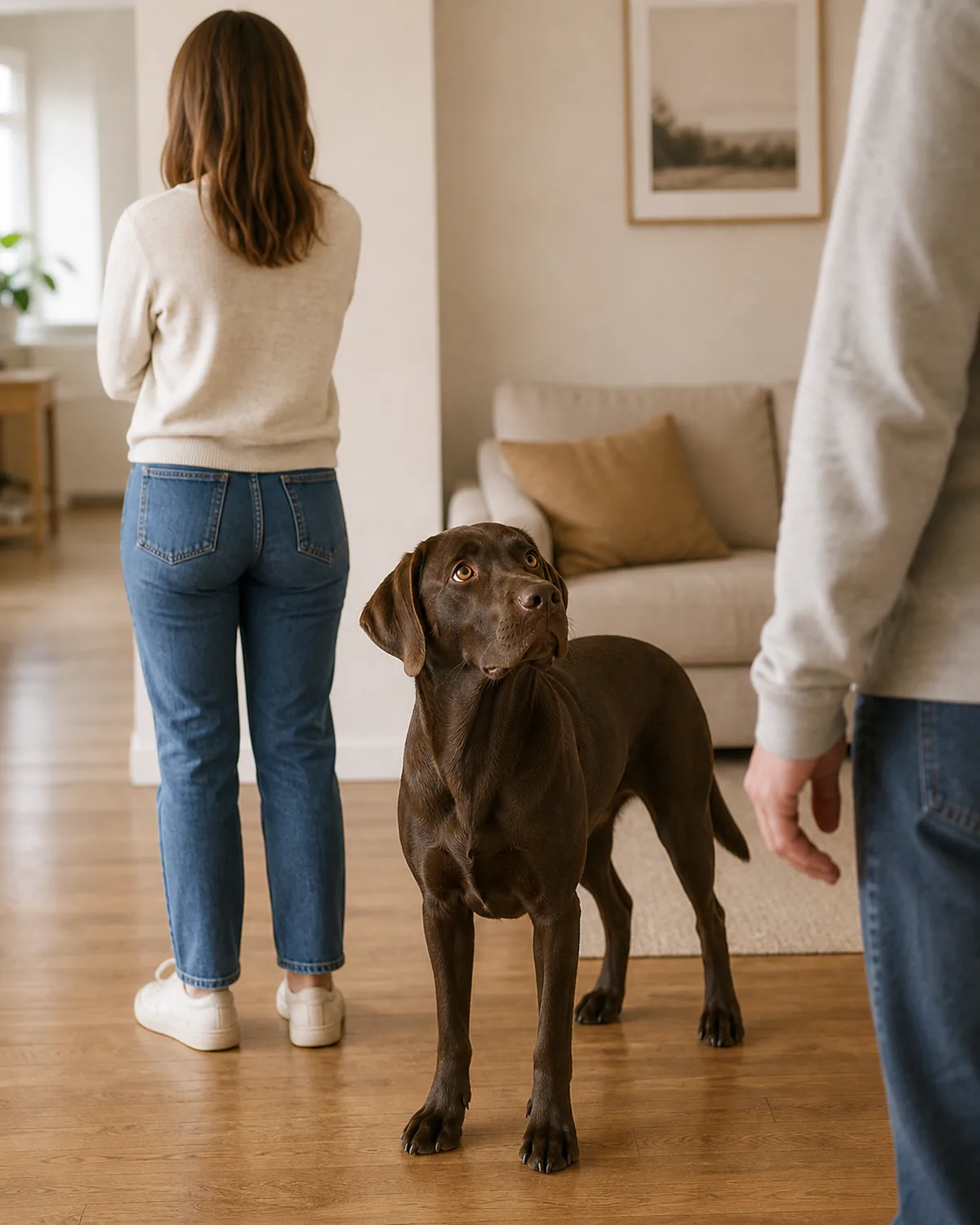
One person rewarding jumping after weeks of consistent training from you is not a minor setback. It puts the behavior back on a partial reinforcement schedule — and partial reinforcement is the most powerful schedule for keeping a behavior alive.
The script does not need to be long. Tell guests before they come in: turn away and cross your arms if the dog jumps, wait for four paws, then say hello. That is the whole thing. Most people will follow a clear, specific instruction more reliably than a vague request to “ignore” the dog.
For environments you cannot fully control — parties, outdoor gatherings, strangers on walks — have a plan ready. A leash gives you a management layer.
A gate or crate removes the rehearsal opportunity entirely. The goal is not perfect training in every situation; it is preventing the behavior from getting reinforced when consistency cannot be guaranteed.
Counter-Surfing: The Jumping Twin You Also Need to Fix
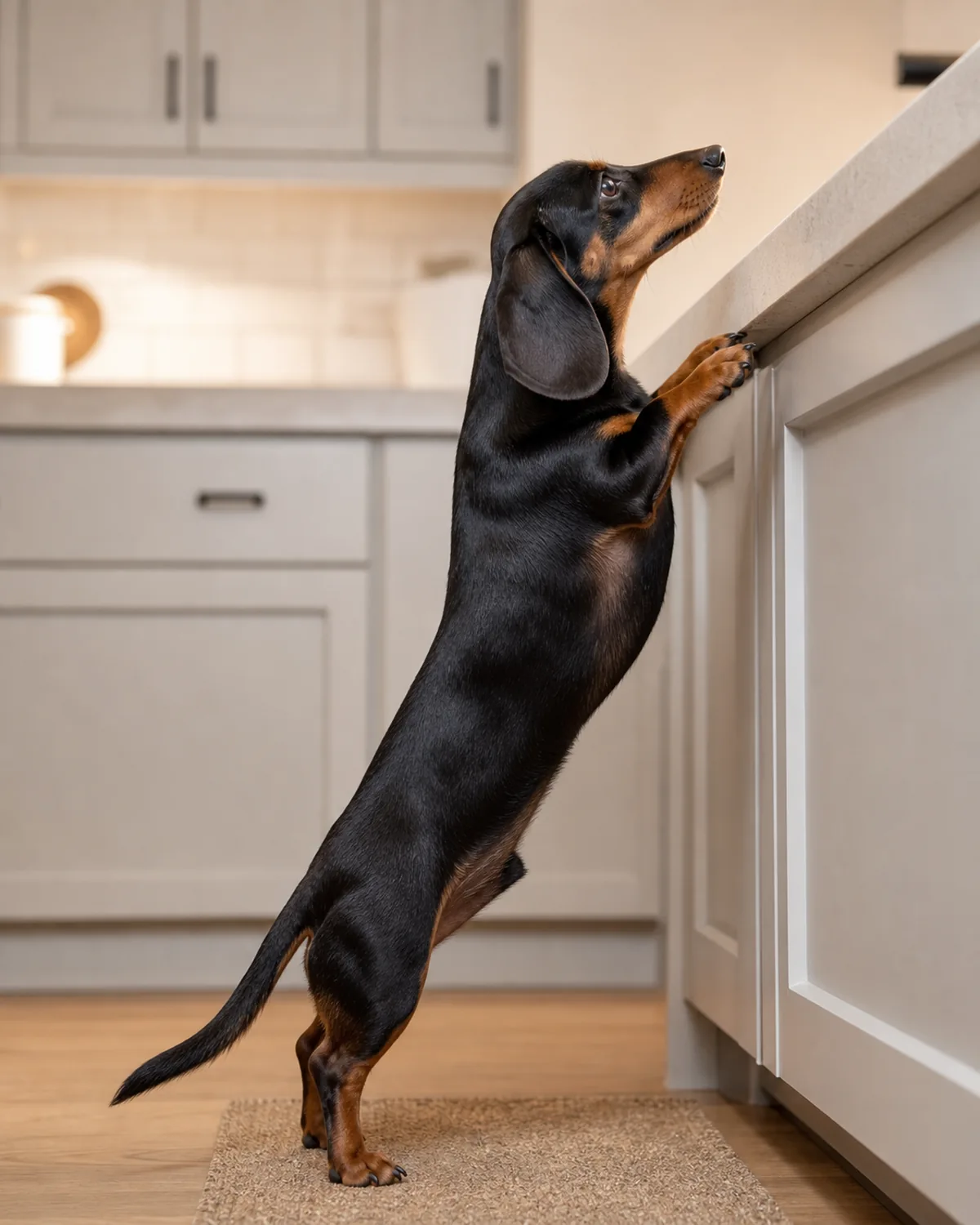
Counter-surfing and jumping on people share the same root: a history of variable reward combined with high arousal in the moment. The dog learned that going up sometimes produces something good — food on the counter, attention from a person — and the unpredictability kept the behavior going.
The protocol is the same. Turn away, remove all attention, and use “off” the moment paws return to the floor.
On counters, management is even more important because you cannot always be present to respond: clear counters of food during training so the variable reward is removed from the environment entirely.
Dogs who jump on people and counter-surf simultaneously usually respond well when both behaviors are targeted with the same framework at the same time. Addressing one while letting the other continue teaches the dog that going up is sometimes appropriate — which keeps the general impulse alive.
Puppies vs. Adult Dogs: Why the Timeline Looks Different
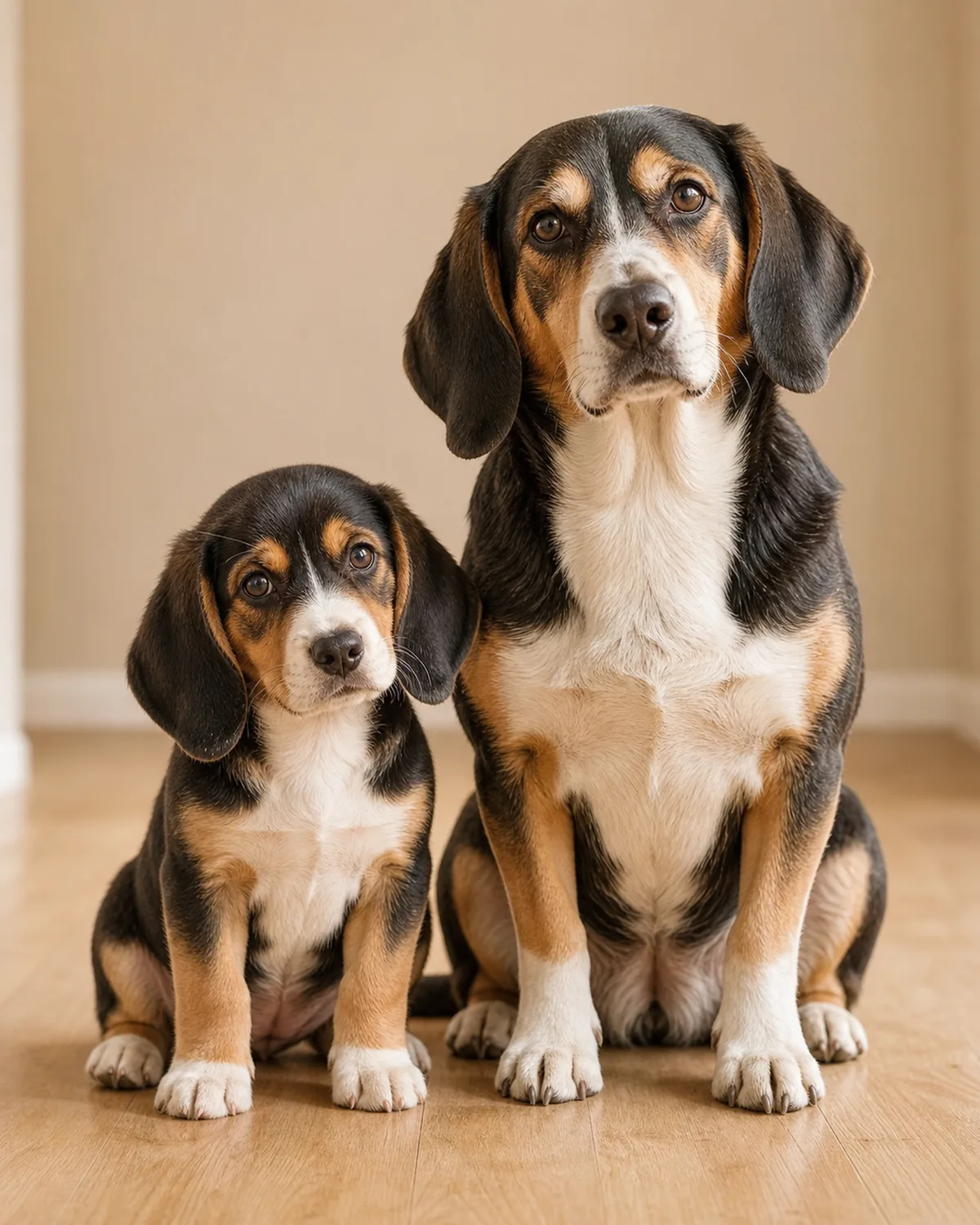
A puppy who has been jumping for three weeks has a much shorter reinforcement history than an adult dog who has been jumping for three years. The protocol is the same, but the timeline is not.
Expect a puppy to show meaningful change in one to two weeks of consistent application. An adult dog with a long history may take four to six weeks, and the extinction burst — a temporary spike in the behavior as it starts to fade — will often be more intense.
The Extinction Burst: When It Gets Worse Before It Gets Better
The extinction burst is the part most owners misread. The dog seems to get worse right before it gets better.
If you hold the protocol through the burst, the behavior drops. If you give in during the burst because it has intensified, you have now reinforced the more intense version, and that version becomes the new baseline.
Why Punishment Slows the Process
Punishment does not speed this up. Corrections and physical blocks teach the dog to suppress the behavior in certain contexts, not to replace it.
When the context changes — new people, high arousal — the suppressed behavior reappears. Consistent application of the replacement protocol produces more durable results, even though it feels slower.
Jump-Stopping Quick Checklist
Run through this list before every doorbell session and every time a new guest arrives. Consistency is the mechanism — not the technique.
- Turn 180° the moment paws leave the floor — before the dog lands.
- Zero eye contact, touch, or speech while the dog is mid-jump or actively soliciting.
- Mark the four-paw landing immediately — verbal marker or clicker, then treat.
- Practice the sit-to-greet cue in a low-distraction space before adding guests.
- Brief every guest before they say hello: “Please turn away if he jumps, and only greet him when four paws are on the floor.”
- Walk the dog before expecting a calm front-door greeting.
- Use a leash at the door to prevent practice reps of the wrong behavior.
- Keep sessions to 5–10 reps; end on a successful four-paw greeting every time.
Children, elderly guests, and anyone who cannot safely absorb a jump: keep the dog on a leash or behind a baby gate until you have at least two solid weeks of four-paw greetings with calmer visitors first.
PAWLIQA · DOG TRAINING
Using a Leash Indoors to Stack Practice Reps
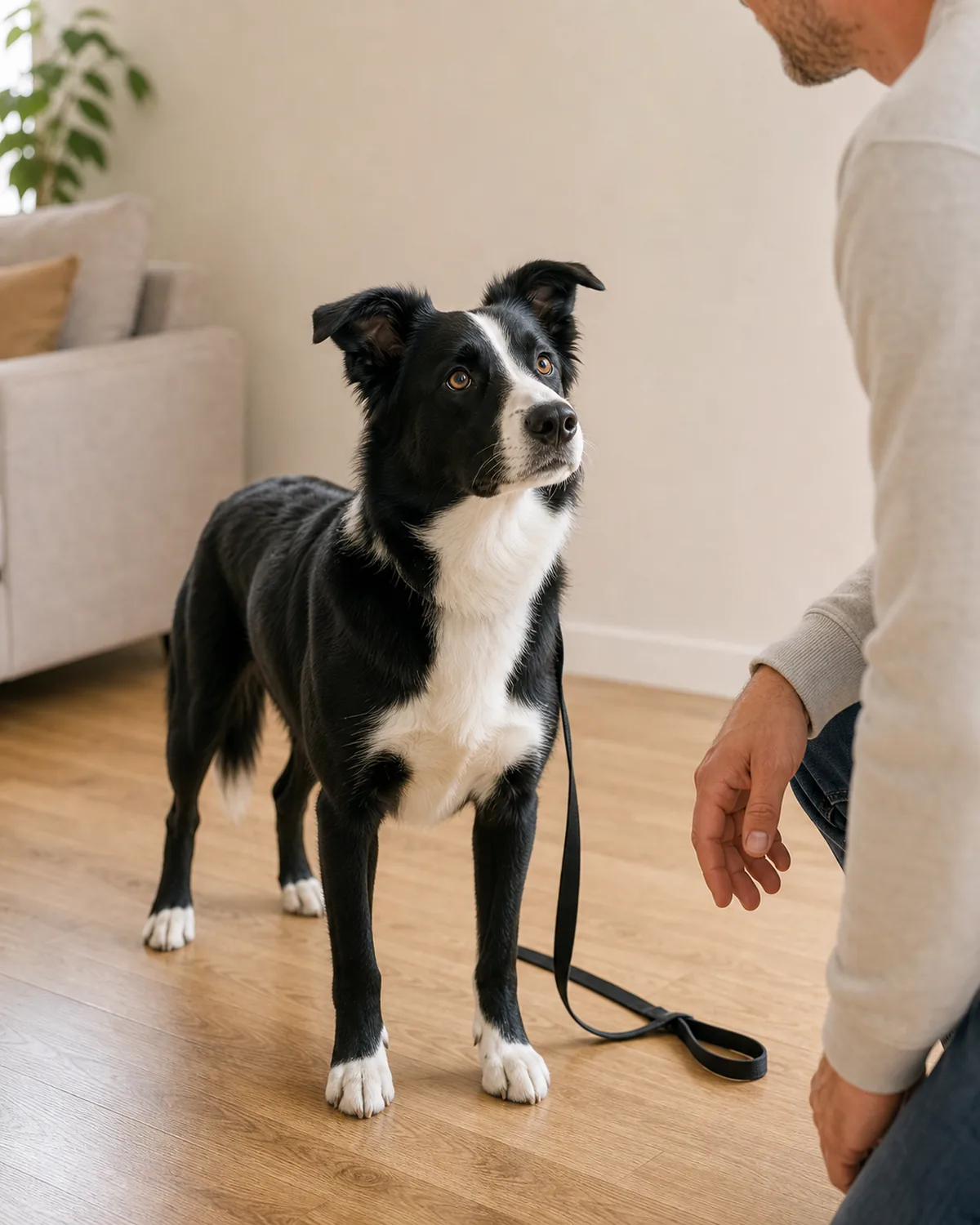
Skill building requires repetition with gradually increasing distraction. The problem with relying on real greetings for practice is that you cannot control the difficulty level or reset the scenario. A leash indoors solves both of those things.
A drag leash — clipped to the dog, trailing on the floor without you holding it — lets you manage access during practice greetings without the tension of a held leash driving up arousal.
Set up a deliberate arrival scenario: someone comes through the door, you watch for the jump attempt, apply the protocol, mark the four-paw landing, treat. Reset. Repeat five to ten times.
Keep sessions short and end on a successful rep. Impulse control is a muscle that fatigues, and long sessions end with more failed reps, not better training. Ten tight repetitions done three times across a day outperform a marathon session where the dog loses composure in the back half.
Marker Precision: The Half-Second Window That Changes Everything
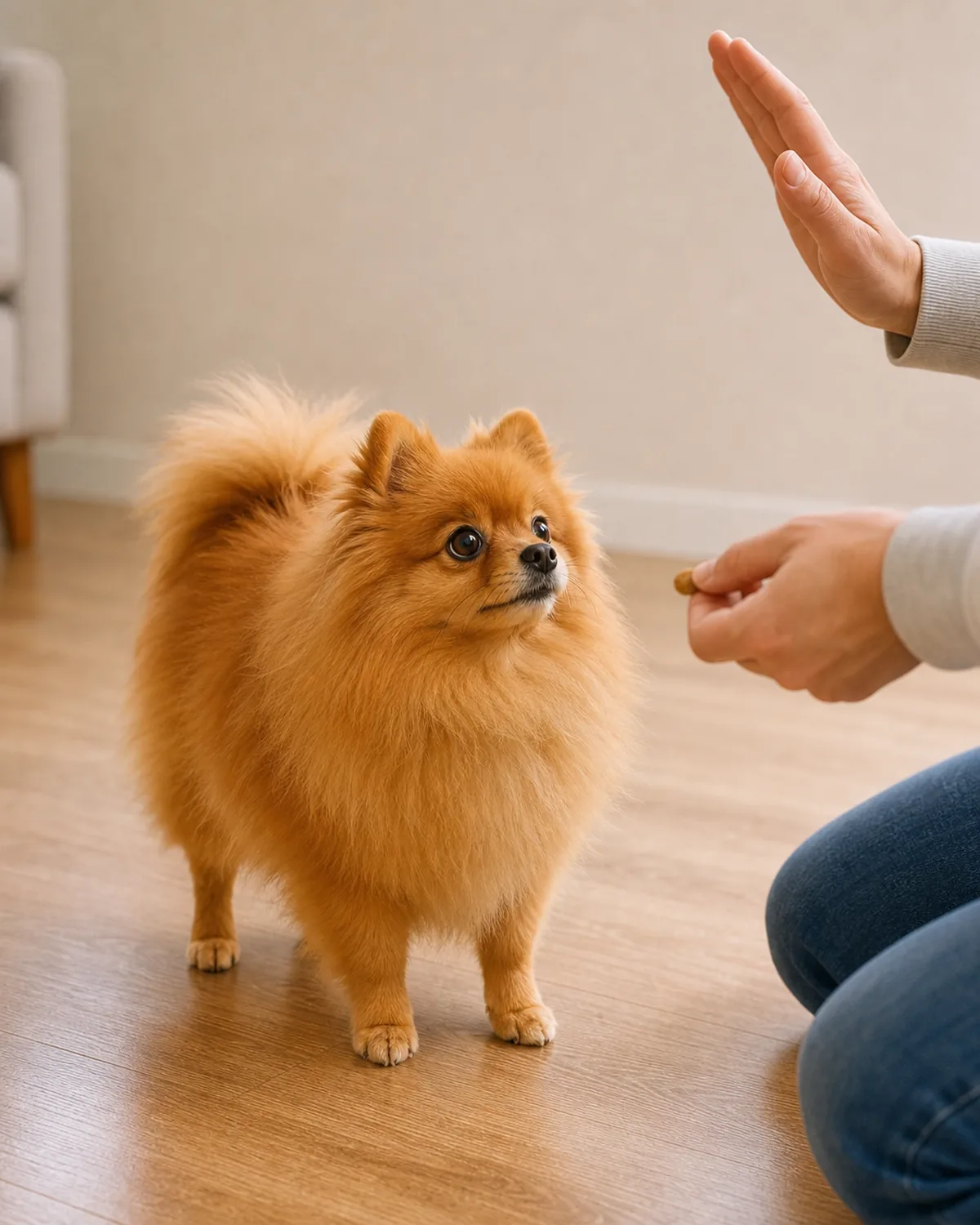
A marker — whether a clicker or a verbal “yes” — is information. It tells the dog which exact micro-behavior earned the reward. The problem is that most people deliver the marker a beat too late, after the dog has already sat or looked up. That marks the sit, not the four-paw landing.
The landing is what you are marking. The moment the front paws touch the floor — not a second later, not after the dog orients toward you — the marker fires.
What Late Marking Actually Teaches
The treat can arrive a moment after, because the marker is the information and the treat is the delivery. Delay the marker and you are teaching something adjacent to what you intend.
This half-second gap is where “sit gets treats” gets accidentally trained instead of “four paws gets treats.”
The dog who learns the first version will still land, sit, and wait — but it has not learned to stop jumping, it has learned to jump and then sit. Different behavior chain, different results when the sit cue is absent.
The 3 Mistakes That Reset Your Progress
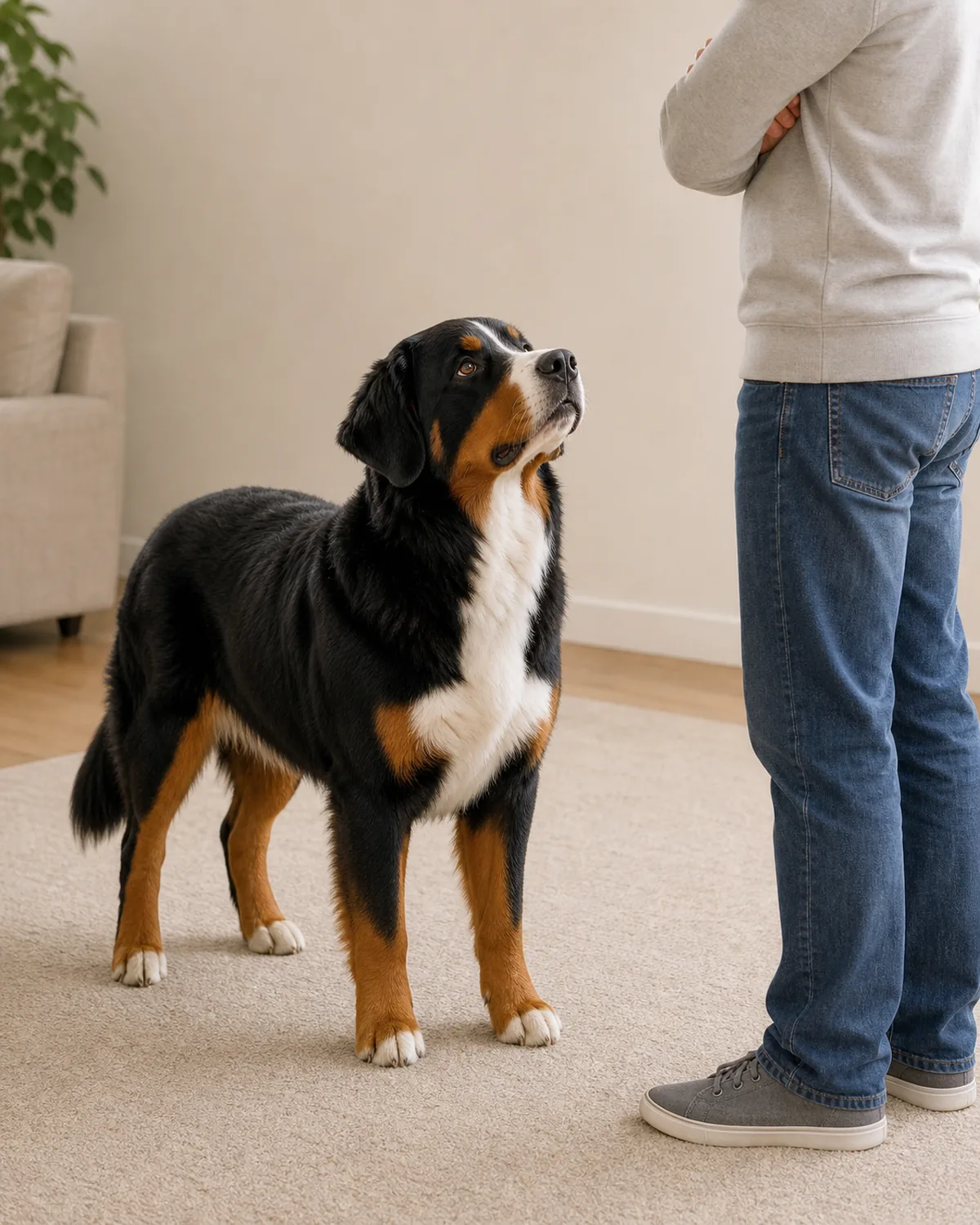
Mistake 1: Letting It Slide With Certain Dogs or Guests
“He’s so excited, it’s fine this one time” is the sentence that puts jumping back on a partial reinforcement schedule. It does not matter how infrequent the exception is.
Intermittent reward is the most durable reinforcement schedule in behavior — one exception can sustain a behavior through weeks of non-reward.
This is especially common with small dogs (“it doesn’t hurt anyone”) and puppies (“he’ll grow out of it”). Neither logic changes the behavioral mechanism. If jumping is rewarded sometimes, it persists.
Mistake 2: Using Physical Corrections That Still Deliver Contact
A knee to the chest, a hip block, grabbing the paws, or pushing the dog back are all forms of physical contact. For a dog who is jumping to get any interaction at all, physical touch — even uncomfortable touch — can still be reinforcing. The behavior continues because attention happened.
Physical corrections also suppress behavior rather than replace it, which means the behavior reappears when the correction is absent. You need the dog to choose four paws, not avoid the knee. Those are different behavioral outcomes with very different durability.
Mistake 3: Marathon Training Sessions That End in Arousal Overflow
Long sessions do not build more skill faster. Impulse control depletes under sustained effort, and a dog who was holding its greeting protocol for the first fifteen minutes may be launching itself at the twentieth repetition. That failed rep is not progress — it is practice of the wrong behavior.
Short, deliberate sessions — five to ten reps, end on a win, repeat across the day — build the behavior more reliably than exhaustion-length training blocks.
When Jumping Signals More Than Excitement: Anxiety and Demand Behaviors
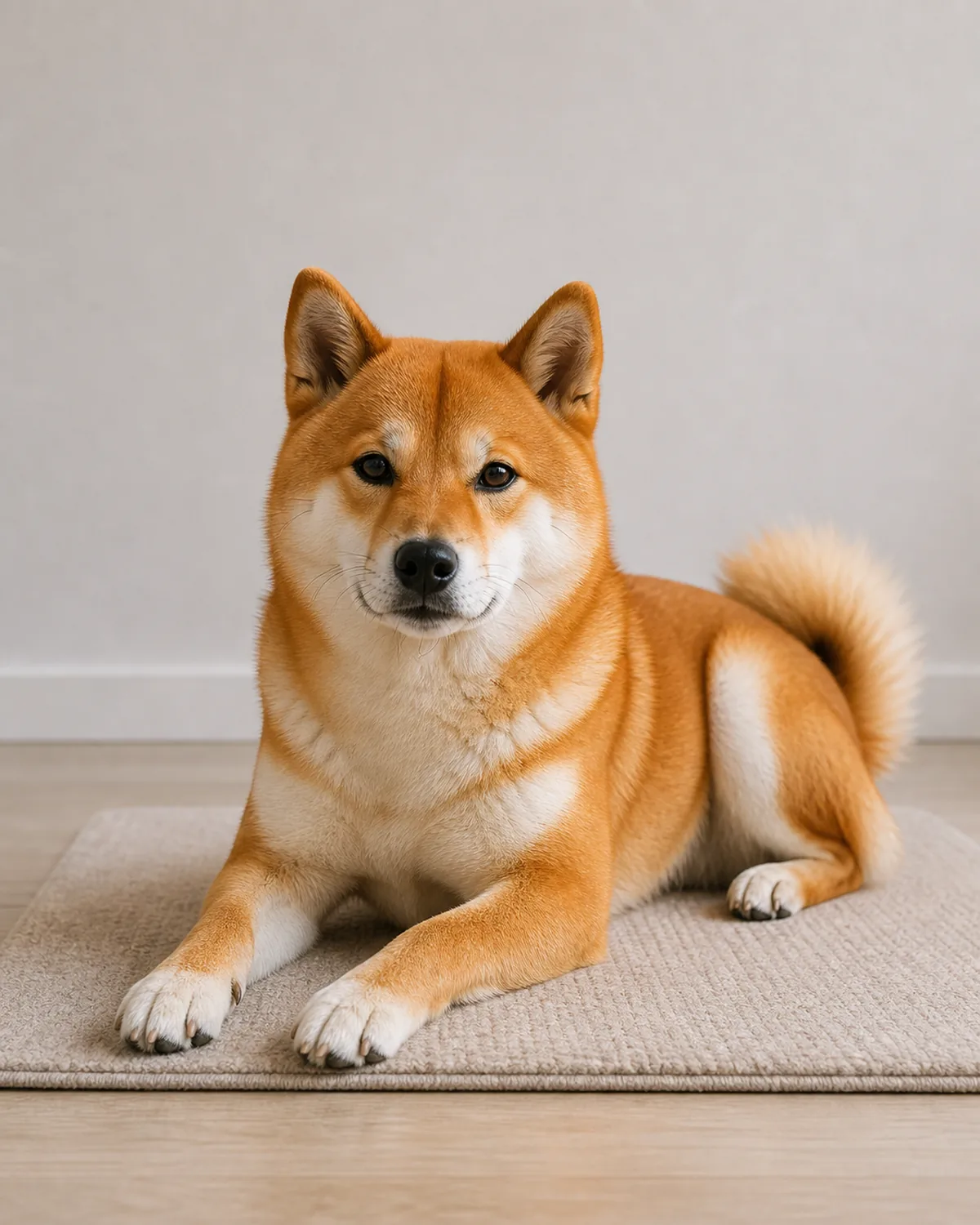
Most jumping is excitement-based: loose body, wagging tail, soft mouth, quick recovery when turned away from. But two other types show up often enough to name.
Demand Jumping
Demand jumping is ritualized and predictable. It happens at specific triggers — the leash comes out, the food bowl is being prepared, the doorbell rings — and has a mechanical quality.
The dog is not reading the social situation; it is executing a sequence it has practiced hundreds of times.
The protocol is the same: no reward until four paws, mark the landing, use “off” as a predictive cue. The key addition is a calm-first requirement before any cue is given.
The leash does not go on until the dog is standing quietly. The bowl does not move toward the floor until four paws are planted. The demand gets zero traction.
Anxiety-Driven Jumping
Anxiety-driven jumping looks different from the outside: stiff body, high-pitched vocalizations, spinning, difficulty settling even when the reward is removed.
Turning away does not produce a calm landing — it produces an escalation. This is not the same behavioral mechanism as excitement jumping, and standard extinction alone will not resolve it.
If the jumping intensifies despite weeks of consistent protocol, or if it is accompanied by destruction, panting, or inability to settle in low-arousal contexts, a vet assessment is the right next step.
Anxiety is a physiological state that management and training alone often cannot address at the root.
— Jess Calloway has spent years training dogs of very different temperaments — a reactive rescue, a stubborn adolescent, and an enthusiastic jumper — and every method she recommends has been tested in her own living room first.

Jess is a dog mom of three — including a rescue who jumped on every person she had ever met, and a puppy who learned that sitting was a faster path to attention than launching herself at guests. Her training guides focus on what actually changes behavior long-term, not just what stops the behavior in the moment. This guide covers why dogs jump and why scolding backfires, the extinction rule and the 180° turn-away, the sit-to-greet replacement, timing your marker correctly, managing arrivals with exercise and a leash, briefing guests, practice rep structure, protecting children and elderly visitors, and when anxiety-driven jumping needs a trainer. Pawliqa is not a substitute for professional behavior help — if your dog’s jumping comes with stiffness, growling, or hard staring, consult your vet or a certified applied animal behaviorist before proceeding. Visit the About page.