Most dogs share every room in the house without owning a single square foot of it. Their bed gets shoved into a corner, their toys pile behind the couch, and their food bowls sit wherever they fit. A dedicated dog room changes that entirely.
You do not need a spare bedroom or a renovation budget. A closet alcove, a mudroom section, or a wide hallway nook can become a space designed around your dog's daily needs — sleeping, eating, playing, and decompressing after a walk.
Here are sixteen ideas for turning any unused corner into a room your dog will actually use.
Start With a Crate Nook That Feels Like a Den
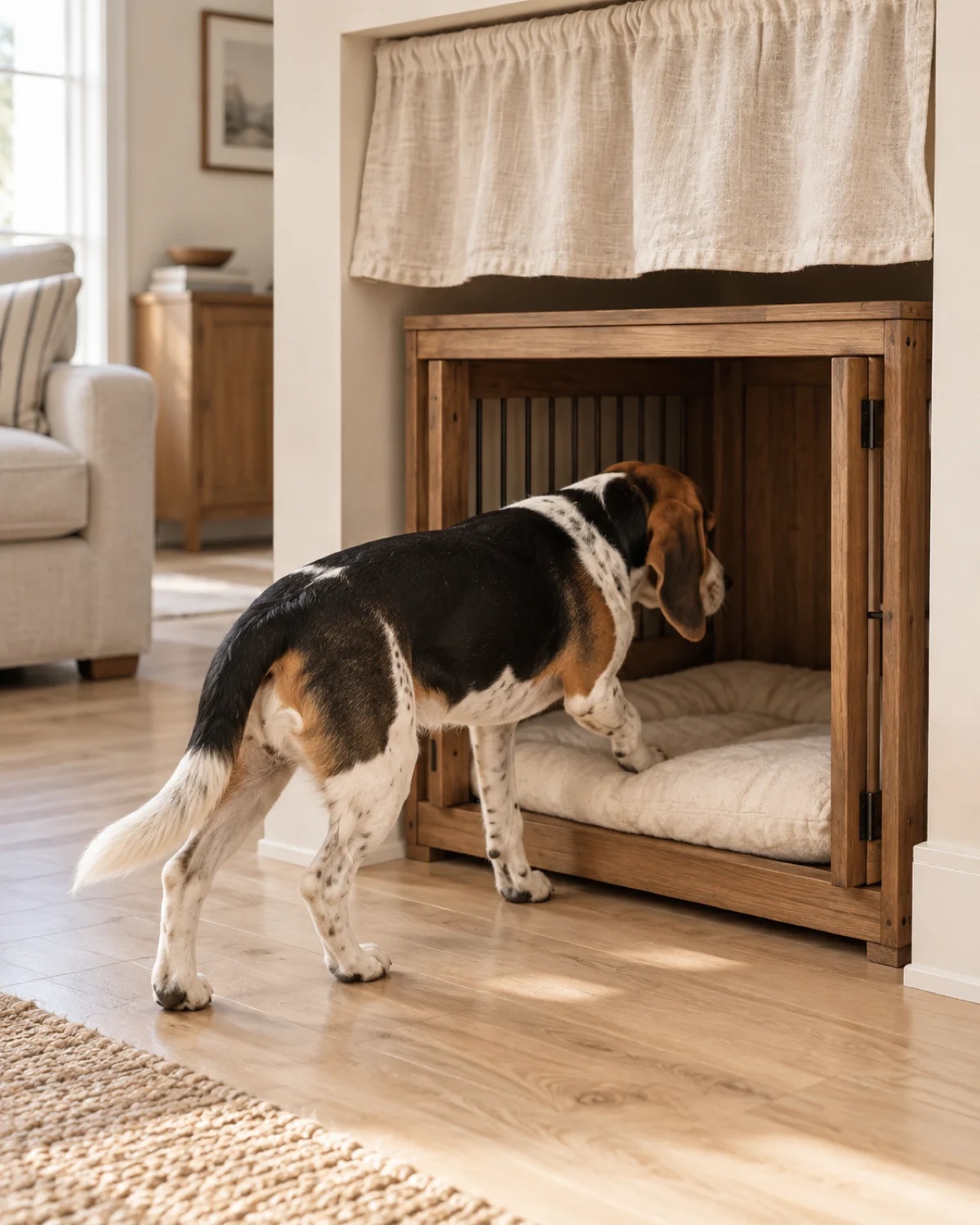
A crate shoved against a bare wall looks like furniture storage. A crate tucked into an alcove or closet nook with a cushion and a draped curtain looks like a den — and dogs treat it that way. The enclosed feeling on three sides triggers the same burrowing instinct that makes dogs crawl under beds during thunderstorms.
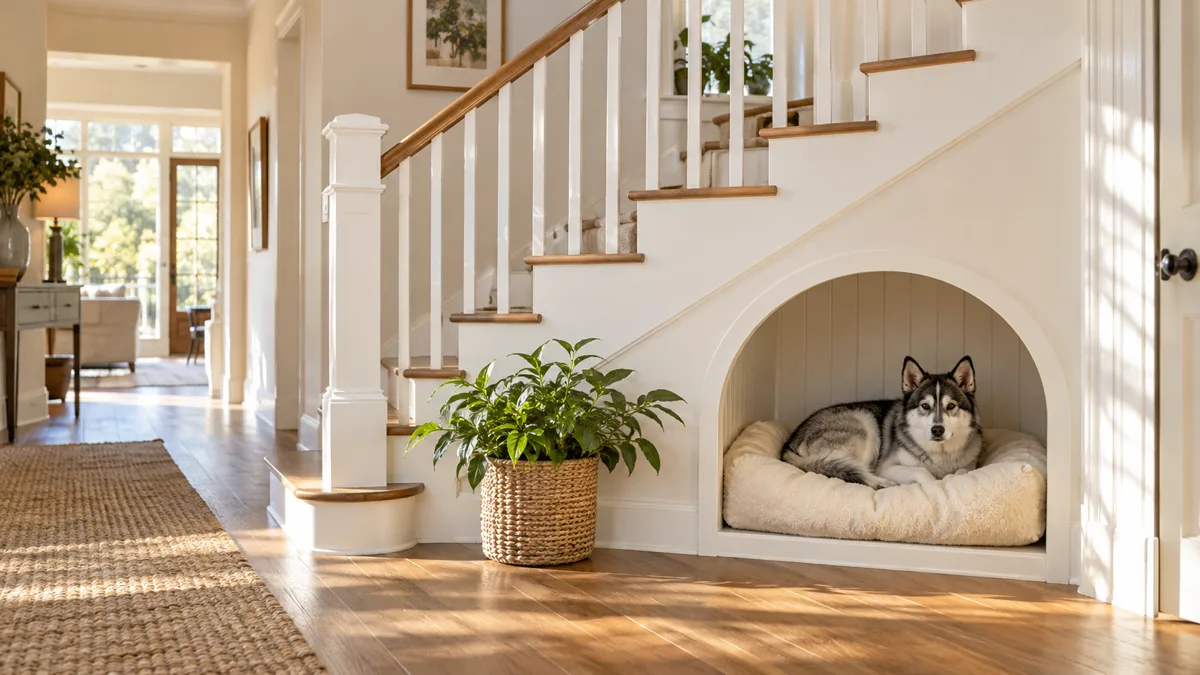
The setup is simple. Find a nook — a closet with the door removed, the space under a staircase, or a gap between two pieces of furniture — and slide the crate in so the back and sides are flush with the walls. Add a washable cushion that covers the floor of the crate and drape a light fabric over the top.
What makes a crate nook work:
- Three-sided enclosure — the walls create the den feeling; an open-room crate does not deliver the same calm
- Washable cushion — accidents happen, and a machine-washable cover saves the cushion underneath
- Light curtain, not a heavy blanket — airflow matters; overheating in a sealed crate is a real risk
- Door stays open — the nook is a retreat, not a cage; close the door only during crate training sessions
For a full crate training walkthrough, see our crate training guide. For more crate arrangement ideas beyond the basic nook, check our crate ideas roundup.
Build a Raised Feeding Station at the Right Height
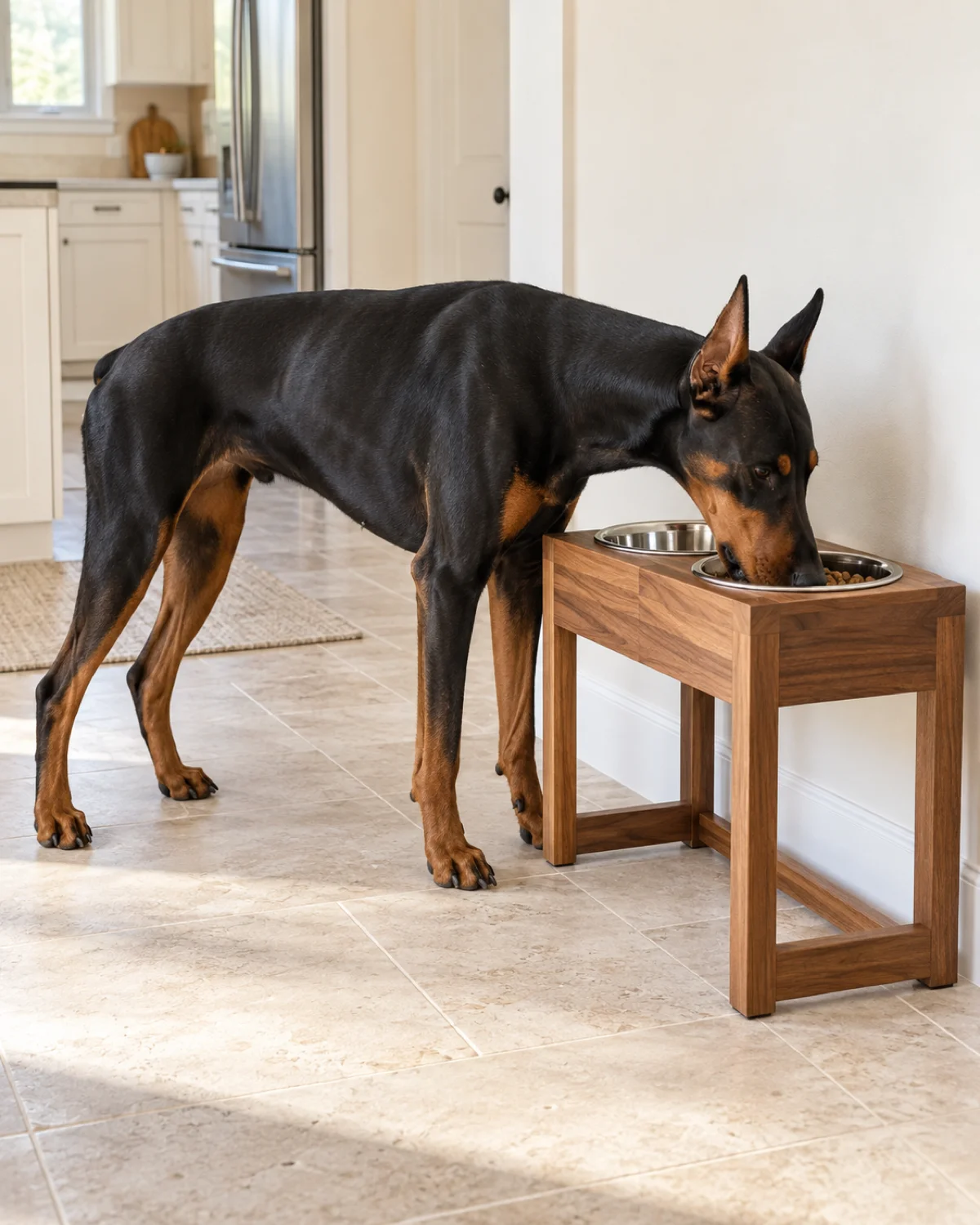
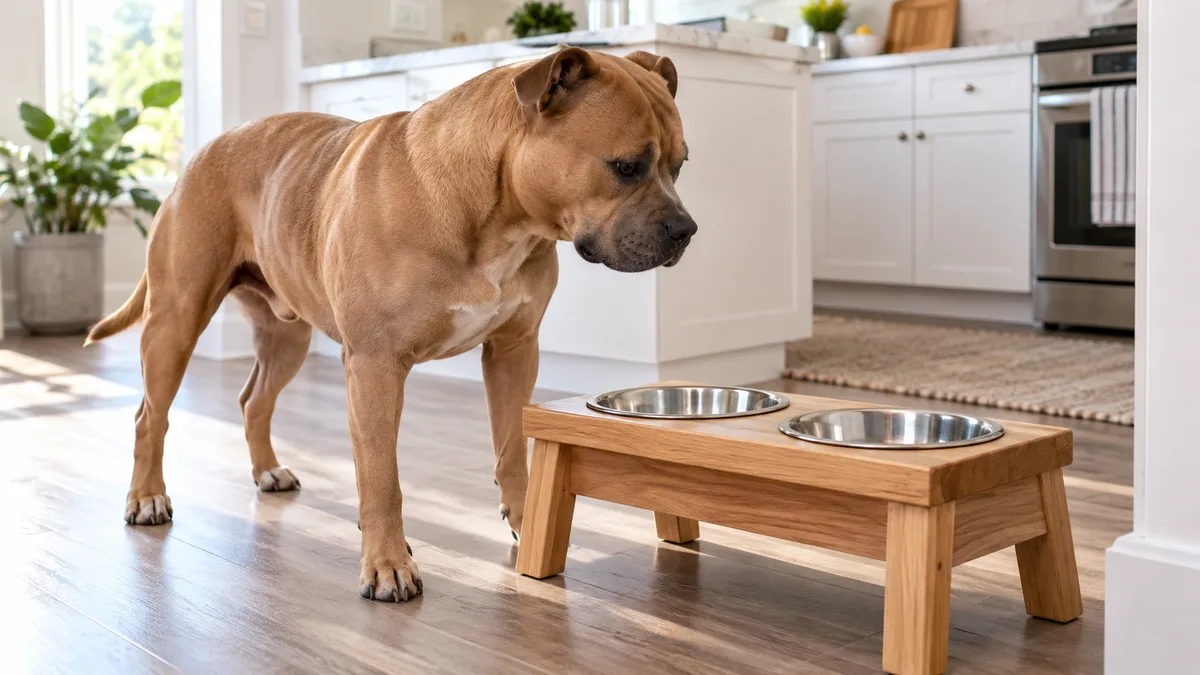
Floor-level bowls work for small dogs. For medium and large dogs, bending all the way to the ground to eat creates unnecessary strain on the neck, shoulders, and front legs — especially over years of daily meals.
A raised feeding station lifts the bowls to a height where the dog can eat with its head roughly level with its shoulders. The right height depends on the dog.
| Dog Size |
Bowl Height |
Station Type |
| Small (under 25 lb) |
4 to 6 inches |
Low wooden platform or a thick rubber mat |
| Medium (25 to 55 lb) |
8 to 12 inches |
Mid-height stand with two cutouts |
| Large (55 to 90 lb) |
12 to 16 inches |
Tall stand or wall-mounted bracket bowls |
| Giant (over 90 lb) |
16 to 20 inches |
Custom-height stand or countertop feeder |
Build or buy a station with removable stainless steel bowls — they clean easier than ceramic and survive drops. Anchor the station to the wall or weight the base so the dog cannot push it across the floor mid-meal.
Save this
16 Dog Room Essentials
- 1Crate NookTuck the crate into an alcove with a cushion and a light curtain for a den-like retreat.
- 2Feeding StationRaise bowls to shoulder height. Stainless steel, removable, anchored to the wall.
- 3Leash OrganizerWall-mounted hooks near the door. One hook per leash. Shelf above for bags and treats.
- 4Baby GatesPressure-mount gates to define the room without closing a door. Easy on, easy off.
- 5Low ShelfWater bowl, treat jar, and a small plant on a shelf the dog cannot knock over.
- 6Washable FloorRubber mat or waterproof liner near the door for post-walk paw wipes.
- 7Toy WallPegboard with hooks and bins at different heights. Rotate toys weekly.
- 8Calming MuralA nature print hung low at dog eye level gives the resting zone a focal point.
- 9Window PerchPadded shelf at window height so the dog can watch the street and decompress.
- 10Wash StationRaised tub in a utility corner with a handheld sprayer. Saves the bathroom.
- 11Splash TilePeel-and-stick tile behind the bowls protects the wall from water and food splatter.
- 12Enrichment CornerPuzzle feeders, snuffle mats, and lick mats in one spot. Rotate daily.
- 13DaybedLow upholstered daybed with a washable cover for supervised naps and downtime.
- 14Under-Shelf LightWarm LED strip under a shelf turns the nook into a cozy evening spot.
- 15Grooming NookRubber mat, brush caddy, and spray bottles in one spot. Everything within reach.
- 16Name SignA wooden sign or paw print art above the bed finishes the space and makes it theirs.
Add a Wall-Mounted Leash and Harness Organizer
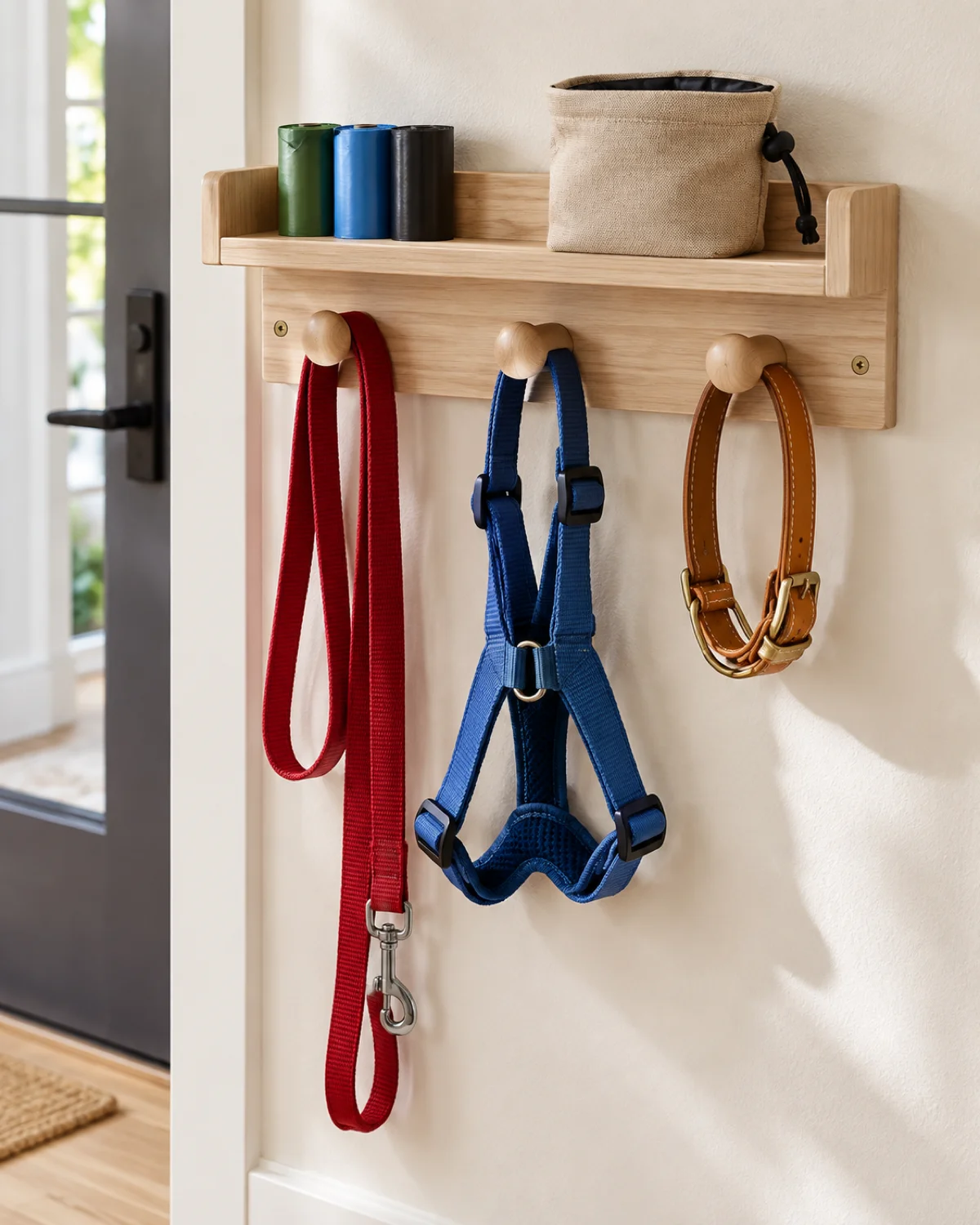
Leashes draped over doorknobs and harnesses stuffed into drawers create a scramble every time you need to leave the house. A wall-mounted organizer near the door eliminates the search entirely.
The best setup uses individual hooks — one per leash, one per harness, one for the collar — so nothing tangles. Mount them at a height you can reach without bending but low enough that you can clip a leash with one hand while holding the dog with the other.
What to include on the organizer:
- Dedicated hooks — separate hooks for each piece of gear; bunching three leashes on one hook defeats the purpose
- A small shelf above — for waste bag rolls, a treat pouch, and your keys; grab everything in one pass on the way out
- A basket or bin below — for seasonal gear like a rain jacket, booties, or a reflective vest
Anchor into studs if the wall is drywall. A loaded organizer with multiple leashes and a treat jar is heavier than it looks, and a bracket that pulls out of the wall mid-grab is a safety issue.
Use Baby Gates to Define the Room Without Closing a Door
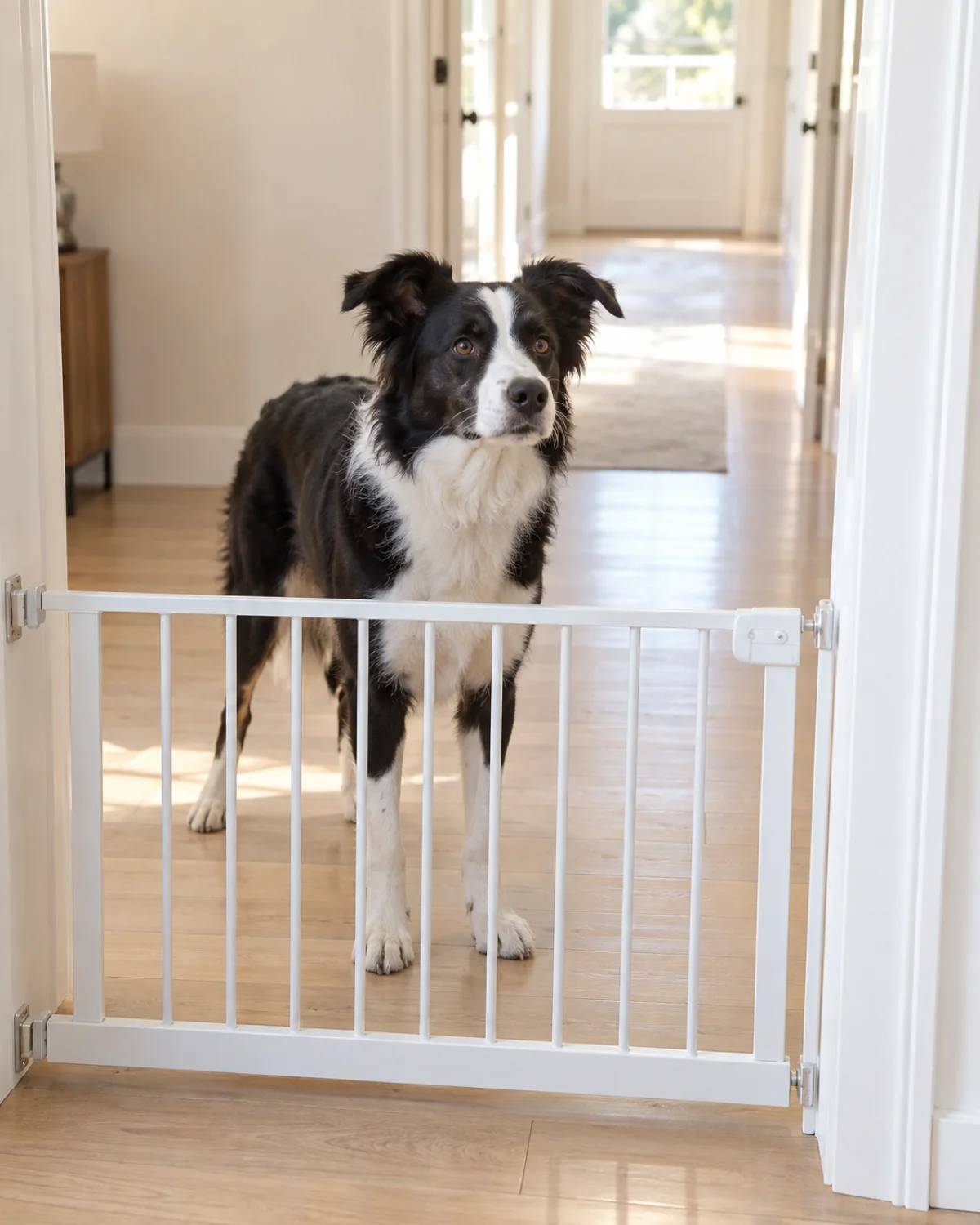
Closed doors create anxiety for dogs that want to know where you are. Baby gates define a boundary without cutting off sightlines or airflow — the dog stays in its room, you stay visible, and nobody panics.
Pressure-mount gates work best for dog rooms because they install without screws and come off in seconds when you need the full doorway. Hardware-mount gates are stronger but leave holes in the frame when removed.
Gate selection by dog type:
- Small dogs — a standard 24-inch gate is enough; most small dogs will not attempt to jump it
- Medium dogs — a 30-inch gate with a walk-through door saves you from stepping over it twenty times a day
- Large dogs — a 36-inch or taller gate, ideally with vertical bars the dog cannot wedge a paw through
- Climbers and jumpers — a tall gate with a smooth top rail and no horizontal bars to use as footholds
For a full breakdown of gate types, placement strategies, and which designs work for different layouts, see our dog gate ideas guide.
Not sure where to start? Pick the problem your space has right now
Where Should You Begin?
You do not need all sixteen at once. Start with the problem below that matches your situation, build those two or three ideas first, and add the rest over time.
Install a Low Shelf for Water Bowls and Treat Jars
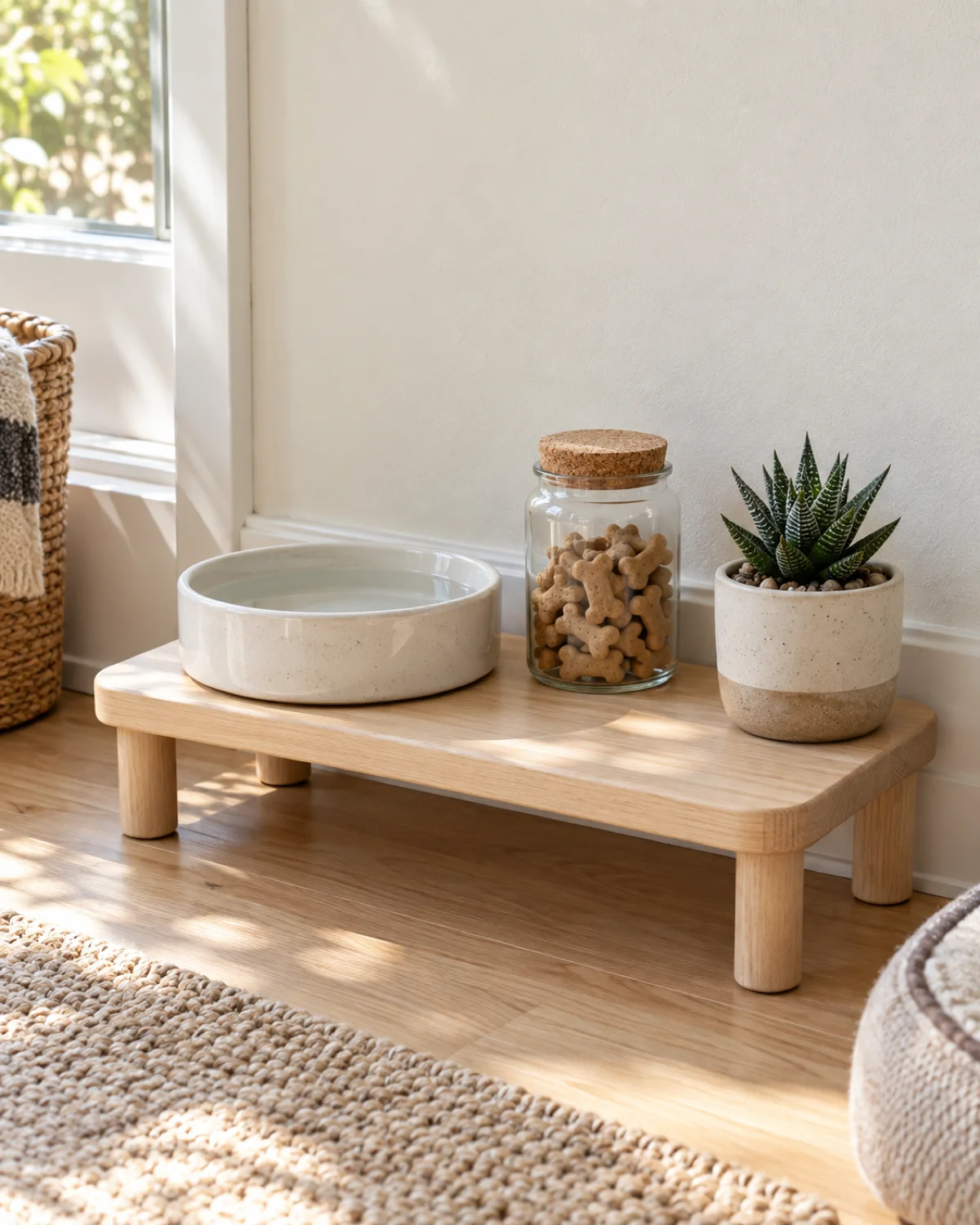
A low shelf along one wall keeps water bowls, treat jars, and grooming supplies off the floor and organized without taking up usable space. Mount it six to eight inches off the ground — high enough to sweep underneath, low enough for the dog to drink comfortably.
The shelf works best with a waterproof surface or a removable tray underneath the water bowl to catch splashes. Dogs that dunk their entire muzzle while drinking will send water over the edge every single time, and a bare wood shelf warps within weeks.
What to put on a dog room shelf:
- Water bowl — ceramic or stainless steel; plastic scratches and harbors bacteria
- Treat jar — clear glass with a tight lid so you can see levels and the dog cannot nose it open
- Small plant — something non-toxic like a spider plant or a succulent; adds life to the corner without risk
Keep medications, cleaning products, and anything with a twist cap on a higher shelf or in a closed cabinet. Dogs that can reach a shelf at their head height will investigate everything on it.
Create a Washable Floor Zone for Post-Walk Cleanup
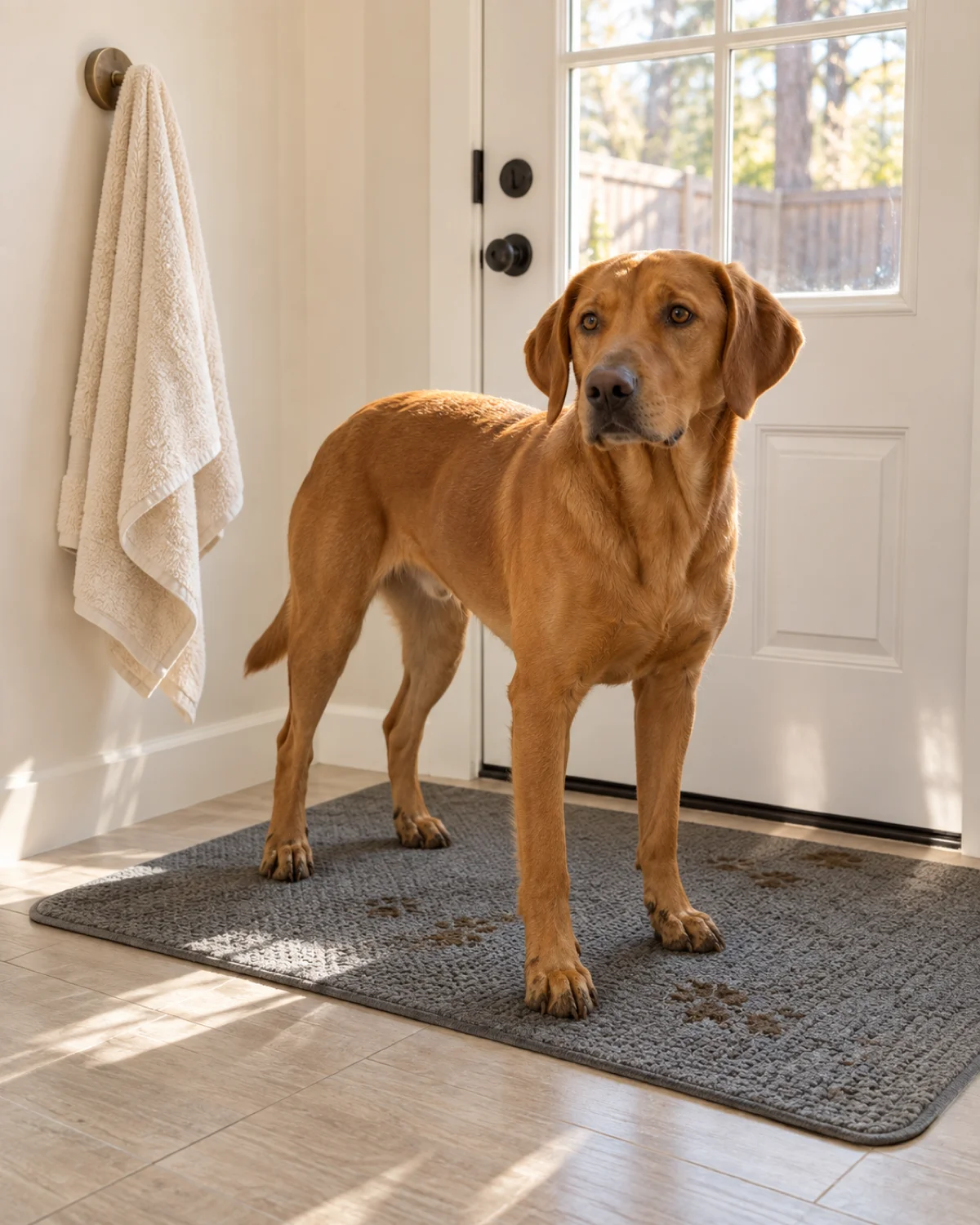
Every walk ends with dirty paws, and every pair of dirty paws meets your floor. A washable floor zone near the entry point catches the mess before it spreads to the rest of the house.
The simplest version is a commercial rubber-backed mat that covers a three-by-four-foot area near the door. The mat traps dirt and water, the rubber backing keeps it from sliding when the dog steps on it, and the whole thing goes into the washing machine once a week.
For a more permanent setup:
- Waterproof vinyl plank — peel-and-stick planks over the existing floor in a six-foot radius around the entry door; wipes clean, handles water, does not stain
- Interlocking rubber tiles — the gym-floor kind; they absorb impact, resist moisture, and lift out for individual cleaning
- A towel station — a hook holding two or three microfiber towels within arm's reach of the mat; grab one, wipe all four paws, toss it in the laundry basket beside the hook
The floor zone should be the first thing the dog touches after coming inside — before the living room carpet, before the couch, before the bed. Train a quick sit-and-wipe routine and the zone becomes automatic within a week.
Set Up a Toy Rotation Wall With Hooks and Bins
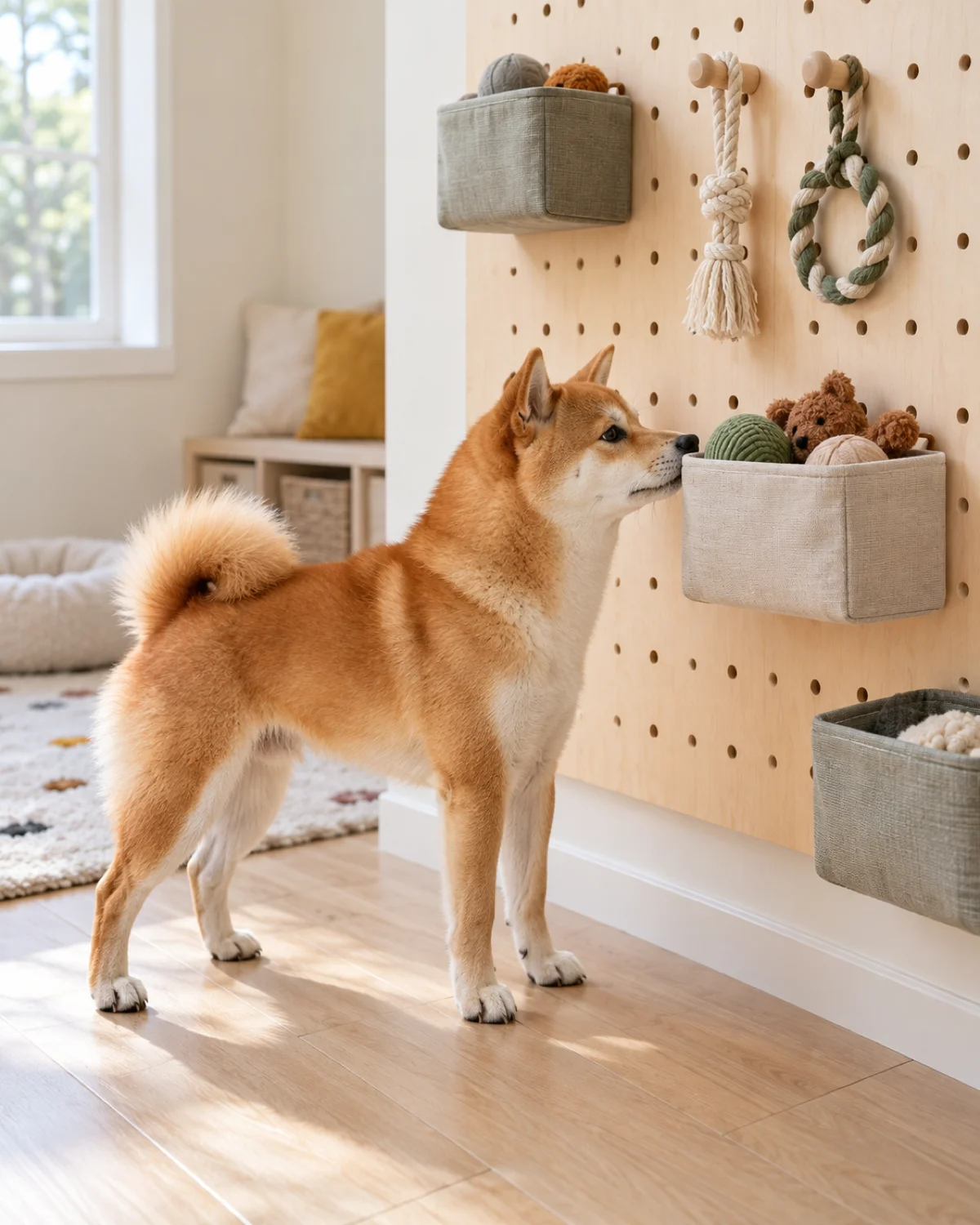
Dogs lose interest in toys they see every day. A toy rotation wall keeps three or four toys in active play while the rest wait out of sight — and every swap day feels like new toys arrived.
Mount a pegboard or a set of wall hooks and small bins at different heights. The lowest bin holds the current rotation. Higher bins hold the reserve stock. Every five to seven days, swap the active set with a reserve set.
How to organize the rotation:
- Active bin — three or four toys the dog is currently playing with; low enough for the dog to browse
- Reserve bins — two or three bins higher up with the rest of the collection; the dog can see them but cannot reach them
- Hook row — rope toys and tug toys hang from individual hooks; they dry faster hanging than sitting in a bin
A rotation wall also reveals which toys actually get used. After a few cycles, the toys that always stay in the bin untouched can go to donation. For DIY toy ideas to stock the wall cheaply, see our DIY dog toys guide.
Hang a Calming Photo or Mural at Dog Eye Level
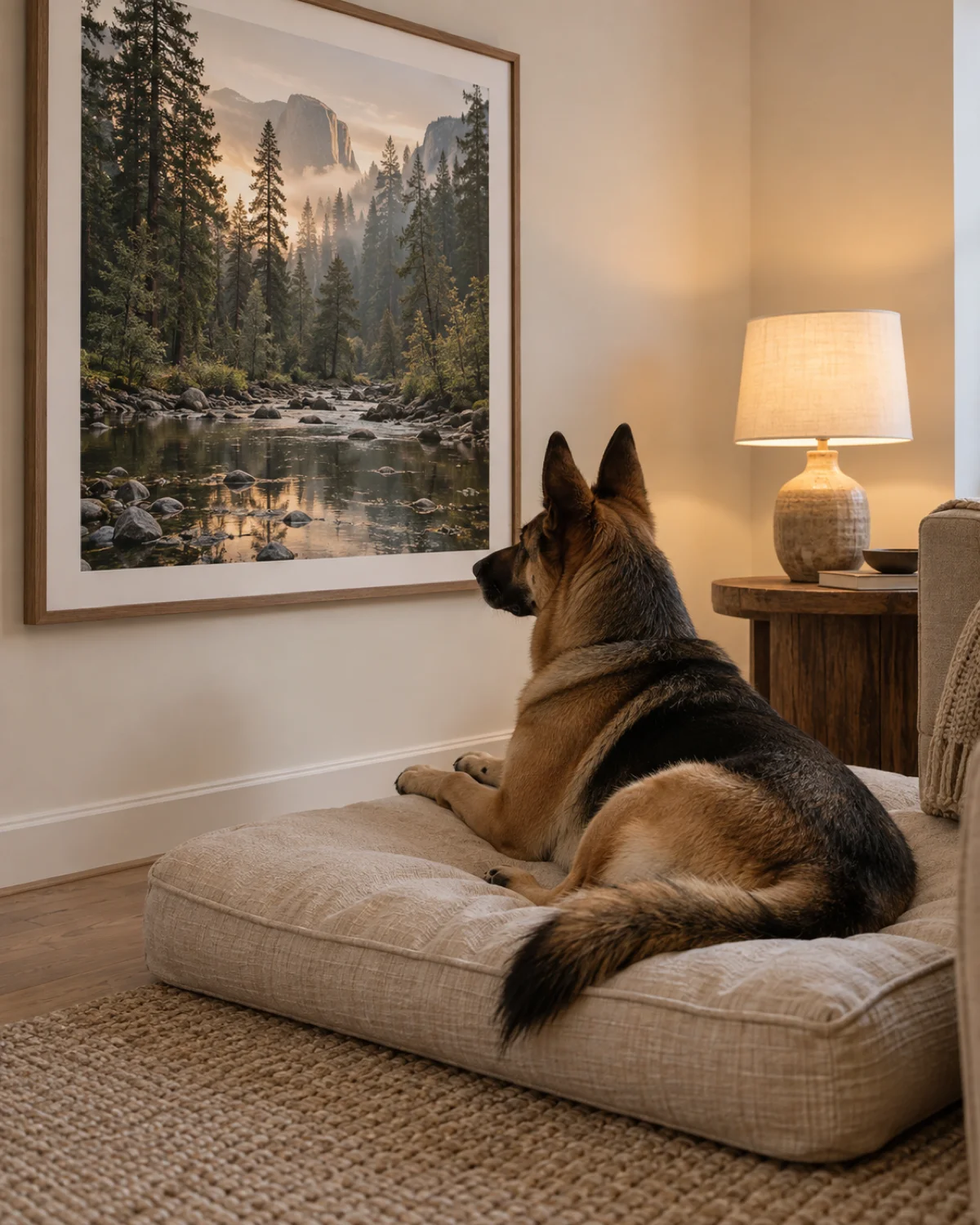
This one sounds like it is for you, not the dog. It is actually both. A large nature image hung low on the wall gives the resting zone a visual anchor — the dog faces it while lying down, and the calm tones in the image influence the mood of the entire corner.
Dogs respond to their environment more than most owners realize. A blank white wall in a quiet room feels sterile. A wall with a large forest or meadow print at dog eye level — roughly twelve to eighteen inches off the floor for a medium dog — creates a backdrop that reads as calm and settled.
What works:
- Nature scenes — forests, meadows, calm water; avoid images with other animals that could trigger alertness
- Muted tones — soft greens, warm browns, blues; avoid high-contrast or neon imagery
- Large format — one big piece reads as a feature wall; a cluster of small frames reads as clutter
Mount the image low enough that the dog sees it from its resting position. If the dog bed is on the floor, the bottom edge of the frame should be close to floor level. This is not standard interior design height — it is dog-eye-level design, and it looks intentional once the bed is in place.
Add a Window Perch So Your Dog Can Watch the World
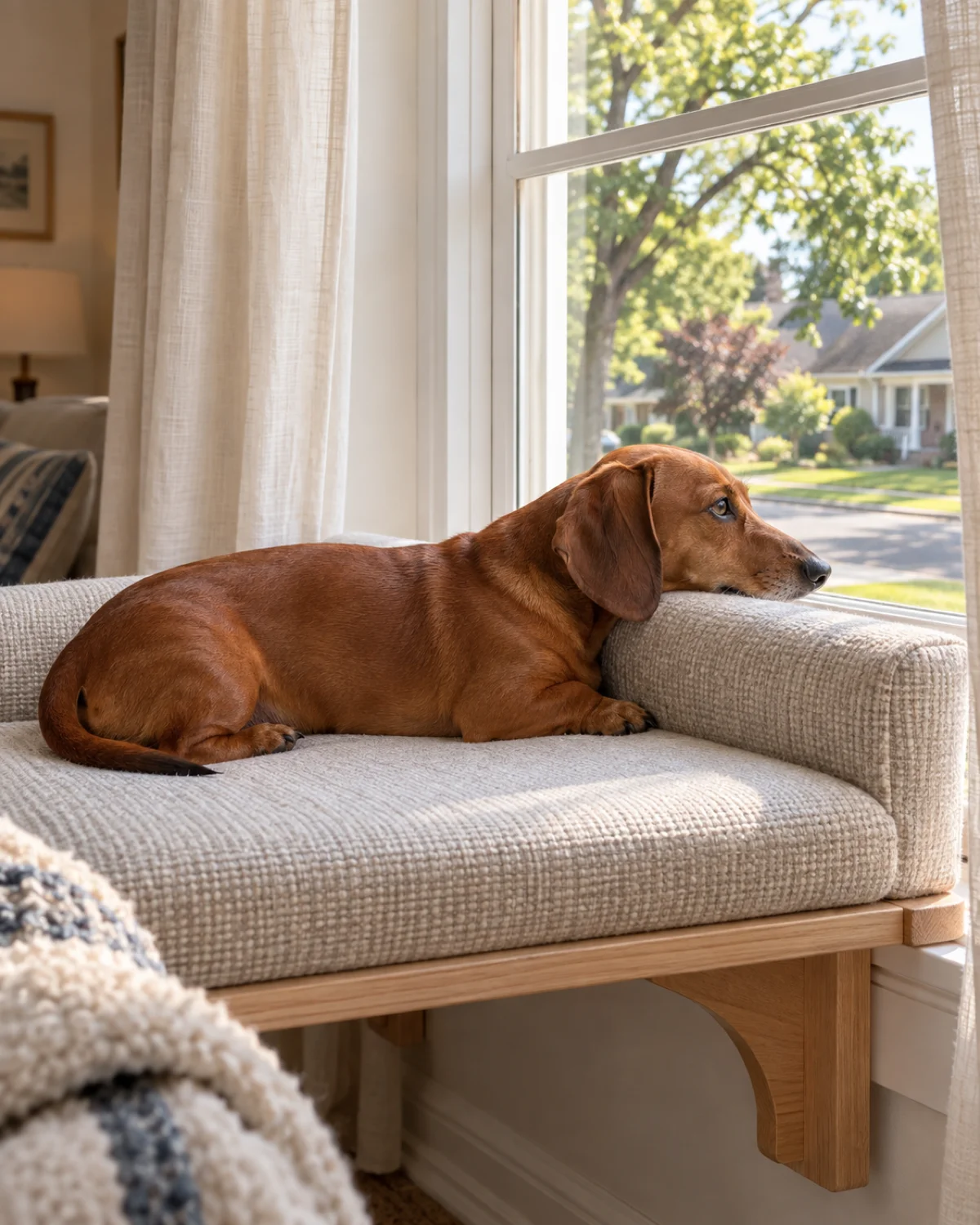
Dogs that spend hours home alone need something to do that does not involve chewing furniture. A window perch gives them a front-row seat to the street — squirrels, mail carriers, passing dogs, leaves blowing — and that passive watching occupies a surprising amount of mental bandwidth.
The perch itself is a padded shelf mounted at window sill height, wide enough for the dog to rest its chin and front paws comfortably. For small dogs, a twelve-inch-deep shelf works. For medium dogs, go sixteen inches.
Installation considerations:
- Weight capacity — a small dog on a shelf bracket is fine; a large dog needs a reinforced platform bolted into studs, not just drywall anchors
- Non-slip surface — cover the shelf in a grippy fabric or a thin rubber mat so the dog does not slide when shifting positions
- Window safety — if the window opens, install a screen lock or a window guard so the dog cannot push through; an excited dog lunging at a squirrel can go through an unscreened window
Not every dog benefits from a window perch. Dogs that bark reactively at everything they see outside may get worse with a dedicated lookout point. If your dog tends to bark at passing dogs or people, skip the perch and try the enrichment corner instead.
Build a DIY Dog Wash Station in a Utility Corner
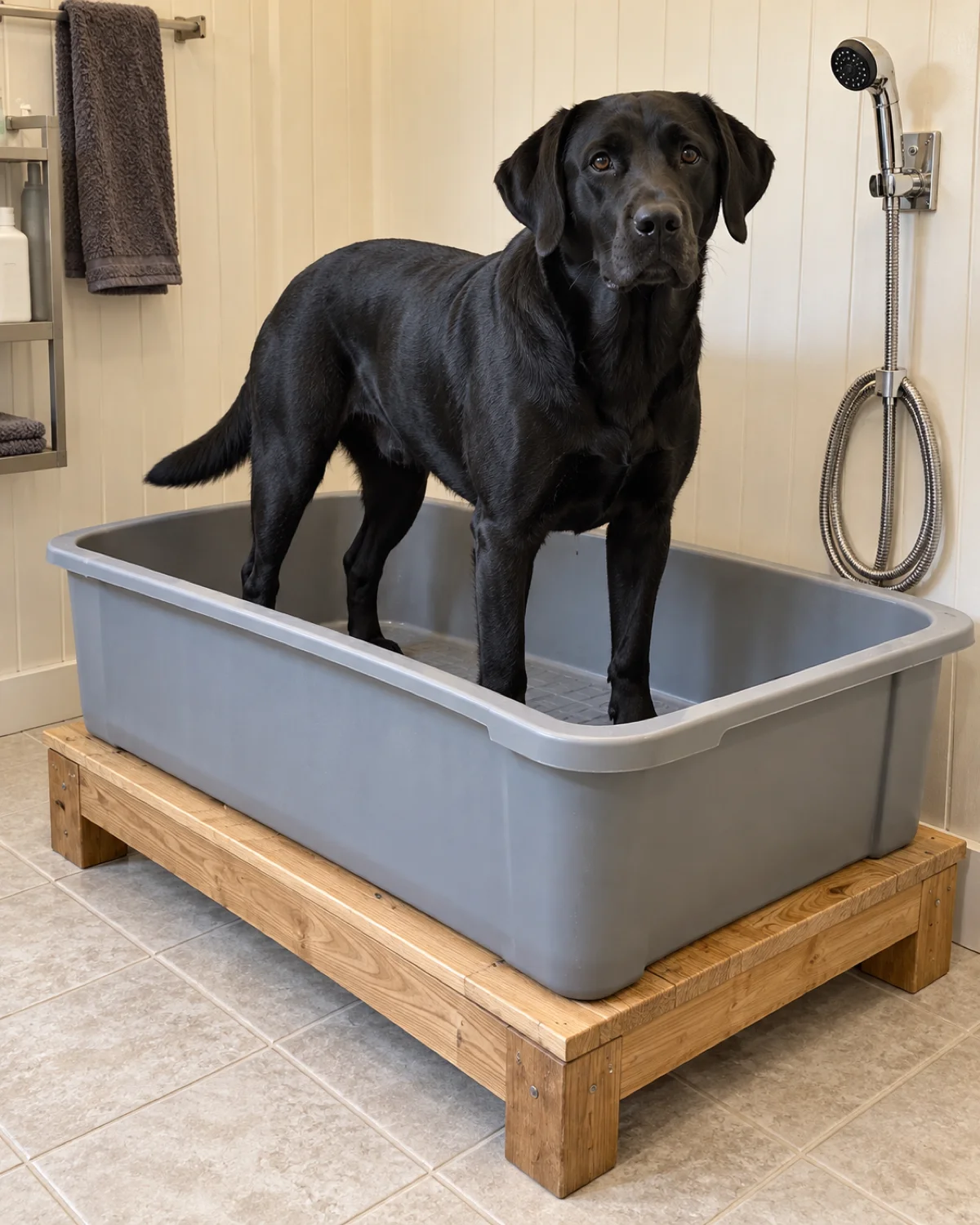
Bathing a dog in the family bathtub leaves hair in the drain, water on the walls, and a wet dog shaking onto every surface in the bathroom. A dedicated wash station in a utility room, laundry room, or garage solves all three problems.
The simplest version uses a large plastic tub — the kind sold for mixing concrete — set on a low platform at a height where you do not have to bend over. Add a handheld sprayer connected to the utility sink faucet with a diverter, and mount a small shelf nearby for shampoo and towels.
Essential components:
- Tub — plastic or stainless steel, large enough for the dog to stand and turn; a lip on all sides keeps water contained
- Sprayer — a handheld attachment with a long flexible hose; trying to rinse a dog with a fixed faucet means half the soap stays in the coat
- Non-slip mat inside the tub — a rubber bath mat prevents the dog from sliding and panicking mid-wash
- Drain solution — a mesh hair trap at the drain opening catches fur before it clogs the pipe
For dogs under thirty pounds, a raised laundry sink with a built-in sprayer works without any modifications. For dogs over sixty pounds, a walk-in shower stall with a removable threshold is the most practical permanent option.
Use Peel-and-Stick Tile to Protect the Wall Behind Bowls
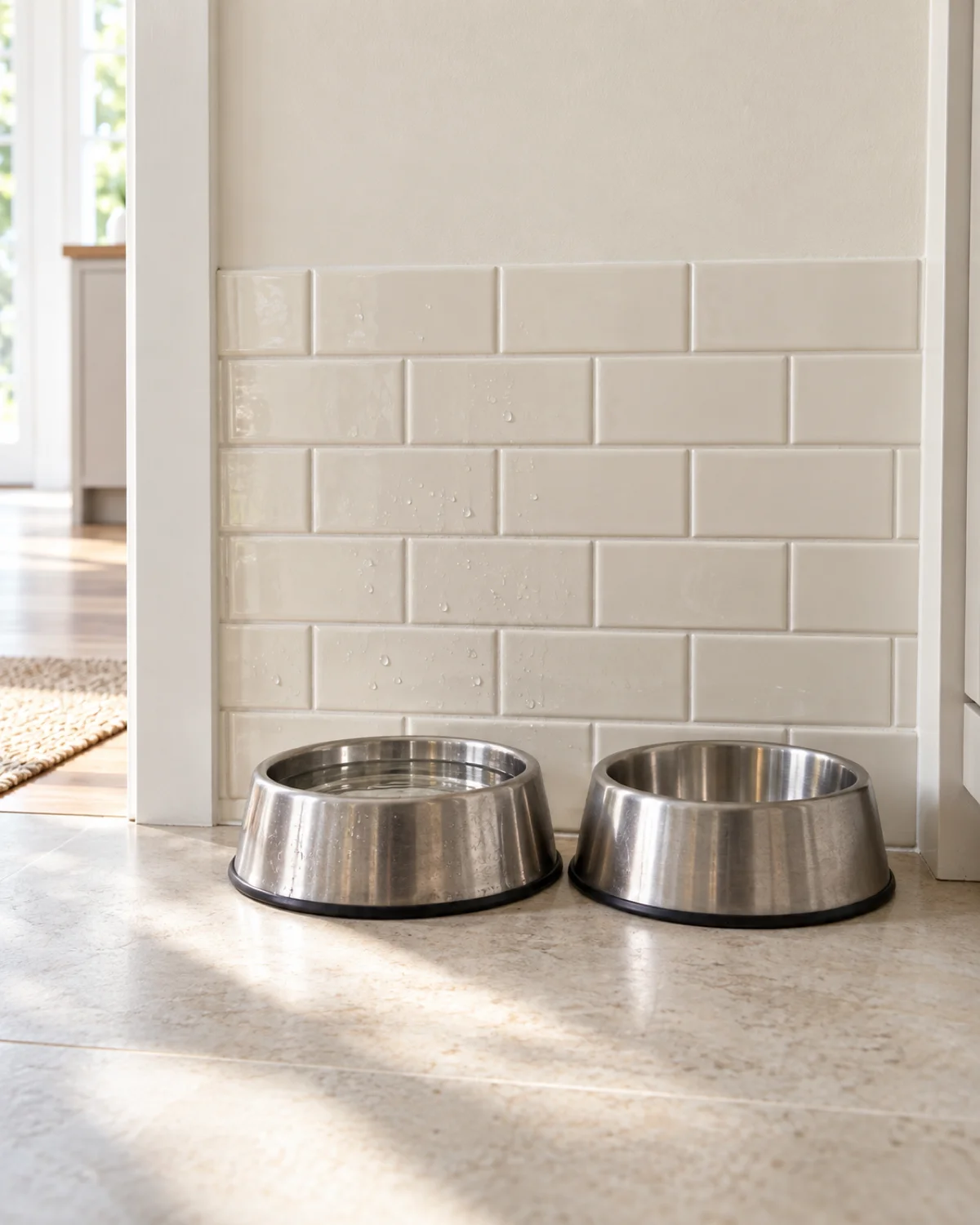
Water bowls splash. Food bowls fling kibble. Within a few months, the wall behind the feeding station has water stains at the base and dried food spots at head height — and if the wall is painted drywall, those stains eventually soak in and darken permanently.
Peel-and-stick tile solves it in an afternoon. Apply a two-foot-wide section from the floor to about eighteen inches up the wall, directly behind the bowls. The tile surface wipes clean with a damp cloth, resists moisture, and peels off without damaging the wall when you move.
Best options for a dog room backsplash:
- Subway tile pattern — classic, easy to clean, available in neutral tones that match any wall color
- Hexagonal tile — slightly more visual interest; the grout lines are decorative, not structural, so cleaning is the same
- Smooth vinyl sheets — the fastest option; one piece, no individual tile alignment, cuts with scissors
Avoid textured tiles with deep grooves — food and water collect in the crevices and require scrubbing instead of a quick wipe. Smooth, glossy surfaces clean fastest and resist bacterial buildup.
Set Up an Enrichment Corner With Puzzle Feeders and Snuffle Mats
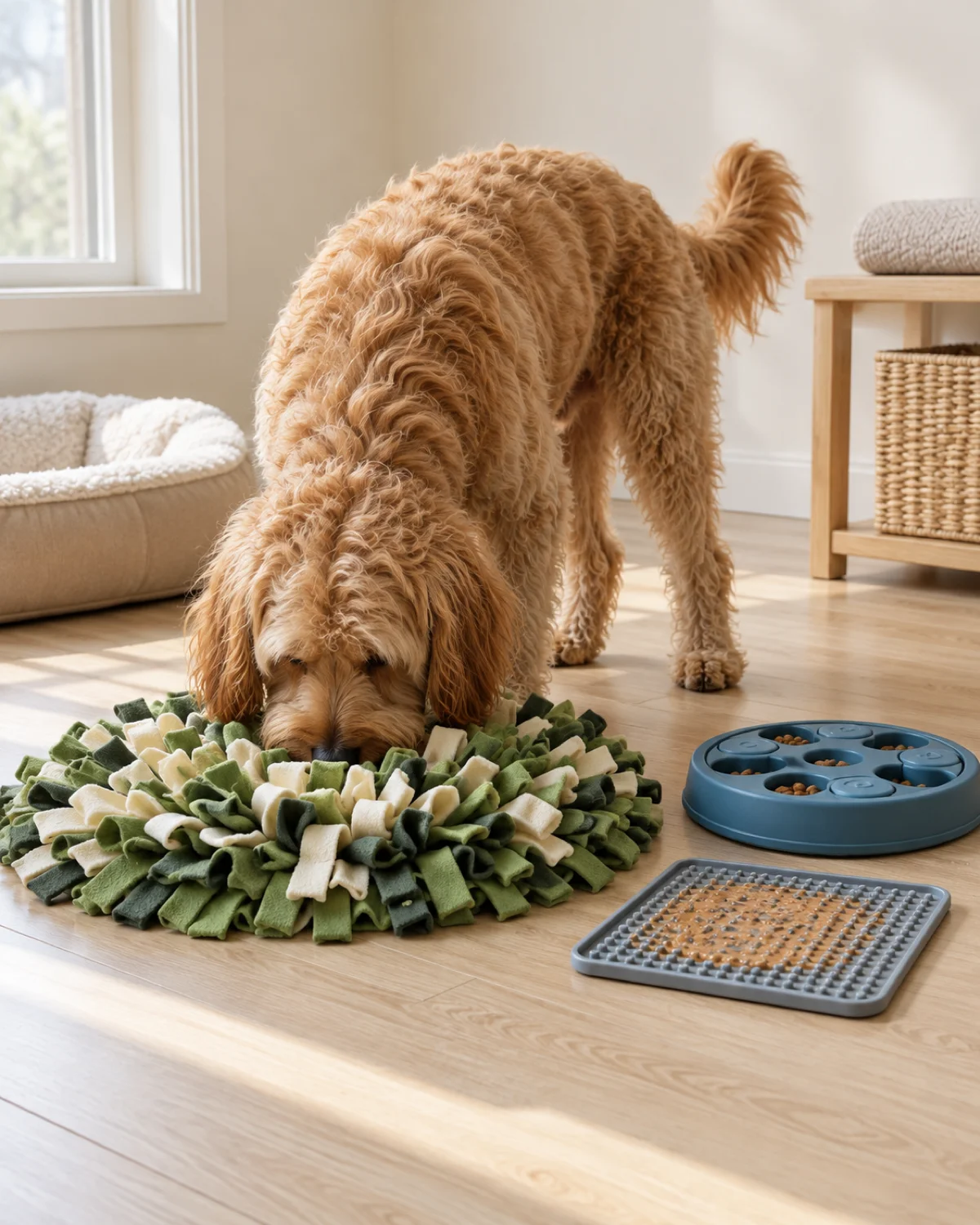
A dedicated enrichment corner gives mental stimulation a fixed location in the dog room — the dog learns that this spot means problem-solving, and it starts going there on its own when it needs something to do.
Stock the corner with three types of enrichment and rotate daily so the dog never gets bored with any single one:
- Puzzle feeders — rubber toys that dispense kibble when rolled or chewed; use these for part of the daily meal instead of a plain bowl
- Snuffle mats — fabric mats with deep folds where you scatter treats; the dog uses its nose to find them, which drains energy faster than physical exercise
- Lick mats — silicone mats spread with a thin layer of peanut butter or yogurt; the repetitive licking activates calming pathways in the brain
| Enrichment Type |
Best For |
Session Length |
Difficulty |
| Puzzle feeder |
Meal replacement |
10 to 20 minutes |
Medium |
| Snuffle mat |
Between-meal snacking |
5 to 15 minutes |
Easy |
| Lick mat |
Calming before rest |
10 to 30 minutes |
Easy |
| Frozen stuffed toy |
Long alone time |
30 to 60 minutes |
Hard |
Keep the enrichment corner simple — a small mat or tray on the floor with the day's selection arranged on it. Store the inactive items in a bin on the toy wall or on a shelf out of reach. For a full list of indoor activities to pair with the enrichment corner, see our indoor entertainment guide.
Add a Cozy Daybed for Supervised Naps and Downtime
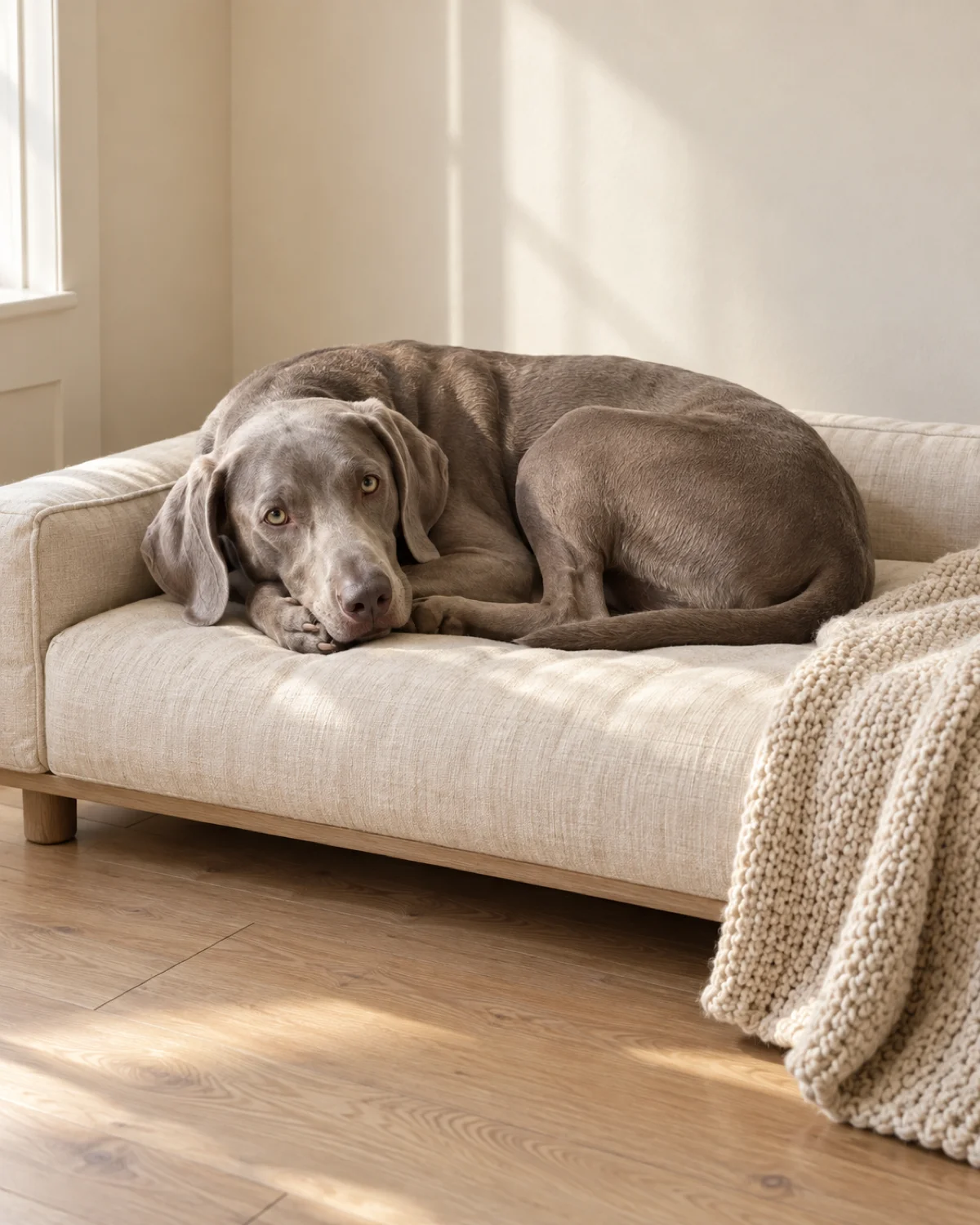
The crate nook is for unsupervised rest and nighttime sleep. The daybed is for supervised daytime naps — the kind where the dog dozes in the same room while you work, read, or watch television. Different purpose, different furniture.
A low upholstered daybed with a washable cover works better than a standard dog bed for this role because it looks like furniture, sits at a height that matches your seating, and gives the dog a spot that feels shared rather than banished.
What to look for:
- Low profile — six to ten inches off the floor; high enough to feel like furniture, low enough for old dogs and puppies to step onto
- Washable cover — a zippered slipcover that goes in the machine weekly; upholstery fabric without a removable cover will smell within a month
- Firm cushion — memory foam or high-density foam; dogs sink through soft polyfill within weeks and end up lying on the frame
- Wide enough to stretch — the dog should be able to lie fully extended on its side without hanging off the edge
Place the daybed where the dog can see you but is not in a traffic lane. A corner of the living room, the end of a hallway, or the foot of a home office desk are all good positions. Add a knit blanket for warmth and texture — dogs that burrow will pull it over themselves, which is exactly the point.
Install Under-Shelf Lighting for a Warm Evening Glow
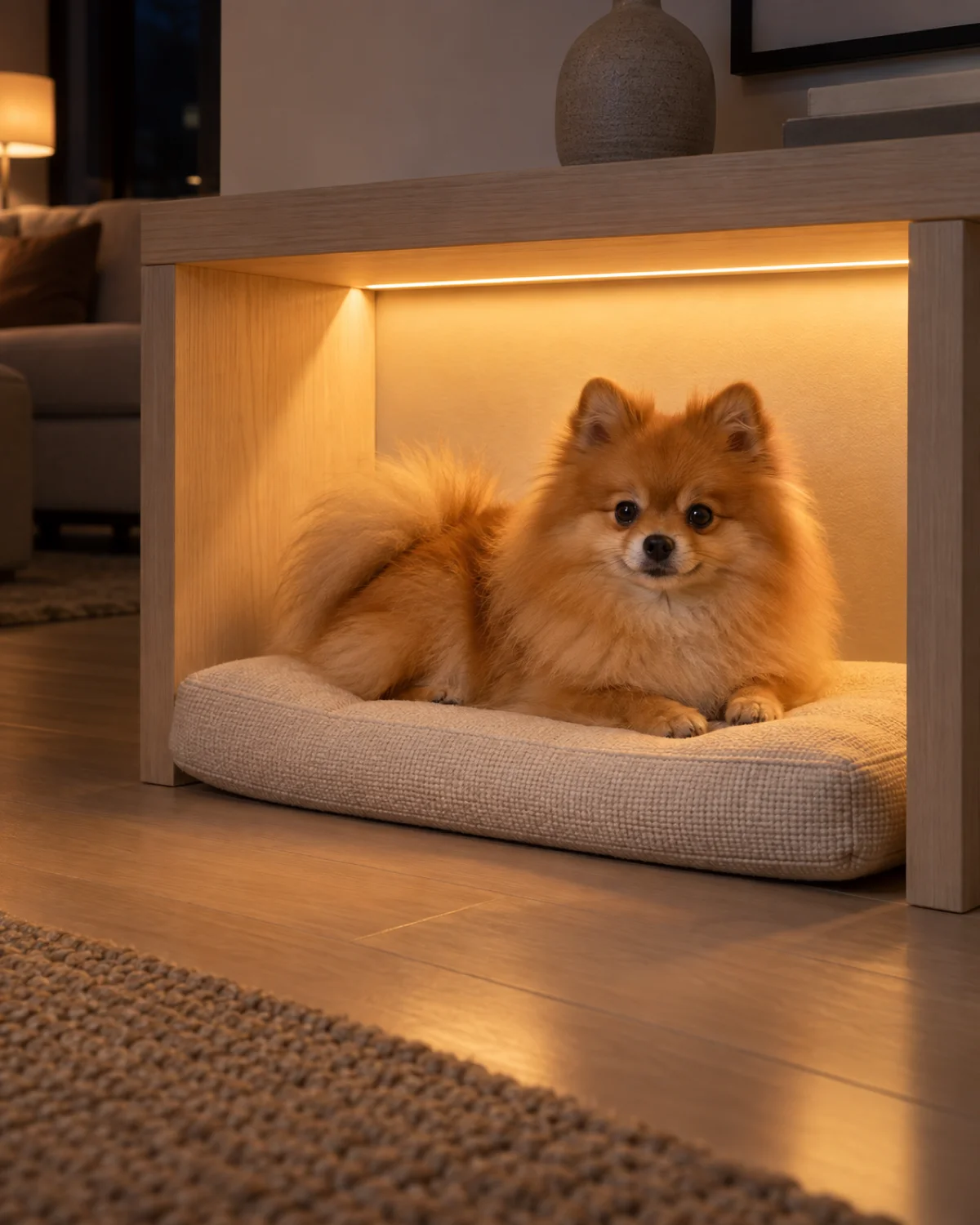
A dog room that goes dark the moment the overhead light turns off loses its appeal at night. Under-shelf LED strips create a low warm glow that keeps the space inviting without flooding it with bright light — exactly the ambiance a dog needs to settle in the evening.
Stick-on LED strips mount to the underside of any shelf or ledge with adhesive backing. Choose warm white or amber — never cool white or blue, which can disrupt the dog's sleep-wake cycle the same way screen light disrupts yours.
Installation in three steps:
-
Measure the shelf length — cut the LED strip to size at the marked cut points; most strips cut every two inches
-
Peel and stick — clean the underside of the shelf with rubbing alcohol, peel the adhesive backing, and press firmly along the edge
-
Connect to power — plug into a nearby outlet or wire to a USB adapter; add a smart plug or timer so lights turn on at dusk and off at bedtime
The result is a nightlight effect that illuminates the dog bed and the immediate floor area without lighting up the entire room. Dogs that are anxious in the dark — and many are — settle faster with a warm glow than in total darkness.
Create a Grooming Nook With a Rubber Mat and Supply Caddy
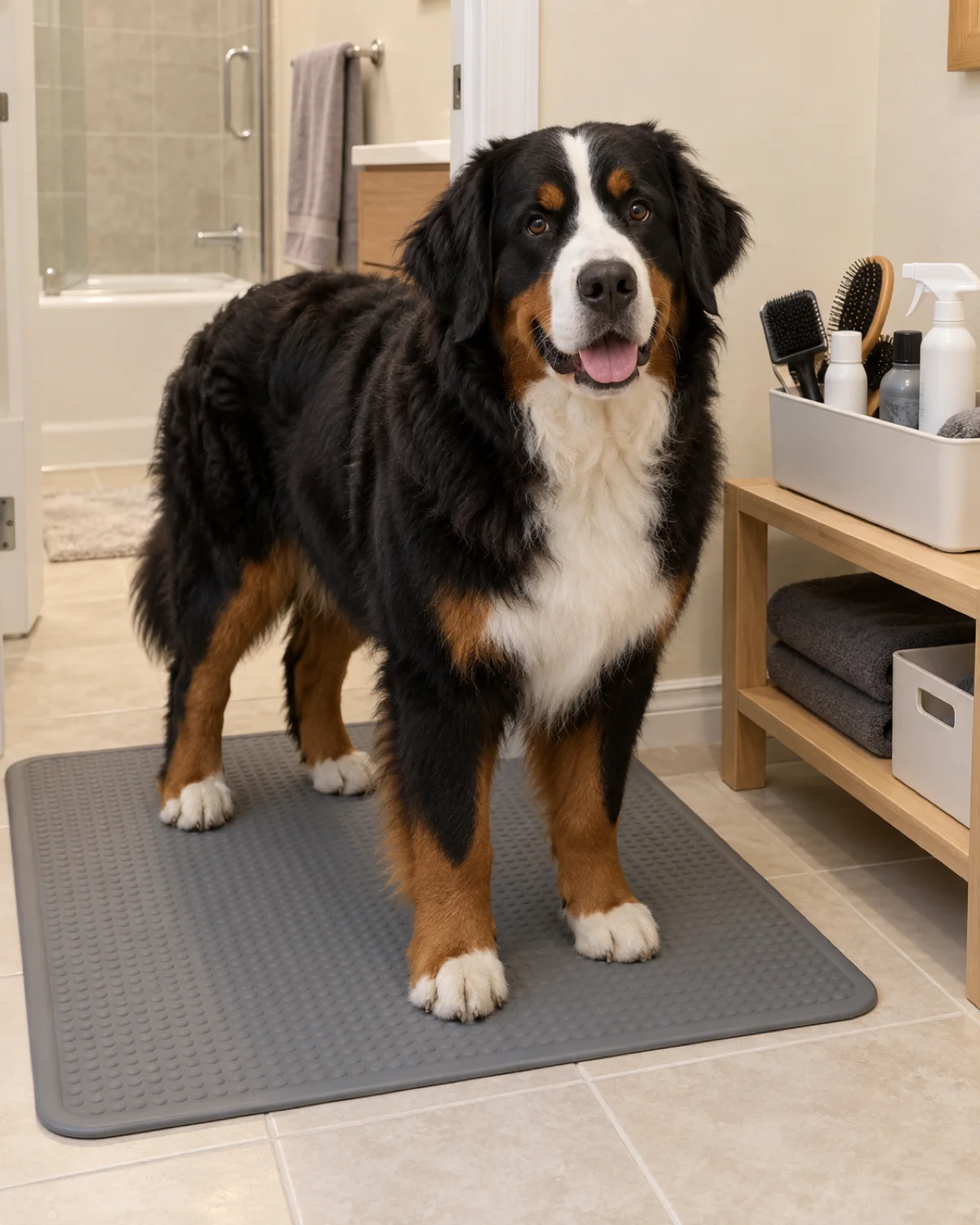
Grooming on the living room floor means loose fur on the carpet, nail clippings under the couch, and spray bottles balanced on whatever surface is closest. A dedicated grooming nook eliminates the scatter.
The nook needs three things: a rubber mat for the dog to stand on, a shelf or caddy with all supplies within arm's reach, and enough light to see what you are doing.
Grooming nook supply list:
- Rubber mat — a textured bath mat or a commercial grooming mat; non-slip so the dog feels secure standing still
- Slicker brush and comb — the two tools that handle ninety percent of coat maintenance
- Nail clipper or grinder — stored in the caddy, not in a bathroom drawer three rooms away
- Detangling spray — for long-coated dogs; keeps the brush from pulling and the dog from fidgeting
- Styptic powder — in case you clip a nail too short; having it within reach prevents a frantic search with a bleeding dog
Place the grooming nook on a hard floor — tile, vinyl, or wood — so loose fur sweeps up in seconds instead of embedding in carpet fibers. A corner of the bathroom or laundry room works well because both have hard floors and easy access to water.
Finish With a Name Sign or Paw Print Art Above the Space
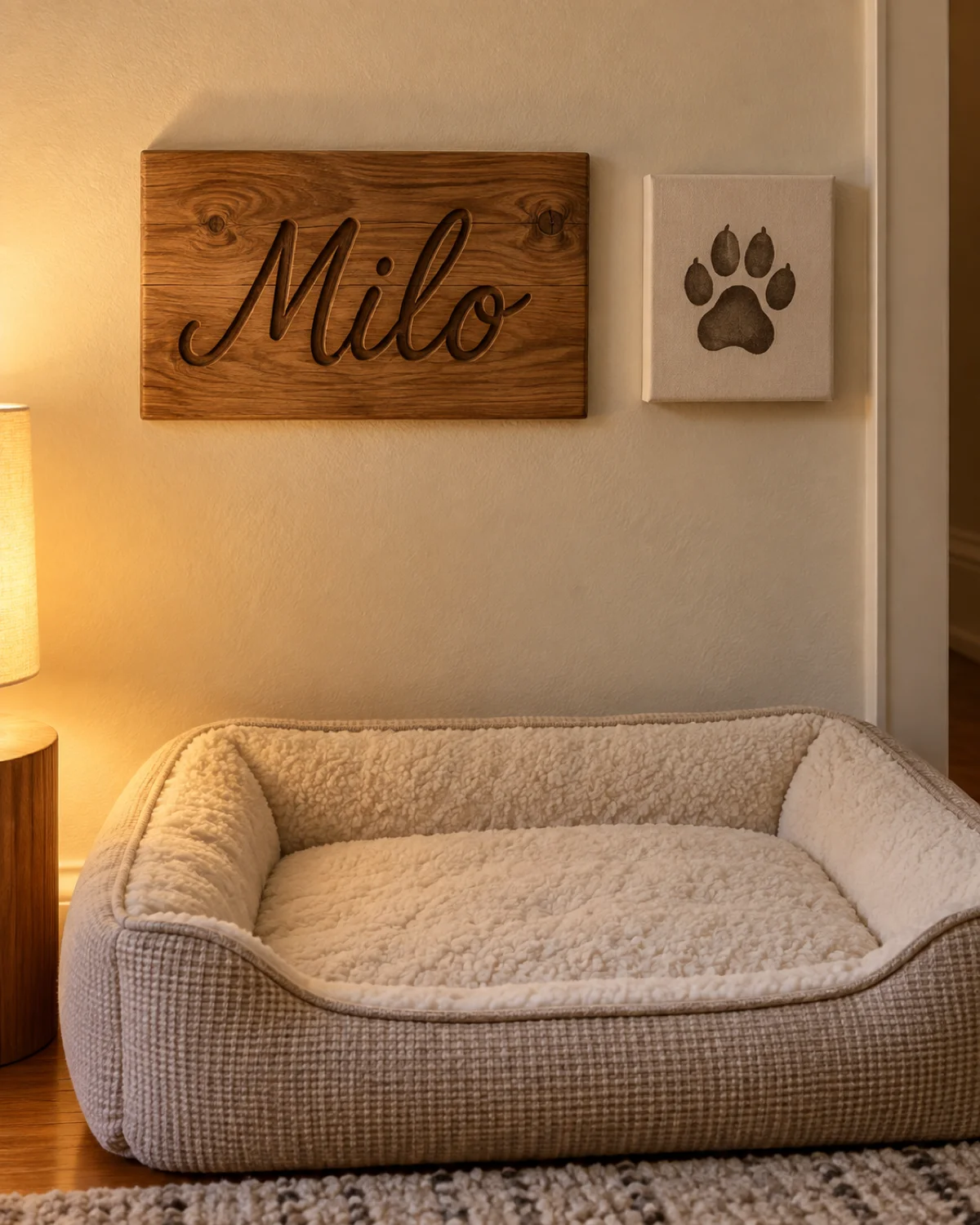
Every room needs a finishing touch that says this space belongs to someone. For a dog room, that finishing touch is a name sign or a piece of paw-print art mounted above the bed or the crate nook.
This is the only purely decorative item on the list, but it does something functional — it signals to everyone in the household that this corner is the dog's space, not a temporary setup that will get reclaimed for storage next month.
Options that work:
- Wooden name sign — a laser-cut or hand-painted sign with the dog's name in script lettering; mount it six inches above the top of the crate or bed
- Paw print canvas — an ink paw print from the dog, scanned and printed on a small canvas; personal and unrepeatable
- Bone-shaped plaque — a simple silhouette shape with the dog's name engraved; subtle and clean
Keep it small. One sign and one complementary piece is enough. A gallery wall of twelve dog-themed prints overwhelms the space and shifts the room from functional to shrine.
Frequently Asked Questions
Do I need a whole room for a dog room?
No. Most dog rooms are a section of an existing room — a closet alcove, a corner of the mudroom, a nook under the stairs, or a three-foot strip along a hallway wall. The key is dedicated space with a clear boundary, not a separate room with a door.
What flooring is best for a dog room?
Luxury vinyl plank or tile is the most practical choice. It resists water, cleans easily, does not absorb odors, and handles nail scratches better than hardwood. Rubber interlocking tiles work well for a temporary or rental-friendly option. Avoid carpet — it traps fur, absorbs moisture, and holds odor.
How much does it cost to set up a dog room?
A basic setup — rubber mat, wall hooks, a shelf, and a dog bed — runs fifty to one hundred dollars. A mid-range room with a raised feeding station, toy wall, peel-and-stick tile, and LED lighting runs two hundred to four hundred dollars. A full build with a wash station and custom crate nook can reach eight hundred to fifteen hundred dollars depending on materials.
How do I keep a dog room from smelling?
Wash the dog bed cover weekly. Wipe hard surfaces with an enzymatic cleaner every three to four days. Keep an open box of baking soda on a high shelf to absorb ambient odor. Open a window or run a small fan for fifteen minutes daily to circulate fresh air. The biggest factor is the floor — hard flooring that wipes clean will always smell better than carpet.
Can I build a dog room in a rental apartment?
Yes. Use pressure-mount gates instead of hardware-mount. Use peel-and-stick tile instead of real tile. Use adhesive hooks and removable shelving instead of screws. Interlocking rubber floor tiles lift right out when you move. Everything on this list except the permanent wash station has a renter-friendly alternative.

Written by
Jess Calloway
Dog mom to three very different dogs and the voice behind Pawliqa. Jess writes about the messy, rewarding reality of life with dogs — from the training wins to the chewed-up couch cushions. Every tip here has been tested on at least one reluctant patient.