Most dog gates get returned within a week. The gate itself is rarely the problem. It is the wrong gate in the wrong spot, installed the wrong way, blocking a space that did not actually need blocking.
Dog gate ideas work when they start with the layout. A narrow hallway, a wide kitchen pass-through, and the top of a carpeted staircase each need a completely different solution.
Here are thirteen gate setups that match real floor plans, real dog sizes, and real budgets, from pressure-mount basics to freestanding room dividers to weekend DIY builds.
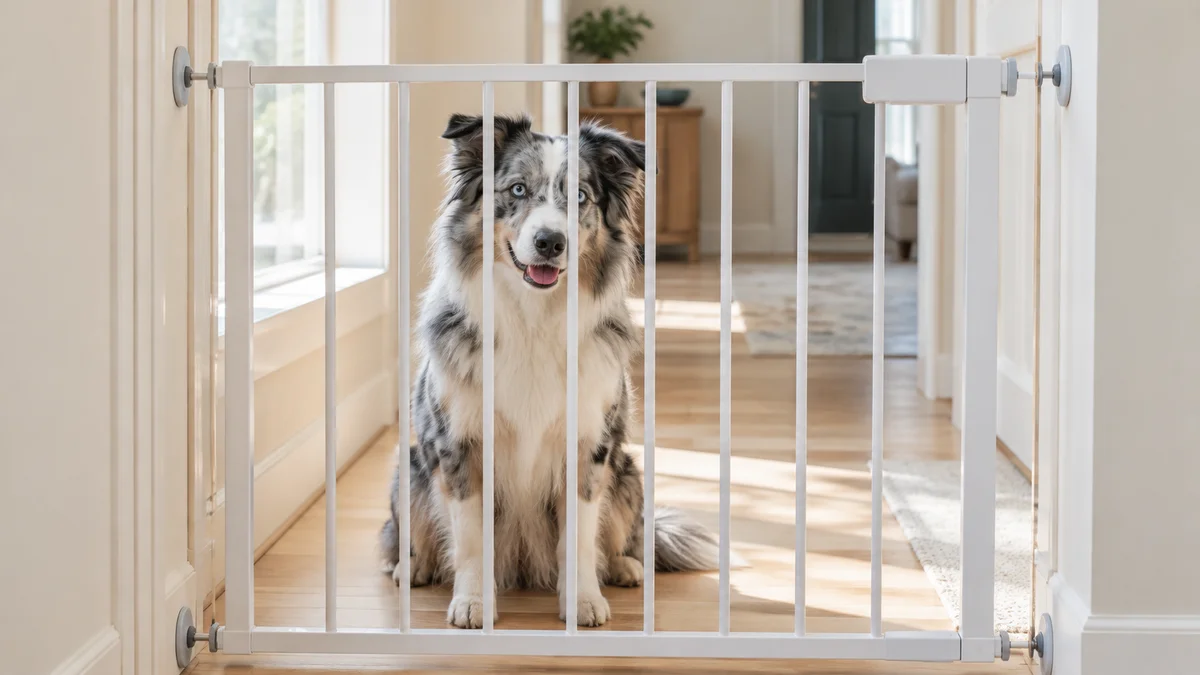
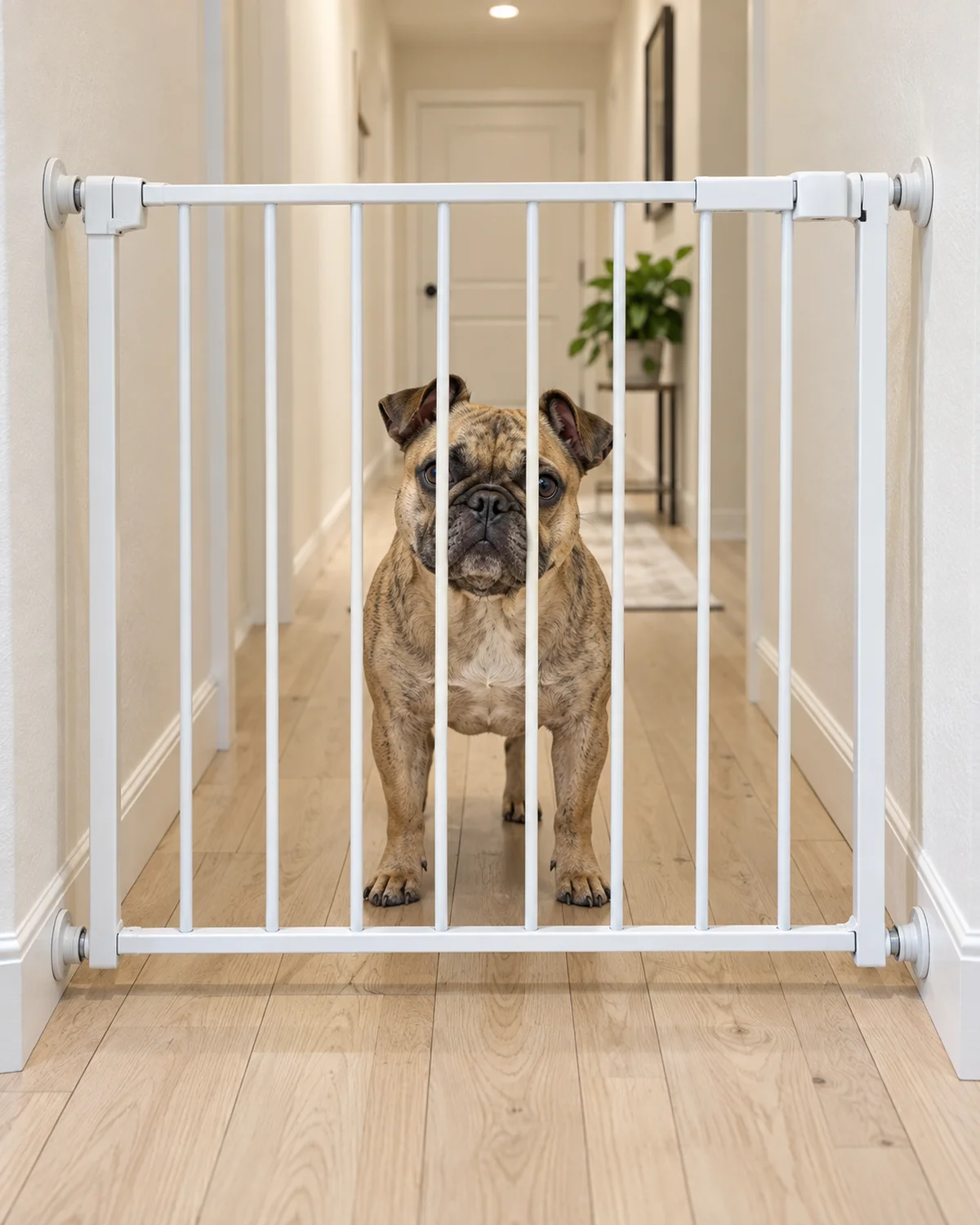
A pressure-mount gate wedges between two walls using rubber pads and a tension rod. No screws, no drill holes, no drywall patches when you take it down. That makes it the default first gate for most dog owners.
The catch is the width. Pressure mounts work best in openings between 28 and 36 inches. Once you add extensions to reach a wider span, the sideways force on the frame increases and the rubber pads lose grip. A dog leaning against an over-extended pressure gate will pop it loose.
Best fit: hallways, bathroom doorways, narrow bedroom entries
Weight limit: most hold up to about 30 pounds of lateral force, which covers small to medium dogs that do not charge the gate
Not for: the top of stairs (a nudge sends it tumbling down the steps) or wide openings over 38 inches without extension panels
Measure the exact width at three heights, floor level, hip level, and near the top. Older houses often have walls that taper, and a gate sized for the widest point will be loose at the narrowest. If your measurements differ by more than half an inch, shim the narrow gap with a thin rubber pad cut to size.
Gates are the first layer of puppy-proofing your home, but the gate only works if it actually fits the opening tight enough that a determined nose cannot push it aside.
Hardware-Mount Gate at the Top of Stairs
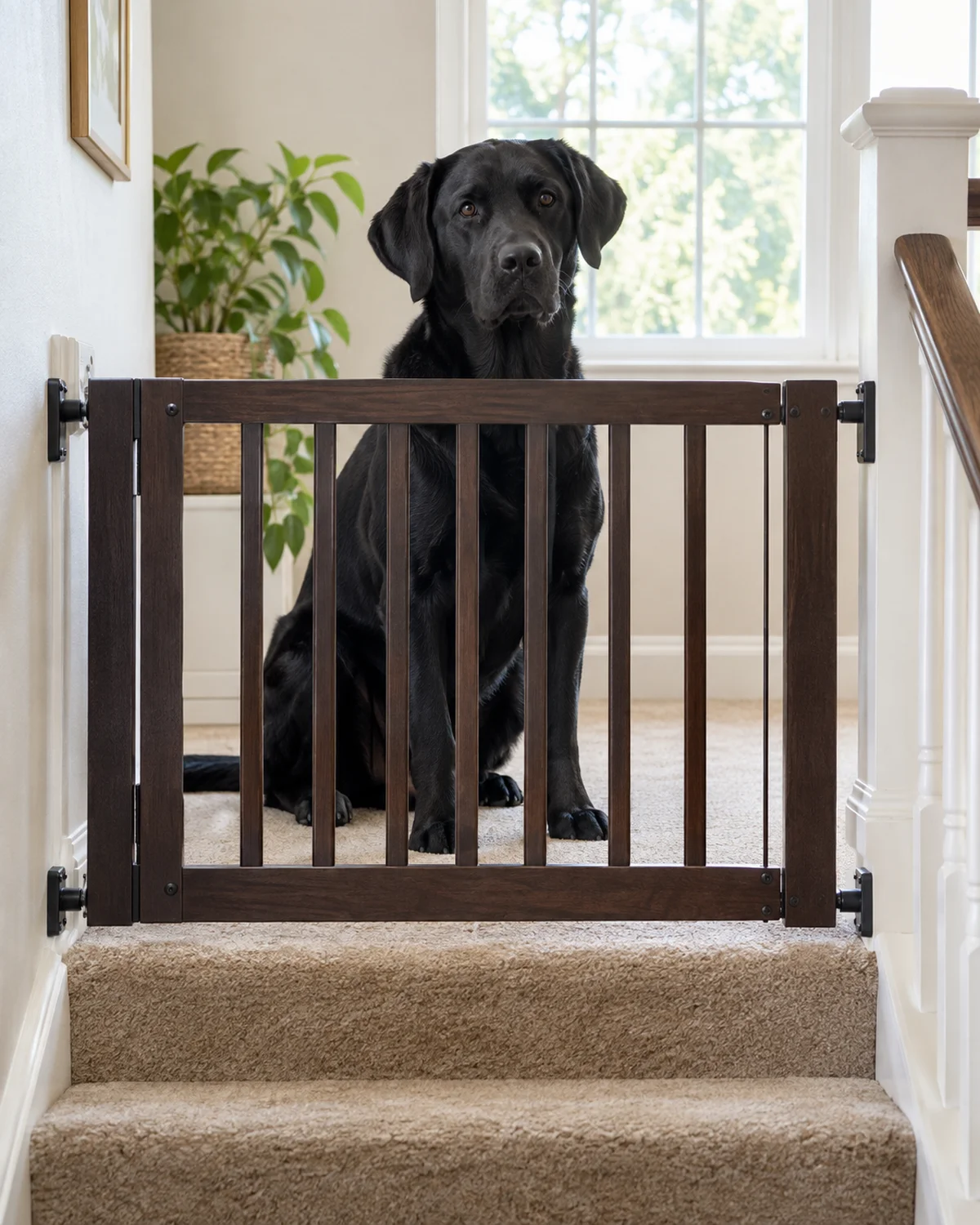
The top of the stairs is the one spot where a pressure-mount gate is genuinely dangerous. If a dog leans into it and the rubber pads slip, the gate and the dog go down the stairs together. Hardware-mount gates bolt into the wall studs and do not move.
Installation takes about twenty minutes with a drill, a stud finder, and the included hardware. Most models come with four screws per side, and the hinge plate sits flush against the drywall so it does not look industrial.
Hinge side: mount on the wall side, not the banister (banisters flex; walls do not)
Swing direction: the gate should swing toward you when you are standing at the top, never out over the stairs
Latch type: one-hand release is worth the extra cost when you are carrying a laundry basket or a toddler
What about the bottom of the stairs?
A pressure-mount gate is fine at the bottom. The fall risk is reversed: if the gate pops free, it falls flat on level ground. A hardware mount at the bottom is overkill unless your dog is large enough to bulldoze through rubber pads.
Quick reference
Gate Installation Quick Check
Measure three heightsFloor, hip, and top. Walls taper in old homes and a loose fit at any point means the gate fails.
Find the studsHardware mounts need studs behind the drywall. A magnetic stud finder costs less than a gate repair.
Stairs = hardware onlyTop of stairs demands bolted hardware. Pressure gates at stair tops are a fall hazard for dogs and people.
Check swing clearanceWalk-through gates need room to swing fully open. Measure the arc before you commit to hinge placement.
Extra-Wide Swing Gate for Open Doorways
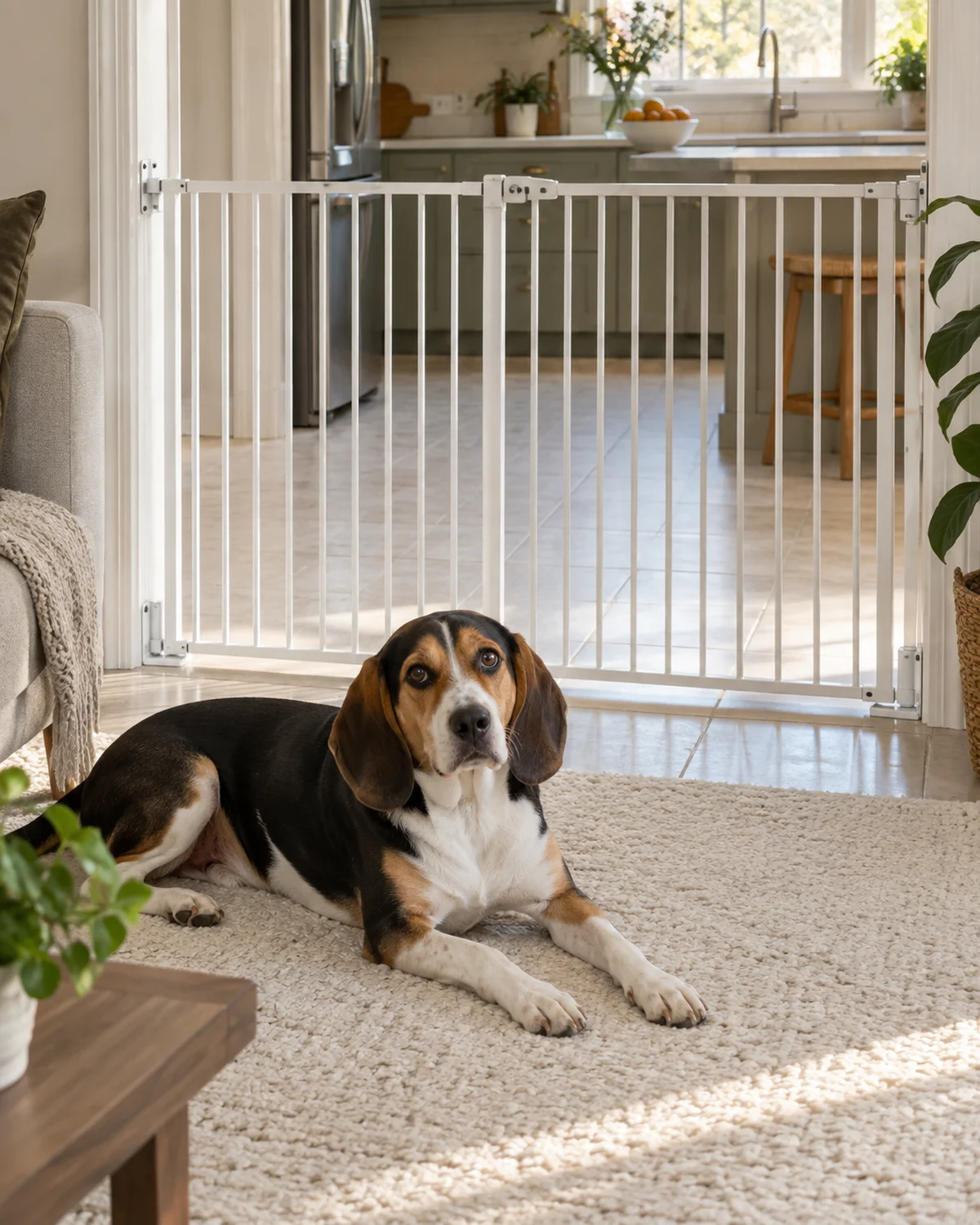
Open-concept homes have doorways that run 44 to 60 inches wide. A standard 30-inch pressure gate with one extension panel will not span that without bowing in the middle. An extra-wide swing gate is purpose-built for these openings.
Most extra-wide models are hardware-mounted and swing open like a door. The hinge sits on one side, the latch on the other, and the gate swings one direction (ideally away from the dog so they cannot push it open).
The key specification to check is the bar spacing. Wide gates use thicker gauge steel or additional vertical bars to prevent the wider panel from flexing. If the bars have more than three inches of gap, a small dog or a puppy can squeeze through.
Walk-through convenience: these gates have a proper latch you can operate with one hand while holding a plate or a mug
Panel count: some models use two panels that meet in the middle with a magnetic latch, which is easier in very wide openings where a single swing would block the entire hallway arc
Floor clearance: look for gates with a bottom rail no higher than two inches off the floor, or a determined puppy will army-crawl under it
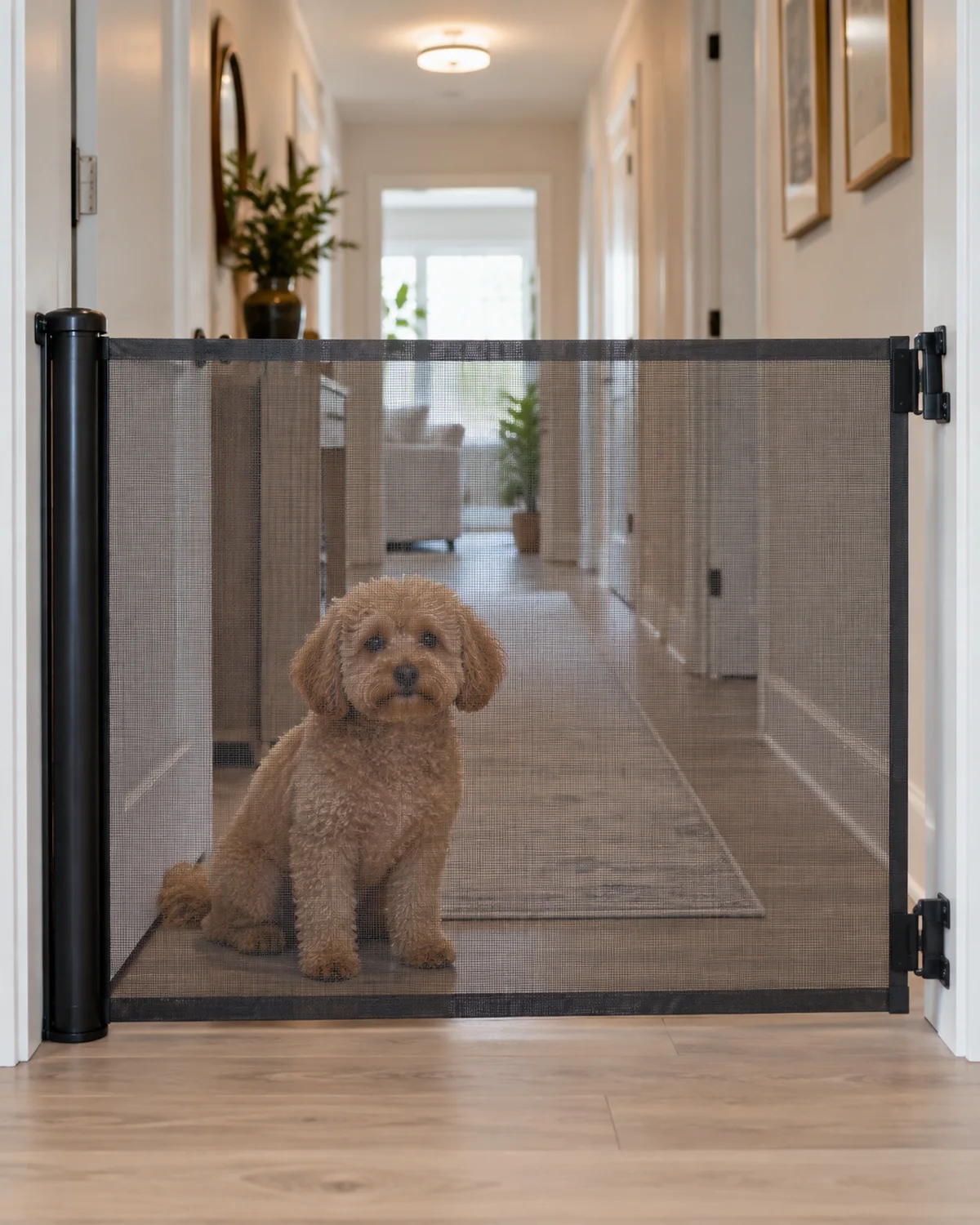
Retractable Mesh Gate for High-Traffic Passages
A retractable gate rolls into a slim housing mounted on one side of the door frame, and the mesh pulls across to latch on the opposite side. When you unlatch it, the mesh retracts and the doorway is completely clear.
This is the gate for passages you walk through twenty times a day. Kitchen to dining room, hallway to living room, the route between the two rooms you live in most. No stepping over a bar, no unlatching and swinging a panel, just pull and click.
The tradeoff is strength. Mesh gates are not designed to stop a 70-pound dog that charges. They are visual barriers, not physical ones. For dogs that respect a boundary once they understand it is there, mesh works perfectly. For dogs that test barriers with their body weight, mesh will not hold.
Best feature: when retracted, the gate is invisible, just a slim housing strip on the door frame
Installation: hardware-mounted on one side, latch plate on the other, four screws total
Cleaning: the mesh collects dust and pet hair inside the housing over time, so pull it out fully and wipe it down monthly
Pro tip
Retractable Gate Survival Tips
Lock the latchAlways click the latch fully shut. A half-latched mesh sags in the middle and teaches the dog it can push through.
Retract slowlyLetting the mesh snap back damages the spring mechanism. Guide it with your hand for the last six inches.
Skip extension kitsRetractable gates lose tension over wider spans. If the opening is over 50 inches, choose a swing gate instead.
Mount at dog nose heightThe mesh should sit at or slightly above your dog's nose when standing. Too high and the bottom gap invites crawling under.
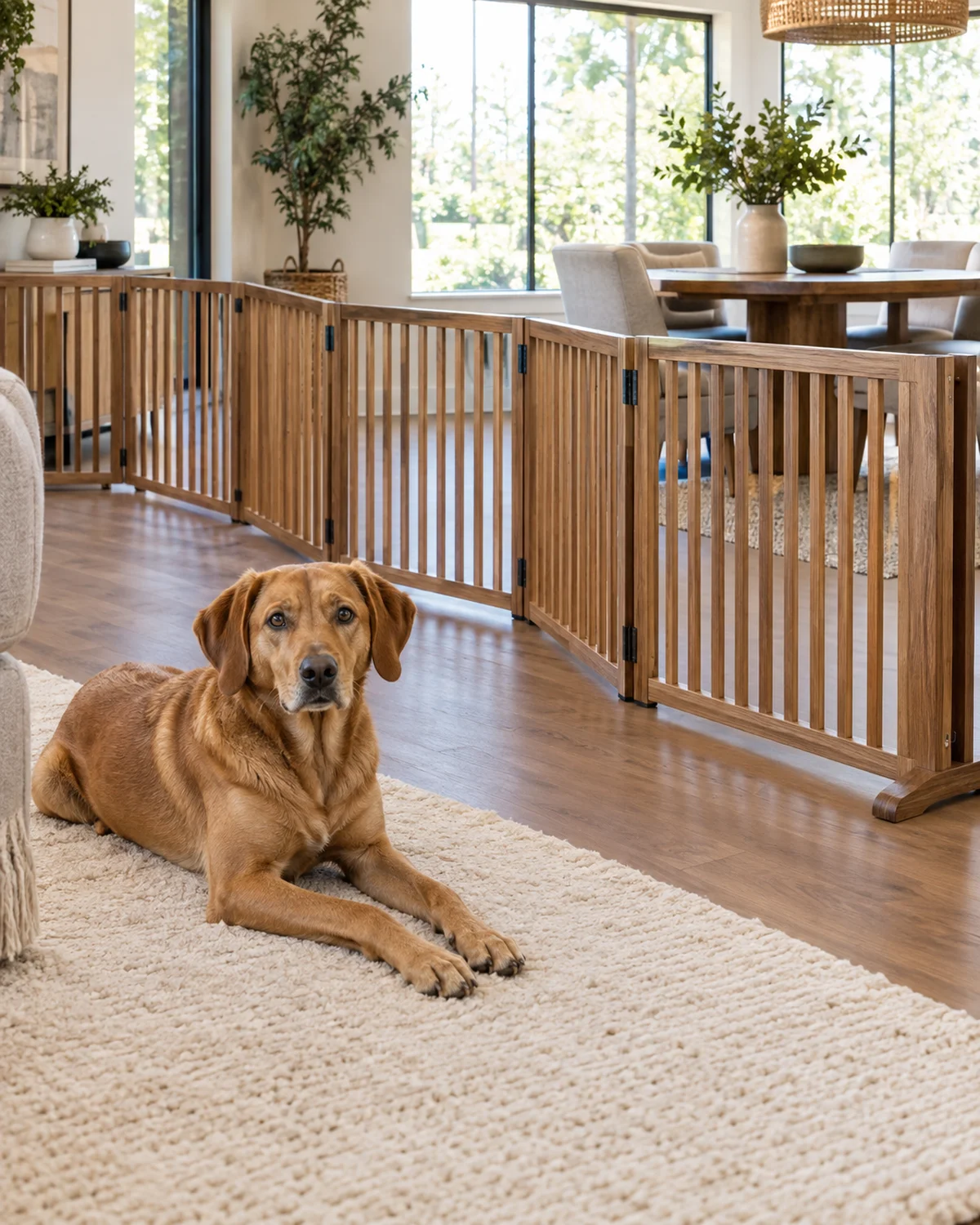
Freestanding Zigzag Panel Gate for Open Floor Plans
Some rooms do not have a doorway to mount a gate in. Open floor plans, loft spaces, and L-shaped living areas need a freestanding barrier that creates its own structure.
A zigzag panel gate stands on its own by folding into an S-shape or a Z-shape. The angle between the panels creates lateral stability, so the gate does not need to touch a wall on either end. Most are made of wood or bamboo and look more like furniture than a pet product.
Panel count: three-panel gates cover about 60 inches, four-panel gates stretch to 80 inches or more
Stability hack: the steeper the zigzag angle, the harder it is to knock over, but the more floor space it eats
Height: most freestanding panels are 24 to 32 inches tall, which is enough for small and medium dogs but not for large dogs that can step over
The visual presence of the zigzag is often enough. Dogs tend to respect a visible boundary even when they could physically walk around the end of it. If your dog does walk around, anchor the end panel against a piece of furniture or the corner of a wall to close the bypass route.
These gates also fold flat for storage, which makes them useful for people who only need the barrier at certain times, during cooking, during a dinner party, or when a puppy is still learning boundaries.
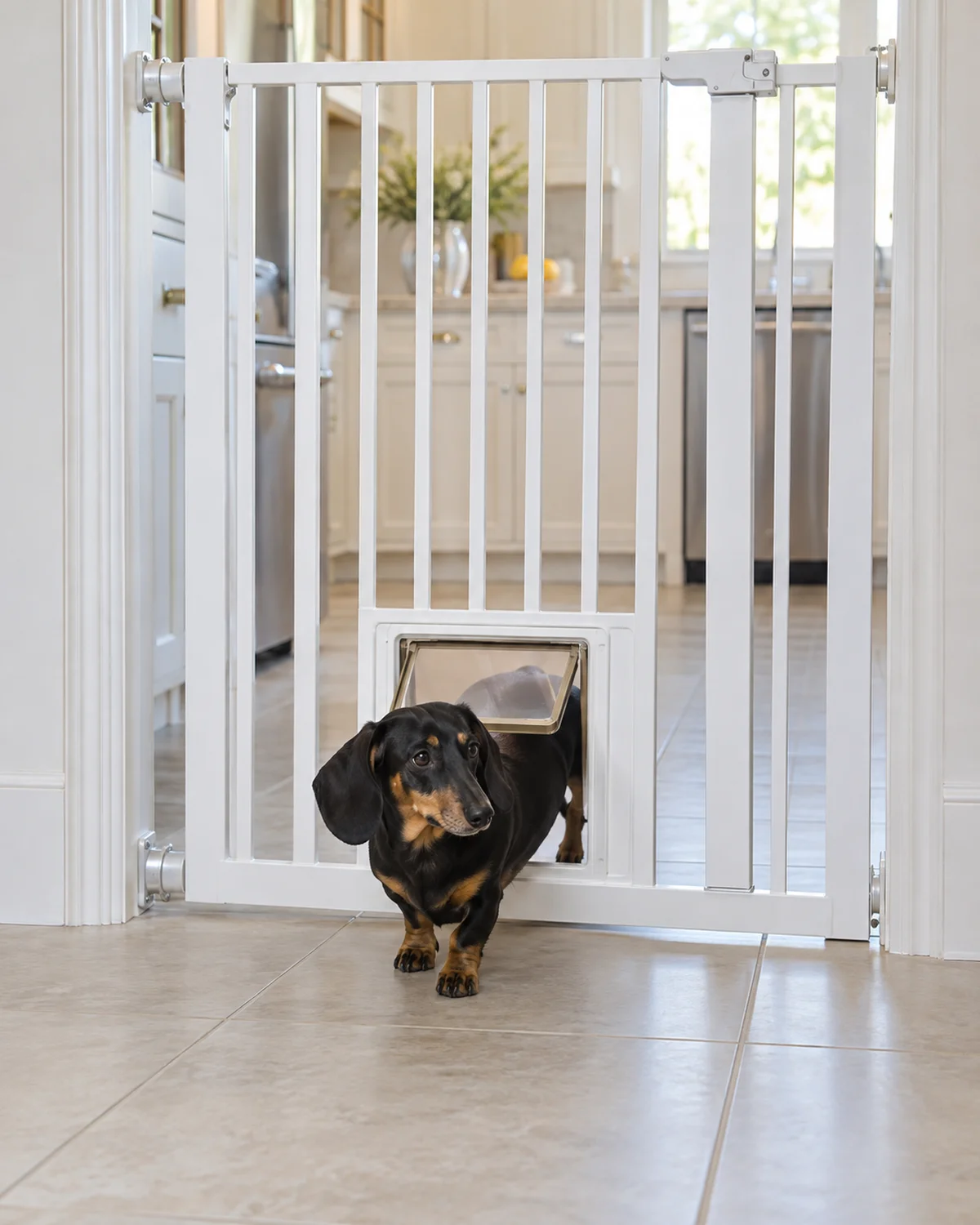
Walk-Through Gate with a Pet Door Built In
If you have a small dog and a large dog, or a dog and a cat, a gate with a built-in pet door solves the access problem without removing the barrier.
The small animal walks through the flap at the bottom while the larger animal stays on the other side. You walk through the full-size door panel when you need to cross.
The critical measurement is the pet door opening. Measure your smaller pet at the shoulder and add two inches. If the flap opening is too small, the smaller pet will stop using it. If it is too large, the bigger dog will try to squeeze through and either succeed or get stuck.
Flap material: rigid plastic flaps are more durable than fabric, but some pets dislike pushing through hard material, so test before committing
Lock the flap: most models include a slide lock that blocks the pet door entirely, useful when you want the barrier to be absolute
Placement: install the gate so the flap faces the room where the smaller pet spends most of its time, not the room you are trying to keep the bigger dog out of
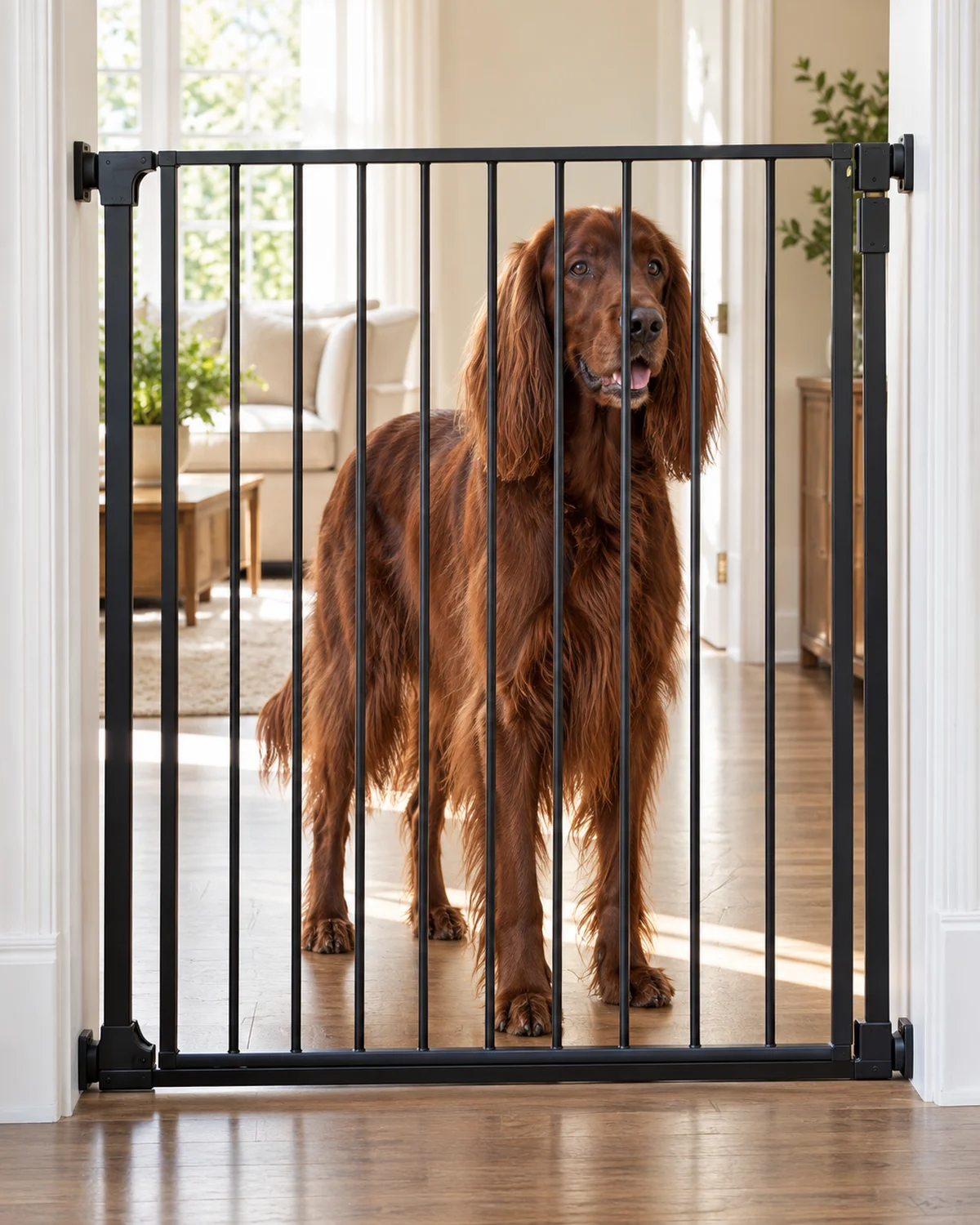
Tall Gate for Dogs That Jump or Climb
Standard gates are 28 to 30 inches tall. A medium-to-large dog that is motivated can clear that height without much effort, and some dogs treat it as a daily athletic event.
Tall gates run 36 to 44 inches and change the calculation. A 42-inch gate is chest-height on most adults and above the head of most medium dogs. The height alone usually eliminates the jumping because the dog cannot see over the top to gauge the landing.
Bar orientation matters: vertical bars are harder to climb than horizontal slats because there is nothing to hook paws onto
Lean resistance: tall gates need a wider base or wall mounting because the leverage from a dog leaning against a tall panel is significantly greater than on a short one
Topper add-ons: some brands sell extension panels that bolt onto the top of a standard gate to add six to twelve inches, which costs less than a new gate
Climbers versus jumpers
Jumpers need height. Climbers need smooth vertical bars with no horizontal crosspieces to step on. If your dog does both, you need a tall gate with vertical bars and no decorative cross-rails in the middle.
Before you buy
Tall Gate Buying Checklist
Measure your dog standingNose to floor when on hind legs. The gate needs to be at least four inches taller than that number.
Check bar directionVertical bars only. Horizontal rails give climbers a stepping ladder straight over the top.
Confirm weight ratingTall gates bear more leverage. Look for a rated weight capacity, not just a vague label.
Test the latch at full heightIf the latch is at 40 inches and you are short, you will hate this gate within a day. One-hand release matters.
Outdoor Deck Gate for Porches and Patios
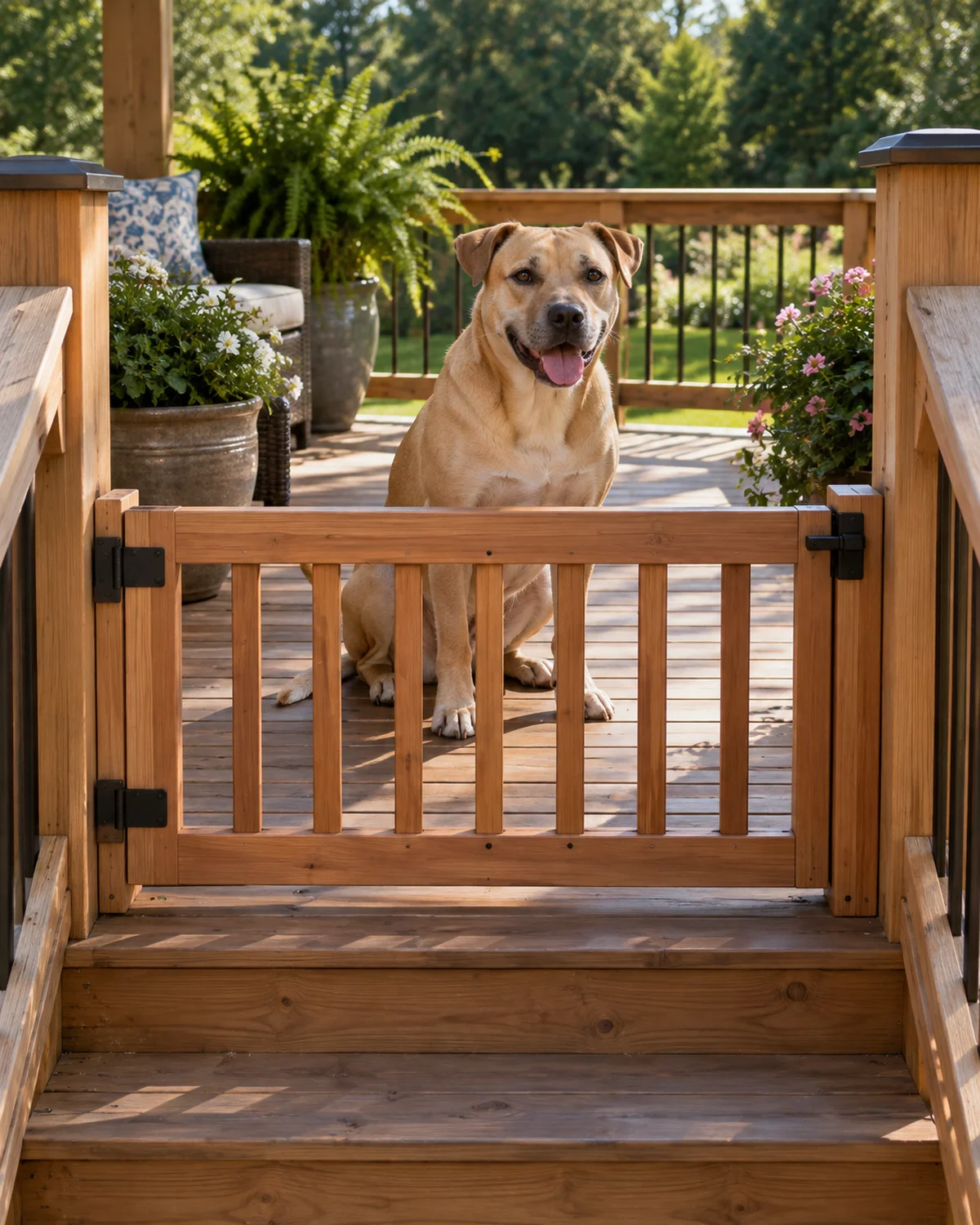
Indoor gates rust outdoors. An outdoor deck gate needs weather-resistant materials: cedar, pressure-treated pine, composite, or powder-coated steel.
The primary job of a deck gate is blocking the stairs. Most dogs will not jump off the side of a raised deck, but they will bolt down the steps the moment a squirrel appears in the yard. A gate across the top of the deck stairs solves that.
Material choice: cedar weathers to a silver grey and lasts years untreated, but it splits if the gate slams repeatedly, so add a soft-close hinge or a bungee cord catch
Height: outdoor gates can be shorter because the deck railing handles the rest of the perimeter, 24 inches is often enough if the dog is not a jumper
Drainage: the bottom rail should sit at least an inch above the deck surface so water does not pool and rot the wood
If your deck wraps around a corner, you may need two gates: one at the stairs and one at any open section where the railing ends. A simple garden gate with a spring hinge works for the secondary spot and costs a fraction of a purpose-built pet gate.
DIY Barn-Door-Style Sliding Gate
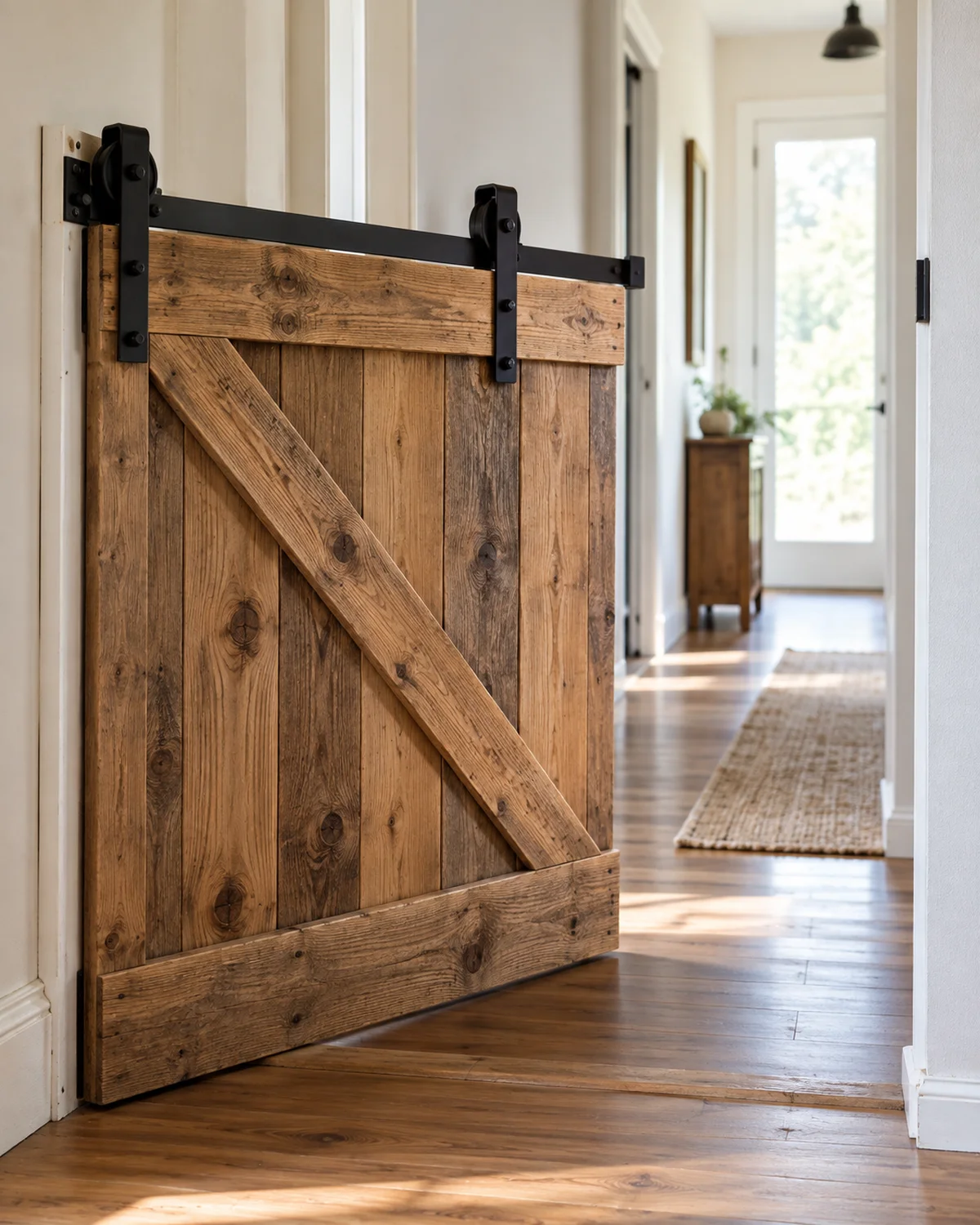
A sliding gate runs on a track above the doorway and pushes sideways instead of swinging. It takes zero floor clearance to open, which makes it ideal for tight hallways where a swing gate would block the path.
The build uses standard barn-door hardware: a rail, two roller wheels, and a handful of bolts. The gate panel itself is reclaimed wood, new pine, or plywood, whatever matches your house.
Materials list
A flat-bar sliding track rated for the weight of your panel (most pet gates weigh under 15 pounds, well within any barn-door kit)
Two roller carriages with sealed bearings
Wood planks or a single plywood panel cut to the opening width plus four inches of overlap on each side
A floor guide to keep the bottom from swinging
Build notes
The track mounts above the door frame on a header board. Use lag screws into the studs, not drywall anchors. The panel should hang about half an inch above the floor, low enough that a dog cannot belly-crawl under but high enough to clear carpet pile.
A stop block at each end of the track prevents the gate from sliding off. Add a simple barrel bolt or hook latch to lock it in the closed position. The whole project takes an afternoon and costs less than most walk-through gates from a pet store.
DIY PVC Pipe Gate on a Budget
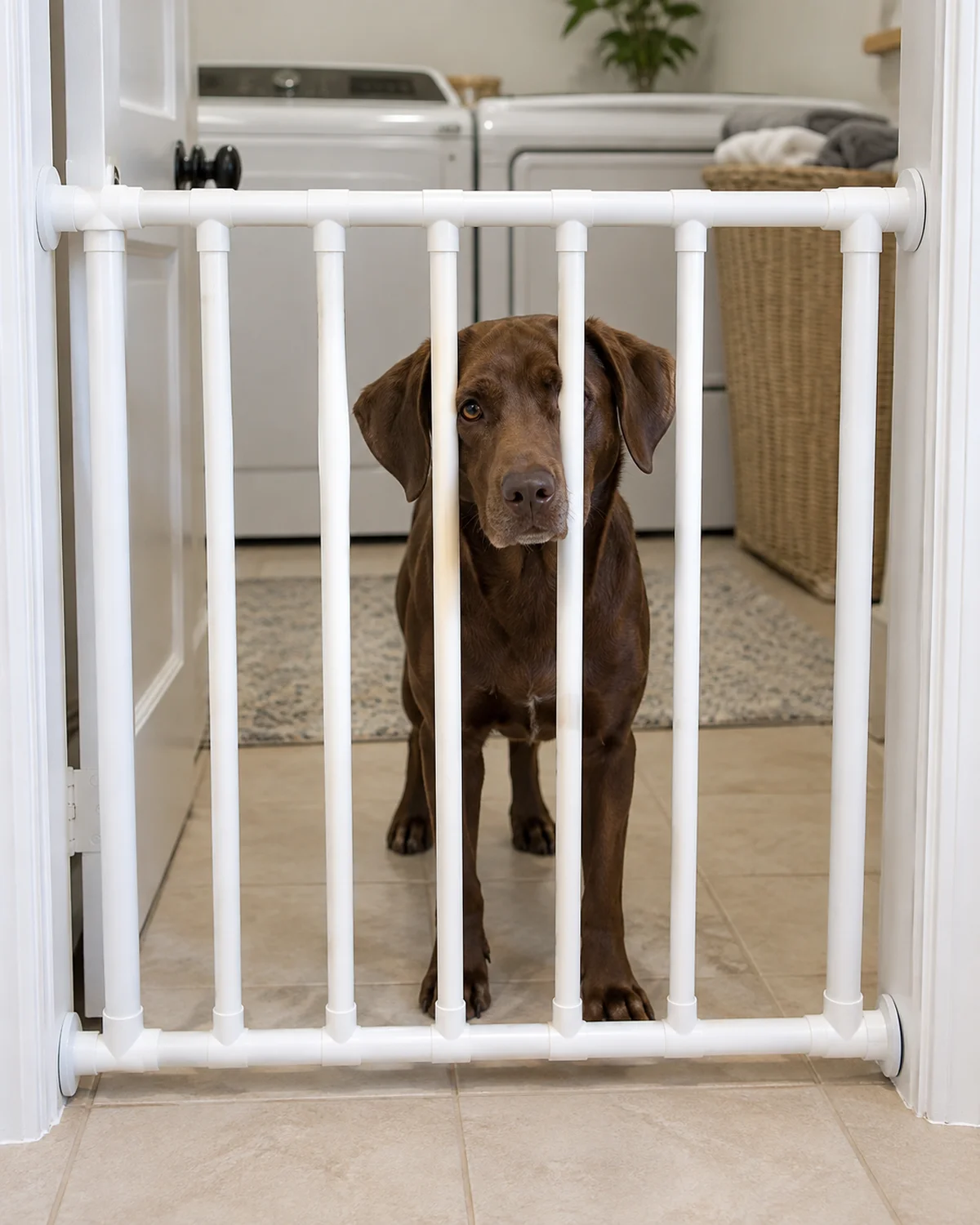
PVC pipe gates cost under twenty dollars in materials and require no tools beyond a hacksaw and PVC cement. They are lightweight, easy to resize, and surprisingly sturdy for small to medium dogs.
The frame is a rectangle made from one-inch PVC pipe and elbow fittings. Vertical bars are shorter pieces of pipe glued into tee fittings along the top and bottom rails. The spacing between bars should be no more than two and a half inches for small dogs, three inches for medium dogs.
Pressure-fit version: cut the frame slightly wider than the opening and wedge it in with rubber end caps, no glue to the walls, removable in seconds
Durability: PVC will not rust, rot, or splinter, and it wipes clean with a damp cloth
Limitations: PVC flexes under force, so this gate is not for large dogs that lean hard or for any high-stakes barrier like the top of stairs
If you want it to look less like plumbing, spray-paint the whole thing matte black or flat white before installation. Two thin coats of plastic-bonding spray paint adhere well and last.
You can combine this with crate training to create a contained safe zone: gate across the room entrance, crate inside with the door open, and the dog chooses between the crate and the gated room.
Save this for later
13 Dog Gate Ideas for Every Layout
1Pressure-mount for narrow hallwaysRubber pads, tension rod, no drill holes. Best for openings under 36 inches.
2Hardware-mount at the top of stairsBolted to studs. The only safe option for stair tops where a fall means injury.
3Extra-wide swing gate for open doorwaysSpans 44 to 60 inches. Swings like a door with a one-hand latch.
4Retractable mesh for busy passagesRolls into a slim housing when not in use. Visual barrier, not a brute-force one.
5Freestanding zigzag panelNo walls needed. The S-curve creates its own stability in open floor plans.
6Walk-through with a pet doorSmall pet walks through the flap, big pet stays out. Measure shoulder height plus two inches.
7Tall gate for jumpers and climbers36 to 44 inches tall with vertical bars only. No horizontal rails to step on.
8Outdoor deck gateCedar or powder-coated steel. Blocks the stairs, weathers the seasons.
9DIY barn-door sliderSlides sideways on a track. Zero floor clearance needed to open.
10DIY PVC pipe gateUnder twenty dollars in PVC and fittings. Lightweight, no rust, renter safe.
11Shelf gate that doubles as storageHalf-wall height with a display surface on top. Barrier plus furniture in one.
12Fabric tension gate for rentersCanvas panel on a spring rod. No holes, no damage, takes down in seconds.
13Custom gate for odd openingsAngled cuts for under-stair nooks and non-standard widths. Template the shape first.
pawliqa.com
Mounted Shelf Gate That Doubles as Storage
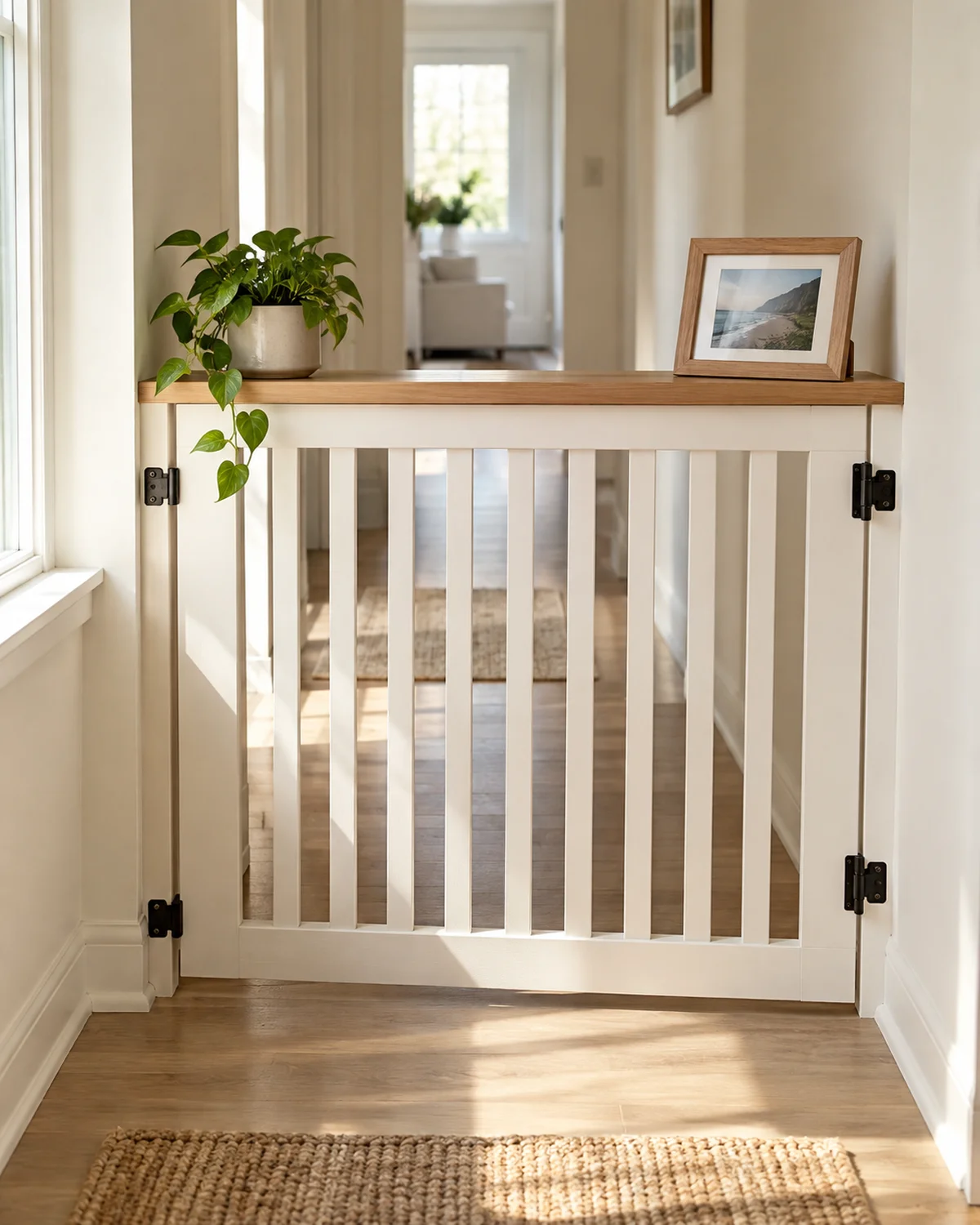
A shelf gate is a half-wall with a flat top surface. It blocks the dog at waist height and gives you a narrow shelf for keys, a small plant, or a framed photo. It looks like built-in cabinetry, not a pet product.
The build is a plywood box frame, open on the bottom, mounted to the wall studs at both ends. The top panel is a finished board, sanded and sealed, that sits flush with the frame edges. Paint it to match the trim and it disappears into the hallway.
Height: 32 to 36 inches keeps most dogs contained while still letting you reach across comfortably
Depth: 6 to 8 inches is enough for a shelf surface without making the hallway feel narrow
Weight on top: keep it light, a heavy vase falling on a dog below is the opposite of the safety this gate is supposed to provide
This is a permanent installation, so it works best in a home you own and in a spot where you always want a barrier. If your needs change, the frame comes down and the screw holes patch easily.
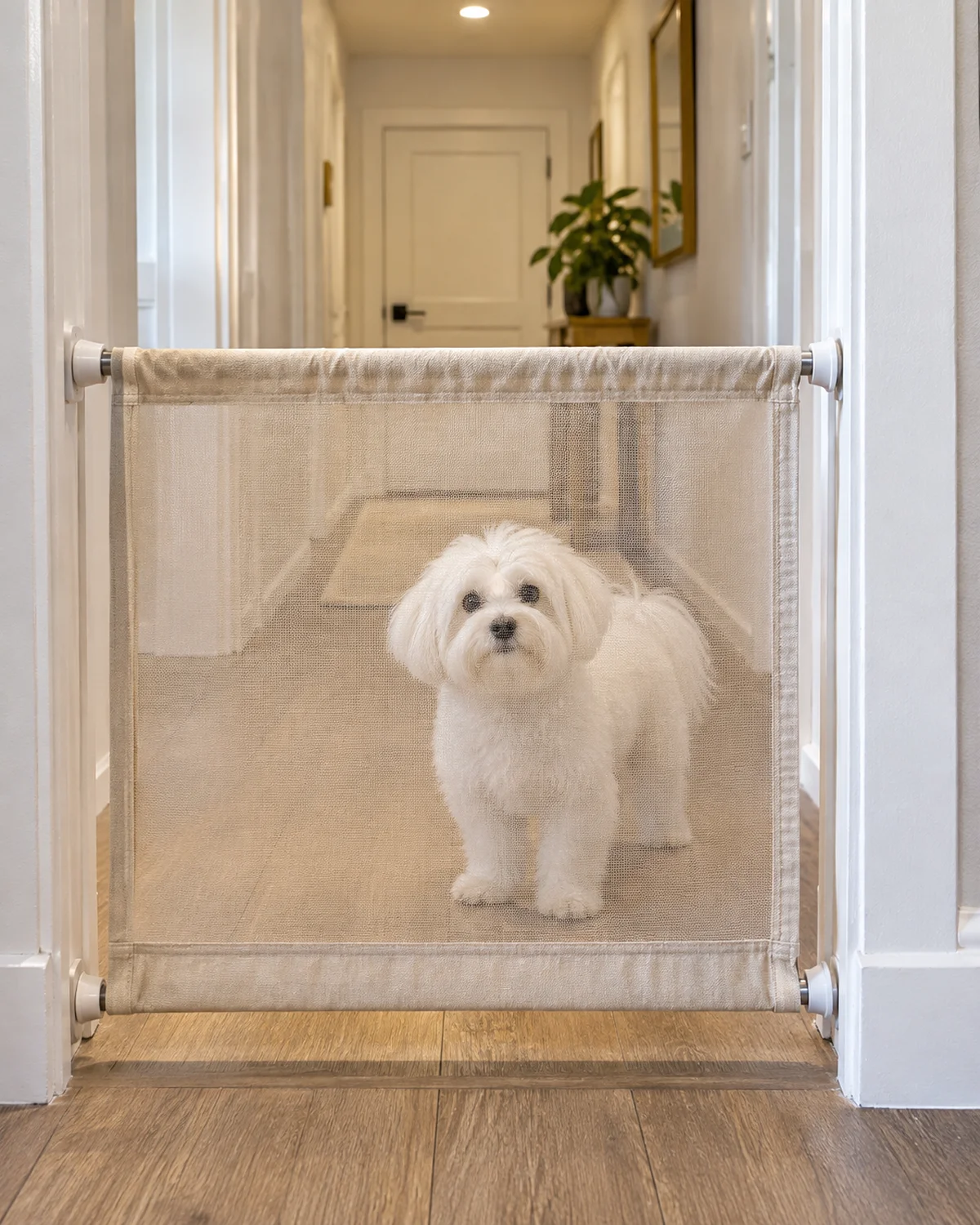
Fabric Tension Gate for Renters
Renters cannot drill into walls without risking their security deposit. A fabric tension gate uses a spring-loaded rod, the same mechanism as a tension shower curtain rod, to hold a canvas or nylon panel across a doorway.
The fabric panel attaches to the rod with loops or Velcro along the top edge. When you want to pass through, you lift the fabric up and over the rod, or some models have a pass-through slit in the center.
Best for: small dogs under 25 pounds that do not test barriers physically
Not for: dogs that chew fabric, scratch at barriers, or have any history of barrier frustration
Visibility: choose a semi-transparent mesh or a fabric with a window panel so the dog can see through it, which reduces anxiety and barking
The spring rod leaves zero marks on the door frame if you fit it correctly. Too tight and it dents the wood, too loose and it falls. Tighten until it holds firm with a gentle push, then stop.
Pair this with positive reinforcement so the dog learns the fabric is a boundary, not a challenge. Reward staying on their side, and the fabric does the rest.
Custom Gate for Odd-Shaped Openings
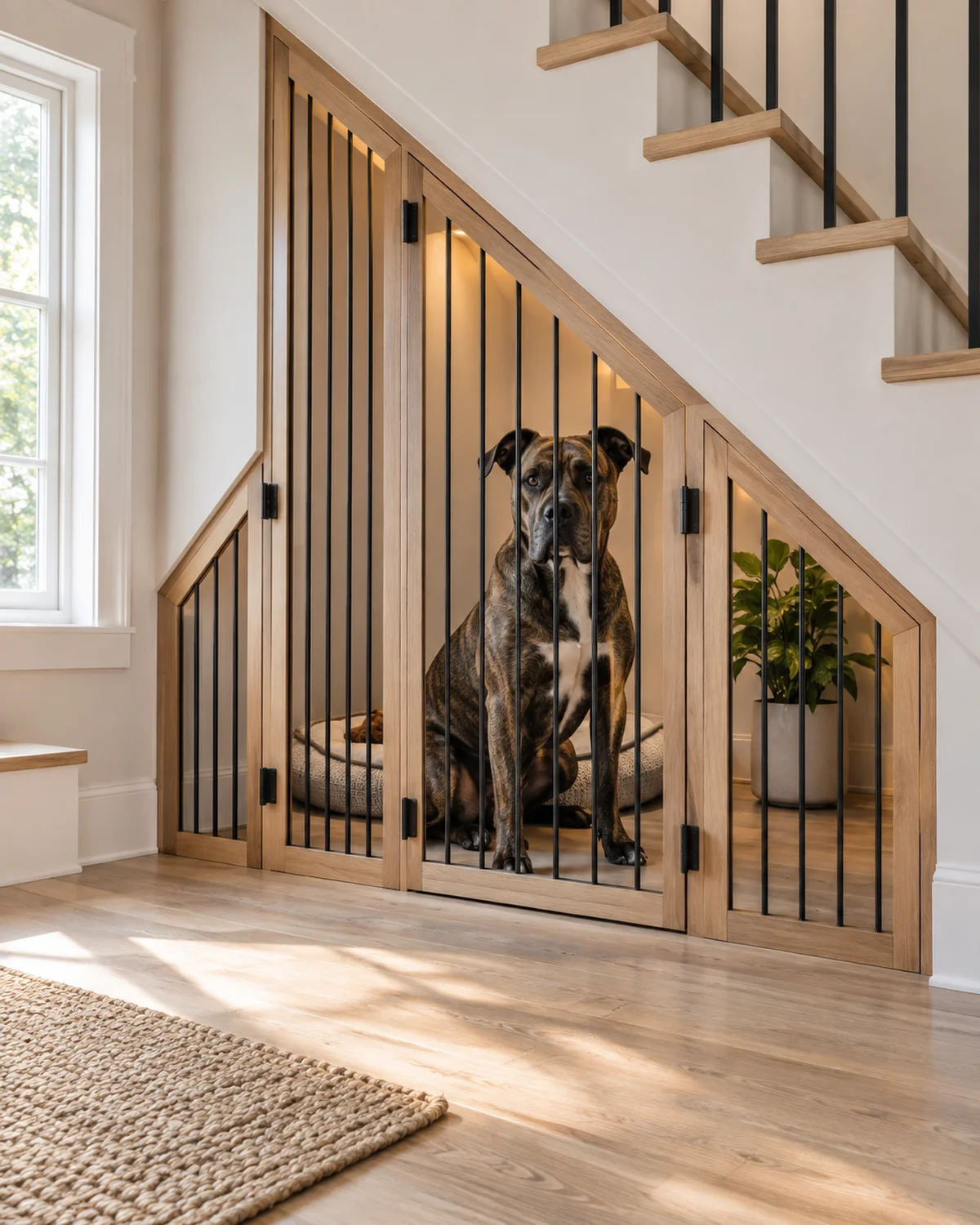
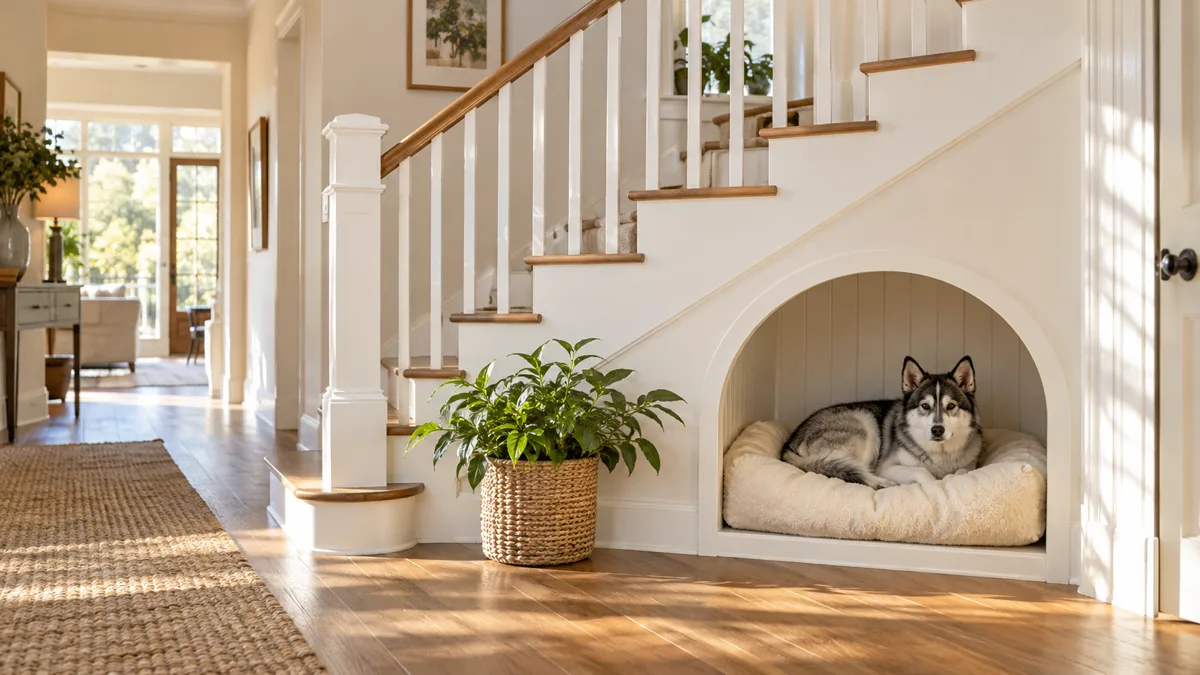
Under-staircase nooks, angled walls, arched doorways, and loft railings with non-standard widths all defeat off-the-shelf gates. A custom gate is the only answer when the opening is not a rectangle.
The process starts with a template. Tape together pieces of cardboard to fill the opening exactly, mark the angles and curves, then transfer those measurements to wood or metal.
Material: for angled cuts, plywood is the easiest to work with because you can cut compound angles on a table saw or a circular saw with a guide
Hinges: use adjustable-angle hinges for openings where the wall meets the gate at anything other than 90 degrees
Finish: match the stain or paint to the surrounding trim so the gate reads as architecture, not an afterthought
Under-staircase gates
The sloped ceiling line is the tricky part. Cut the top rail of the gate to follow the slope, and add a vertical bar every four to six inches along the slope to fill the triangular gap. The bottom rail stays level with the floor.
If carpentry is not your skill set, a local handyman can build a custom gate for about the cost of two high-end store-bought gates, and it will fit perfectly where nothing else will.
Common questions
FAQ
Can I use a baby gate for my dog?
Baby gates and dog gates overlap in size and mounting style, but there are differences. Baby gates are tested against a child leaning or pushing. Dog gates need to handle a running 40-pound animal hitting the gate at speed. If your dog is calm and does not charge barriers, a baby gate works. If your dog is excitable or large, choose a gate rated for pet use with reinforced hinges and a heavier frame.
How do I stop my dog from pushing the gate open?
First, confirm the gate is installed tight. Pressure mounts should not wobble when you press them at the center. Second, upgrade the latch. Some gates come with gravity latches that a smart dog learns to nose open. A double-lock latch or a carabiner clip through the latch hole solves it. Third, if the dog is pushing the bottom, add a floor anchor or switch to a hardware-mounted gate.
What gate width do I need for a double-wide doorway?
Measure the opening at floor level, mid-height, and top. Use the largest number. For openings over 48 inches, look at extra-wide swing gates or freestanding zigzag panels. Extension kits for pressure-mount gates lose stability past about 42 inches and are not recommended for openings wider than that.
Are gates bad for dogs psychologically?
Gates reduce anxiety for most dogs by giving them a defined, manageable space. A dog left loose in an entire house while the owner is away often becomes anxious because the territory to patrol is too large. A gated area with their bed, water, and a chew toy gives them a den-sized zone that feels safe. The gate should never be used as punishment, only as a normal part of the home layout.
How tall should a gate be for a large dog?
At minimum, 36 inches. For dogs that jump, 40 to 44 inches. Measure your dog standing on hind legs with front paws extended upward. The gate should be at least four inches taller than that reach. If you cannot find a gate tall enough, consider a Dutch door conversion where the bottom half of an interior door stays closed and the top half stays open for airflow and visibility.
P
About the author
Jess Calloway
Jess Calloway edits Pawliqa, where she shares dog care, grooming, training, and new-owner tips — plus DIY and pet-friendly home ideas — for anyone who wants a happy, well-cared-for dog. As a dog mom to three very different dogs, she writes the honest, tested version of what actually works. Every guide is image-led and reviewed for clarity, usefulness, image accuracy, and Pinterest-to-page alignment before it goes live. Visit the About page.
Making a dog collar at home gives you full control over fit, material, and style. This guide walks through picking the right webbing, threading hardware, hand-sewing a box stitch that holds, and running the safety checks that matter before your dog wears it out the door.