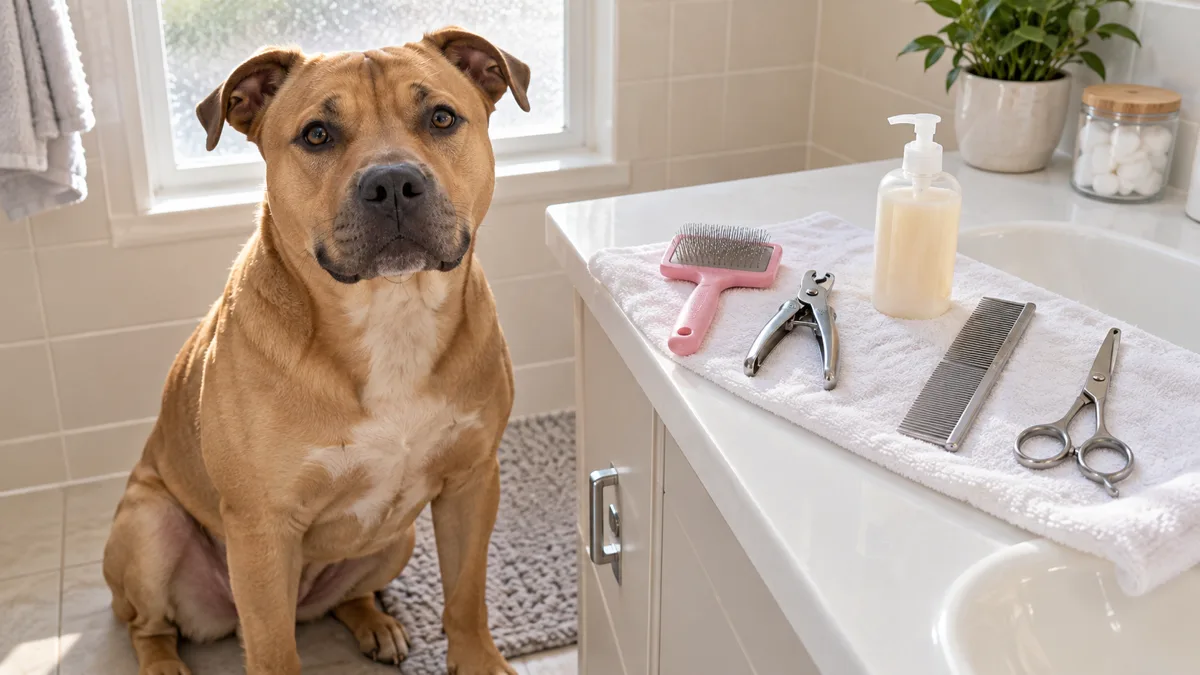
Most dental advice for dogs starts with a brush in your hand and a dog already pulling away. That is exactly backward, and it is why so many owners try once, get bitten at, and quit for good.
My three dogs taught me the order the hard way. The first one I tried to brush like a toddler — pinned, rushed, paste everywhere — and she fought it for a year. The next two I trained the mouth before the brush, and now they hold still for it.
Section five is the part almost nobody does and the part that decides everything: the desensitization ramp. Read that one even if you skim the rest.
Brushing your dog’s teeth is not a wrestling match — it is a short desensitization ramp, the right dog toothpaste, a 45-degree angle at the gumline, and 30 honest seconds a day. Build the habit slowly so your dog learns the brush means a reward, not a hold-down. Here is the step-by-step version, plus the red lines and the signs that mean it is time for a vet cleaning.
- 1Why dental care is the step almost everyone skips
- 2The 60-second mouth check: healthy vs. trouble
- 3What you actually need: brush, finger brush, or gauze
- 4Never use human toothpaste: the red line
- 5The desensitization ramp: lip touch first
- 6Let them taste the paste first
- 7The first real brush: angle and the 45-degree gumline
- 8How long and how often: the 30-second rule
- 9The calm-hold setup: where to sit and how to position
- 10Dental chews and water additives: add-ons, not replacements
- 11Small breeds, flat faces, and seniors need extra care
- 12The 5 mistakes that make dogs hate brushing
- 13When home brushing isn’t enough: signs you need a vet
Why Dental Care Is the Grooming Step Almost Everyone Skips
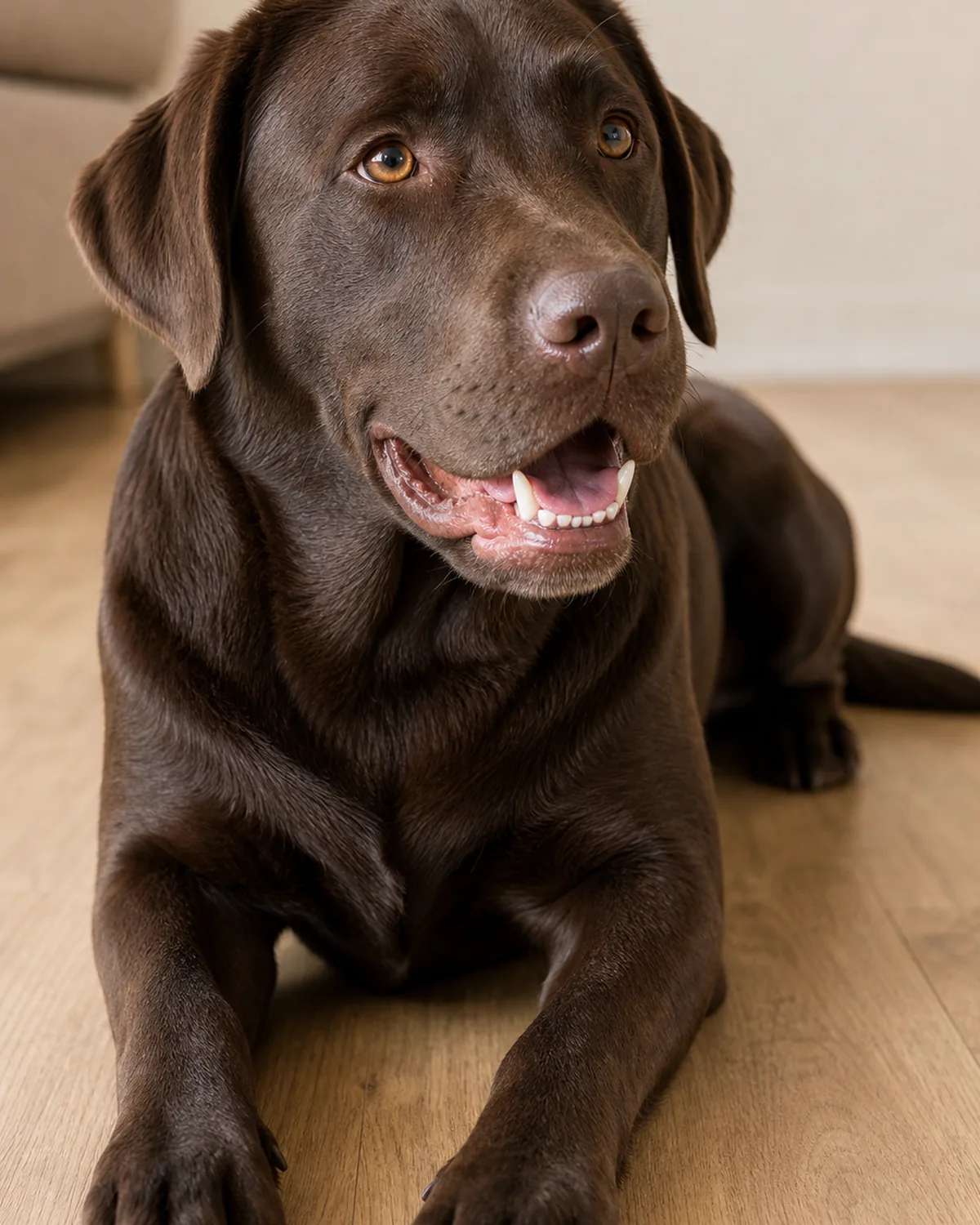
Roughly 80 percent of dogs show some periodontal disease by age three, and almost none of their owners ever picked up a toothbrush. Dental care is the grooming step that gets skipped because the damage is silent until it is expensive.
Here is the mechanism that makes it urgent. Plaque is a soft bacterial film, and within 24 to 72 hours it mineralizes into hard tartar you cannot brush off. Tartar drives gingivitis, then root abscesses, then a steady inflammatory load on the heart, kidneys, and liver. Brushing physically breaks up that film before it hardens — it is the one gold-standard thing you can do at home.
- Plaque is soft and brushable; tartar is hardened and is not. The whole game is hitting plaque inside that 24-to-72-hour window.
- This is prevention, not diagnosis. Anything that already looks infected, swollen, or painful goes to a vet, not a brush.
- No chew, water additive, or kibble removes plaque the way mechanical brushing does. Everything else is a supporting act.
The 60-Second Mouth Check: Healthy vs. Trouble
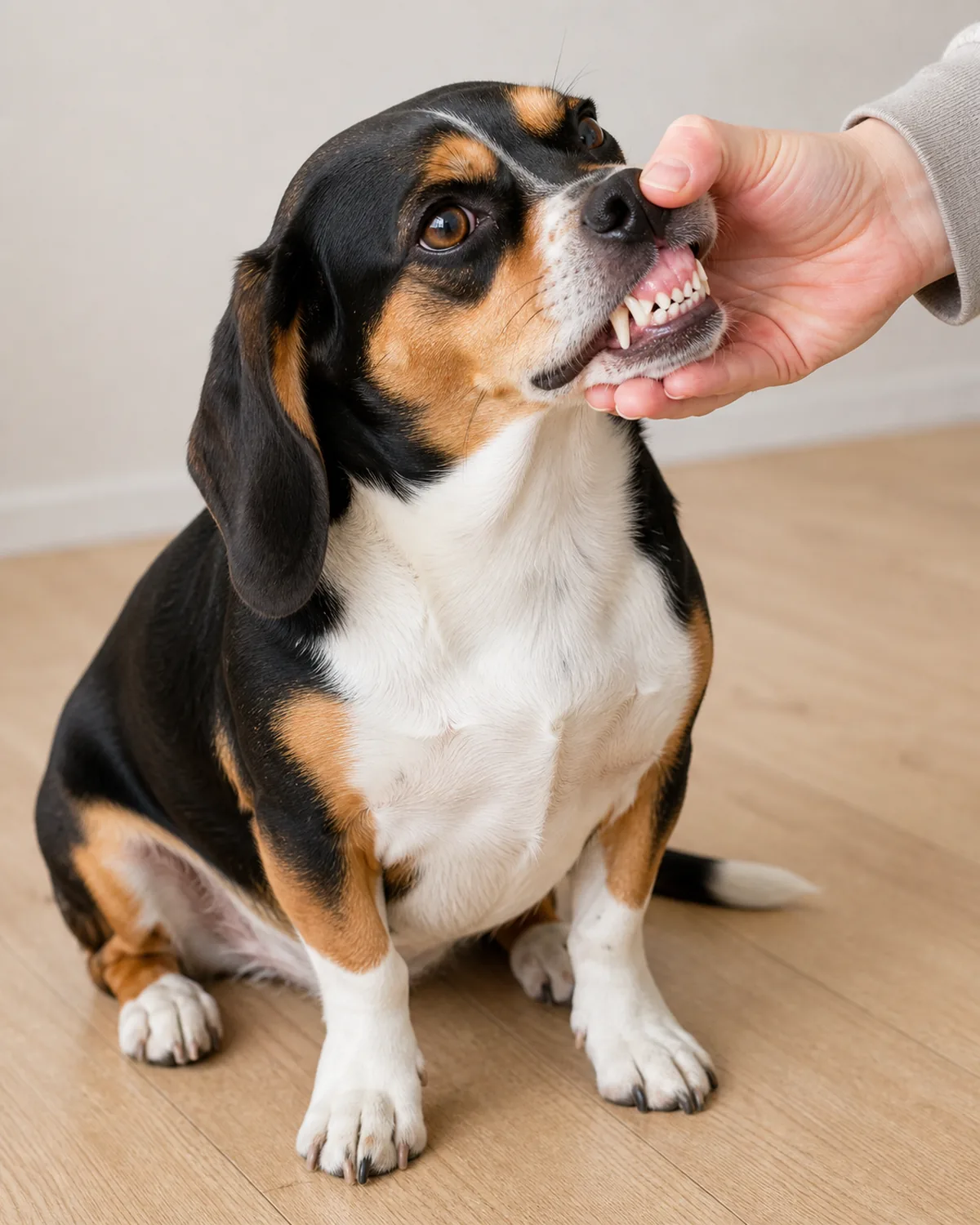
Before you brush anything, learn to read the mouth. A weekly 60-second check tells you what is normal for your dog and catches the early shift before it becomes a crisis. The check, not the calendar, decides how hard you push.
Lift the lip and read three things: gum color, the tartar line, and breath. Healthy gums are pink; angry red or washed-out pale is a problem. A brown-yellow crust riding along the gumline is tartar. And while “dog breath” is a meme, foul or sweetly rotten breath is a real warning sign, not a personality trait.
Three signs that skip the brush and go straight to the vet
- A loose or wobbly tooth, or any bleeding from the gums when you lift the lip.
- Chewing on only one side, dropping food, or flat-out refusing to eat.
- A visible lump, a cracked tooth, or a face that is suddenly swollen on one side.
What You Actually Need: Toothbrush, Finger Brush, or Gauze
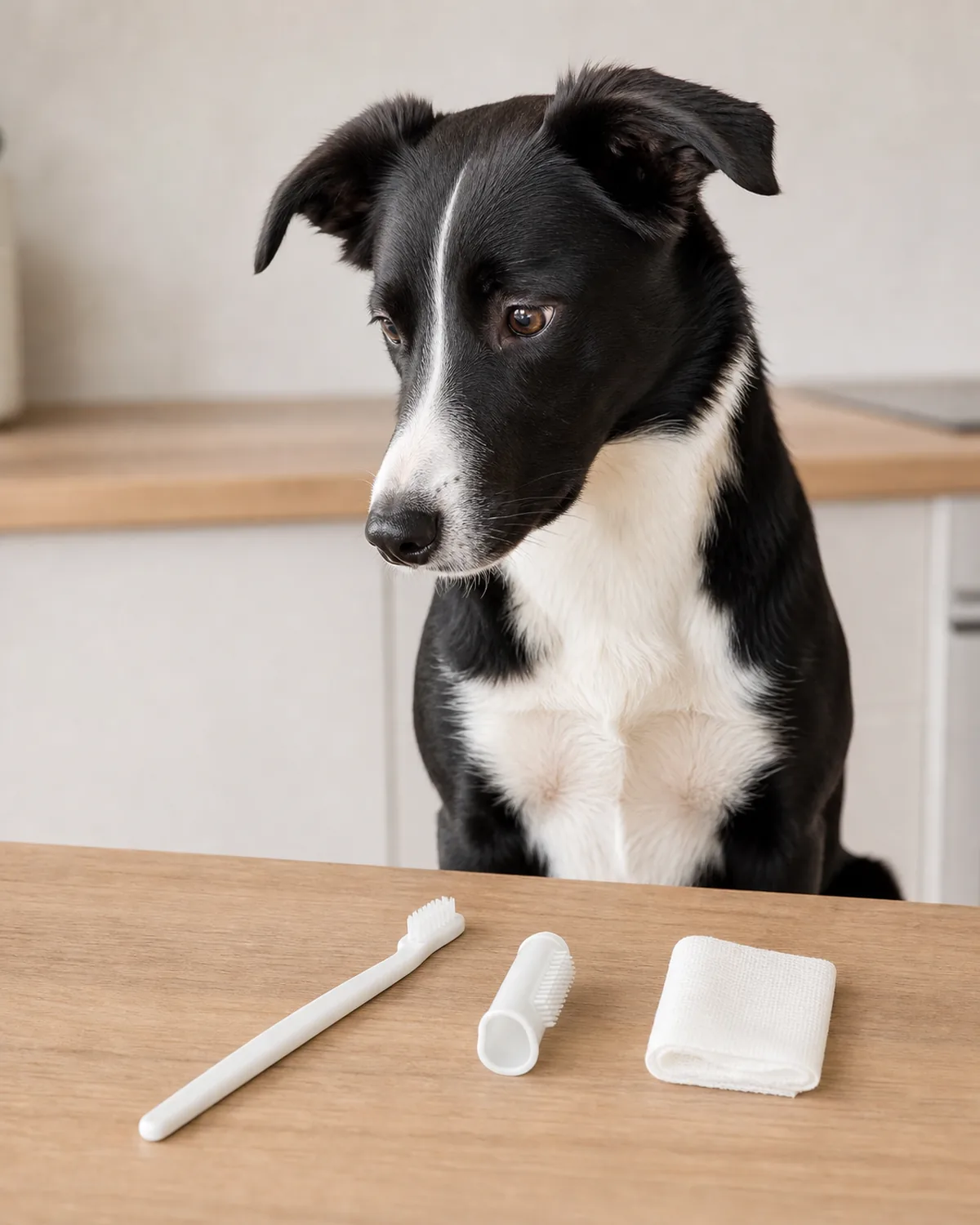
You do not need much, and the most expensive option is not the best one. There are three honest tiers, and the right one depends on your dog’s size and how much fuss it makes — not the price tag.
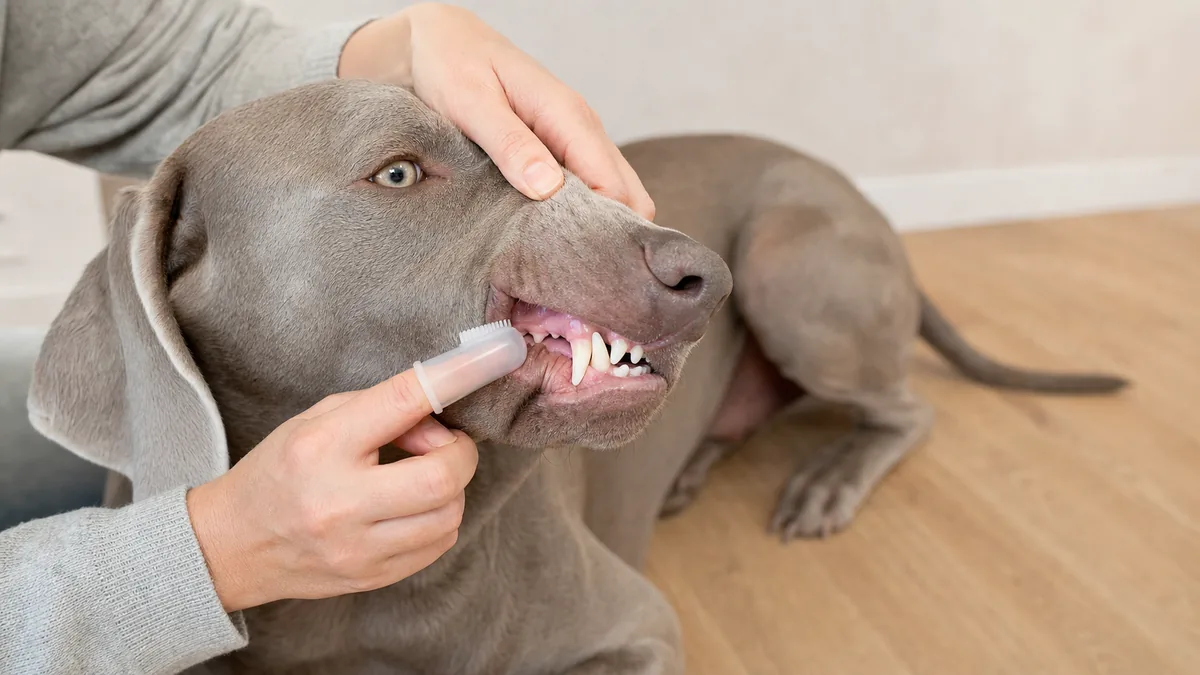
A long-handled dog toothbrush reaches the back molars on a big dog. A silicone finger brush gives you far more control and is the friendliest place for beginners to start. And plain gauze wrapped around a finger is the gentle transition for a dog that still panics at the sight of a brush.
- Big dog with cooperative behavior: long-handled dog toothbrush for the back molars a finger cannot reach.
- Small dog or nervous dog: silicone finger brush for control, or gauze on a finger as the no-brush warm-up.
- Skip the stiff human toothbrush entirely. The bristles are too hard for dog gums and it teaches the mouth to brace.
The fastest way to make a dog hate tooth brushing is to start on day one with a full brush in his mouth. Pick your starting point by how comfortable your dog already is with you near his mouth — not by how dirty his teeth look. Match the entry point to your dog’s tolerance and the brush becomes a calm 30-second habit instead of a daily fight.
Never Use Human Toothpaste: The Xylitol and Fluoride Red Line
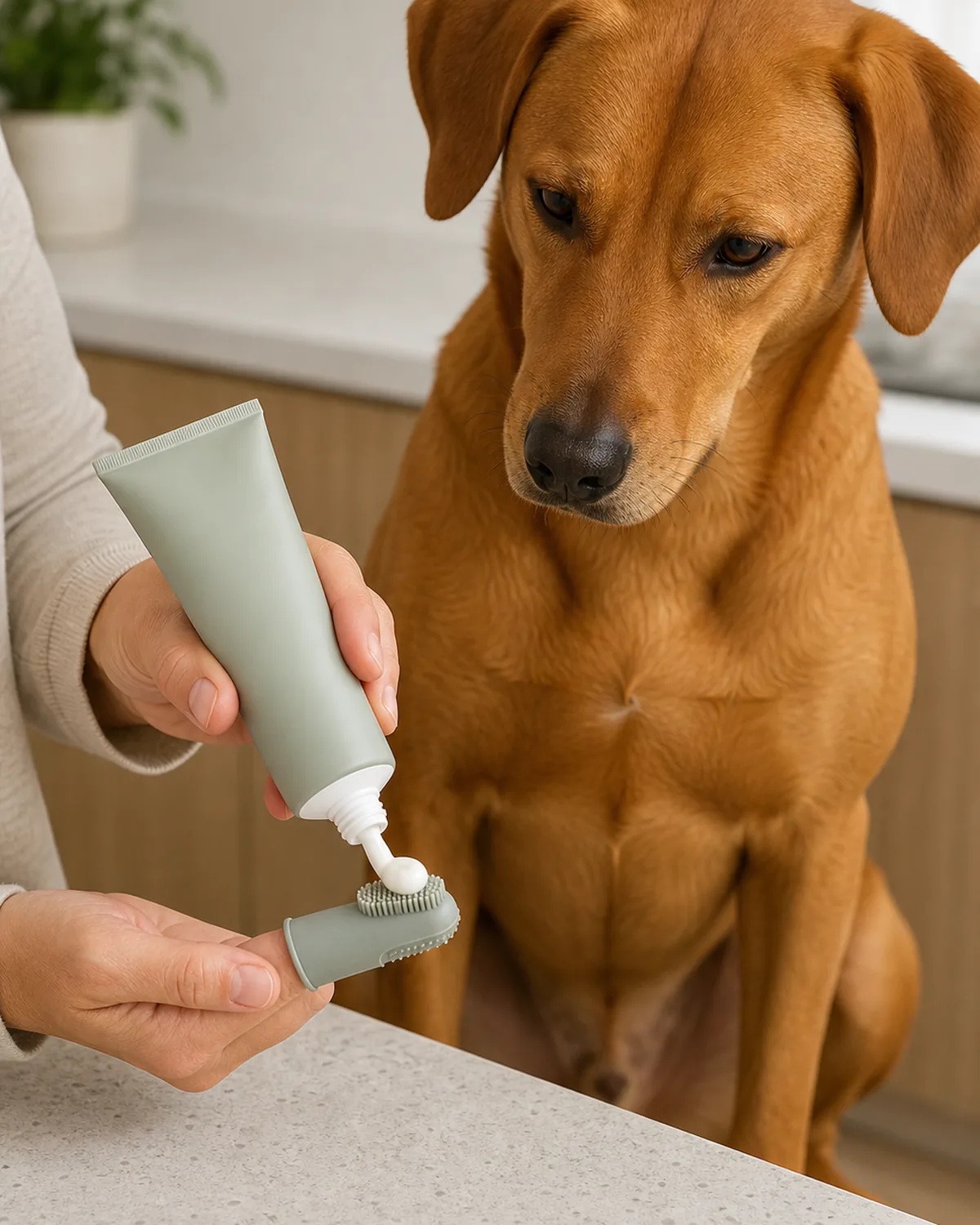
This is the one rule with no exceptions. Human toothpaste is dangerous for dogs, and the reason is simple: dogs do not rinse and they do not spit. Whatever you put in the mouth gets swallowed, so the formula is a hard line.
Human paste often contains xylitol, which is toxic to dogs and can cause crashing blood sugar and liver failure. It also has fluoride, which is poisonous when swallowed in those amounts, plus foaming agents that upset the stomach. Enzymatic dog toothpaste, by contrast, is made to be swallowed and keeps breaking down plaque after you stop brushing.
- Use only enzymatic dog toothpaste, typically in a poultry or beef flavor the dog will actually want.
- Never use human toothpaste, baking soda, or salt scrubs. Xylitol and fluoride are the non-negotiable reasons.
- The meaty flavor is a feature, not a gimmick — it is what turns brushing into something the dog tolerates instead of dreads.
The Desensitization Ramp: Lip Touch Before You Ever Brush
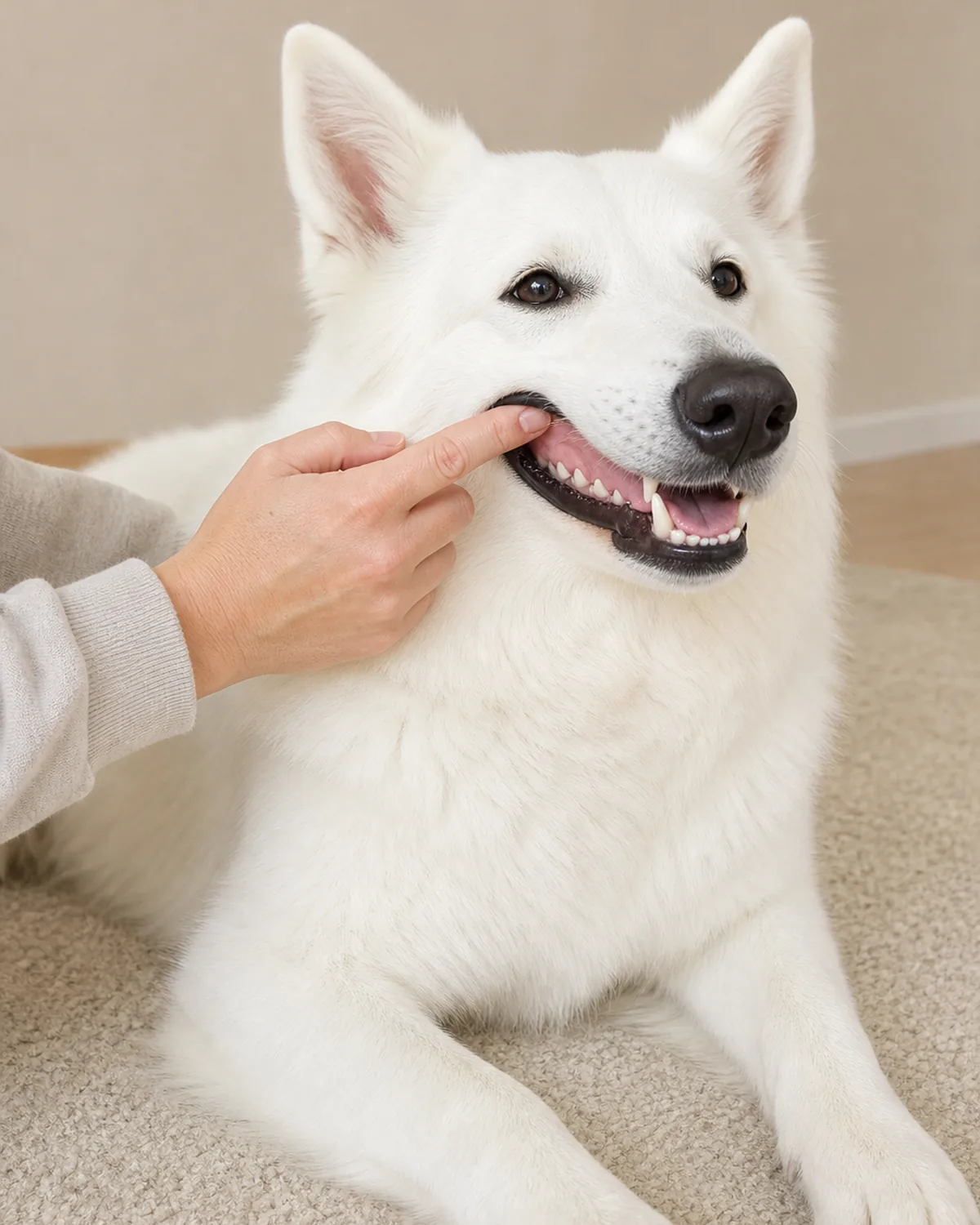
This is the step that separates dogs who tolerate brushing from dogs who fight it forever. For the first few days you do not brush at all. You touch the lip, touch the gums, and reward — building the idea that a hand near the mouth predicts good things.
It is the same logic I lean on when a dog already hates being handled: touch, reward, keep each rep short, and let the trigger become a predictor of the treat. The only difference here is the target. Instead of working the coat, you are working the mouth.
The first-three-days ramp
- Day one: lift the lip for one second, reward, done. That is the entire session.
- Day two: lift the lip and lightly touch a gum or tooth with a fingertip, then reward. A few short reps, not one long one.
- Day three: rub a fingertip along the outer gumline for two or three seconds, reward, and stop while the dog is still relaxed.
Let Them Taste the Paste First (Flavor as the Reward)
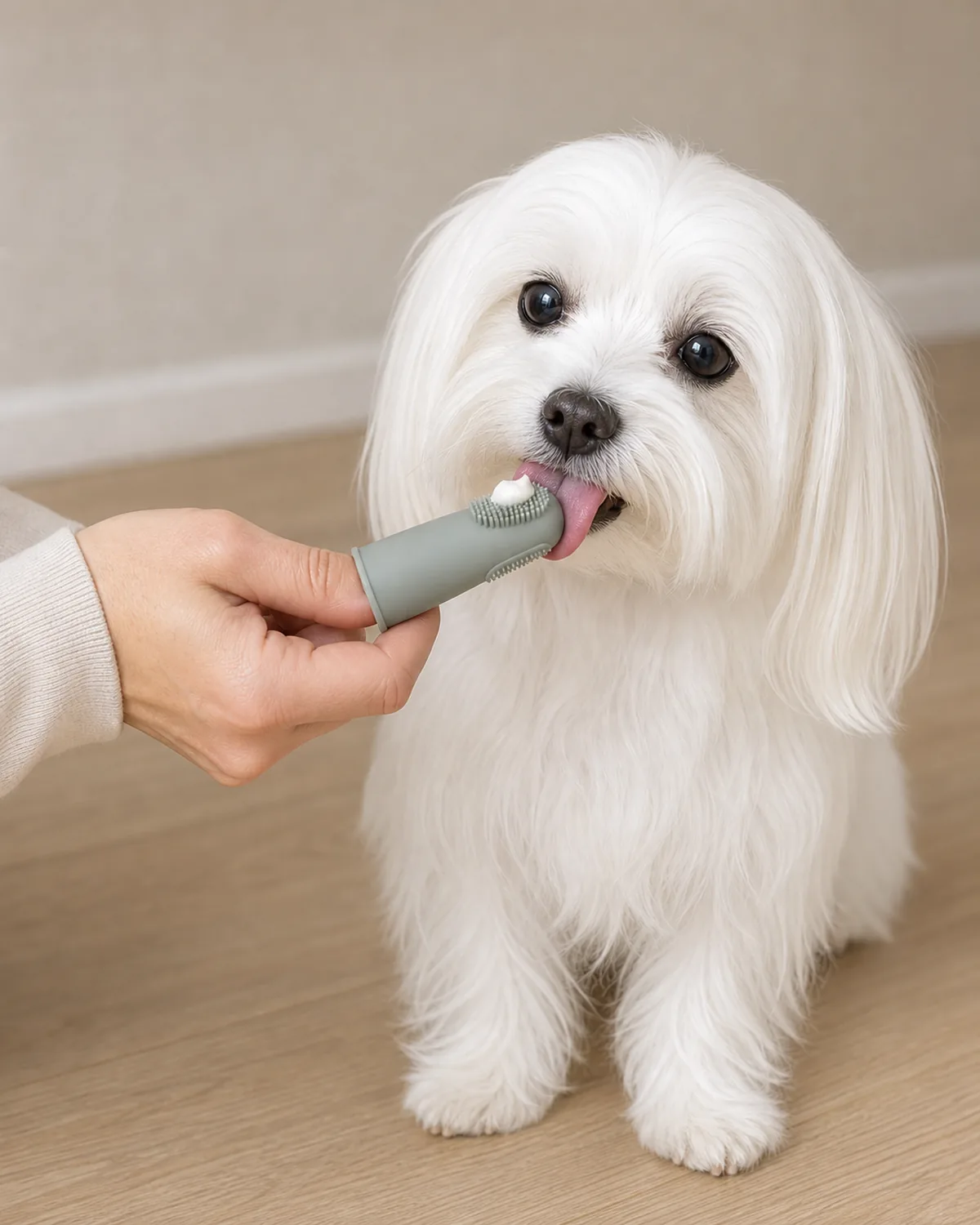
Before the brush ever touches a tooth, let the paste become a treat in its own right. A dog that already loves the taste meets the brush halfway, because the brush now carries something it wants.
Over a few days, offer the enzymatic paste on a finger or finger brush just to lick. The meaty flavor is doing real work here — it is a reinforcer, so the positive association forms before any scrubbing starts. The mistake is loading a brush and forcing it into a mouth that has never met the paste.
- Let the dog lick a pea-sized dab of paste off your finger or the finger brush for a few days. No brushing yet.
- Once it leans in for the paste, you have the foundation. Now the brush head shows up carrying a flavor it already likes.
- Do not skip straight to a loaded brush jammed into the mouth. That undoes the taste association in one bad rep.
The difference between a dog who offers his mouth and one who clamps shut at the sight of the brush comes down to these lines. Read both columns once before your first session, then keep the never list in mind every time you are tempted to rush.
Always Do
- Use enzymatic dog toothpaste only — poultry or beef flavored, designed to be swallowed safely.
- Angle the brush 45 degrees toward the gumline, where plaque actually collects.
- Brush the outer surfaces — the cheek side — where most tartar builds; the tongue cleans some of the inside.
- Aim for daily, since plaque hardens into tartar in 24 to 72 hours; at minimum, three times a week.
- Run the desensitization ramp first — lip touch and paste tasting before any real brushing.
- Keep each session to 30 to 60 seconds and reward every few seconds.
- Do a 60-second mouth check weekly: gum color, the tartar line, and breath.
- Treat VOHC-sealed dental chews and water additives as helpful add-ons to brushing.
Never Don’t
- Never use human toothpaste — the xylitol and fluoride are toxic to a dog who swallows it.
- Never headlock or pin your dog’s head to force the brush in — it ends cooperation for good.
- Never start with a full brushing on day one; skipping the ramp teaches him to dread the tool.
- Never use a stiff human toothbrush — the bristles are too hard for a dog’s gums.
- Never let a dental chew or water additive replace brushing — only the brush breaks the biofilm.
- Never assume a “dental” label means it works — if there is no VOHC seal, stay skeptical.
- Never brush only when your dog is tired or annoyed — pick a calm, settled moment.
- Never try to scrape off hardened tartar at home — that belongs to a vet cleaning under anesthesia.
The First Real Brush: Angle, Pressure, and the 45-Degree Gumline
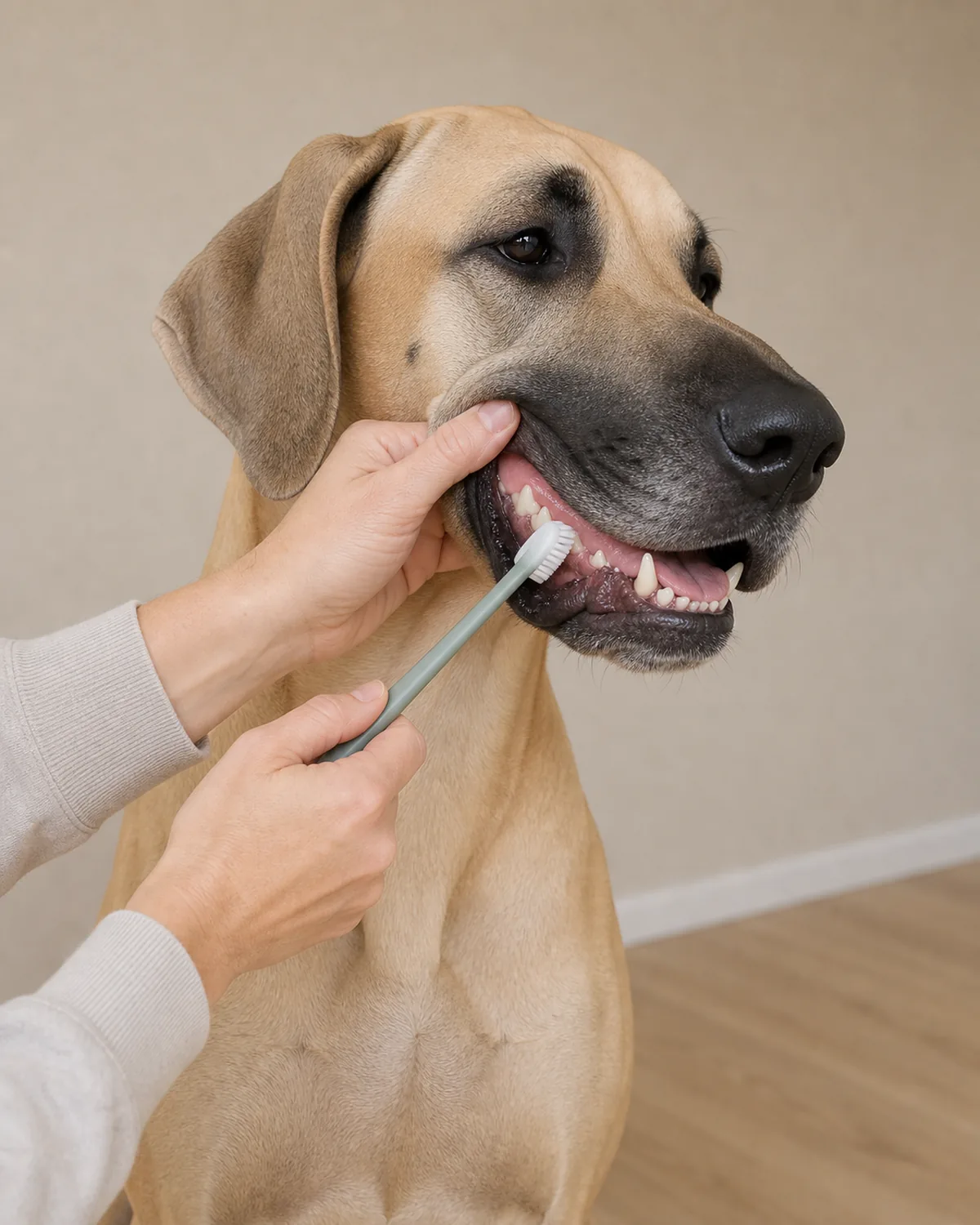
Now the brush goes in, and technique matters more than effort. The goal is the gumline, because that is exactly where the bacterial film collects and where tartar starts. Get the angle right and a short pass does most of the work.
Hold the brush at about 45 degrees to the gumline, use light pressure, and work in small circles. Brush only the outer surfaces — the cheek-facing side holds the most plaque, and the tongue naturally cleans some of the inner side for you. Start at the canines and the big back molars, where tartar builds fastest.
- 45 degrees to the gumline, light pressure, small circles. You are sweeping the film, not scrubbing the enamel.
- Outer surfaces only. The cheek side carries the most plaque and the tongue handles a chunk of the inside.
- Start at the canines and rear molars. Those are the tartar hot spots, so you get the most benefit per second there.
How Long and How Often: The 30-Second Rule
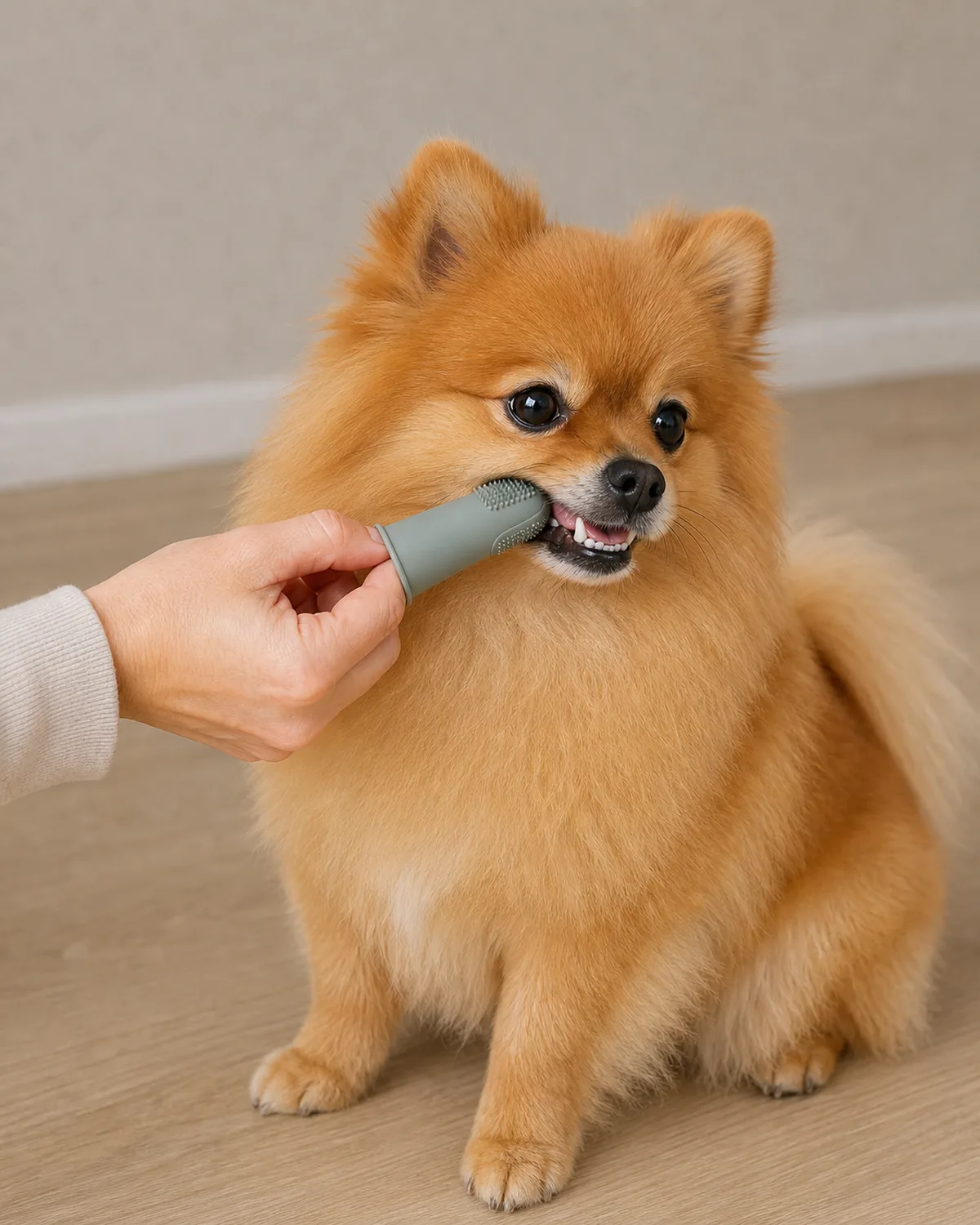
Owners quit because they think brushing means a thorough, two-minute clean every night. It does not. Thirty to sixty seconds across the main tooth surfaces is enough, and chasing a perfect mouth is the fastest way to burn out both of you.
Frequency is where the real leverage sits, and it ties straight back to the mineralization window. Plaque hardens into tartar in 24 to 48 hours, so daily brushing keeps catching it while it is still soft. If daily is genuinely impossible, three times a week is the floor that does anything measurable.
- Aim for 30 to 60 seconds covering the main surfaces. Good-enough-daily beats perfect-occasionally every time.
- Daily is the target because plaque mineralizes in 24 to 48 hours. You are racing that clock, not the calendar.
- Three times a week is the realistic floor. Once a week is nearly useless — the tartar has already hardened between sessions.
The Calm-Hold Setup: Where to Sit and How to Position
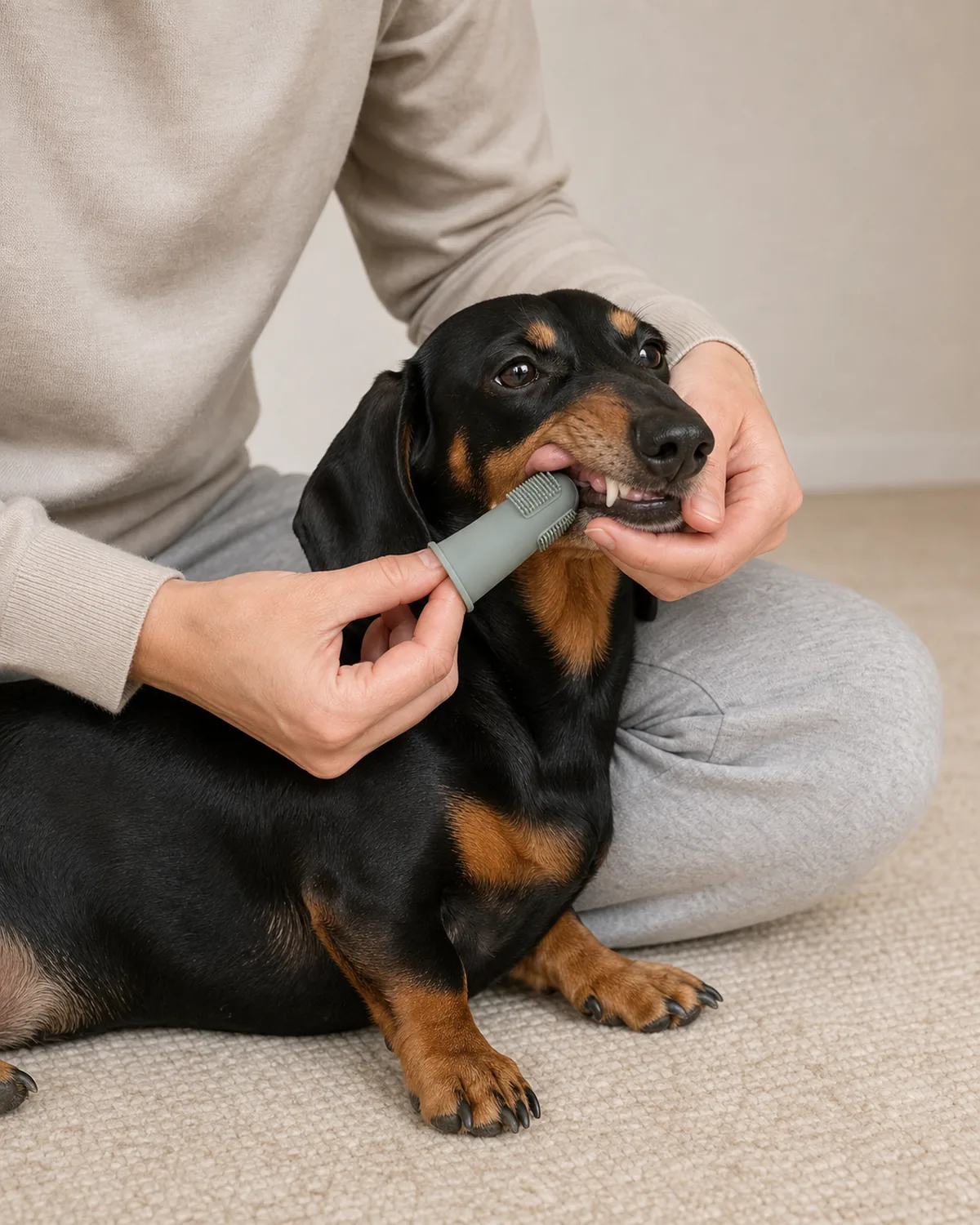
Position decides whether the dog feels like a partner or feels pinned, and a pinned dog never relaxes into this. Sit on the floor with the dog’s back against your side, not facing it down. One hand gently cradles the chin and lifts the lip; the other brushes; you reward every few seconds.
The calm itself can be borrowed from elsewhere. A dog that can already settle quietly in a crate brings that same calm baseline to having its mouth handled — so the move is to build a settled dog first and brush second, not to wrestle a wound-up one into stillness.
- Sit on the floor, dog’s back against your body. Never loom over it or hold it down by the head.
- One hand cradles the chin and lifts the lip; the other brushes. Reward every few seconds so the session stays a conversation.
- Start from a calm dog, not a revved-up one. If it cannot settle yet, work on that before you work on teeth.
Dog Tooth-Brushing Quick Card
The 5-step brush
- Lift a lip and touch the gumline for a second, then reward.
- Let him taste the enzymatic paste as if it were a treat.
- Slip on a finger brush and rub a few outer surfaces.
- Angle 45 degrees at the gumline and brush outer surfaces in small circles.
- Stop at 30 seconds and finish with a reward while he’s still calm.
How often cheat sheet
- Daily is best — plaque hardens in 24 to 72 hours.
- Three times a week is the honest minimum that still helps.
- Once a week does almost nothing — aim higher.
- Weekly: lift a lip and run the 60-second mouth check.
Gear and add-ons
- Dog toothbrush — long handle reaches the back molars.
- Finger brush — most control, easiest entry point.
- Gauze on a finger — a gentle bridge for nervous dogs.
- Enzymatic dog paste — poultry or beef, safe to swallow.
- VOHC-sealed chews and additives — helpers, never replacements.
Hard red lines — never cross these
- No human toothpaste — xylitol and fluoride are toxic
- No headlock or forced hold — desensitize first
- No scraping hardened tartar at home — that’s a vet job
PAWLIQA · DOG GROOMING
Dental Chews and Water Additives: Add-Ons, Not Replacements

Dental chews and water additives are everywhere, and the marketing implies they replace brushing. They do not. They can shave down some plaque, but the mechanical scrub of a brush is still the main event — these are support, not substitutes.
The one thing worth trusting on the label is the VOHC seal, the only credible third-party backing in the category. A package that just says “dental” tells you nothing about whether it works. The chew’s abrasion and enzymes help around the edges, while brushing does the heavy lifting.
- Look for the VOHC seal. “Dental” on the front of the bag is marketing; the seal is the actual evidence standard.
- Use chews and additives as a backup for days you cannot brush, never as the whole plan.
- Match chews to size and chewing style so they are safe to gnaw — and they still do not replace a single proper brushing session.
Small Breeds, Flat Faces, and Seniors Need Extra Attention
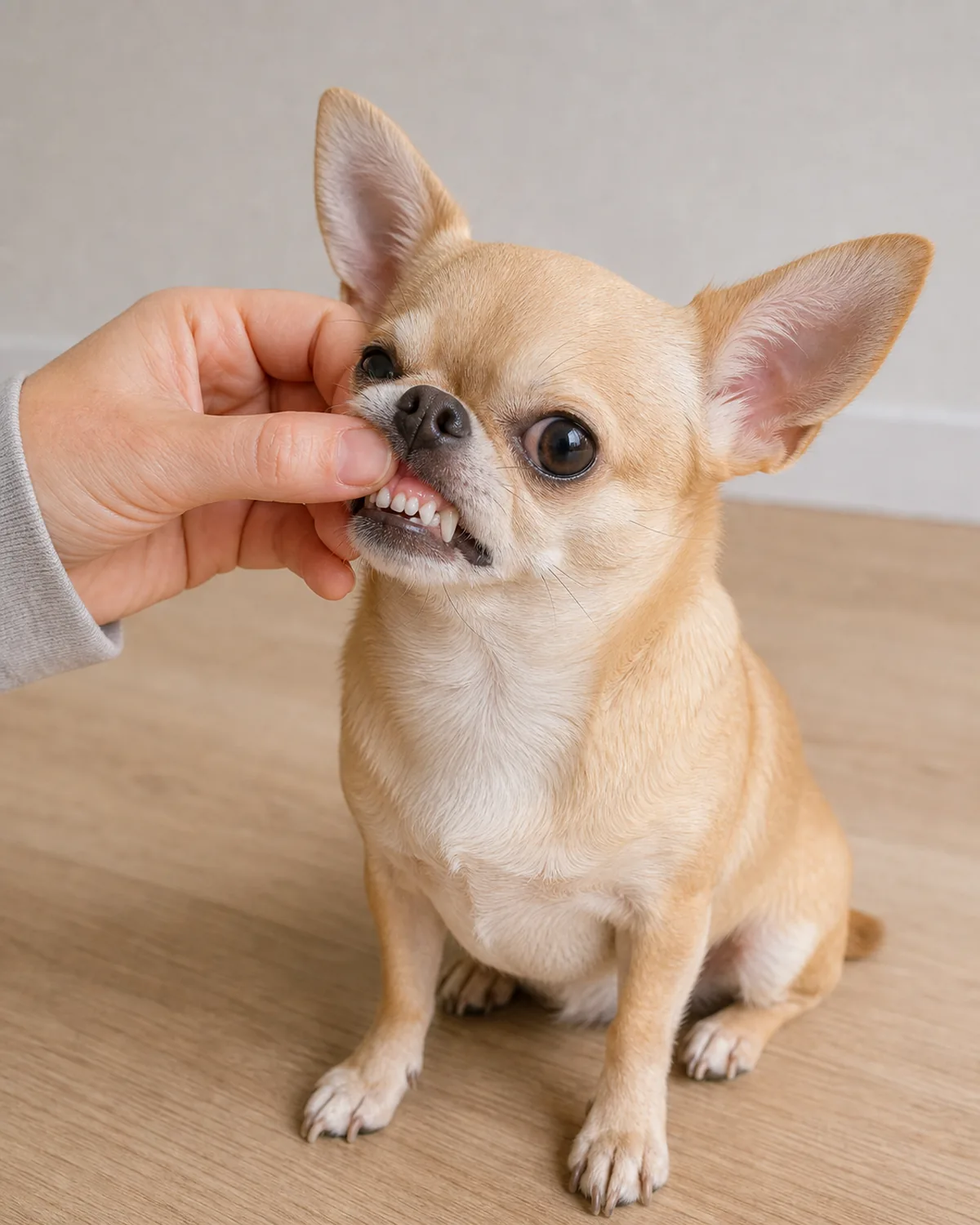
Some mouths carry more risk by anatomy alone, and those dogs need higher frequency and earlier vet checks. The pattern is about build, not breed — small jaws with packed teeth, short muzzles with crowding, and older mouths with receding gums.
Small dogs pack the same number of teeth into a tiny jaw, so they crowd, trap food between them, and can start losing teeth by age five. Short-faced dogs have misaligned bites that catch debris. Senior dogs lose gum coverage, exposing the vulnerable tooth roots underneath.
- Small jaws with crowded teeth: food gets trapped between them, so these dogs benefit most from genuinely daily brushing.
- Short muzzles with misaligned bites: pay extra attention to the overlapping and rotated teeth where debris hides.
- Seniors with receding gums: brush gently, watch the exposed roots, and get on a more frequent vet-check schedule.
The 5 Mistakes That Make Dogs Hate Tooth Brushing
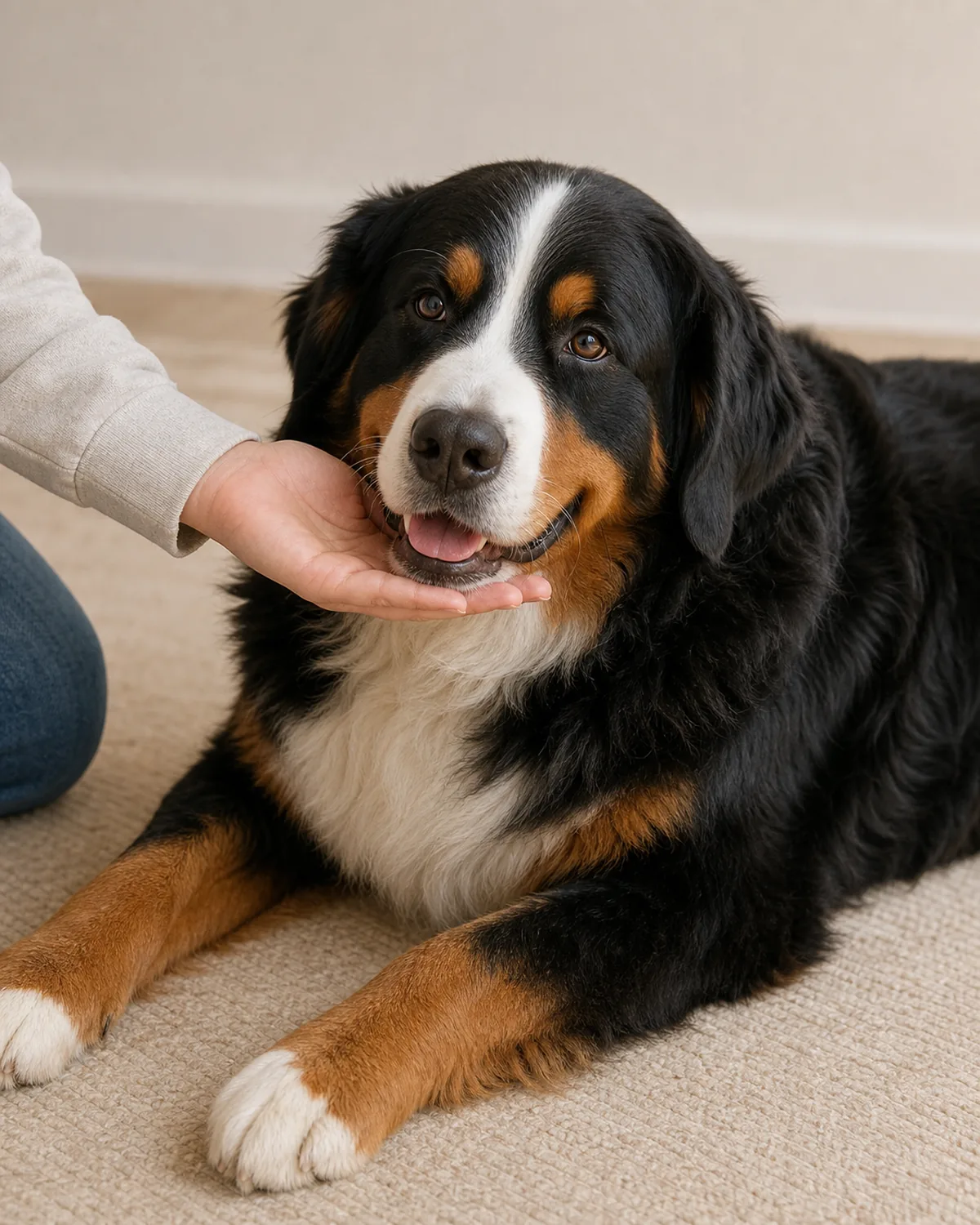
Almost every dog that “hates” tooth brushing was taught to hate it. The handling, not the brush, is usually the problem. Each of these mistakes turns a routine into a fight and quietly destroys long-term cooperation.
The fixes are the reverse of everything in sections five through nine — go slow, use the right paste, and keep the dog a willing participant. A dog that trusts the process holds still; a dog that has been pinned learns to clamp shut the moment it sees a hand move toward its face.
The five that backfire
- Forcing a brush in on day one instead of running the desensitization ramp first.
- Using human toothpaste — the xylitol-and-fluoride red line from section four.
- Pinning the head in a headlock instead of using the calm-hold position.
- Only brushing when the dog is already tired, cornered, or annoyed.
- Skipping desensitization to chase a perfectly clean mouth, and souring the whole routine in the process.
When Home Brushing Isn’t Enough: Signs You Need a Vet Cleaning
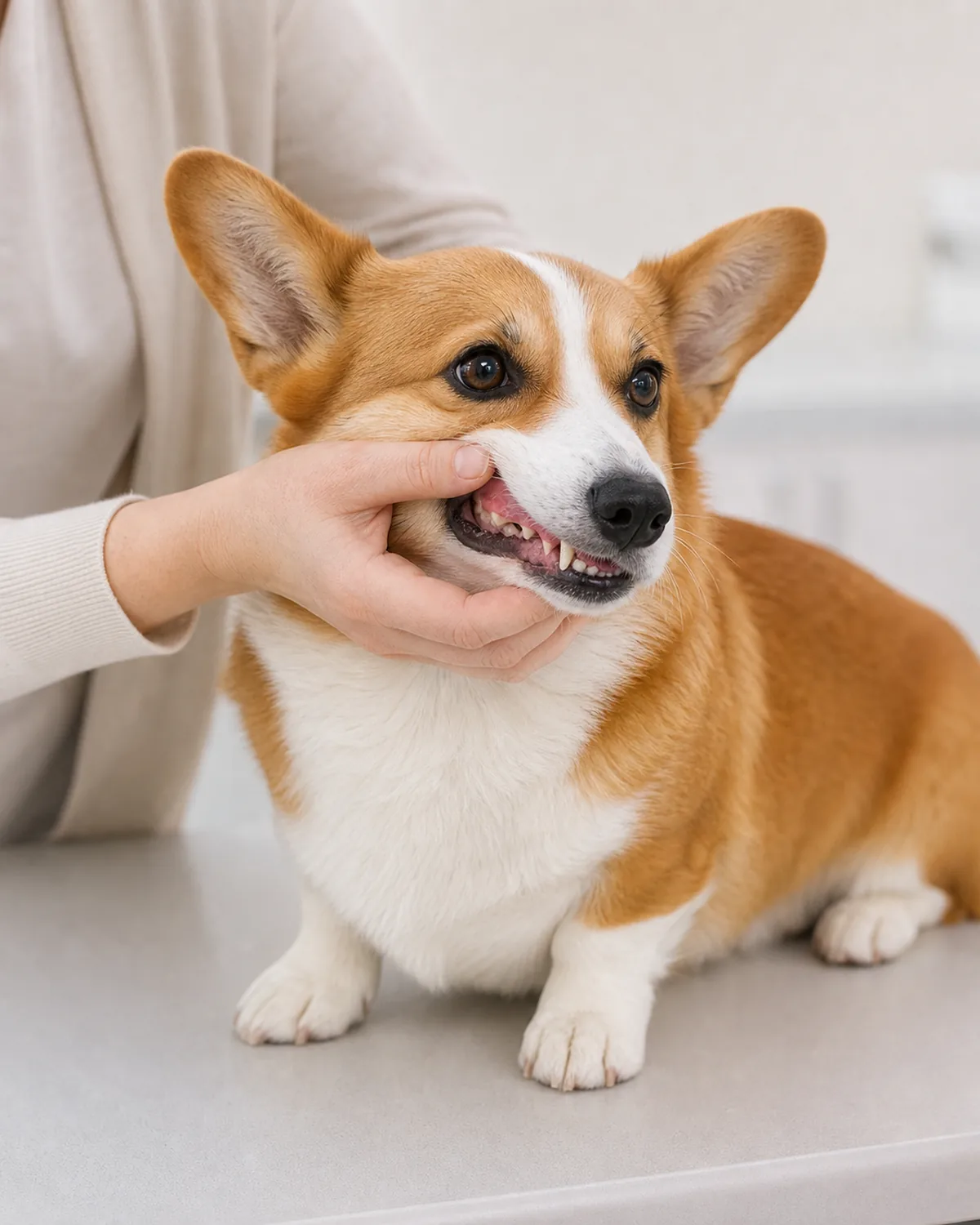
Home brushing has a hard limit, and it is honest to name it. Brushing prevents new plaque from hardening, but it cannot remove tartar that has already formed — especially the stuff packed below the gumline where a brush never reaches. Maintenance is not treatment.
When the red flags show up, the answer is a vet, not more brushing. A professional cleaning happens under anesthesia, which is what allows below-the-gumline scaling and dental X-rays — the parts that actually treat disease. That is a different thing entirely from the awake “cosmetic scraping” sometimes sold at groomers.
Signs it is time to book the vet
- Persistent bad breath, bleeding gums, or a loose tooth that brushing is not fixing.
- Refusing food, chewing on one side, or pawing at the mouth.
- Any visible lump, broken tooth, or one-sided facial swelling — those go in sooner rather than later.

Jess Calloway edits Pawliqa, where she shares dog care, grooming, training, and new-owner tips — plus DIY and pet-friendly home ideas — for anyone who wants a happy, well-cared-for dog. As a dog mom to three very different dogs, she writes the honest, tested version of what actually works. This tooth-brushing guide covers the 60-second mouth check, choosing between a toothbrush, finger brush, or gauze, the enzymatic-paste red line on human toothpaste, the lip-touch desensitization ramp, the 45-degree gumline angle, the 30-second rule, the calm-hold setup, where dental chews and water additives fit, the extra care small breeds, flat faces, and seniors need, and the signs that mean it is time for a professional vet cleaning. Pawliqa is not a substitute for veterinary care — loose teeth, bleeding gums, persistent bad breath, or refusing food mean it is time to call your vet. Every guide is image-led and reviewed for clarity, usefulness, image accuracy, and Pinterest-to-page alignment before it goes live. Visit the About page.