A new puppy’s first month is one long mouth experiment — cords, socks, baseboards, the soft thing under the couch — and her judgment about what is safe to swallow is zero. Proofing is not for the puppy. It is for the human who would spend a year chasing.
This is the prevention card: a seven-room hazard walk, the ten most-missed risks, eight toxic foods and six toxic plants worth memorizing, the two poison hotlines worth posting, and the supervise-versus-confine-versus-roam plan no checklist can replace.
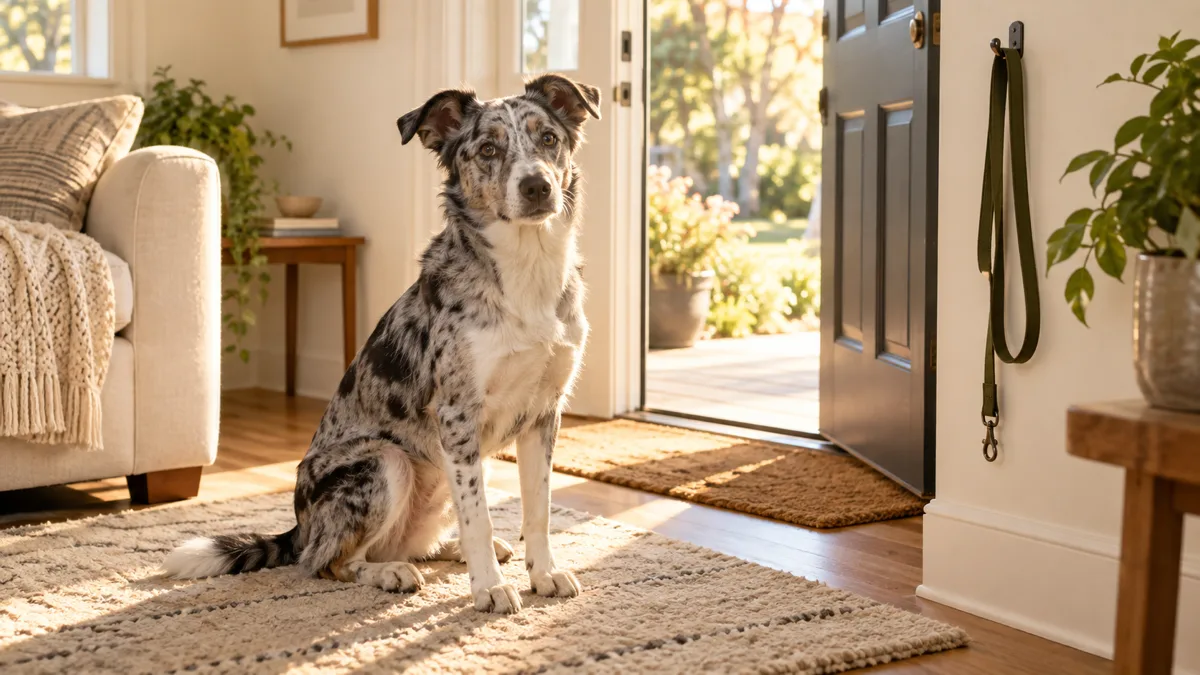
My first puppy was sixteen weeks when she swallowed an AirPod — one ER night and one lesson. The second got a thirty-minute hazard walk before the door opened and ran a clean first month. The third walked into the same setup.
The first two weeks at home decide the next ten years. Puppy-proofing is what lets you stop chasing your puppy around the house grabbing things out of her mouth, and start enjoying her instead. This is the honest playbook — what to walk, what to lock down, and what to supervise.
- 1Why the first two weeks decide everything
- 2The 10 most-missed hazards
- 3Living room — cords, outlets, decor
- 4Kitchen — toxic foods, trash, latches
- 5Bedroom — meds, hair ties, shoes
- 6Bathroom — toilet, razors, mats
- 7Garage & utility — antifreeze red zone
- 8Yard & patio — toxic plants, gaps
- 9Houseplant audit — top indoor toxics
- 10Furniture anchoring — TVs, dressers
- 11Designing the “yes” zone
- 12Supervise / crate / free-roam tiers
- 13The 14-day re-walk + vet hotline list
Why the First Two Weeks Decide Everything (Developmental Why)

The eight-to-sixteen-week window is the socialization window most owners have heard about. It is also the peak oral exploration window, and the two overlap on purpose. A puppy learns the shape of the world by putting it in her mouth.
She is not being naughty. She is being a normal eight-week-old whose only research tool is her teeth, and she has no concept that some research subjects are lethal.
Why the mouth phase matters
That means the home proofing pass is not really aimed at the puppy. It is aimed at the human. Done once in the first week, you stop thinking about it for the next fourteen months. Skipped, you spend every day chasing her, retrieving the thing she just grabbed, and absorbing one ER scare per quarter on average.
The math is unforgiving on the other side too. A puppy ER visit for a foreign-body ingestion or a poisoning runs $1,000 to $5,000 before anyone talks about surgery. One afternoon of proofing prevents most of them.
- Eight-to-sixteen weeks is oral exploration plus socialization stacked — your puppy reads the world by mouth.
- Proofing serves the human as much as the puppy — one afternoon now beats fourteen months of chasing.
- An average puppy ER visit starts at four figures and climbs fast — prevention pays for itself the first time.
The 10 Most-Missed Hazards New Owners Skip
Most new owners do an honest first pass and still miss the same ten things, because the things in question are exactly the ones already invisible to an adult human reading the room from five feet up. The list is worth memorizing before the puppy arrives so you can run a low-angle walk-through on her behalf.
Top ten in plain order. USB-C charging cables on coffee tables and floor sockets — chew risk plus strangulation. AirPods, coins, and Lego pieces lost in the couch — common foreign-body surgery cases. Baseboard crumbs in the kitchen — raisins, chocolate flecks, onion skins. Plastic bags, shoelaces, and underwear under the bed — intestinal obstruction.
Three high-value sweeps
Bathroom shampoo and mouthwash bottles within reach. Lilies, sago, and pothos on a low shelf. Antifreeze in the garage, sweet, lethal, often unguarded. Yard mushrooms after a wet week. Unanchored bookshelves and TVs. And open staircases without a baby gate.
Each gets a dedicated section below, but the punch list above is the single best thirty-second scan you can run before bringing the puppy in.
- Run the audit from puppy height — get on your knees and scan every room from shoulder level of an eight-week-old.
- Memorize the ten — they cover roughly eighty percent of preventable first-month incidents.
- A printed checklist on the fridge beats a remembered one — the section-three through eleven walk is the form.
Living Room: Cords, Outlets, Remote Controls, Small Décor
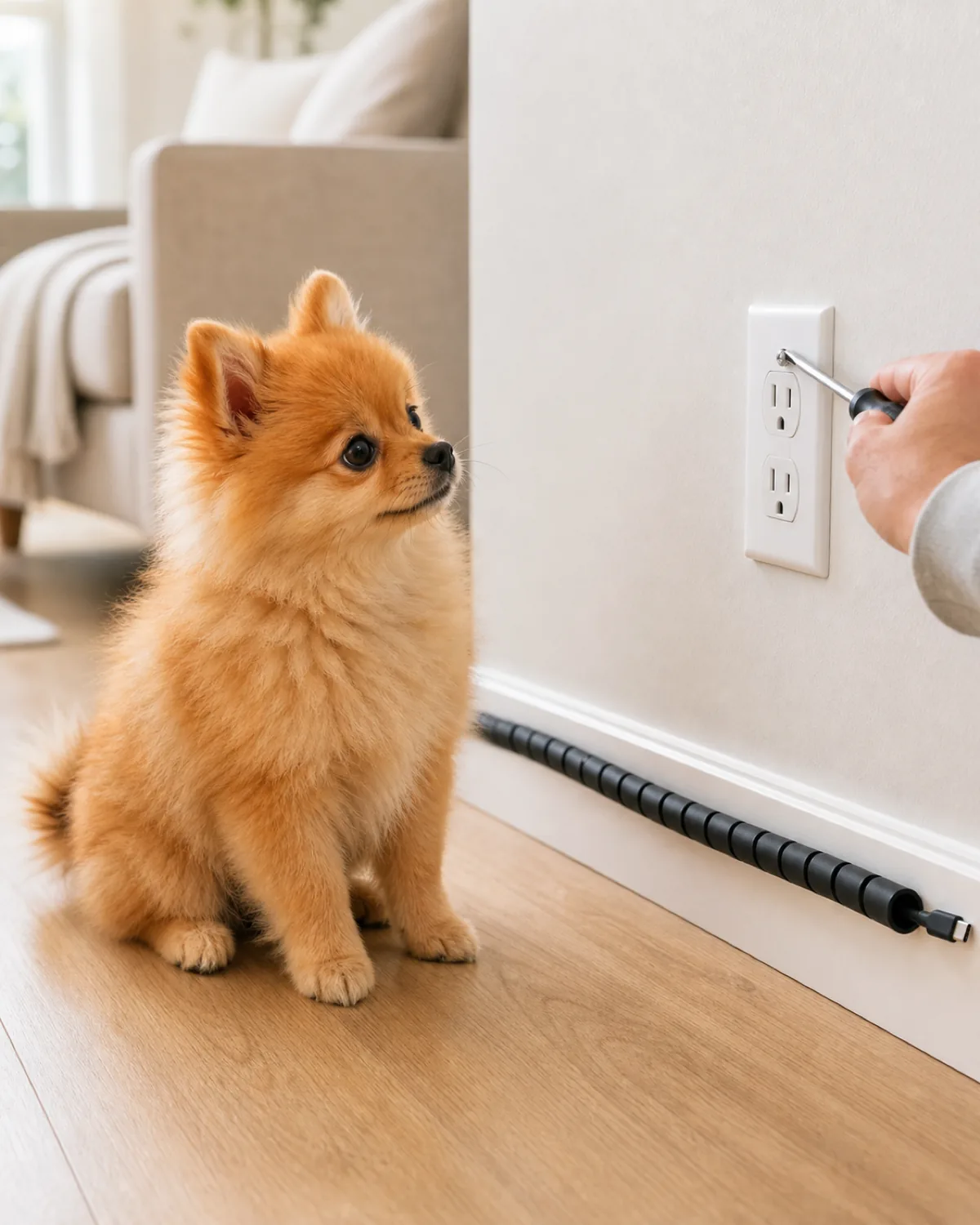
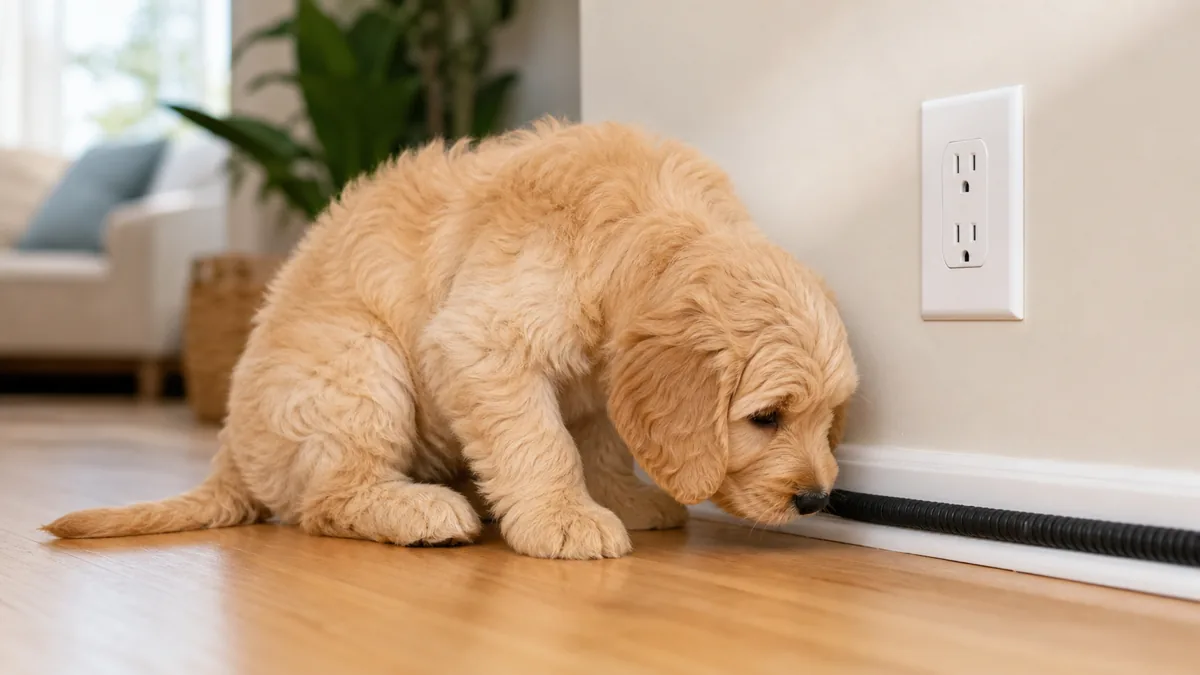
Living-room proofing is mostly cord management. Every USB-C charger, lamp cord, and AV cable goes into a plain solid spiral cable wrap or routes through a baseboard cord channel. The wrap is two dollars per foot at any hardware store and ends the chew risk in one afternoon.
Outlets get permanent screw-in covers, not the press-in plastic plugs, which a puppy peels off in a week.
Cables, screens, and small objects
Remote controls, AirPods, phone chargers, headphones, and the TV remote live on a shelf at adult chest height now. Not the coffee table. Not the side table. Adult chest height or higher, no exceptions. AirPod swallowing is the single most common foreign-body surgery a vet sees on a small or medium puppy, and the prevention is a habit, not a gadget.
Candles, vases, breakables, throw blankets with tassels, and small décor on coffee tables go up onto a shelf for the next year. A puppy at six weeks already body-checks coffee table legs, and by twelve weeks she can stand on her hind legs and reach the surface. Treat the whole room as if a curious toddler with no inhibitions lives there — because functionally one does.
- Spiral wrap every cord plus screw-in outlet covers — the press-in plastic plugs do not hold.
- Remotes, earbuds, and chargers live at adult chest height or higher, not on the coffee table.
- Treat the coffee table and side tables as empty surfaces for twelve months — puppies stand and reach earlier than you think.
A puppy from eight weeks to about twelve months should never be unsupervised in the house. The real question every fifteen minutes is not “is the room safe enough yet” — it is “which tier is she in right now.” Hazards never fully go away. Supervision is what keeps a missed hazard from becoming an emergency.
Kitchen: Toxic Foods, Trash, Cleaning Products, Cabinet Latches
Eight toxic foods are worth memorizing because they cause most of the kitchen calls to the poison hotline. Grapes and raisins cause acute kidney failure, the safe dose is unknown, and any ingestion is an emergency.
Chocolate, with darker meaning worse. Xylitol is the artificial sweetener in sugar-free gum, mints, and some peanut butters, and causes lethal hypoglycemia at roughly 0.1 g per kilogram of body weight.
Eight foods worth memorizing
Onions and garlic, including powder forms, destroy red blood cells. Macadamia nuts, raw yeast dough, alcohol, and caffeine round out the list. If a puppy gets any of these, call your vet and the ASPCA Animal Poison Control Hotline at (888) 426-4435 right then, not later.
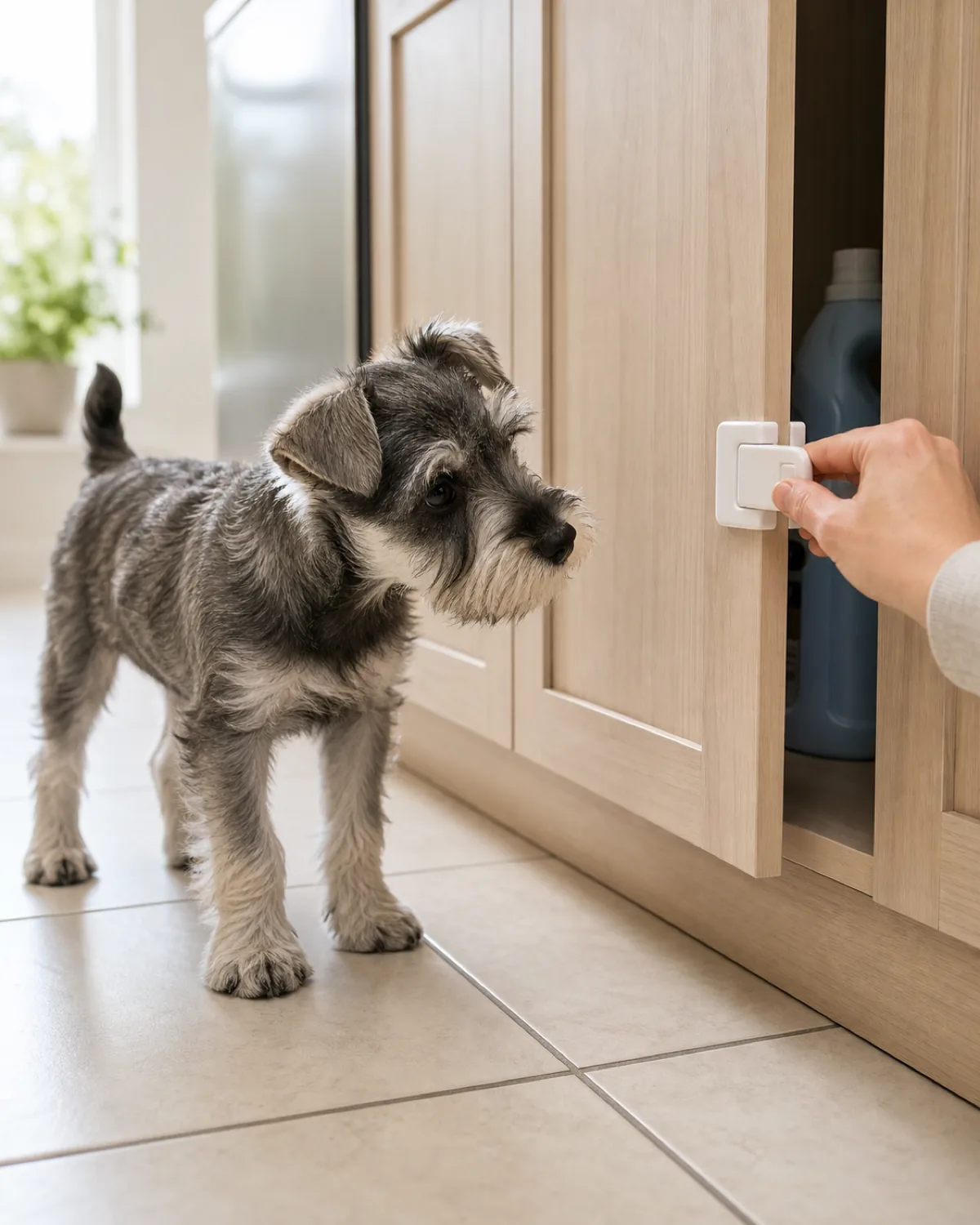
Trash cans get a child-proof lid latch or move into a cabinet that does. Cleaning products, dishwasher pods, and detergent go behind a child-proof cabinet latch, five dollars a pair and twenty minutes to install across the kitchen. Counters stay clear of food while you are not standing there.
And on treats: a puppy’s treat budget caps at ten percent of daily calories, with the full safe-food list in our puppy feeding guide. That ten percent rule keeps the kitchen from turning into a permanent reward zone.
- Memorize the eight: grapes, chocolate, xylitol, onions, garlic, macadamia, raw dough, alcohol and caffeine — any ingestion is a hotline call.
- ASPCA Animal Poison Control: (888) 426-4435. Pet Poison Helpline: (855) 764-7661. Write both on the fridge before the puppy arrives.
- Child-proof latches on every lower cabinet plus a latched trash can — five dollars and twenty minutes of work pays for itself once.
Bedroom: Medications, Hair Ties, Shoes, Under-Bed Pulls
Human medications are the bedroom red line. Ibuprofen, acetaminophen, Adderall, SSRIs, high-dose vitamin D, weight-loss prescriptions — any one tablet can kill a small puppy, and a puppy can find and swallow a tablet inside thirty seconds. Every bottle moves into a child-proof container inside a drawer that is itself behind a latch, well off the floor.
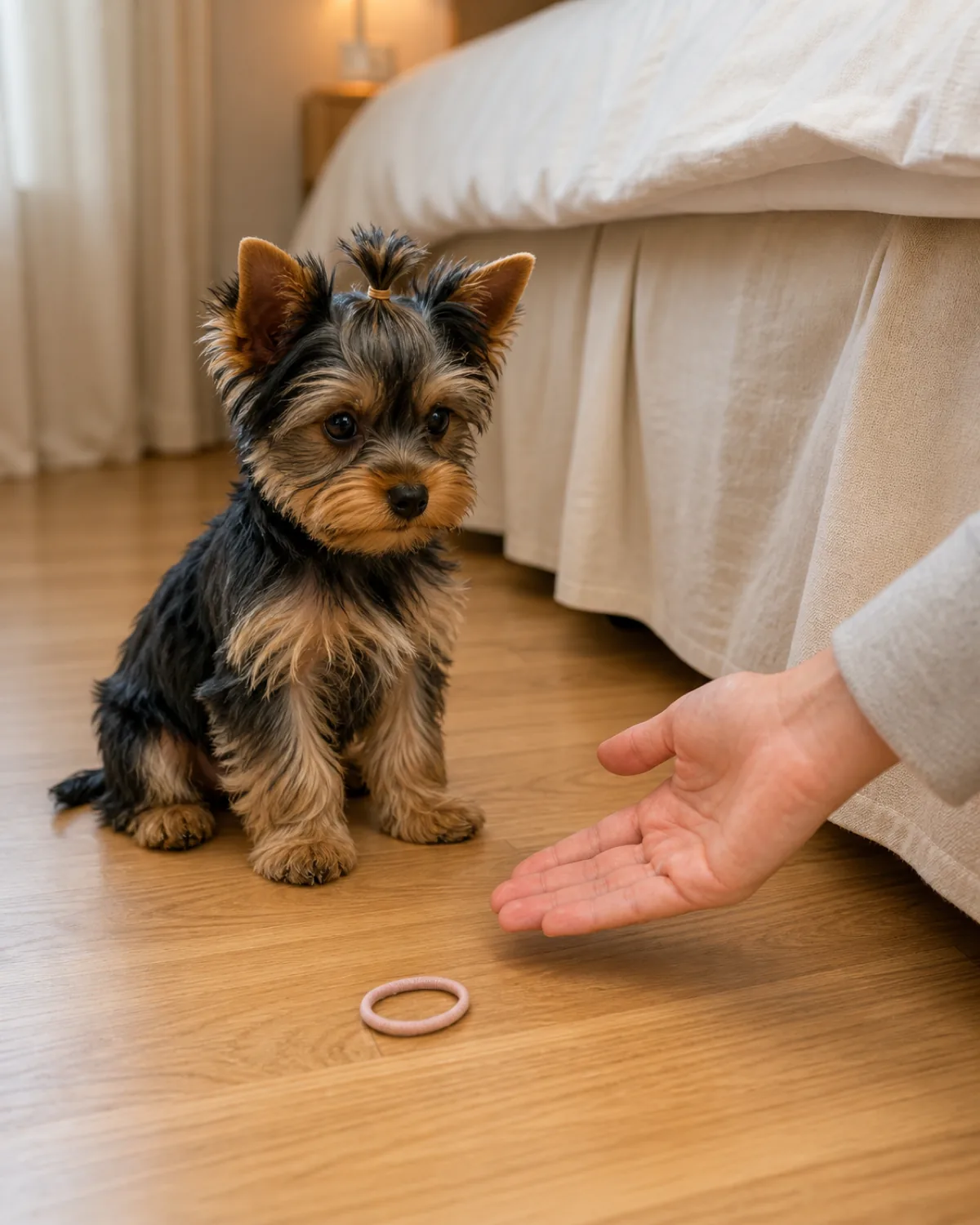
Hair ties, socks, underwear, plastic bags, and shoe laces are the second cluster — soft fabric and small loops are the most common foreign-body cases after AirPods, and the cause is almost always something the owner left within reach because “she has never gone for it.” She had never seen it before. Now she has.
Meds first, fabric second
Under-bed sweeps run weekly for the first month. A wet bath towel does not stay on the floor — fabric is swallowed surprisingly fast and tangles in the gut. Nightstand drawers get child-proof latches too. If you trade up rather than snatch when she does pick something up — open hand, high-value treat in the other hand — she learns to come trade, not to run and swallow first.
- Every medication goes into a child-proof bottle, in a drawer, behind a latch, off the floor — no exceptions.
- Hair ties, socks, and underwear are the second cluster of foreign-body cases — weekly under-bed sweeps for month one.
- Trade up, do not snatch — open palm plus a high-value treat teaches “come trade” instead of “grab and swallow.”
Bathroom: Toilet, Razors, Bath Mats, Cabinet Latches
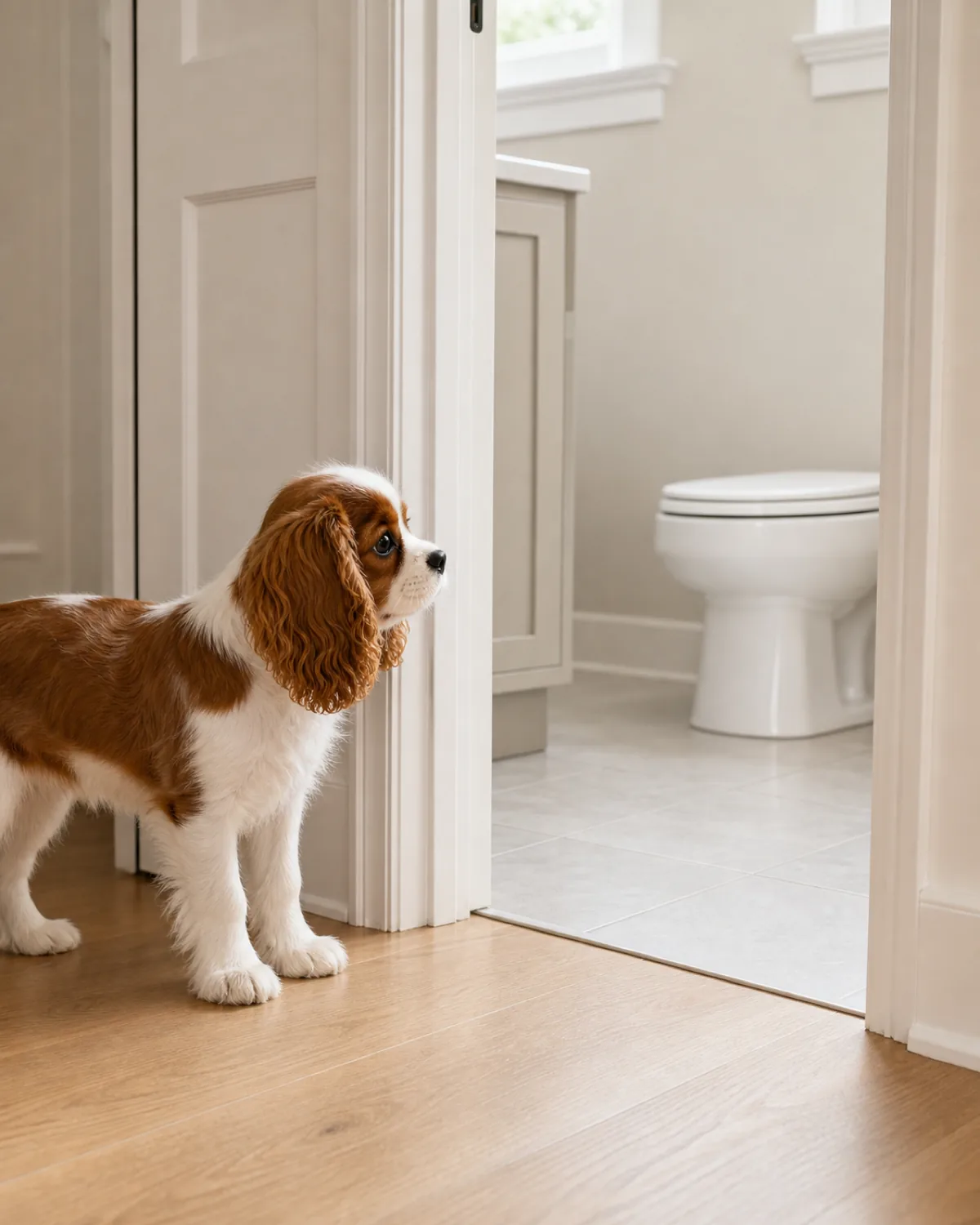
The toilet lid stays down. Always. A puppy who drinks toilet water gets a dose of whatever cleaner or freshener is in the tank, and a small puppy can fall in and drown in a household bowl. The rule is binary because the failure mode is fatal and the prevention is one second of habit per family member.
Razors and disposable razor blades move up onto a shelf out of reach. Shampoo, body wash, and mouthwash often contain xylitol or alcohol and live behind a child-proof cabinet latch. Toilet paper rolls go up on a wall-mount the puppy cannot pull down — a chewed-and-swallowed roll is a real intestinal obstruction surgery vets see every spring.
Door closed by default
The highest-impact bathroom rule is the door itself. The bathroom door stays fully closed during the day, not “mostly closed.” Most bathroom incidents start with “I thought I had closed the door.” A closed bathroom door is not confinement for the puppy — she is never inside, she is outside in the proofed yes-zone — it is a barrier between her and a room you cannot fully proof.
- The toilet lid stays down every single time — drowning risk plus tank cleaner ingestion, both fatal.
- Razors, mouthwash, and shampoo go behind a child-proof cabinet latch — many bath products contain xylitol or alcohol.
- The bathroom door stays fully closed during the day — most bathroom incidents start with “mostly closed.”
Almost every puppy emergency-room visit traces back to a violation on the right side of this card. Read both columns once before the puppy comes home, then again the night before day fourteen.
Always Do
- Walk every room at puppy hip height before day one and again on day fourteen.
- Keep yes-zone walls (gates and doors) closed unless you are actively in that room with the puppy.
- Store every human medication in a child-proof bottle behind a closed cabinet, not on the nightstand.
- Move every charging cable into a spiral wrap, a cord box, or under a furniture skirt.
- Anchor every freestanding TV, bookshelf, and dresser with a wall strap before the puppy arrives.
- Keep the ASPCA Animal Poison Control number (888-426-4435) on the fridge and in your phone.
- Trade up — swap a forbidden item for a high-value treat instead of yanking it out of her mouth.
Never Don’t
- Never leave a puppy free-roam in the home, even for a five-minute shower or quick porch trip.
- Never close a puppy alone in the bathroom or garage as a substitute for a proper crate or pen.
- Never assume “she has not tried it yet” means “she will not try it” — week three is the surprise.
- Never leave grapes, raisins, chocolate, xylitol gum, or onion scraps within nose reach of a puppy.
- Never use the word “no” without offering a clear alternative item to chew or do in the same breath.
- Never skip the fence audit because the yard “looks fine” from standing height — get on her level.
- Never tell yourself “my puppy is the good one” — that sentence ends in a vet ER bill on a Sunday.
Garage and Utility Room: Antifreeze, Rodent Bait, Sharp Tools, Salt

The garage is a no-go zone. Antifreeze containing ethylene glycol is the worst single hazard a puppy can find. One teaspoon kills a small dog, the puppy will actively drink it because it tastes sweet, and even with a fast vet response the outcome is often grim.
Rodent bait, ant traps, lawn fertilizer, snail bait, pesticides, road de-icing salt, glass, nails, and power tools sit beside it.
Garage is a no-go zone
The proofing decision is whole-room, not item-by-item. The garage door stays closed at all times. The puppy never goes in unsupervised. A baby gate at the connecting door to the house is a second barrier in case someone leaves the inside door open. Chemicals move to a locked overhead cabinet she cannot reach even at twelve months when she has grown.
When you open the garage door to take the trash out or pull the car in, do a five-second foot check first. Every year a few puppies get pinned by a closing garage door because they followed an adult out and stood right under the panel.
Make that look a habit. The garage door is the single mechanical hazard in your house that can do permanent damage in one moment of inattention.
- Antifreeze plus rodent bait plus chemicals make the garage your house’s highest-risk room — treat it as off-limits.
- Two barriers: the garage door stays closed, and a baby gate guards the connecting door from the house.
- Five-second foot check every time the garage door opens — closing-door pinning is a real annual cause of puppy injury.
Yard and Patio: Toxic Plants, Fence Gaps, Pesticides, Water Sources
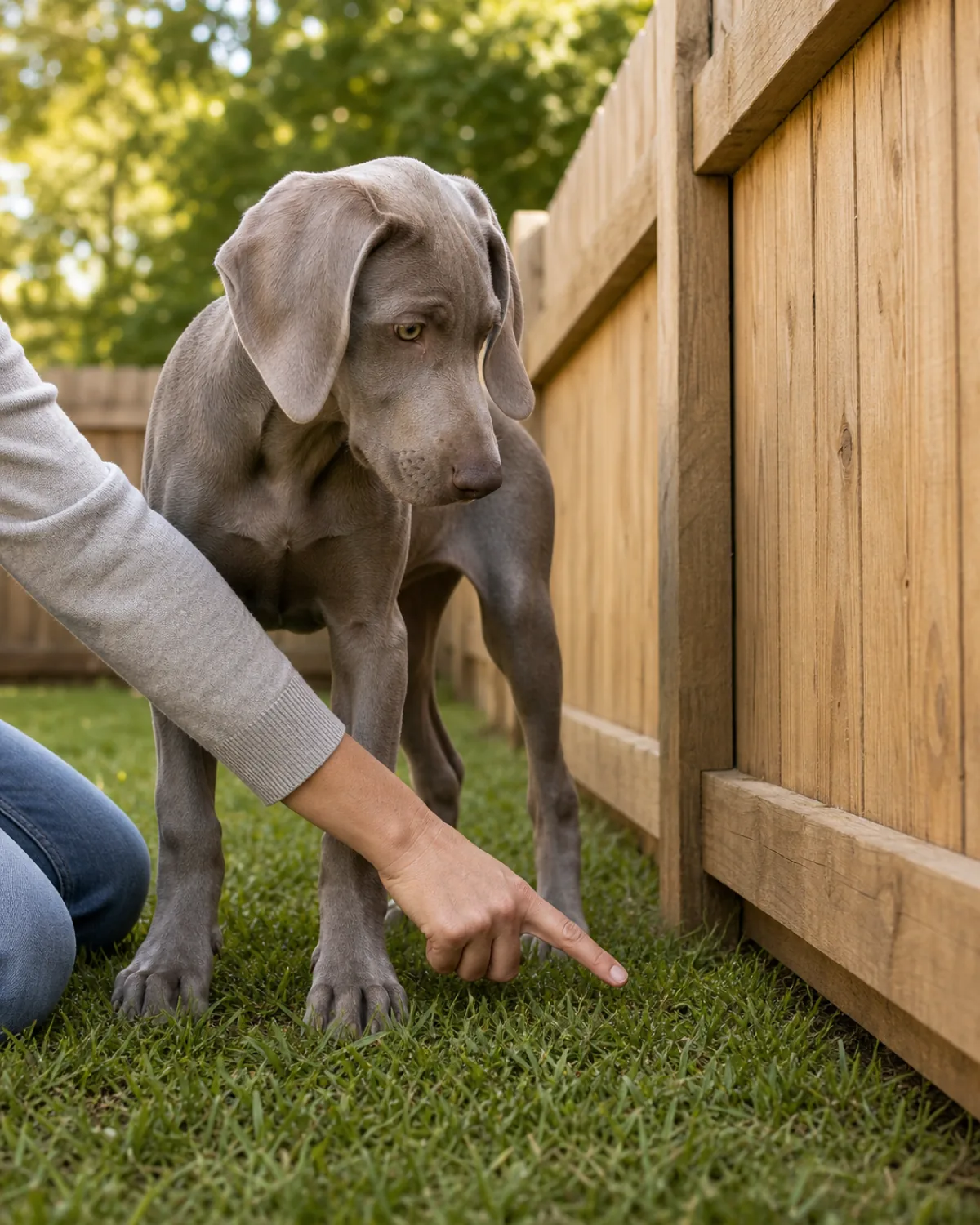
The yard audit starts with the fence. Bottom gap under two inches the whole way around — a twelve-week puppy can wriggle through a four-inch gap and a small breed at sixteen weeks can clear a low spot you never noticed. Minimum fence height four feet, and check every gate latch closes on its own. Walk the fence line on day one, not on the day she escapes.
Common backyard toxic plants are worth knowing on sight. Azalea and rhododendron are fatal cardiac toxins. Lily-of-the-valley. Oleander. Hydrangea. Tomato vines. And after a wet week, wild mushrooms appear overnight and a puppy who chews one can be in liver failure within hours.
Fence audit at puppy height
Use cedar or pine bark mulch, never cocoa mulch, which contains the same toxic compound as chocolate and smells delicious.
Water sources are the second yard category. Pools, ponds, and large water buckets are drowning risks for a curious puppy who cannot yet swim — a barrier or cover is the answer. And after any pesticide or herbicide treatment, the puppy stays off the lawn for forty-eight hours and the application area gets rinsed before the first paws hit grass.
- Fence audit: bottom gap under two inches, minimum height four feet, every gate self-latching — walk it day one.
- Six toxic plants worth knowing on sight — azalea, rhododendron, lily-of-the-valley, oleander, hydrangea, tomato vine — plus wild mushrooms after rain.
- Pool and pond access gets a barrier, and the lawn is off-limits for forty-eight hours after any chemical treatment.
Houseplant Audit: Common Indoor Toxic Plants
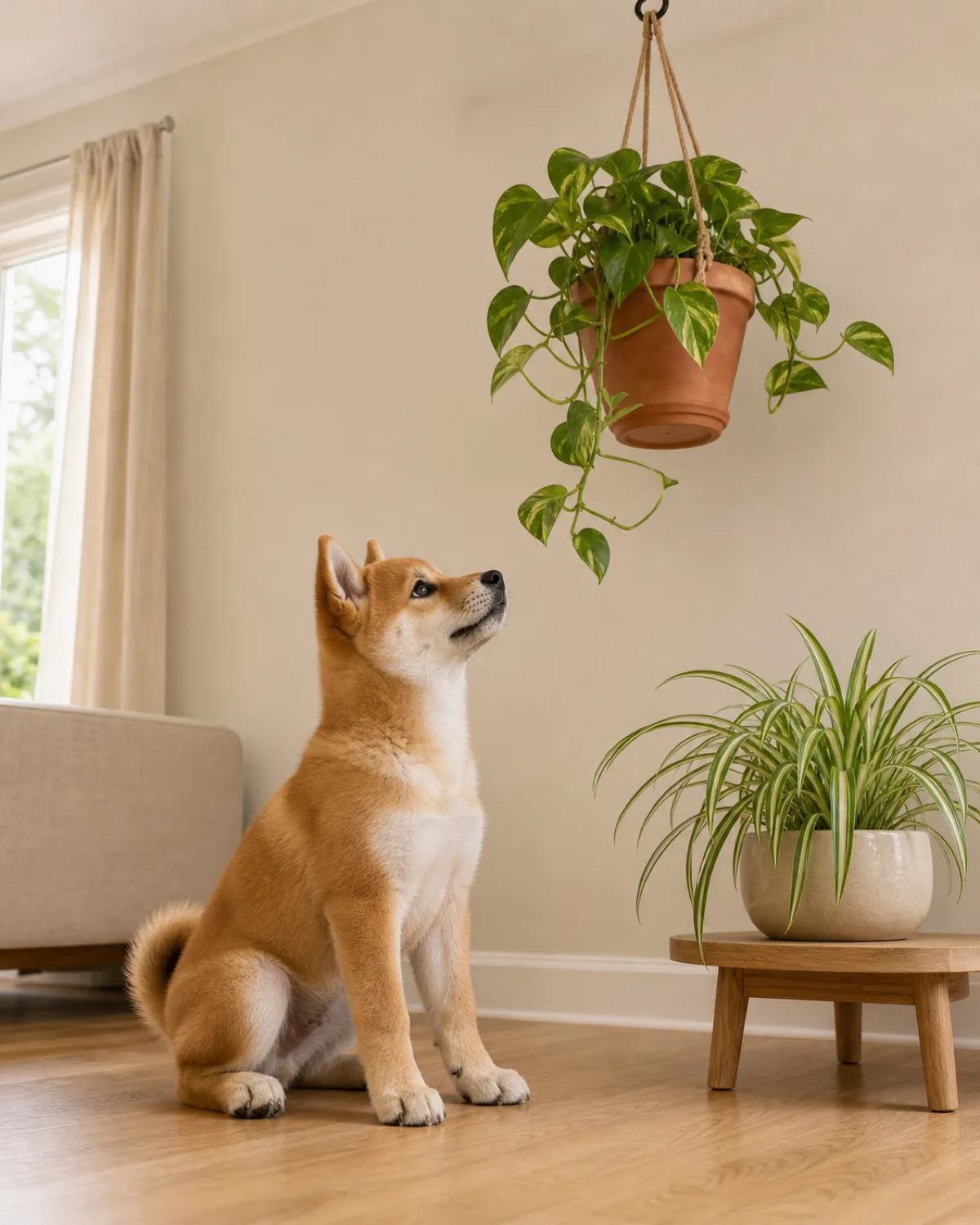
The indoor plant pass starts with the six worth removing or relocating. Lilies of all kinds, fatal for cats and rough on dogs. Sago palm, the single most lethal common houseplant, where one leaf or one seed can cause acute liver failure in seventy-two hours.
Pothos. Peace lily. Dieffenbachia. English ivy. Aloe causes painful gastrointestinal symptoms even though it sits on every kitchen counter as a “natural” remedy.
Sago palm and lily families
The answer is structural, not behavioral. A puppy cannot be trained to avoid a chewable green thing at floor level — her brain is not wired for it yet. Move the toxic plants to high hanging hooks the puppy cannot reach even by climbing the couch arm, or move them out of the house for the first year, or replace them.
Safe replacements that look good in the same spot include spider plant, Boston fern, most cat palms, African violet, and most prayer plants. The full reference is the ASPCA toxic and non-toxic plant database, which is the first stop before buying any new plant for the next twelve months.
A two-minute search before the cart click prevents a real percentage of poison-hotline calls.
- Six plants are worth removing or relocating before the puppy walks in — lilies, sago palm, pothos, peace lily, dieffenbachia, ivy.
- The answer is structural: move toxic plants up high or out of the house — you cannot train a puppy to avoid floor-level greenery.
- Spider plant, Boston fern, cat palm, and African violet are safe swaps — ASPCA’s database is the buy-check before any new pot.
The Puppy-Proof Quick Card
Walk every room
- Living room — cords, charging cables, remote batteries.
- Kitchen — trash latch, toxic foods, low cabinet locks.
- Bedroom — meds on nightstand, hair ties, shoes under bed.
- Bathroom — toilet lid down, razors and floss in drawer.
- Garage — antifreeze, rodent bait, sharp tools off floor.
- Yard — fence gaps at puppy height, mushrooms, mulch type.
- Houseplants — sago palm, lilies, pothos out of reach.
10 Most-Missed Hazards
- USB-C charging cables left on the floor
- AirPods, earbuds, remotes between sofa cushions
- Kitchen baseboards with old crumbs and grease
- Plastic shopping bags under the bed or in closets
- Shampoo, conditioner, soap bars on the tub edge
- Sago palm — the most lethal common houseplant
- Antifreeze drips on the garage floor (sweet, deadly)
- Backyard mushrooms after rain — remove daily
- Unanchored TV on a media console — tip-over risk
- Open stair gate or balcony — fall risk for small breeds
Toxic foods top 8
- Grapes & raisins — acute kidney failure
- Chocolate — dark and baking are the worst
- Xylitol gum & sugar-free anything
- Onion & garlic — raw, cooked, powdered
- Macadamia nuts
- Raw yeast bread dough
- Alcohol — any amount
- Caffeine — coffee grounds, tea, energy drinks
Toxic indoor plants top 6
- Sago palm — most lethal, all parts
- Lilies (all varieties)
- Pothos
- Peace lily
- Dieffenbachia
- English ivy
If puppy ate something — call NOW
- ASPCA Animal Poison Control 888-426-4435
- Pet Poison Helpline 855-764-7661
- Regular vet + 24-hour emergency vet on speed dial
PAWLIQA · NEW DOG OWNERS
Furniture Anchoring: TVs, Bookshelves, Dressers (The Climbing Puppy)

A puppy starts climbing earlier than most owners expect. By fourteen weeks the front paws are up on the lowest shelf, and by six months a small breed can scramble two shelves up a bookshelf.
Anti-tip straps for TVs, dressers, bookshelves, and any tall standing furniture are five to six dollars per pair, take fifteen minutes per piece, and prevent the worst single household injury pattern in the data: falling-furniture impact and crushing.
Anti-tip straps on every cabinet
Wall-mount the TV if the wall allows it. Otherwise the TV stand gets an anti-tip strap from the back of the unit to a stud. A simple test: stand behind the unit and lean fifty pounds of weight sideways, and if it sways visibly, it gets strapped today.
Dressers, especially the cheap pressboard kind with light bases, are the single most-reported tip-over incident in households with toddlers, and a puppy is functionally a toddler with no hands and four feet.
Open drawers get pushed back in every time. A puppy will climb into an open lower drawer the same way a cat does — once she has, the drawer can slide shut, and a forgotten puppy inside a closed dresser drawer for a few hours becomes a heat-and-suffocation emergency. The rule is simple: drawer open = adult standing right there; drawer closed = puppy cannot be inside.
- Anti-tip straps on every TV, bookshelf, and dresser — five dollars per pair, fifteen minutes per piece, prevents the worst injury pattern.
- Lean test: push fifty pounds sideways on each piece — if it sways visibly, strap it today.
- Drawers stay closed when no adult is right there — a closed drawer with a hidden puppy inside is a heat emergency.
Designing the “Yes” Zone: Where Puppy Can Go vs Closed-Off Areas

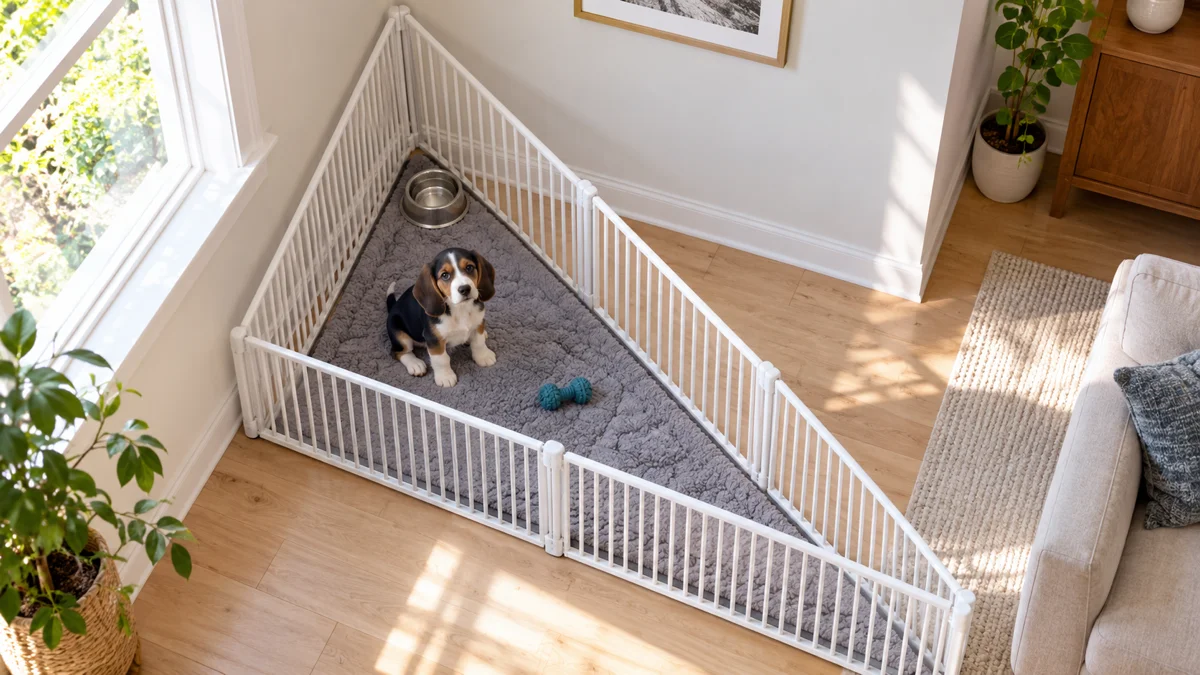
The faster way to proof a house is to proof less of it. Instead of treating every square foot as accessible and trying to remove every hazard, define a yes-zone — usually the living room plus the kitchen entryway plus one corner of the dining area — and close everything else off. Now the proofing work is concentrated in three contiguous rooms, not the entire floor plan.
The tools are familiar and cheap. Baby gates at least thirty inches tall, metal frame rather than plastic because puppies chew the plastic edges and a determined twelve-week-old can pop a flimsy gate.
Start with one room
An exercise pen with eight panels at thirty-six inches or higher for the times you need to subdivide further. Doors stay closed to off-limits rooms. Every door is a free gate if you remember to use it.
Start the yes-zone small in week one. One room, maybe two. By weeks two and three you can expand to add a second room as the proofing audit holds up. Opening up three rooms on day one triples the proofing workload and almost guarantees something is missed — a slow expansion buys you time to fix what you didn’t see the first pass.
- Yes-zone is faster than whole-house proofing — concentrate the work in three contiguous rooms, close the rest.
- Metal baby gates at thirty inches plus, eight-panel X-pens at thirty-six inches plus — plastic gates fail to a determined chewer.
- Start small in week one and expand by week three — opening three rooms on day one almost guarantees a missed hazard.
The Supervise vs Crate/Pen vs Free-Roam Tiered Plan
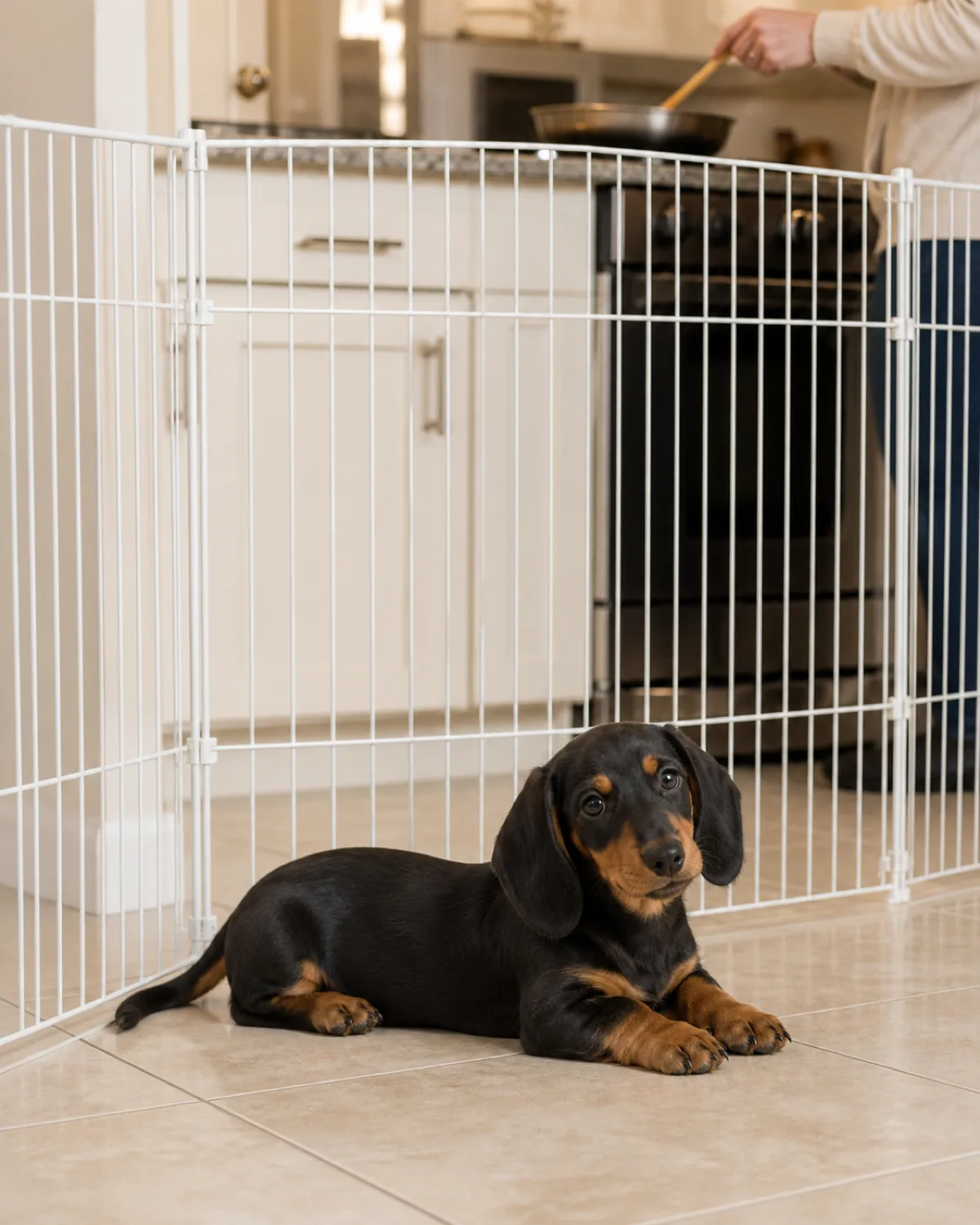
A proofed house is not enough on its own. A puppy still needs a tiered supervision plan, because no checklist catches the hazard you forgot. Three tiers cover every minute of the day. Tier 1 is active supervision — you can see her, hear her, and reach her within five seconds. She is loose in the yes-zone, you are not on a screen, you are watching her in your peripheral vision.
Tier 2 is confined. You are cooking, on the phone, in the bathroom, answering the door, anything where you cannot watch her for five minutes straight. She goes in a crate or X-pen, not in the bathroom and not behind a closed bedroom door alone.
Tier 1, 2, 3 in plain English
The crate is the safest single confined space when she is comfortable in it, and the day-by-day adaptation plan is in our crate training guide. Comfort first, confinement second.
Tier 3 is free-roam. She gets the run of the proofed zone unsupervised. This tier does not open before twelve months at the earliest, and only after a clean fourteen-day run with zero incidents at Tier 1 and Tier 2.
Most owners try to open it at six months because she “seems trustworthy now.” She is not. The thirty-second self-check that prevents most incidents is one question: in the next fifteen minutes, what tier am I running?
- Three tiers cover every minute: active supervision, confined in crate or pen, or free-roam earned after twelve months plus a clean fourteen-day run.
- The crate is the safest confined space when she is comfortable in it — never the bathroom, never a closed bedroom alone.
- Ask the thirty-second question every shift: in the next fifteen minutes, what tier am I running?
The 14-Day Re-Walk + Vet Emergency Hotline Setup
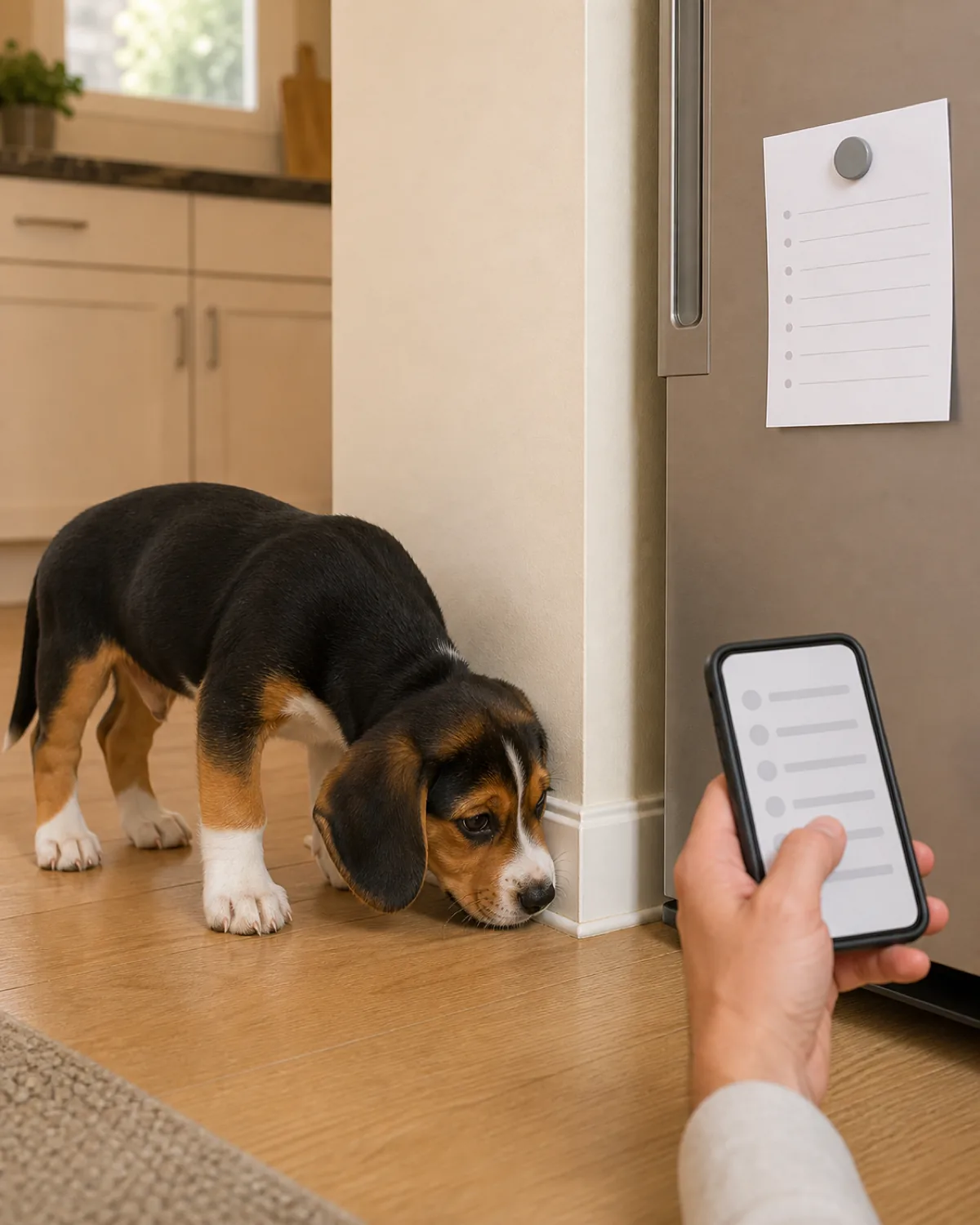
Two weeks after the puppy comes home, do the proofing walk again from her height. Get on your knees, shoulder level of an eight-week-old, and scan every room.
You will find hazards you missed on day one: a cord that worked loose from its wrap, a chewed bit of baseboard that exposed a paint chip, a new low corner she has been investigating. The first walk was a draft, the fourteen-day walk is the revision.
Phone-list to fridge magnet
Three phone numbers go on the fridge before the puppy arrives, written on plain index cards under a magnet. Your regular vet’s daytime line. The nearest twenty-four-hour emergency vet. The ASPCA Animal Poison Control Hotline at (888) 426-4435, with the Pet Poison Helpline at (855) 764-7661 as backup.
The ASPCA hotline charges a consultation fee around ninety-five dollars and is the single most useful purchase you can make in any active poisoning event.
I tell every new puppy parent the same thing. In the first month she is going to swallow something she should not. Do not yell, do not pry her mouth open, do not punish.
Note exactly what she got, how much, and how long ago, then call the vet or the hotline. Prevention beats treatment by a margin that is not even close, but when prevention fails, the calm phone call beats the panicked one every single time.
- Re-walk the house from puppy height at day fourteen — the first walk was a draft, the second is the revision.
- Three numbers on the fridge before she arrives: your vet, the nearest twenty-four-hour ER, and ASPCA (888) 426-4435 with Pet Poison Helpline (855) 764-7661 as backup.
- When something gets swallowed, note what plus how much plus how long ago, then call — calm beats panicked, and prevention beats treatment.

Jess Calloway edits Pawliqa, where she shares dog care, grooming, training, and new-owner tips — plus DIY and pet-friendly home ideas — for anyone who wants a happy, well-cared-for dog. As a dog mom to three very different dogs, she writes the honest, tested version of what actually works. This puppy-proofing guide covers the room-by-room hazard walk, the ten most-missed risks new owners skip, the toxic foods and plants every puppy parent should memorize, and the supervise-vs-crate-vs-free-roam tiered plan that prevents most first-year emergencies. Every guide is image-led and reviewed for clarity, usefulness, image accuracy, and Pinterest-to-page alignment before it goes live. Visit the About page.