Your puppy is not being difficult. A ten-week-old puppy crying at two in the morning has just left its mother, its littermates, and every familiar scent it has ever known. That cry is a survival instinct, not a behavior problem.
Once you understand that distinction, the fix becomes straightforward. The right crate setup, a predictable bedtime routine, and a few middle-of-the-night rules will get most puppies sleeping through the night within a week.
Jump to a section
How to stop a puppy from crying at night
From understanding why puppies cry to building a bedtime routine and handling middle-of-the-night whining, step by step.
Why Puppies Cry at Night (It Is Not Misbehavior)

A puppy separated from its litter for the first time is biologically wired to vocalize. In a wild setting, a pup left alone calls out so the pack can find it. Your living room is safe, but your puppy does not know that yet.
The three most common reasons behind nighttime crying break down like this. First, separation distress — your puppy has never slept without warm bodies pressed against it. Second, environmental unfamiliarity — new sounds, new smells, new darkness patterns. Third, a full bladder — an eight-week-old puppy can only hold it for about three to four hours.
Recognizing the category changes the response. A puppy that needs to pee gets a quiet trip outside. A puppy adjusting to its new home gets proximity and patience, not correction.
Every adult dog sleeping on a couch right now went through this exact phase. It passes. Your only job during these first few nights is to make the adjustment feel safe rather than frightening.
Make the Crate Smell Like You Before Lights Out
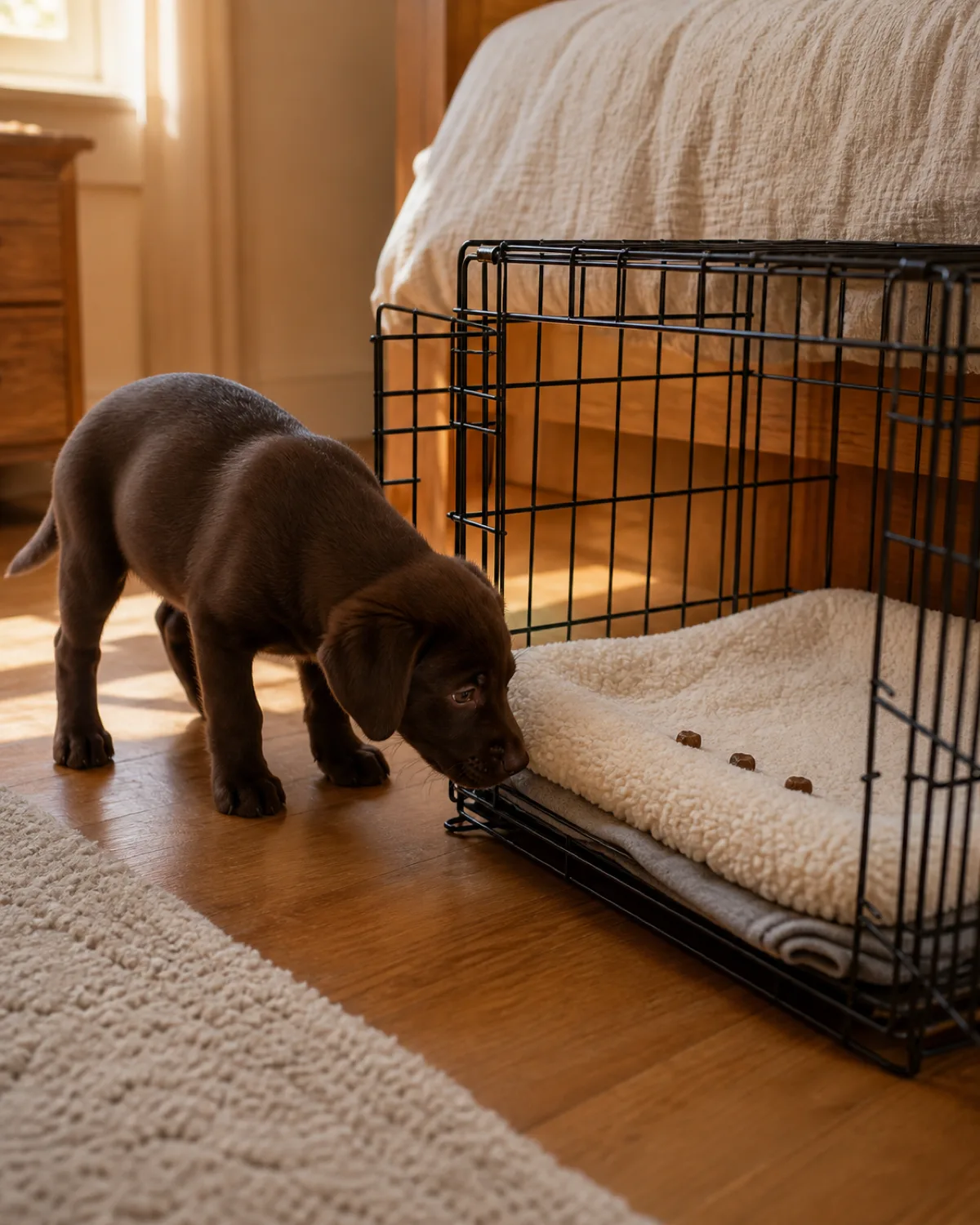
If your puppy already has a positive relationship with its crate from daytime crate training, nighttime is about layering sleep-specific comfort cues on top of that foundation.
If it does not, spend the afternoon letting the puppy explore the crate with the door open and treats scattered inside. But the real work here is what you add for the overnight hours.
The overnight crate needs three things your daytime setup probably does not have. First, a T-shirt you have actually slept in for the last two nights. Not one from the laundry pile — one that carries your strongest body scent. Tuck it under the crate pad so it does not bunch up but your puppy can still smell it through the fabric.
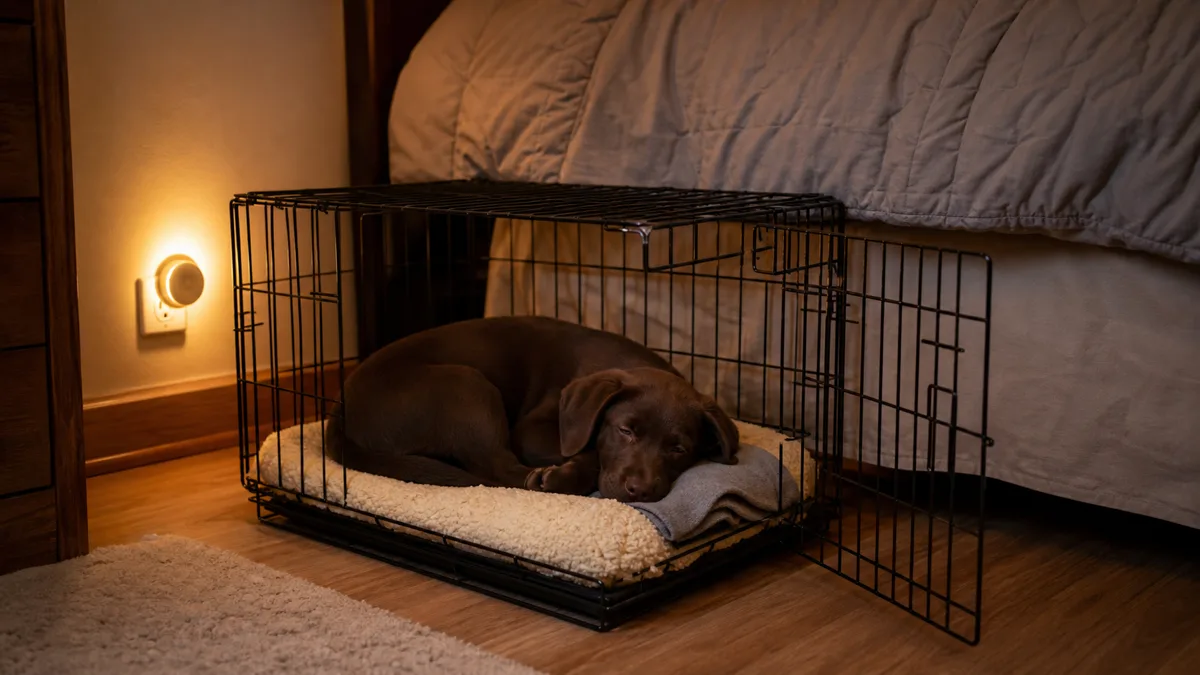
Second, position. The crate goes on the floor directly next to your bed, close enough that your arm can hang over the side and nearly touch it. Your breathing rhythm and body scent drifting down are the two most powerful overnight calming signals. Moving the crate even six feet away to the far wall measurably increases first-night crying duration.
Third, light control. A small nightlight near the crate — not overhead lighting, not total darkness. Puppies separated from their litter for the first time often panic in complete blackness because they cannot confirm they are not alone. A faint warm glow lets your puppy see the outline of the crate walls and your bed above, which is enough.
The 30-Minute Bedtime Routine That Actually Works

Puppies learn through pattern recognition. A consistent sequence of events before bed teaches your puppy that what comes next is predictable and therefore not scary.
The routine goes like this. Thirty minutes before bed, take your puppy outside for one final bathroom trip. Come back inside for ten minutes of calm, low-energy interaction — gentle petting, a slow puzzle toy, quiet voice. No tug games, no running, nothing that spikes adrenaline.
Offer a small treat as your puppy enters the crate. Close the door gently. Dim the lights or turn them off. Start a white noise source. Get into bed yourself.
Doing this in the same order at the same time every night is the variable that makes it work. Your puppy cannot read a clock, but it reads sequences. After three to five nights of the same pattern, most puppies begin relaxing the moment the routine starts.
Your puppy's first week home is all about building these kinds of reliable daily rhythms.
Where the Crate Goes Matters More Than the Crate Itself
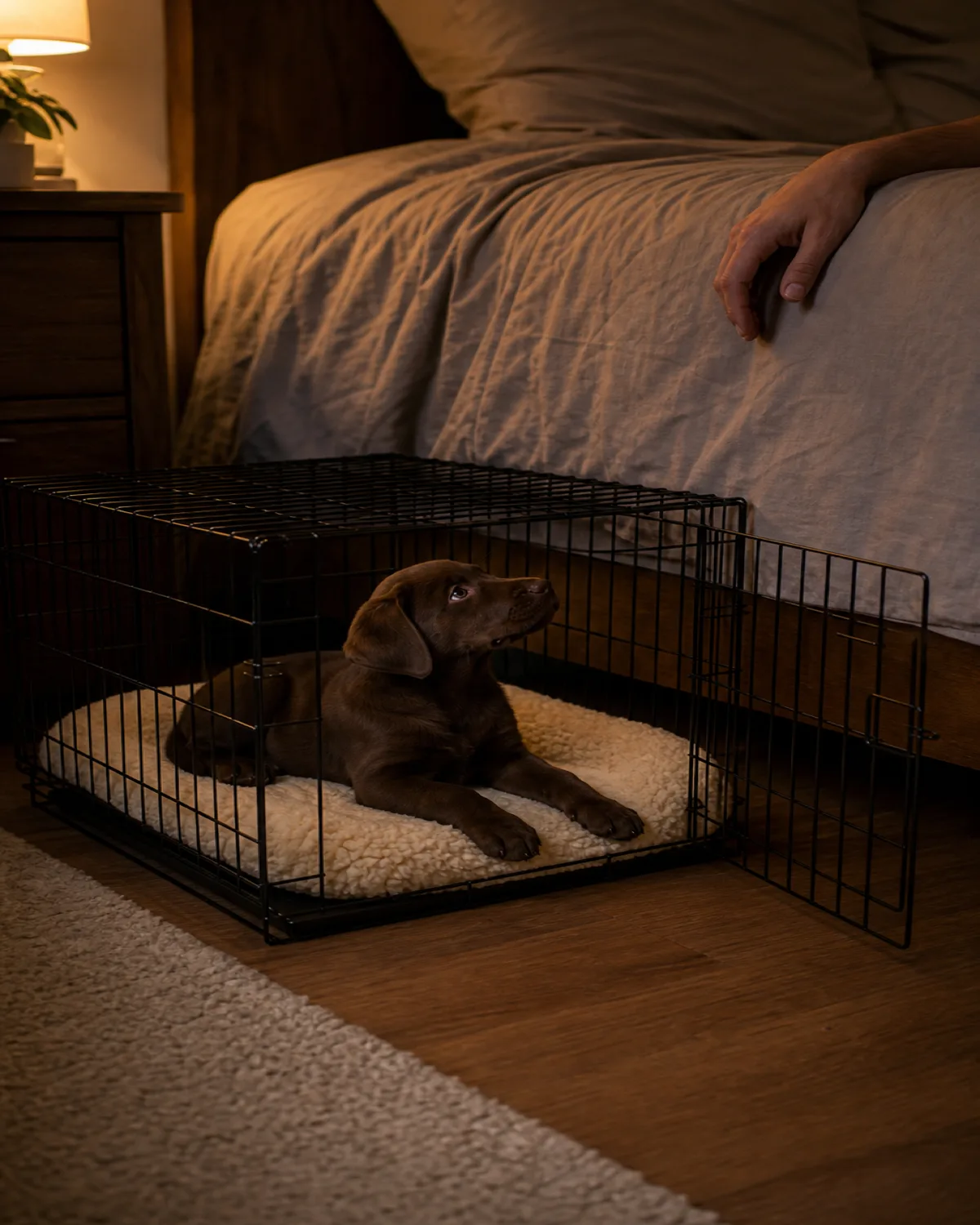
For the first week, the crate belongs right next to your bed. Not across the room. Not in the hallway. Not downstairs. Right next to the bed, close enough that you could reach down and touch it.
Your puppy needs to hear your breathing, smell you, and see your shape in the darkness. Remove those signals and you are asking a baby animal to sleep alone in what feels like an empty void. That is not a training opportunity — it is an unfair setup.
Starting the second week, begin moving the crate toward its permanent location by shifting it one to two feet per night. This gradual transition gives your puppy time to adjust without a sudden change that triggers a regression.
If you want the crate in another room eventually, that is fine. But week one is about survival, not ideal furniture placement. You can rearrange the bedroom later. Right now, proximity is the cheapest and most effective anti-crying tool you have.
What to Do When the Crying Starts (and What Not to Do)
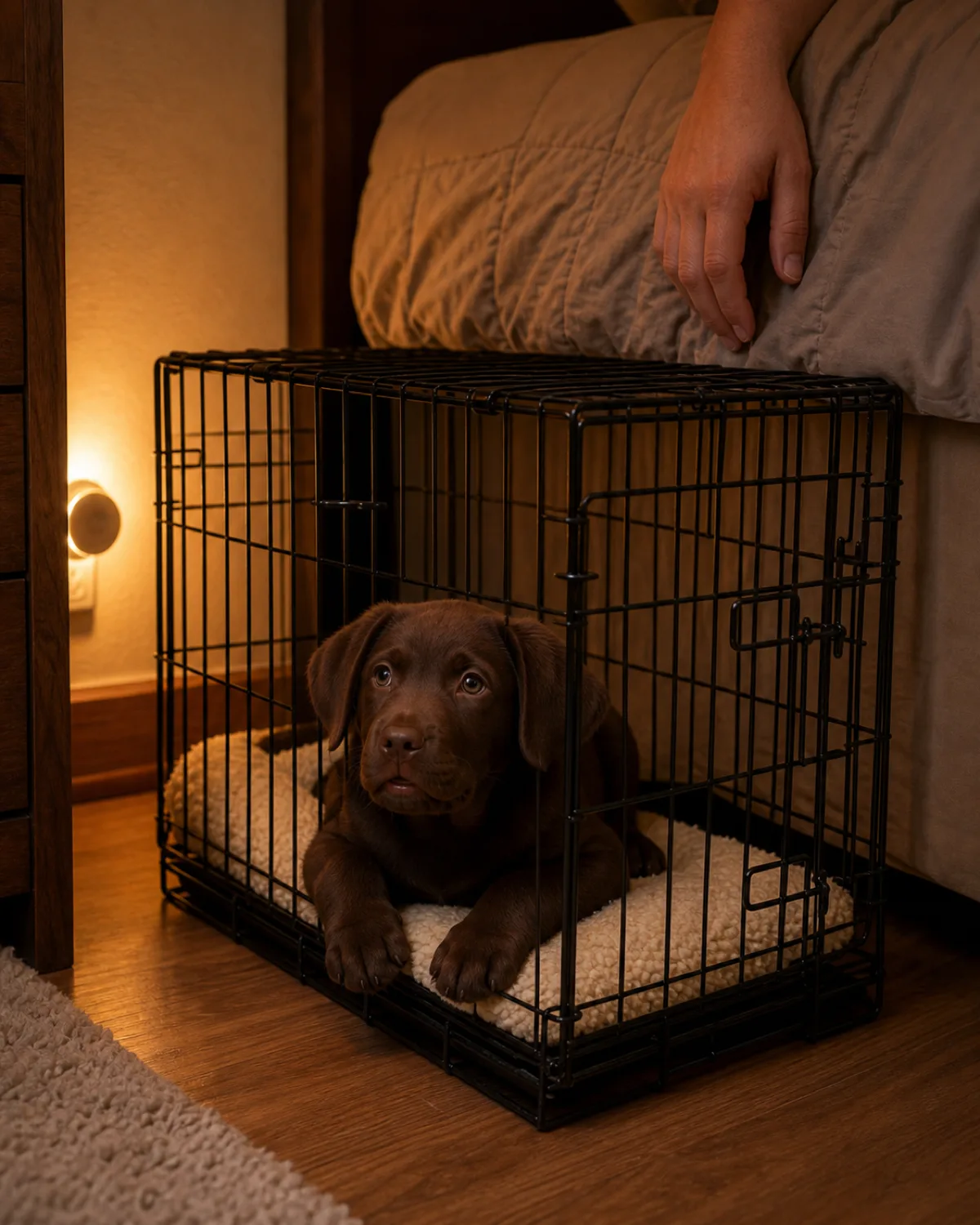
The first cry of the night will test your resolve. Here is the decision framework.
When crying starts, wait two to three minutes without responding. Many puppies fuss briefly, reposition themselves, and fall back asleep. Rushing to the crate the instant you hear a whimper teaches your puppy that noise produces attention.
If crying continues past five minutes with increasing intensity, offer a brief verbal reassurance — a quiet "shh, you are okay" — without opening the crate, turning on lights, or making eye contact. Your voice alone is often enough.
If the crying sounds different — restless movement, nose pushing against the crate door, circling — that is usually a bathroom signal. Handle it with the silent toilet protocol from the next section.
What never to do
Yelling, slapping the crate, dragging it to another room, or putting your puppy in bed with you as a fix. The last one is fine if you plan to allow it permanently, but once that door opens it does not close again. Punishment creates a puppy that fears the crate. Inconsistency creates a puppy that escalates the crying because sometimes it works.
Identify the cry type first
Your puppy is crying right now — what type of cry is it?
The response depends entirely on what the crying means. Read the signals before you act.
Toilet signalRestless movement, nose pushing door, circlingQuietly open the crate. Carry your puppy directly outside to the bathroom spot. No talking, no lights, no play. One quiet "good" when finished. Carry back to crate, close door, return to bed. The entire trip should feel boring.
Attention / anxiety cryIntermittent whining or howling, body mostly stillWait two to three minutes. Many puppies self-settle. If crying continues past five minutes, offer a quiet "shh" without opening the crate or turning on lights. Do not pick up, do not make eye contact, do not bring to your bed.
The Middle-of-the-Night Toilet Run (Keep It Boring)
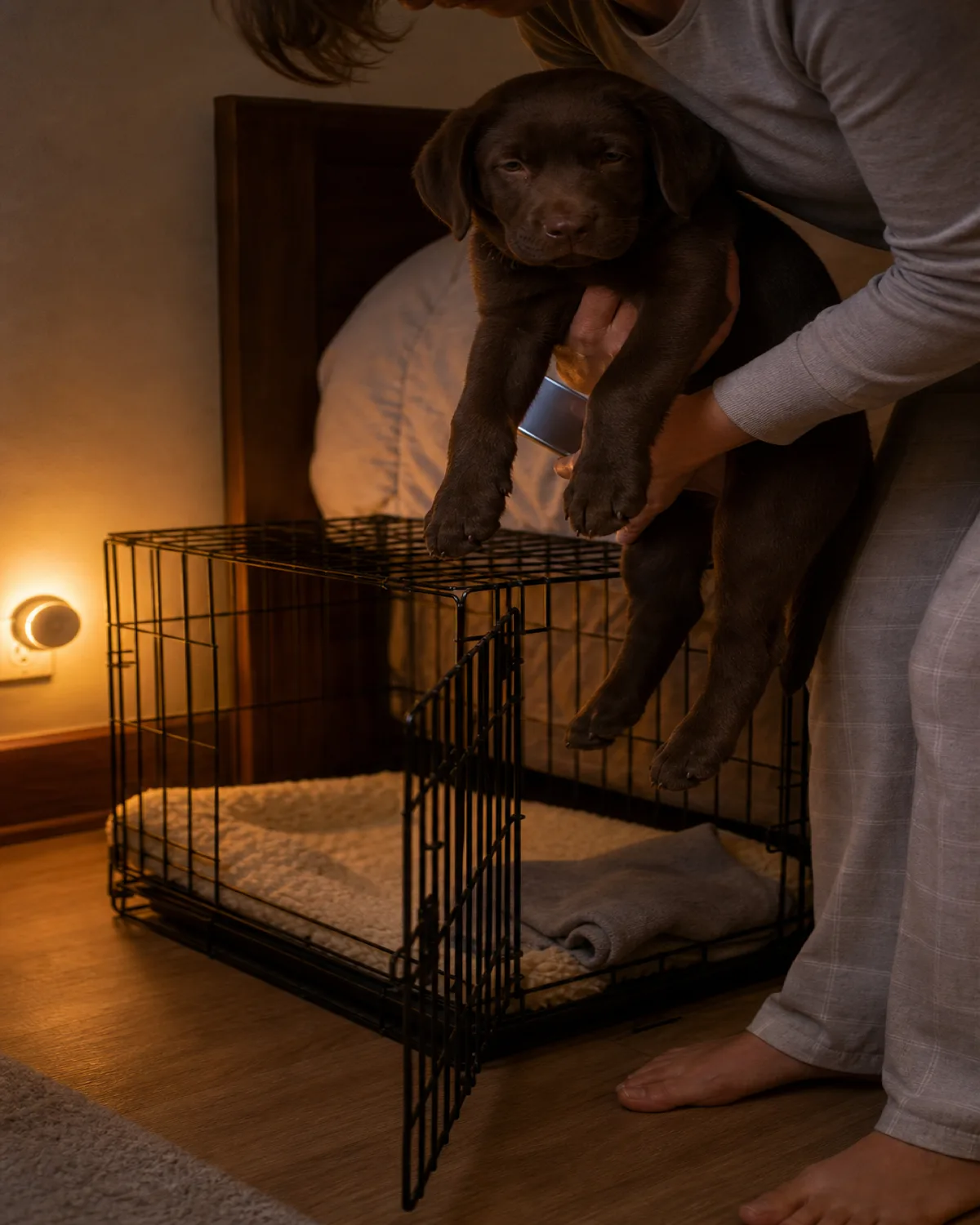
At eight to ten weeks, your puppy's bladder capacity tops out at three to four hours. Set an alarm to preempt the crying rather than waiting for it.
The protocol is deliberately unexciting. No talking. No lights except what you need to avoid furniture. Open the crate door, pick up your puppy, carry it directly to the designated bathroom spot outside. Wait for it to go. One quiet "good." Pick it up, carry it back, place it in the crate, close the door. Get back into bed.
No treats, no petting session, no play. This is not a training moment. The entire interaction should feel so boring that your puppy learns nighttime outings are functional, not social.
Extend the interval by about thirty minutes each week. By twelve weeks, most puppies can manage four to five hours. By sixteen weeks, six to eight hours is typical. If your puppy consistently wakes before your alarm, it is probably ready for the next interval.
White Noise, Heartbeat Toys, and What Actually Helps
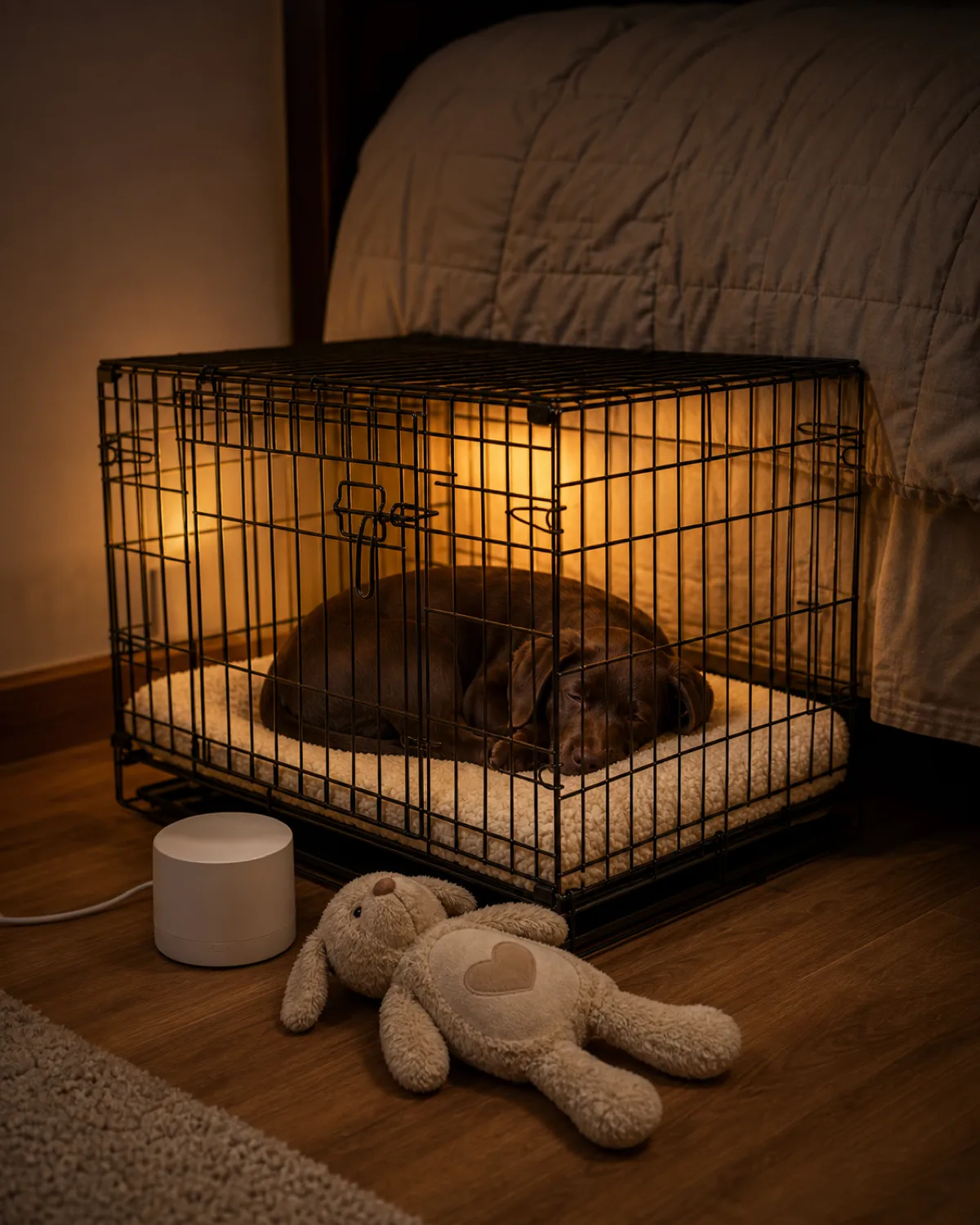
A fan, a white noise machine, or a phone app playing steady background sound does one thing well: it masks the random household noises that wake light-sleeping puppies. The refrigerator cycling on, a pipe expanding, a car door outside — these small sounds are the top reason puppies wake up and start crying in the middle of the night.
Heartbeat toys — stuffed animals with a rhythmic vibration module inside — simulate the feel of sleeping next to a littermate. There is genuine behavioral research supporting their calming effect during the first two to three weeks of separation. They are not magic, but they help.
What is less useful than most pet stores suggest: calming sprays, pheromone diffusers, and herbal supplements. These are not harmful, but reaching for them before establishing a consistent routine and proper crate placement is solving the wrong problem first. Get the basics right, then add tools if needed.
The simplest version
A twenty-dollar fan pointed at the wall near the crate. That alone handles most of the nighttime sound-trigger problem.
How Long Until the Crying Stops (A Realistic Timeline)
Night one is almost always the hardest. Expect intermittent crying for thirty to sixty minutes, sometimes longer. This is normal and does not mean you are doing anything wrong.
By night two or three, most puppies cut the crying time in half. By the end of the first week, the majority of puppies settle within five to ten minutes of the crate door closing.
Some puppies take two to three weeks. Puppies taken from litters earlier than eight weeks and puppies from shelter environments may need extra patience.
Progress is not linear. Night four might be worse than night three. A thunderstorm, a schedule change, or a visitor in the house can reset the clock temporarily. This does not erase the progress your puppy has already made. Stay the course.
If your puppy is still crying intensely every night after three weeks of consistent routine and crate placement, consult your veterinarian. Persistent distress beyond that window may indicate separation anxiety that benefits from professional guidance.
The boundaries that make nighttime work
Puppy night routine ground rules
Follow these every night. Consistency is the fastest path to a puppy that sleeps through.
Always
- Place the crate in the bedroom where your puppy can see and smell you
- Take your puppy outside for a bathroom trip as the last step before bed
- Set an alarm to preempt nighttime bathroom needs rather than waiting for crying
- Follow the same routine in the same order every night
- Put a worn T-shirt with your scent inside the crate
- Use white noise or a fan to mask household sounds
- Wait two to three minutes before responding to crying
Never
- Never yell at or slap the crate when your puppy cries
- Never let your puppy cry until it exhausts itself without checking
- Never play, give treats, or turn on lights during the nighttime toilet run
- Never change the sleeping arrangement from night to night
- Never leave a collar on your puppy inside the crate (snag risk)
- Never lock the crate door longer than your puppy's bladder can hold
Three Mistakes That Make Night Crying Worse

The first mistake is letting your puppy cry until it exhausts itself. The "cry it out" method does not translate to puppies. You are not teaching self-soothing — you are teaching a baby animal that calling for help produces no response. That damages trust and often makes the anxiety worse long-term.
The second mistake is the opposite extreme: rushing to the crate the moment crying starts, opening the door, scooping up the puppy, bringing it to your bed, and lavishing attention. This directly reinforces the behavior. Your puppy learns that crying hard enough produces the exact outcome it wants. Tomorrow night, it will cry harder and longer.
The third mistake is inconsistency. One night in the crate, one night in your bed. One night the crate is in the bedroom, one night it is in the kitchen. One night you respond after two minutes, one night you wait an hour. Unpredictability is the enemy of puppy sleep. A predictable system — even an imperfect one — outperforms a perfect strategy applied randomly.
Save this for later
Your Puppy Night Routine Quick Guide
- Crate in the bedroom right beside the bed (not across the room)
- Soft pad plus a T-shirt you have slept in (your scent)
- White noise or fan running near the crate
- 30-min bedtime routine: bathroom, calm play, treat in crate, dim lights
- 8-10 weeks: set alarm every 3-4 hours for toilet run
- 12-16 weeks: extend to every 4-6 hours
- Night toilet run: no talking, no lights, no play
- When crying starts, wait 2-3 minutes before responding
- Quiet voice reassurance OK, but do not open the crate door (unless toilet signal)
- Same routine, same order, same time every night
- Typical improvement: 3-7 nights for noticeable progress
- No improvement after 3 weeks: consult your vet about separation anxiety
Your Puppy Will Sleep Through the Night

It is probably two in the morning right now. Your puppy is whimpering. Your eyes are barely open. You are wondering whether bringing this animal home was a mistake.
It was not.
Every dog that has ever curled up beside its owner on a Sunday morning, every dog that has ever fallen asleep with its head on someone's foot while they worked, every dog that has ever sighed contentedly and closed its eyes the moment the lights went out — that dog was once a puppy that cried at night.
Slide the crate a little closer to the bed. Say "I'm right here" one more time. Close your eyes. Tomorrow night will be a little easier. And the night after that, easier still. And one morning you will wake up and realize your puppy slept the whole night through, and you will not even remember when it started.
That morning is closer than you think.

About the author
Jess Calloway
Jess Calloway edits Pawliqa, where she shares dog care, grooming, training, and new-owner tips — plus DIY and pet-friendly home ideas — for anyone who wants a happy, well-cared-for dog. As a dog mom to three very different dogs, she writes the honest, tested version of what actually works. Every guide is image-led and reviewed for clarity, usefulness, image accuracy, and Pinterest-to-page alignment before it goes live. Visit the About page.