Most new puppy owners make the same mistake on day one. They clip a leash to a collar their puppy has never worn, open the front door, and expect a calm walk.
What happens next is predictable: the puppy freezes, thrashes, or bolts — because a strange rope attached to its neck plus traffic noise plus new smells is too much at once.
Leash training works when you break it into small indoor steps first and save the sidewalk for later.
Why Leash Training Starts Before the First Walk
A puppy who has never worn a collar or felt resistance on a leash has no framework for understanding what is happening when you clip one on and walk outside. Every sensation is new at the same time — the pressure around the neck, the tug when the leash pulls taut, the sound of the clip jingling, and every outdoor stimulus competing for attention.
Stacking all of those firsts into a single experience overwhelms even the most confident puppy.
The fix is sequencing. You teach the collar separately from the leash. You teach the leash indoors before you go outdoors. You teach walking on a quiet sidewalk before you try a busy park.
Each layer gets introduced only after the previous one is boring. This turns leash training from a single stressful event into a gradual process that most puppies move through in two to four weeks of short daily sessions.
The puppy who panics on a leash almost always had the steps compressed, not a temperament problem.
Getting Your Puppy Used to a Collar and Harness
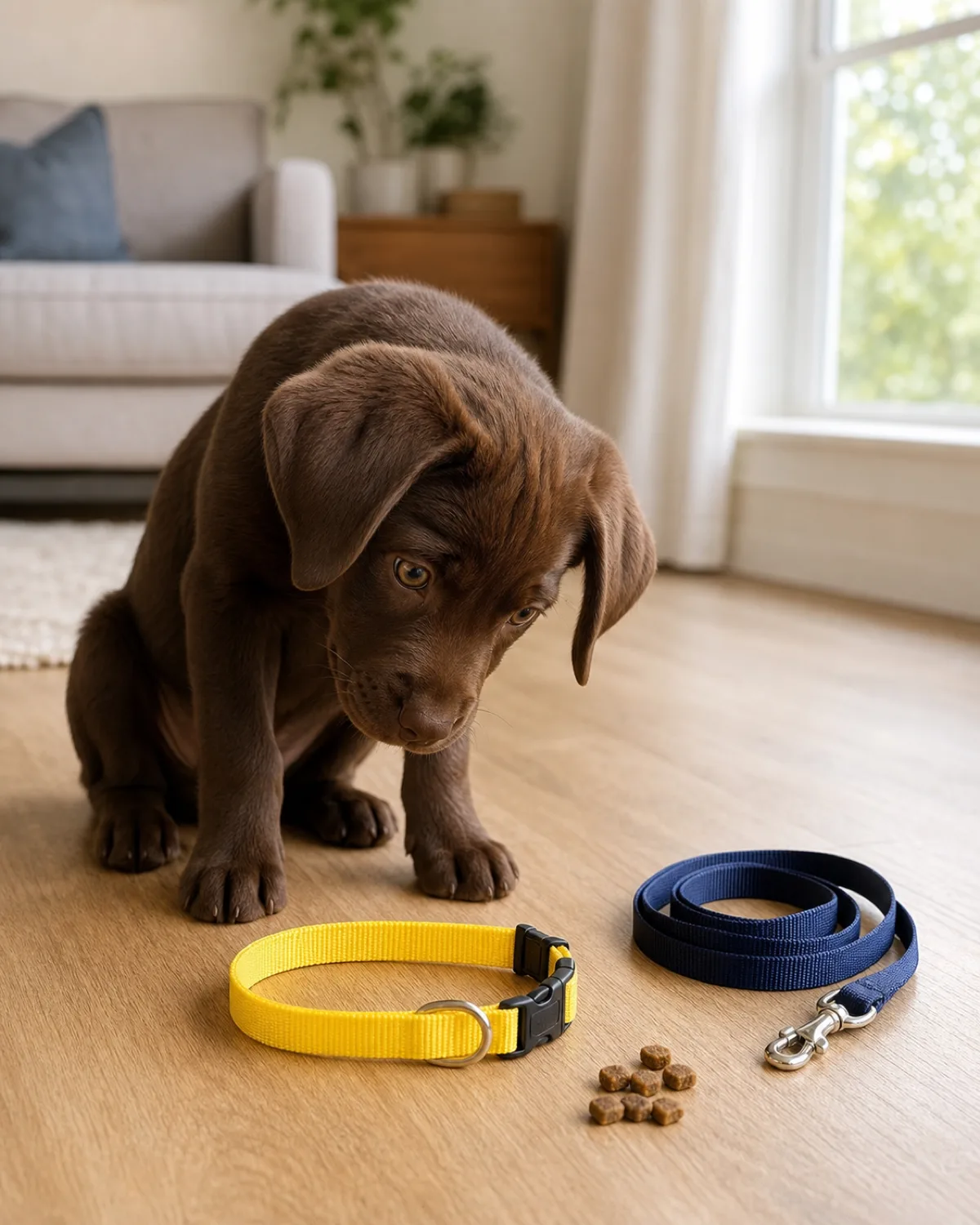
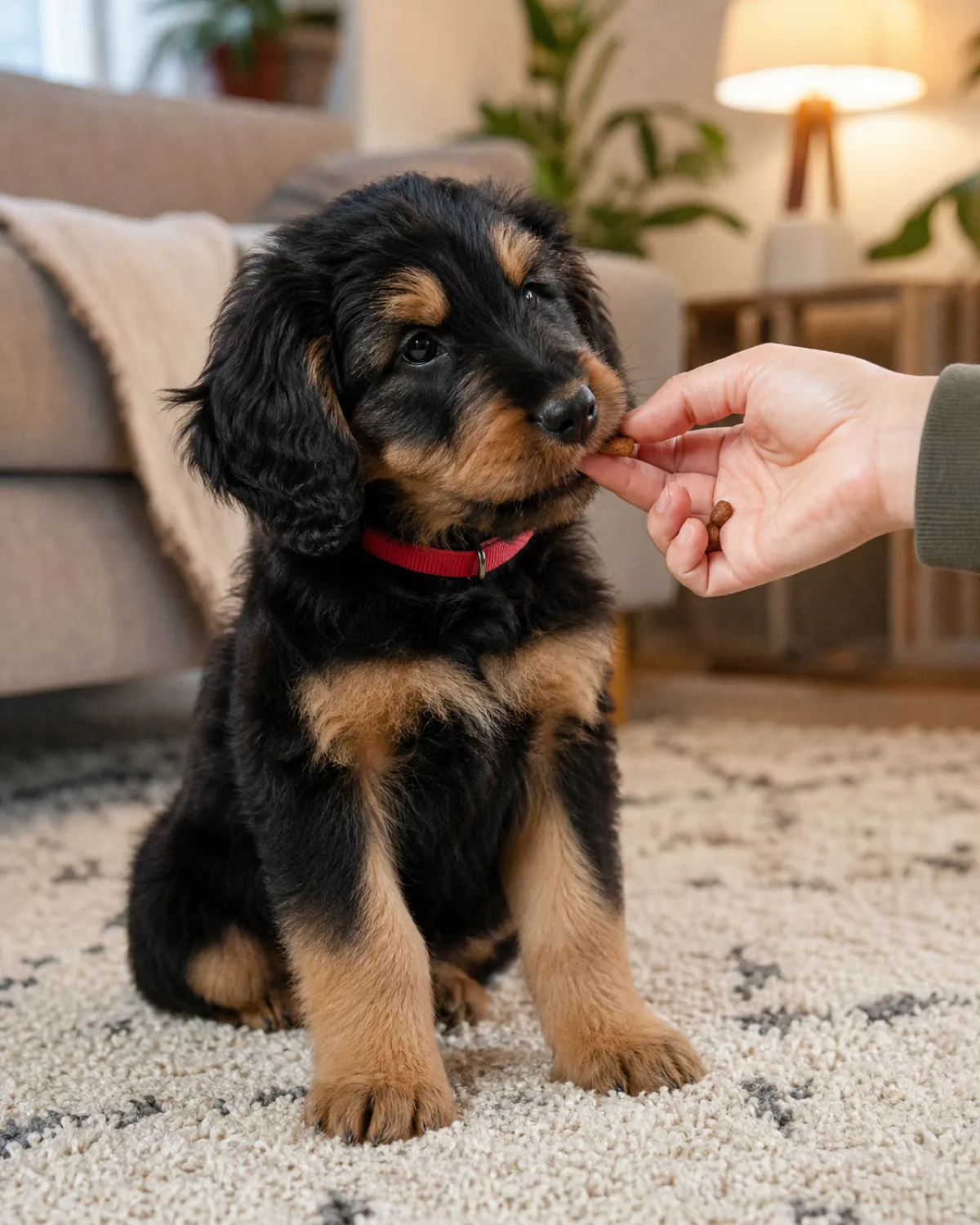
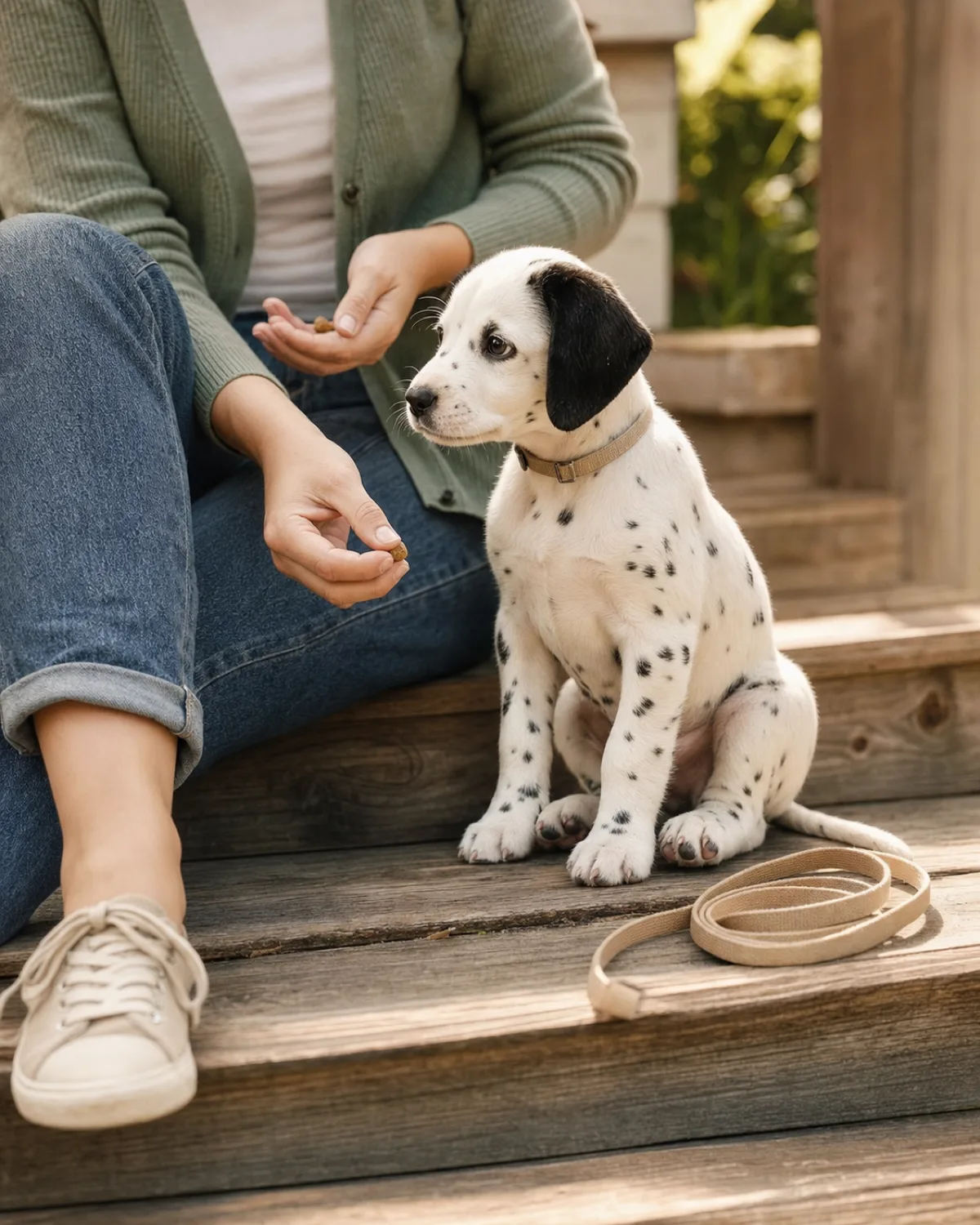
For a puppy who has never worn anything around its neck or chest, a collar feels like a foreign object pressing against skin that has always been free. Start by setting the collar on the floor near your puppy during a play session. Let the puppy sniff it, paw it, ignore it. Give a treat while the collar is nearby so the object starts to predict good things.
Next, drape the collar loosely over the puppy's neck for three seconds and remove it. Treat immediately. Repeat a few times per session, gradually extending to ten seconds, thirty seconds, one minute, then an entire meal.
If the puppy scratches at the collar or shakes its head, do not remove it in response — that teaches the puppy that scratching earns freedom. Instead, redirect with a toy or treat until the scratching stops, then calmly remove the collar a moment later.
A harness follows the same pattern but takes an extra step because the puppy needs to put its legs through openings. Step-in harnesses are easier for beginners than over-the-head styles.
For either type, check the fit by sliding two fingers between the strap and the puppy's body — that gap is the correct snugness. A harness distributes pressure across the chest instead of concentrating it on the throat, which matters especially for puppies who have not yet learned not to pull.
Jump to a section
How to leash train a puppy
From the first collar fitting through indoor practice to confident outdoor walks.
Most leash training guides skip this step, and it shows in the results. There is a mental gap between wearing a collar and having a human control your movement through a rope. Bridging that gap is what the drag phase does.
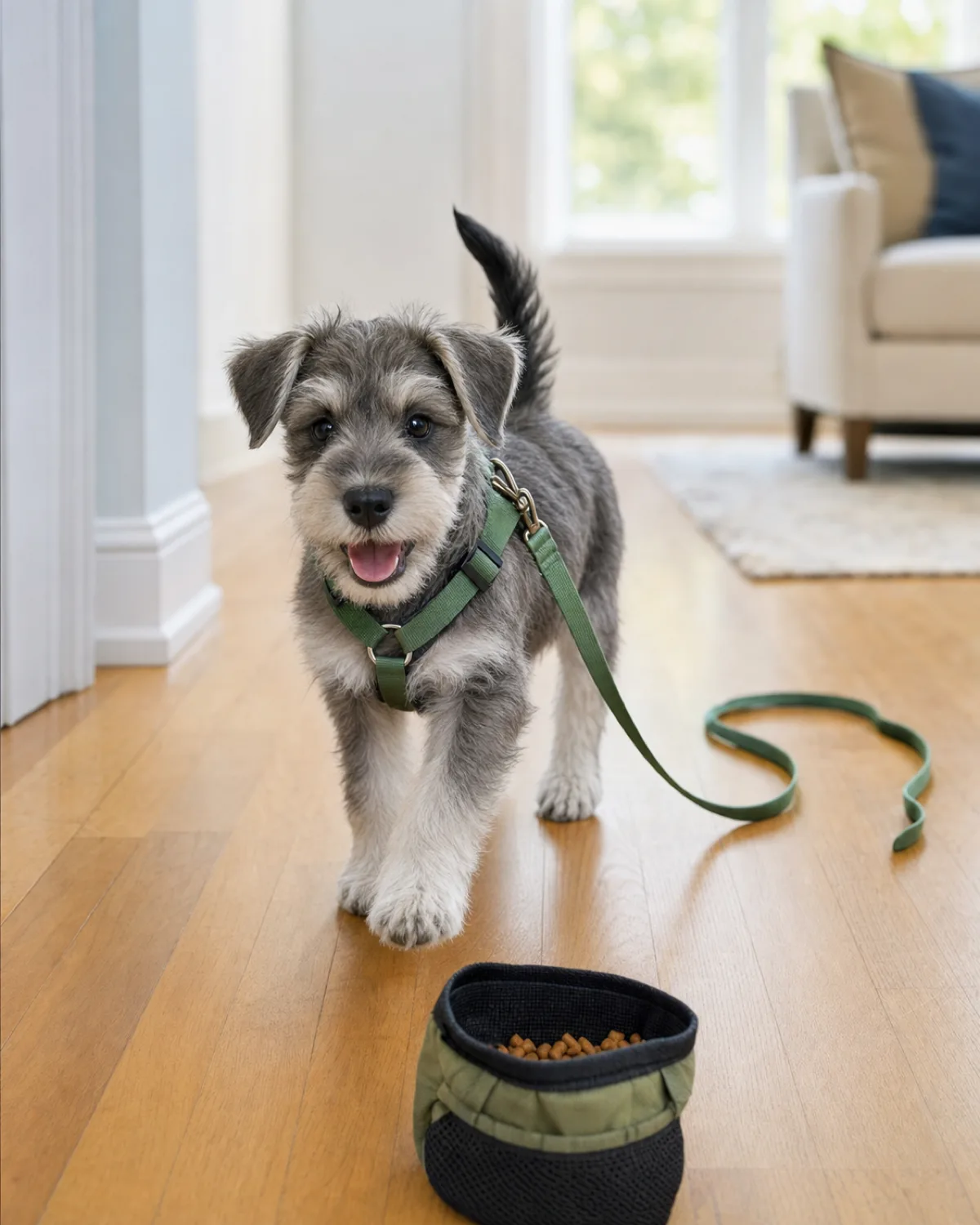
Once your puppy wears the collar or harness without reacting, clip on a lightweight leash — four to six feet of thin nylon, not a heavy leather lead — and let the puppy walk freely around the house with the leash trailing behind. You are in the room supervising but not holding the leash.
The puppy learns what it feels like to have something following along, the sound of a leash sliding across a floor, and the occasional gentle tug when the leash catches on a chair leg.
If the leash snags on furniture, quietly untangle it. Do not make it dramatic. Drop treats on the ground periodically so the puppy associates the leash dragging behind it with random good things appearing.
Run three to five sessions of five to ten minutes each over several days, or until the puppy completely ignores the leash. The milestone you are looking for is a puppy who walks, plays, and sniffs normally as if the leash is not there.
Walking on a Leash Indoors First
Now you pick up the leash. This is the step where the puppy learns that a human is on the other end and that the leash creates a boundary. Start in the room your puppy is most comfortable in — the living room, a hallway, or the backyard if it is enclosed and familiar.
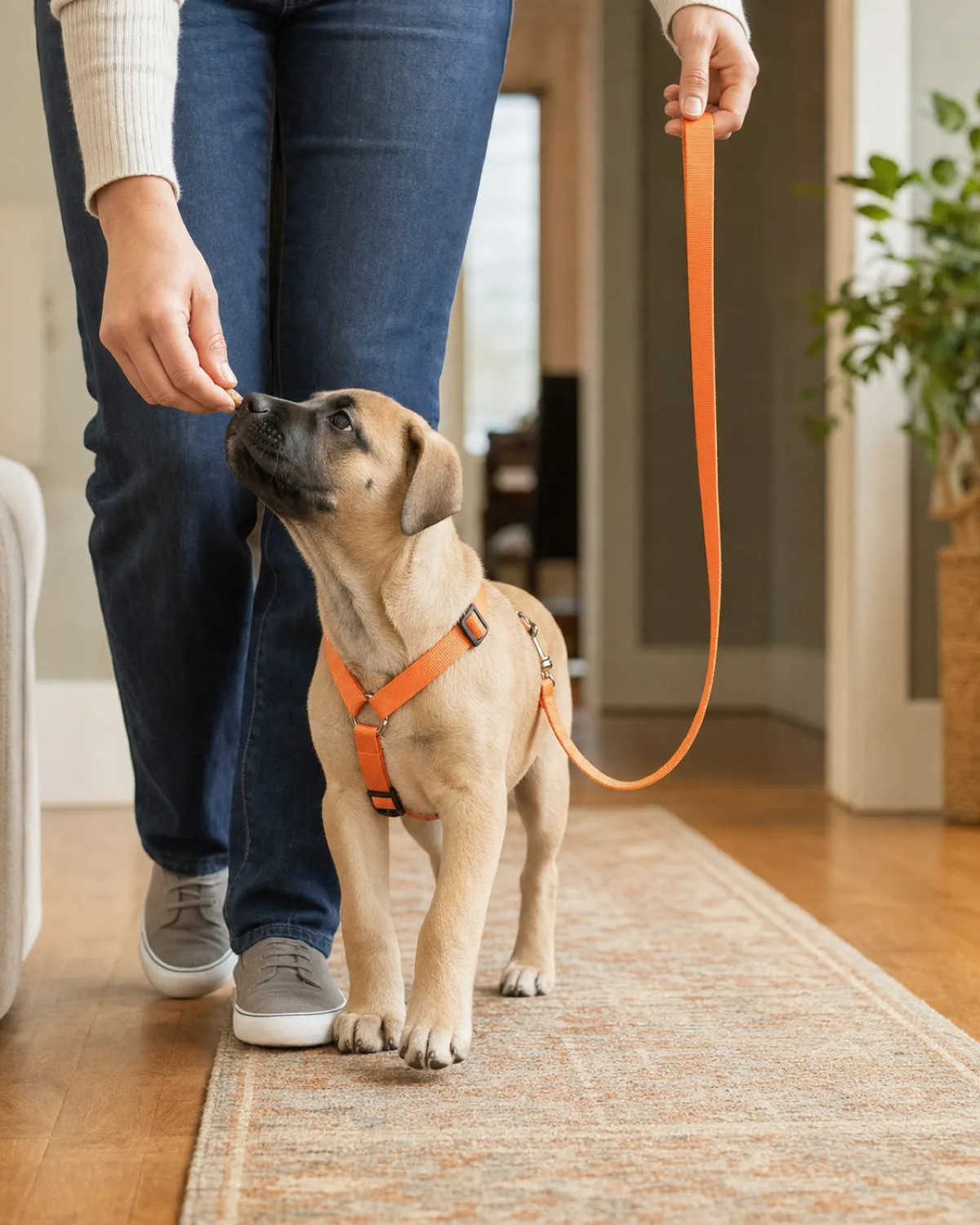
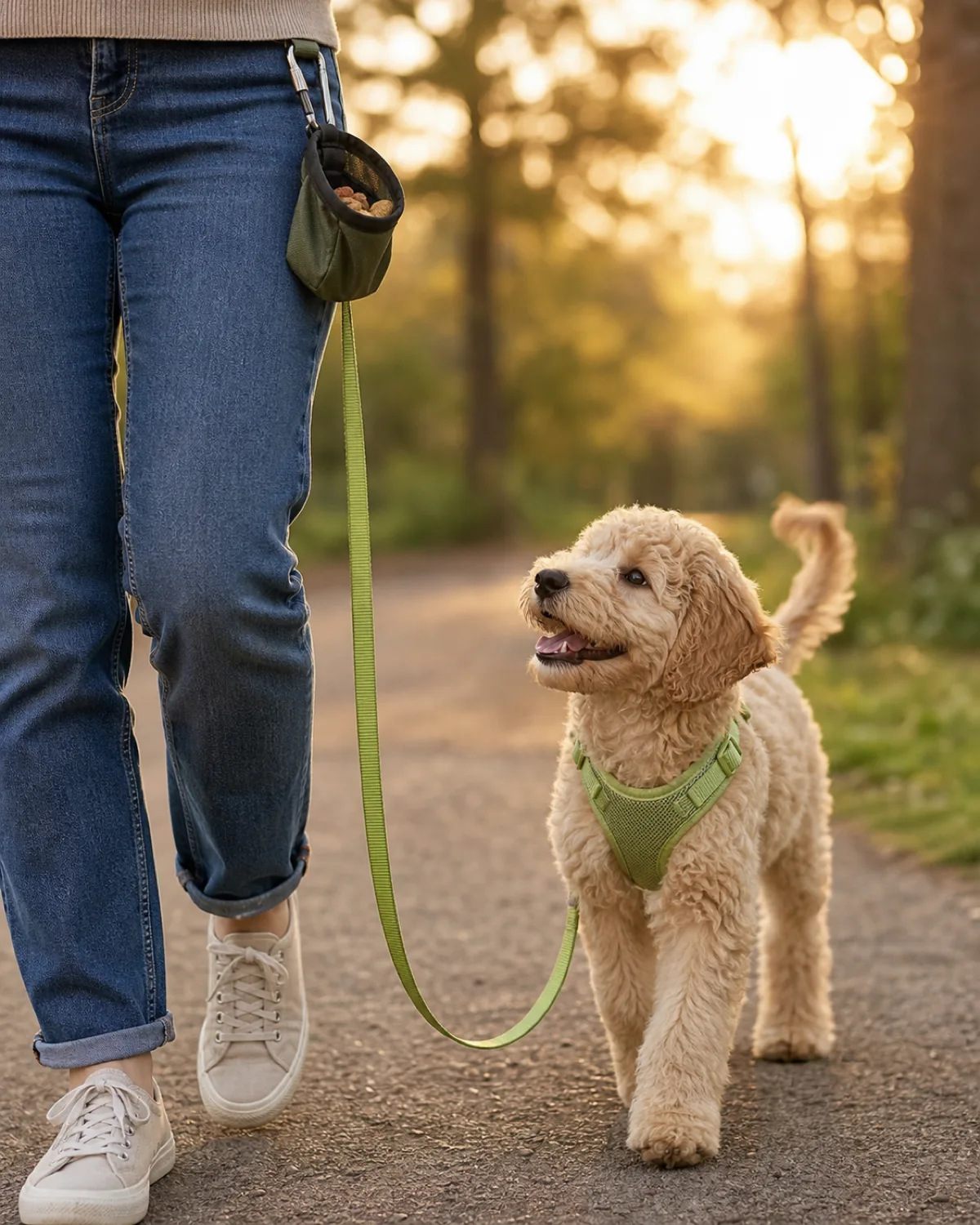
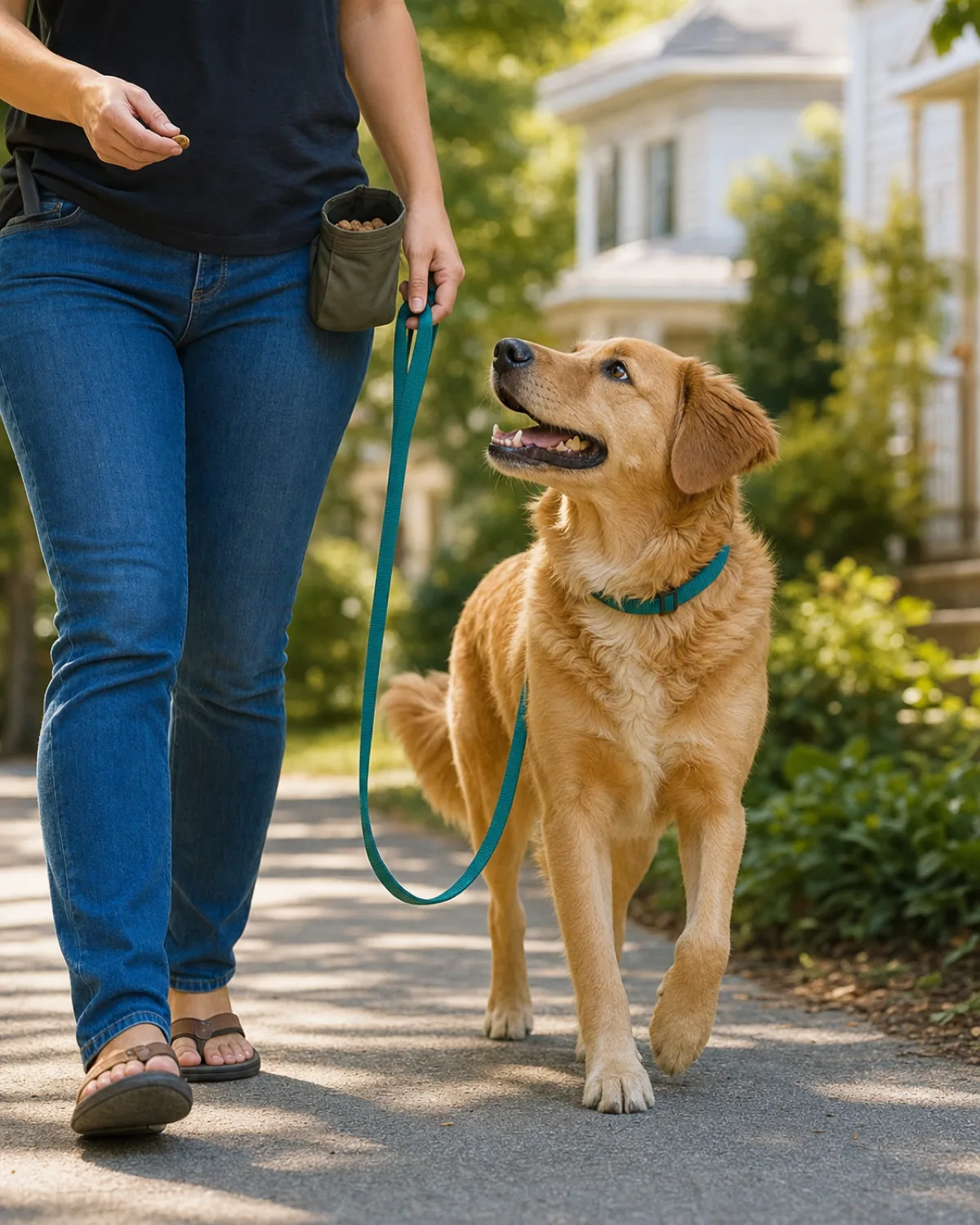
Hold the leash loosely and follow your puppy wherever it goes. When the puppy happens to be walking beside you with the leash slack, say yes and deliver a treat at your left side. You are rewarding the position you want — next to you with a loose leash — without forcing the puppy into it.
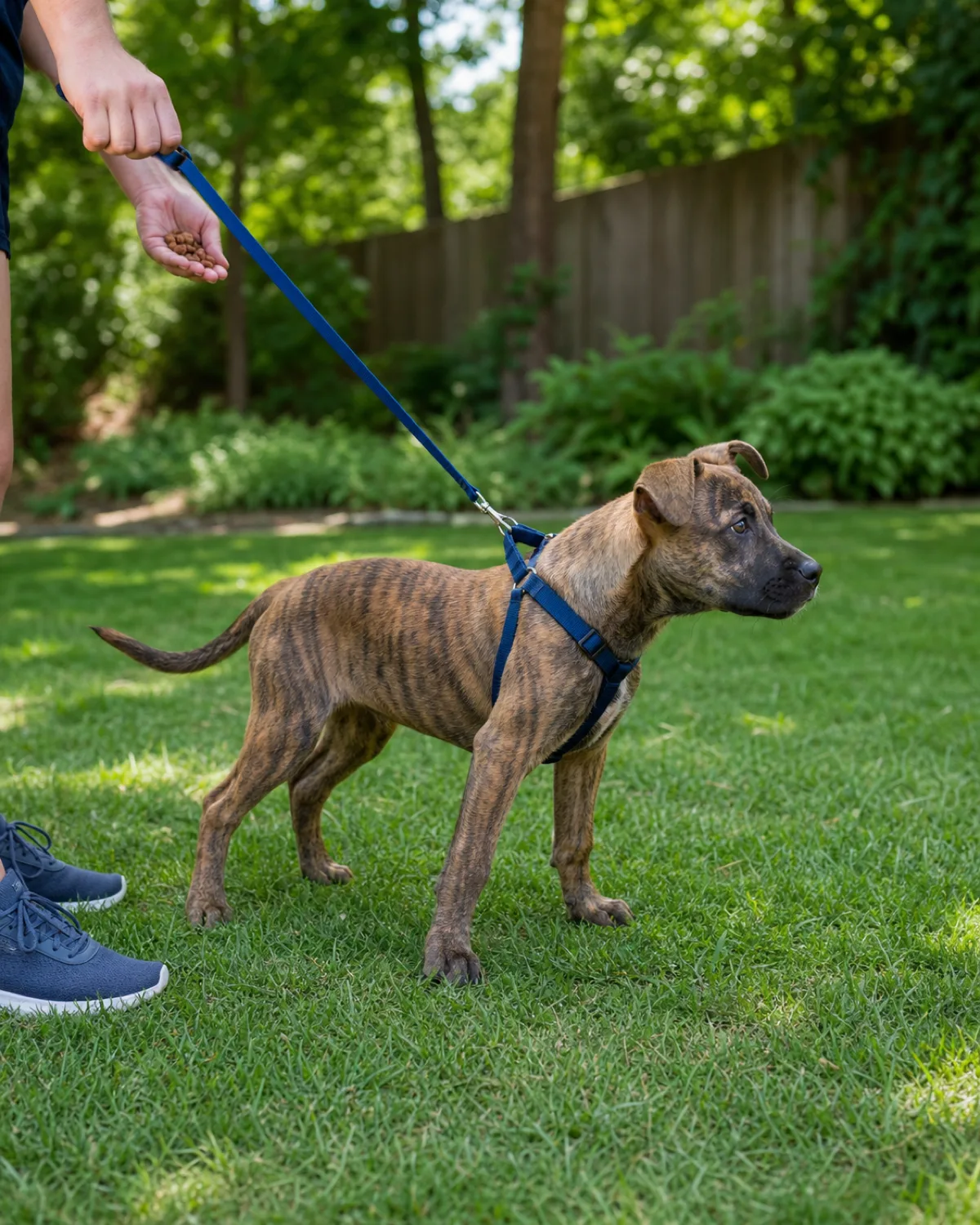
When the puppy walks ahead and the leash goes taut, stop. Become a tree. Do not pull the puppy back. Do not say anything. Just stop. The puppy will eventually look back at you or wander back to your side, creating slack in the leash. The instant the leash goes loose, say yes and treat. Then start walking again.
This stop-and-reward cycle is the entire foundation of leash training. It teaches the puppy a clear rule: tight leash means everything stops, loose leash means we keep moving and treats appear. The same logic applies as in crate training a puppy — you create conditions where the right choice is the rewarding one, rather than physically forcing compliance.
Keep sessions to five to ten minutes and end while the puppy is still engaged. A puppy who is tired, bored, or frustrated learns nothing useful.
Your First Outdoor Walk (Keep It Short)
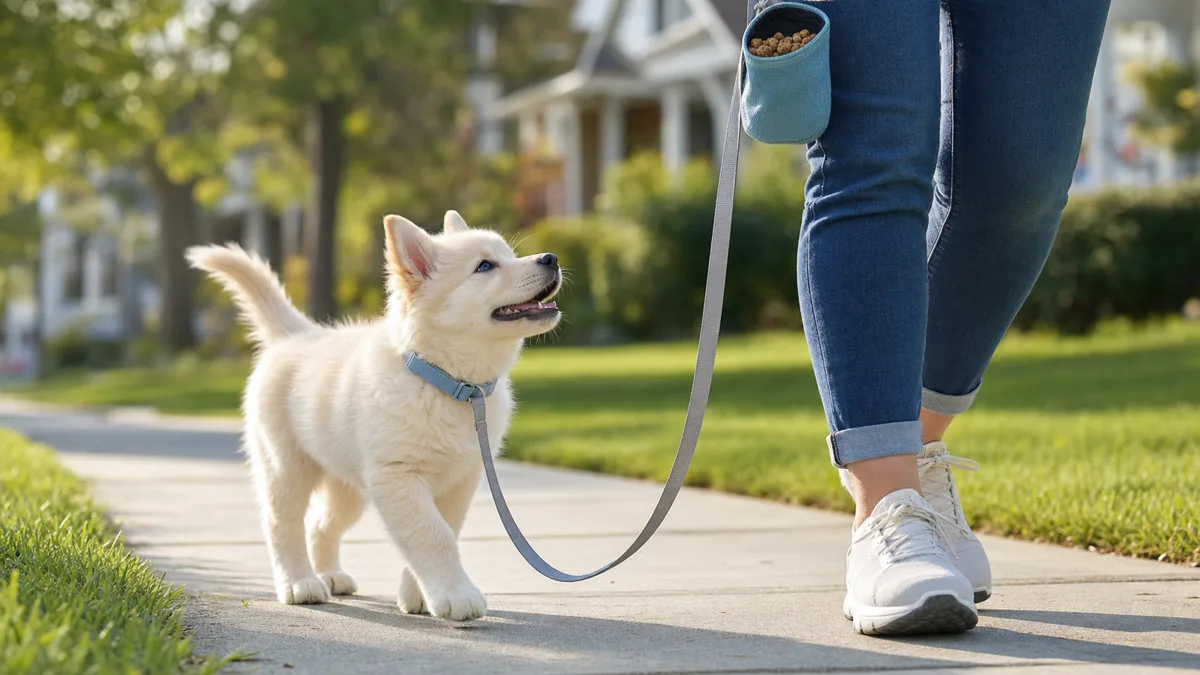
After one to two weeks of consistent indoor practice, your puppy is ready to try the real world — in a very controlled dose. Do not start at the dog park or the busy downtown sidewalk. Choose the quietest stretch of pavement within a short walk from your front door.
The goal of the first outdoor walk is not distance. It is maintaining the same loose-leash behavior you practiced inside, but now with wind, bird sounds, passing cars, and a thousand new smells competing for attention.
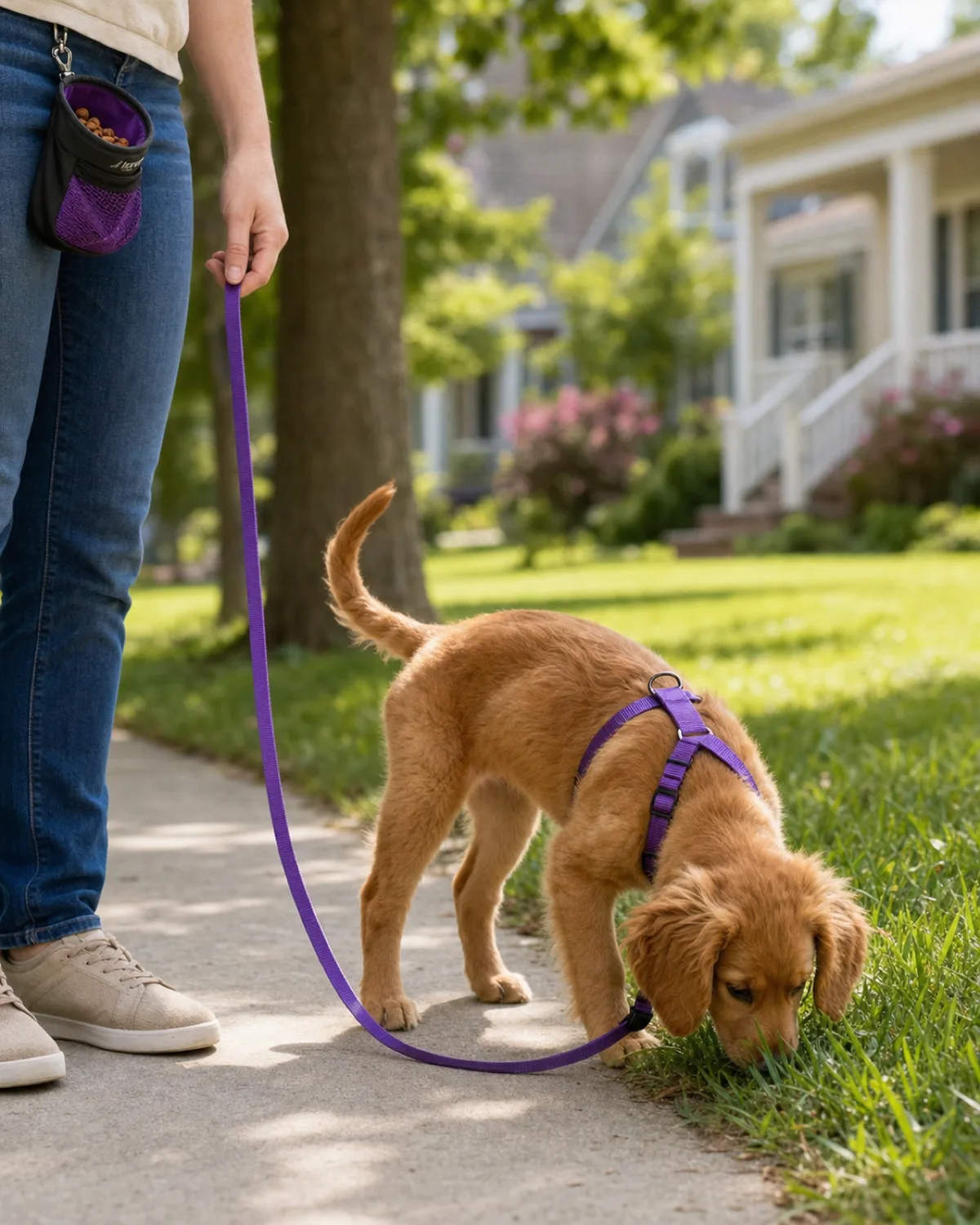
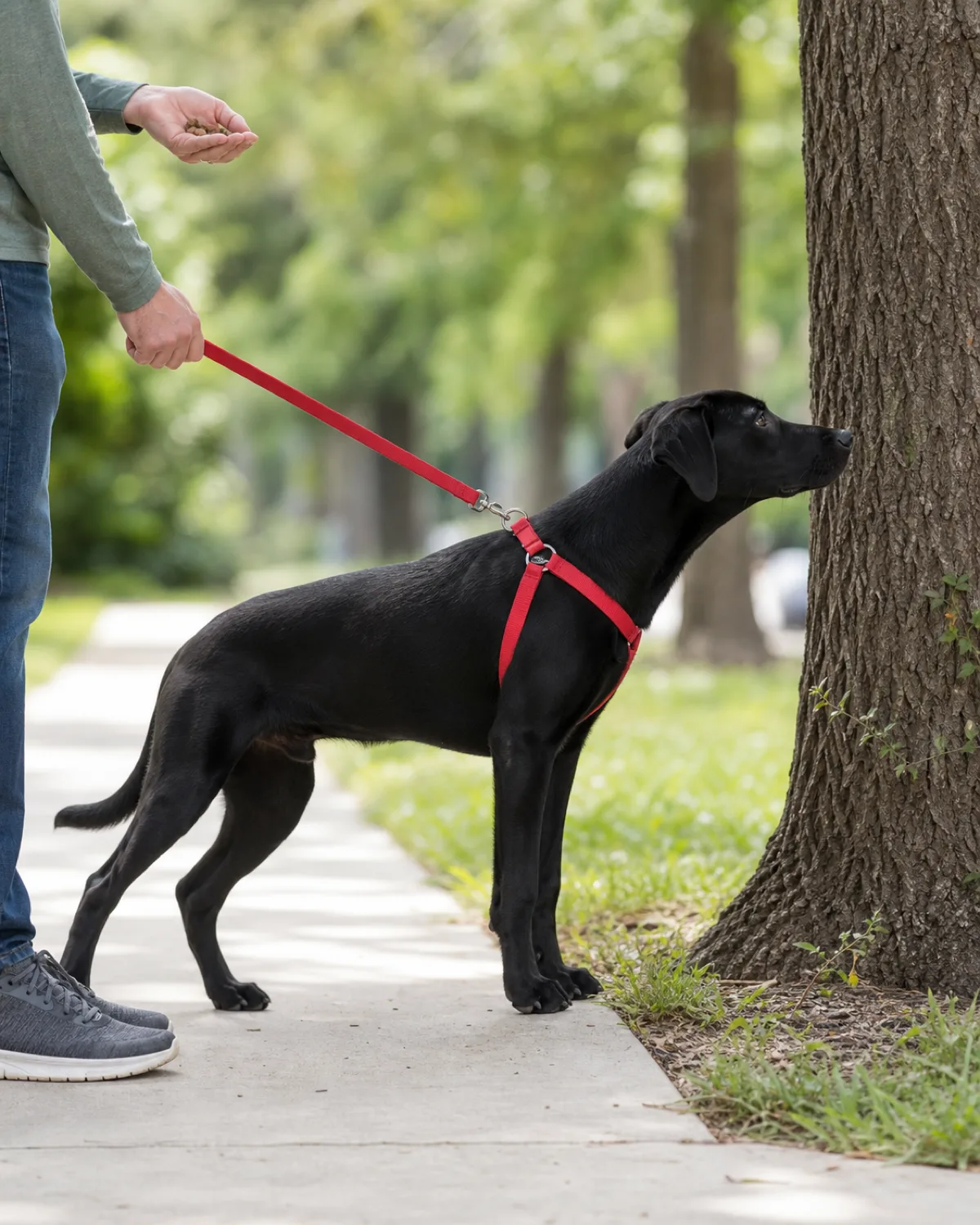
Your puppy will stop constantly to investigate scents. Let it sniff for ten to fifteen seconds — sniffing is how puppies process new environments — then lure it forward with a treat held at your side. Do not jerk the leash.
Keep the first outdoor walk to five minutes. Walk home before your puppy hits a wall of overstimulation. During the first week, aim for one to two five-minute walks per day. The second week, stretch to ten minutes. Add five minutes each week from there.
If your puppy came home during the first week and you started collar desensitization from day one, the outdoor walk timeline lines up naturally around week three or four after adoption.
Quick check
Is your puppy ready for outdoor walks?
Moving outside too early stacks too many new experiences at once.
Ready to go outside
Wears a collar or harness without scratching or freezing. Drags the leash indoors without reacting to it. Walks beside you indoors with the leash mostly slack. Looks back at you or responds to its name when you call. Start with five-minute walks on a quiet street.
Not ready yet
Still scratches at the collar or tries to back out of the harness. Freezes or panics when the leash drags behind. Pulls to the end of the leash every time indoors. Cannot be redirected with treats. Go back to the previous step and extend indoor sessions before trying outside.
What to Do When Your Puppy Sits Down and Refuses to Walk
This is one of the most common scenes in puppy parenthood. You are halfway down the block and the puppy plants its rear on the sidewalk and will not budge.
The instinct is to pull the leash and drag the puppy forward. That is the worst response for almost every reason this can happen.
A puppy who stops mid-walk is usually telling you one of three things. Fear: a new sound, surface, or sight triggered a freeze response. Fatigue: puppy legs are short and their stamina is limited. Overstimulation: too many new inputs crashed the processing system.
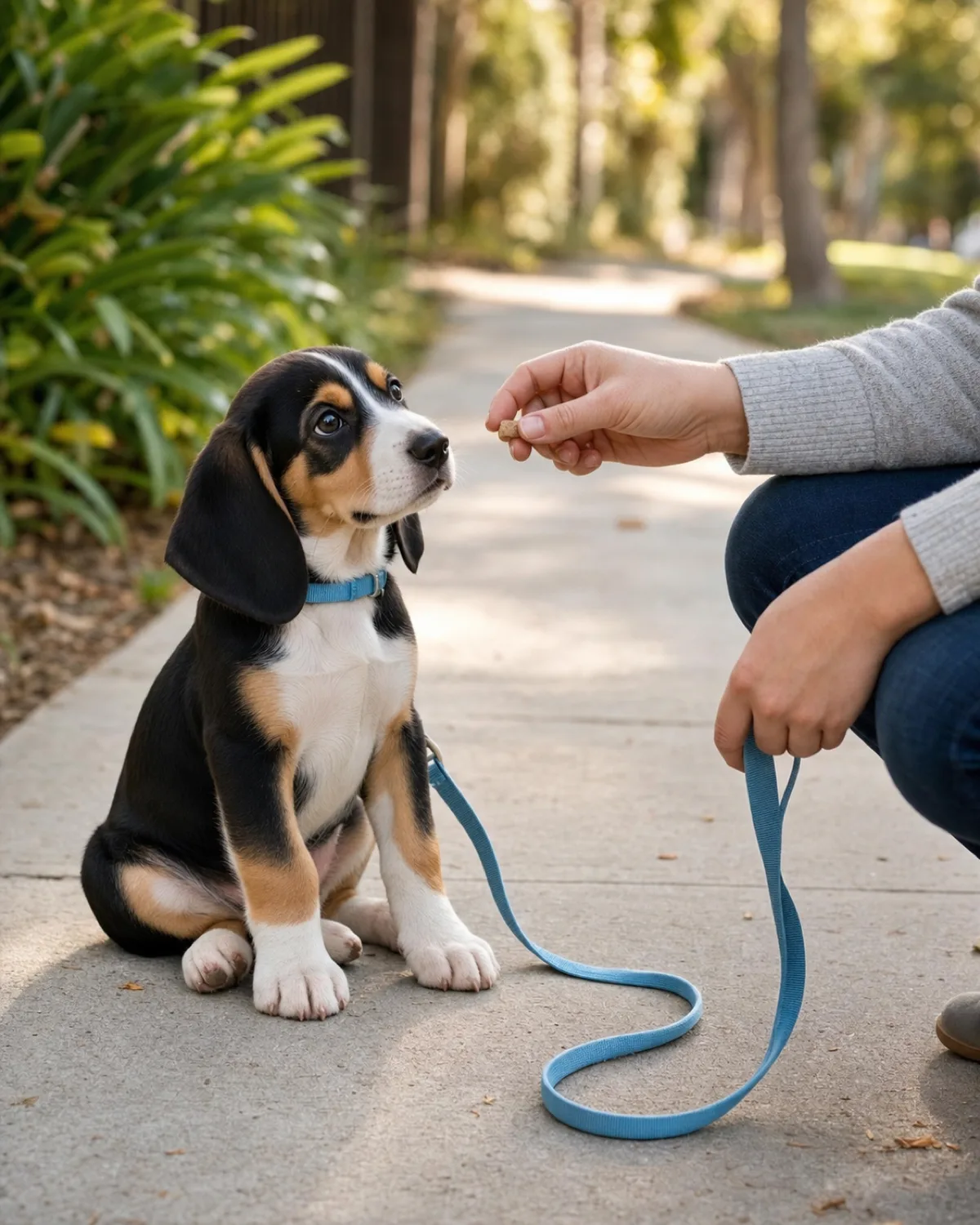
Crouch down to your puppy's eye level. Show a treat in front of its nose and back up a few steps, encouraging the puppy to follow you. If it does, praise immediately and keep walking.
If thirty seconds pass with no movement, the puppy has hit a real limit. Pick the puppy up gently, carry it to a quieter spot or back home, and try again next time with a shorter route.
Not every walk needs to be completed successfully. The priority is never creating a negative association with the leash, the outdoors, or you.
A Gentle Carry Is Not a Failure
One bad experience can set leash training back by weeks. One kind carry-home costs you nothing and preserves the puppy's trust completely.
Common Mistakes That Make Leash Training Harder
Retractable leashes are the biggest single equipment mistake for puppy training. These spring-loaded spools teach the puppy that pulling creates more slack and more freedom — the exact opposite of the rule you are trying to establish.
They also create a safety hazard because the thin cord can snap taut at speed. Use a fixed-length four-to-six-foot nylon or biothane leash throughout the entire training phase.
Training sessions that run too long rank second. A puppy's attention span peaks at five to ten minutes. Anything beyond that is noise.
Inconsistency is the third wrecker. If you reward your puppy for walking on your left side on Monday and your right side on Tuesday, the puppy cannot figure out where the rewarded position is. Pick a side — left is traditional — and stick with it.
The fourth and most common mistake is following a pulling puppy. Every time the leash goes taut and you take a step forward, you just taught the puppy that pulling works.
The One Rule That Prevents Future Problems
From the very first session, a tight leash must mean you freeze in place. Every time. This single rule, enforced consistently, prevents the pulling problem that sends adult dogs to remedial training.
The ground rules
Puppy leash training: always and never
These apply from your first indoor session to every outdoor walk.
Always
Let your puppy get comfortable with the collar before adding the leash
Keep sessions to five to ten minutes and stop while the puppy is still happy
Stop walking the instant the leash goes taut
Reward with treats when the puppy walks beside you with a slack leash
Use a fixed-length four-to-six-foot nylon leash
Pick one side and always reward the puppy for walking on that side
Add no more than five minutes per week to outdoor walk duration
Never
Use a retractable leash for training (it rewards pulling)
Yank, drag, or pull a puppy that has stopped walking
Use a choke chain, prong collar, or shock collar on a puppy
Follow a pulling puppy forward (it teaches pulling works)
Run training sessions longer than ten minutes
Skip indoor practice and go straight to outdoor walks
Force a frightened puppy to keep walking
Punish a puppy for adolescent regression (it is normal development)
How to Build Up to Longer Walks
The progression follows the same logic as a running program for humans. You build volume gradually and add distance only when the current level feels easy.
At eight to twelve weeks old, a puppy's walk should be five to ten minutes, repeated two to three times a day. At twelve to sixteen weeks, extend to ten to fifteen minutes. At four to six months, fifteen to twenty minutes is appropriate. A rough guideline is five minutes of walk per month of age.
These numbers account for more than just stamina. Puppy growth plates do not fully close until twelve to eighteen months of age (later in large and giant breeds). Excessive walking on hard surfaces during this window can affect joint development.
Puppy walks should be mostly sniffing and exploring at a casual pace, not sustained marching on concrete.
Watch the Recovery
After each walk, observe your puppy. Falls asleep within minutes of getting home — the walk was at the upper edge of appropriate. Still bouncing around with energy — next time can be a few minutes longer. Limping or excessive panting — the walk was too much, scale back.
When Leash Training Gets Easier (And It Will)
Setting realistic expectations matters because leash training feels tedious when you are in the middle of it. Every walk is stop-start-treat-stop. Progress is invisible day to day.
By week three or four of daily sessions, most puppies walk indoors on a loose leash without needing a treat every few steps. By month two, outdoor walks shift from constant redirection to occasional corrections. By three months, the puppy understands that the leash means a walk is happening and gets excited in a focused way rather than frantic.
Then adolescence arrives between six and eighteen months, and the puppy who walked beautifully last week starts lunging at squirrels, pulling toward other dogs, and generally acting as though leash training never happened.
This is not a training failure. It is developmental, equivalent to a human teenager testing boundaries they understood perfectly at age ten. The response is identical to what worked before — stop when the leash goes taut, reward when it goes loose, keep sessions short. The regression passes in a few weeks if you hold the rules steady.
Save this timeline
Your Leash Training Timeline
1
Week 1-2Collar and harness desensitization indoors. Two to three sessions of five minutes daily with treats.
2
Week 2-3Leash dragging freely indoors. Supervised five-to-ten-minute sessions until the puppy ignores the leash.
3
Week 3-4Indoor leash walking with you holding the leash. Stop-and-reward rule. Pick one side and stay consistent.
4
Week 4-5First short outdoor walks. Five minutes on a quiet street. One to two walks per day with plenty of treats.
5
Week 5 onwardAdd five minutes per week. By four months of age, aim for twenty-minute walks at a sniff-and-explore pace.
Patience now means calm walks for years to come
What Your First Walk Together Will Actually Look Like
Here is an honest preview so you know what to expect and what counts as success.
You will walk about half a block. Your puppy will stop to sniff everything — every leaf, every crack in the sidewalk, every spot where another dog has been. You will say yes and deliver treats roughly every ten to fifteen seconds.
Your puppy will sit down at least once and you will crouch, lure, and wait. You will see another dog across the street and your puppy will either lunge or freeze. You will turn around and walk the other direction.
The entire outing will last about seven minutes and cover maybe two hundred feet.
That is a successful first walk. Distance is irrelevant. The metrics that matter are: the leash stayed loose more often than it was tight, you did not drag the puppy at any point, and the puppy came home wagging.
Everything else builds from there. The picture at the other end of this process — a dog who walks beside you on a slack leash, pauses to sniff a bush, then returns to your side at a quiet word — is not a naturally obedient dog. That is two hundred five-minute practice sessions stacked on top of each other.
Jess Calloway
Dog mom to three very different dogs and the voice behind Pawliqa. Every guide here comes from real experience — the messy, the exhausting, and the unexpectedly sweet. I am not a veterinarian; when in doubt, your vet is the call to make.
Teaching a dog to spin starts with a food lure at nose level, progresses to an open-palm hand gesture, and ends with a verbal cue alone. This guide walks through every stage, flags the mistakes that stall progress, and shows how to keep training sessions short and productive.
An overstimulated dog is not being bad. This guide walks through the place cue, structured down-stays, environment management, and daily decompression routine that teach a dog to settle on its own.
Fourteen puppy training games covering hide and seek recall, the name game, touch targeting, cup puzzles, puppy pushups, which hand, red light green light, muffin tin puzzles, tug with rules, scent work, two-toy fetch, obstacle courses, spin tricks, and settle mat training for puppies who learn best through play.